You’re watching the range number hit zero on a DC-area road. The pack won’t take you another exit. Searching mobile EV charging near me is the right move. You want 240-volt power at the car, not a tow. Charge Pro DC is a referral line. We match stranded drivers in the District, Maryland, and Virginia with independent local operators. The operator quotes you before they plug in. They bill you directly.
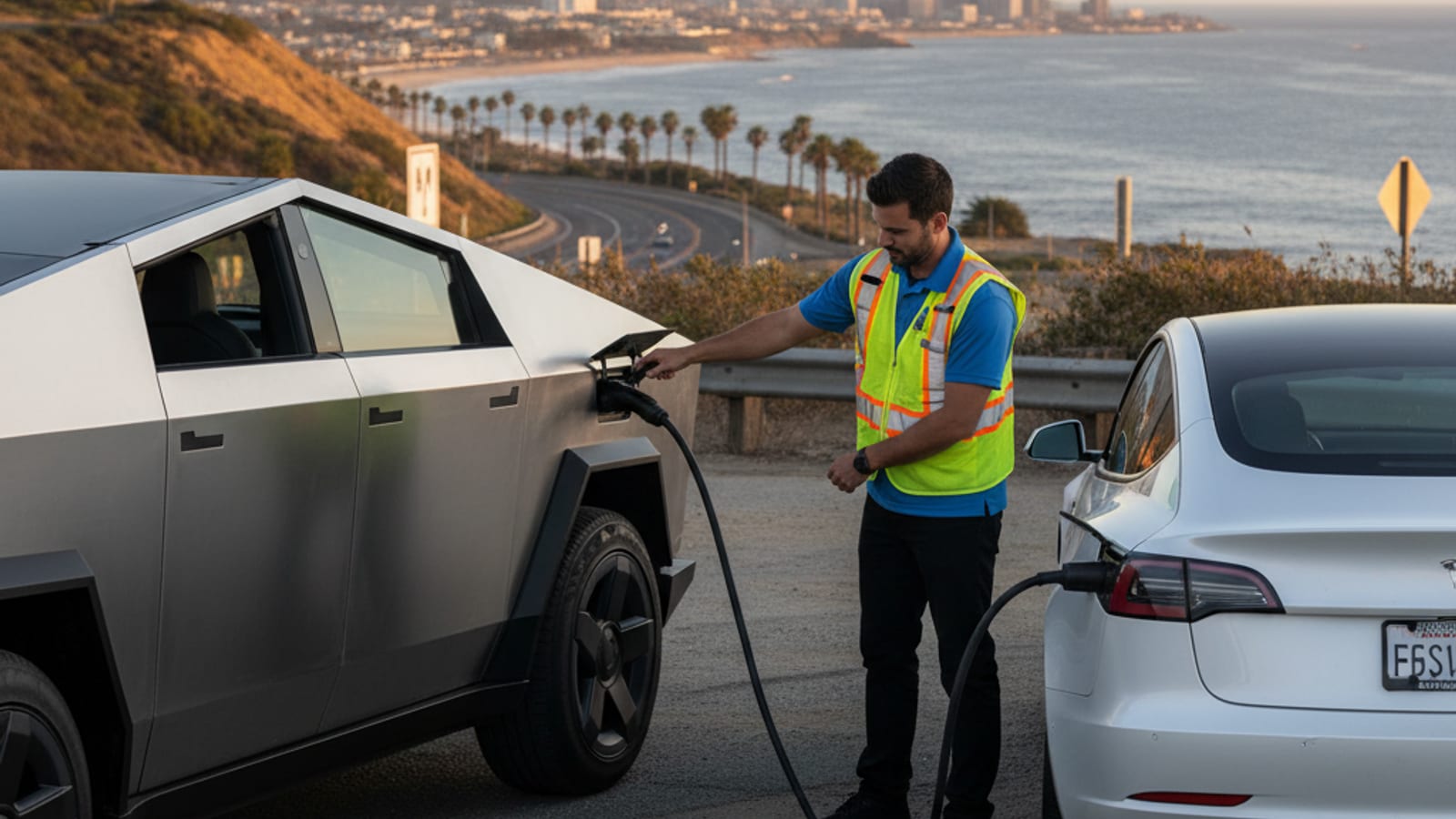
The truck isn’t ours. The charger isn’t ours. We don’t employ the technician. They typically add 10 to 20 miles of range. That takes 15 to 30 minutes of charging. That window is charging time. It isn’t an arrival time. Tesla gets a native NACS plug. Other EVs get a CCS or J1772 adapter.
What near me means in this metro
This isn’t one city with one set of rules. A stall on the Woodrow Wilson Bridge sits at a three-jurisdiction line. Alexandria, Oxon Hill, and the District all meet there. The American Legion Bridge does the same between McLean and Montgomery County. Your map pin says near me. The operator still has to know the shoulder, the agency, and the jurisdiction.
Charge Pro DC serves the District of Columbia, Maryland, and Virginia. Start with the Washington-area charging hub if you want a city page. The work itself is mobile EV charging. We don’t hold a trade license. We don’t own trucks. We don’t set prices.
If the car won’t wake, the traction pack may still have range. A flat 12-volt battery will black out the screens and keep the car asleep. Operators we connect you with can jump or replace that 12-volt on site.
Why a planned day still ends on the shoulder
This metro drains EVs in ways a trip planner underplays. Traffic, cold, old housing, and airport garages all show up in the same week.
Idle on the Beltway, heat still running
The Capital Beltway and I-95 through Prince William stop more than they flow. Climate control while you sit still burns pack and adds zero miles. Recurrent Auto studied more than 30,000 EVs. A typical car keeps about 80 percent of range at 32F. It keeps about 70 percent at 20F. Cabin heat is the reason. Heat-pump cars held about 83 percent. Cars without a heat pump held about 75 percent. Don’t treat those figures as a Tesla number. They’re a multi-brand study.
Dulles runs colder and snowier than Reagan National. Loudoun, upper Montgomery, and Prince William freeze harder than the District and the inner Virginia core. That split is local.
The January 2022 I-95 shutdown is what locals still mean by stuck overnight. About 14 inches of snow and a multi-truck crash closed roughly 50 miles near Fredericksburg. The road closed about 5:30 p.m. on January 3. It reopened about 7:40 p.m. on January 4. That comes from VDOT and State Police reporting. Hundreds of drivers sat more than 36 hours with the heat on. That stretch sits just south of our service area. We don’t match operators south of Fredericksburg. The same idle-plus-heat math still applies on I-95 through Woodbridge and Dale City. A pack that looked fine in Springfield can be empty after a crawl.
Houses and apartments that predate a plug
A lot of this housing stock went up before anyone wired a garage for a car. Census ACS 2019-2023 figures put pre-1980 housing at 90.0 percent in Takoma Park. Annandale sits at 79.8 percent. Wheaton sits at 73.1 percent. Washington sits at 70.3 percent. Takoma Park is an incorporated city. Annandale and Wheaton are census-designated places. Don’t call them cities. Washington is the District.
The no-home-plug call pattern is strongest in Arlington, Alexandria, the District, Silver Spring, Wheaton, Hyattsville, and Annandale. Newer tracts in Ashburn, Gainesville, Centreville, and Germantown have much less of that old stock. A driveway in Ashburn isn’t the same problem as a 1960s apartment in Wheaton.
A week in a garage, then a car that won’t wake
The call we hear most isn’t an empty pack on a highway. It’s a traveler who left the car for a week.
Reagan National puts complimentary EV charging on Level 1 of Parking Garages 1 and 2. It’s first come, first served. MWAA has 2026 electrical upgrades expanding capacity. Those garages connect to the terminal.
Dulles puts Level 2 charging in Garage 1 and Garage 2. The Economy Lot is the largest on-airport option. A shuttle runs to Curb 2F. People leave an EV there for a week and return to a dead 12-volt. Mobile Tesla charging after Dulles economy parking is that stall, written out.
Union Station’s garage and WMATA park-and-ride lots follow the same long sit. Read the garage’s own page before you assume a plug is waiting.
National Harbor sits in Oxon Hill, not in its own town. Day-trip parking there has the same 12-volt pattern after a long day with climate on.
Parkways that aren’t interstates
The Baltimore-Washington Parkway, the George Washington Memorial Parkway, Clara Barton Parkway, Rock Creek Parkway, and Suitland Parkway are National Park Service roads. Commercial vehicles and trucks over 10,000 lb are banned. Shoulders are narrow or missing. A disabled vehicle on the Baltimore-Washington Parkway is reported to the US Park Police.
That doesn’t mean you’re out of options. It means the call has to name the parkway. The operator has to work inside those rules. A VDOT or CHART truck isn’t the unit that brings 240 volts.
What the operator actually rolls up with
The truck is theirs. The 240-volt Level 2 source is theirs. They quote before they plug in.
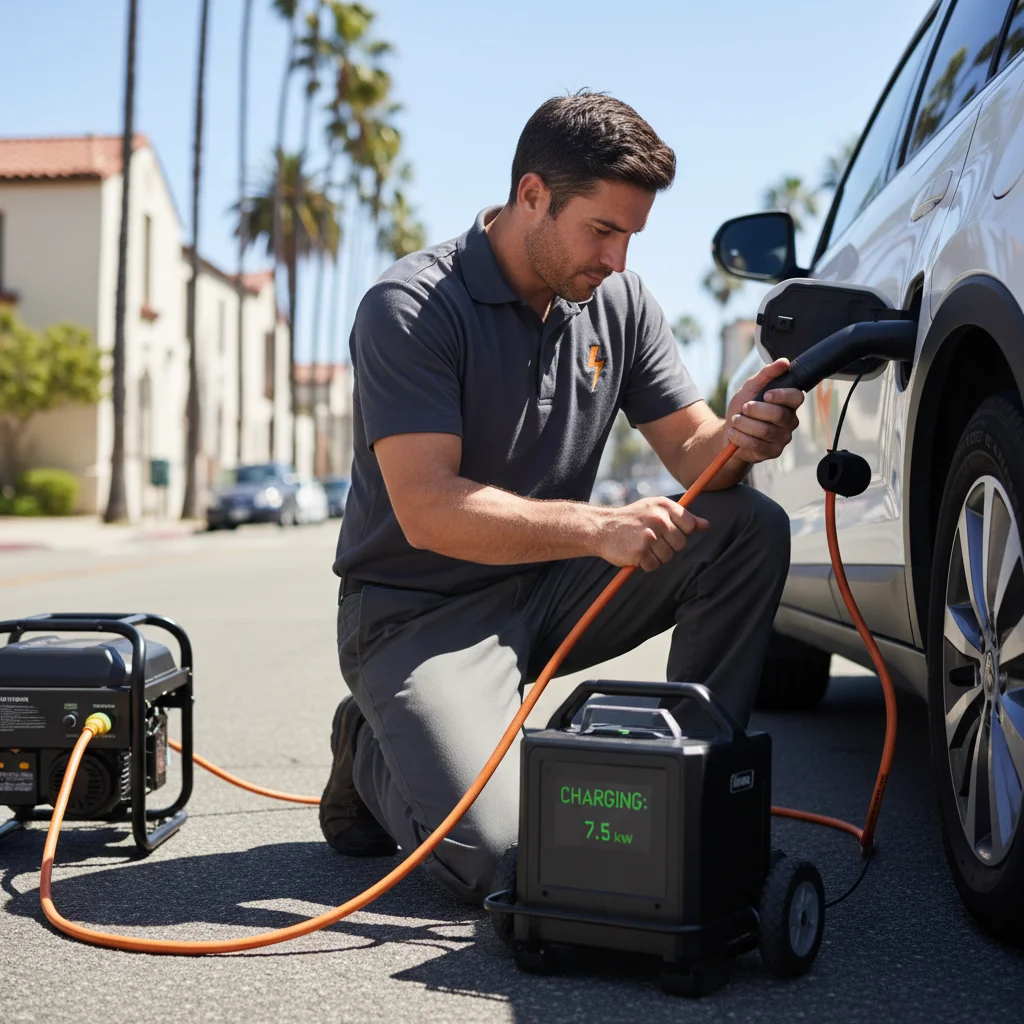
A typical visit is a top-up, not a full pack. Ten to 20 miles is usually enough. That gets you home, a Supercharger you already meant to use, or a public stall. For the hardware and who owns it, read what’s an EV charging truck.
Tesla takes native NACS. Rivian, Ford, Hyundai, Kia, Chevy, BMW, and Mercedes take CCS or J1772 through an adapter. Say the make and model on the call. They’ll tell you if they can connect.
They also handle a dead 12-volt. Black screens, doors that don’t latch, a car that won’t wake: start there. A traction pack that still shows range won’t save you if the small battery is flat.
What to do when the number is already zero
Get out of the live lane
If you can still roll, take a shoulder, a ramp, a lot, or a quiet street. Hazards on. Stay in the car when that is safer.
On the 495 Express Lanes, pull to the left shoulder. Those lanes sit in the median. On the 95 and 395 Express Lanes, pull to the nearest shoulder. Transurban and VDOT publish that rule. Stay in the car until help arrives. Express Assist is a free patrol on those lanes. It helps with minor mechanical issues. It will call a tow. It doesn’t tow. It doesn’t publish EV charging.
I-66 inside the Beltway is tolled in peak hours. Outside the Beltway, the I-66 Express Lanes are a separate system. The Dulles Toll Road, VA-267, is MWAA. The Dulles Greenway is a private road west of the airport. I-270 and the Beltway general lanes are free. None of that changes the first move. Get out of the travel lane.
For the Beltway stall in more detail, use out of charge on the Capital Beltway.
Know what the public patrols will and won’t do
Maryland drivers on state primary roads can dial #77. That covers I-495, I-270, US-50, and MD-295. MDOT SHA CHART Emergency Traffic Patrol operates around the clock in the Baltimore/Washington area. Technicians change tires. They jump-start 12-volt batteries. They add about a gallon of gas. They put water in a radiator. Their published pages don’t describe charging an EV traction pack.
Virginia drivers reach VDOT Safety Service Patrol through Virginia 511. The patrol covers Virginia interstates, including I-95 and I-66. Published work is incident clearance, debris, and short-term traffic control. It doesn’t describe EV charging.
We couldn’t confirm a DDOT motorist-assistance patrol in the District. DC drivers lean on MPD, a private roadside plan, or US Park Police on the parkways.
You can still call CHART or 511 for a safer stop or a 12-volt jump. Then you still need a mobile charge if the pack itself is empty. That’s why this referral line exists.
Say where you actually are
Cross streets, a mile marker, a garage level, a lot name. Near Tysons isn’t a location. Tysons is a census-designated place, not an incorporated city. The mall is still Tysons Corner Center. Fairfax County and the City of Fairfax are different jurisdictions. Arlington is a county with no towns inside it. Alexandria, Fairfax, Falls Church, Manassas, and Manassas Park are independent cities. Prince George’s County takes the apostrophe. A District address without NE, NW, SE, or SW is ambiguous.
Give the make, model, and year. Say whether the car will wake. Say whether you’re on an NPS parkway, an Express Lane, or a garage ramp.
When a boost beats a tow, and when it doesn’t
Towing a dead EV here is its own mess. Many EVs need a flatbed. Virginia lets localities cap private-property tows by ordinance, on top of a statewide passenger-car cap. Maryland counties set their own tow rules. Confirm the current tow cap with the county or city before you pay. DC towing and impound sit under Title 50 and the DC Municipal Regulations. If DPW takes the car, the documented impound is Blue Plains, 5001 Shepherd Parkway SW.
None of the three codes we read has a special out-of-charge statute. Disabled-vehicle rules apply to an EV the same as any other car.
A mobile charge keeps the car on its wheels. You skip the hook, the storage clock, and the shop queue. When the pack is empty and the car is otherwise fine, the boost is the direct fix. When a control arm is bent or a tire is shredded, you still need a tow. Mobile EV charging or a tow splits those cases.
Your utility won’t come charge the car in the road
Pepco serves the District, Montgomery County, and Prince George’s County. Its EV program is Pepco EVsmart. Maryland Pepco customers can look up a residential Level 2 smart-charger rebate and a multifamily charging program. Confirm current amounts on Pepco’s pages. The District program sits under the city’s alt-fuel infrastructure tax-credit rules, and those move.
Dominion Energy Virginia serves most of Northern Virginia. Named programs include residential EV rate Schedule 1EV. There’s a voluntary Off-Peak Plan that needs a smart meter. There’s also EV Charger Rewards. NOVEC serves parts of Loudoun and Prince William, including much of Sterling, Ashburn, and Gainesville. BGE touches parts of Laurel. SMECO serves the southern edge toward Clinton. The City of Manassas runs its own municipal electric utility. Confirm the serving utility by address. Don’t guess from the ZIP.
No utility EV page we reviewed offers a service that charges a stranded car. Home rates and rebates help you leave the house full. They do nothing for a stall on I-66.
Virginia charges a Highway Use Fee at registration for EVs. Confirm the current number with the Virginia DMV. Maryland’s EV credits and the annual surcharge move with the budget. Check MVA before you count on either. In the District, the old full excise-tax exemption ended in February 2025. Check dmv.dc.gov for the current rate.
Make the next stall less likely
Run the commute on the in-car map and a charging app before you trust a garage stall. That matters at a Silver Line lot in Reston, a Tysons garage, or a week at Dulles. Precondition the cabin while you’re still plugged in on a freezing Loudoun morning. Keep tire pressures at the door-sticker number.
Watch the 12-volt as closely as the range bar. A car that sits in a dark garage at National Harbor will flatten the small battery first. The same thing happens in Oxon Hill and at Metro lots. If you live in older housing in Takoma Park, Annandale, Wheaton, or the District, plan around that. Assume you may not have overnight Level 2. Treat the public stall or a mobile visit as part of how you drive.
If the home unit trips a breaker, a mobile 240-volt visit still works. The operator comes to the driveway. You don’t have to wait on an electrician to roll.
Frequently asked questions
What happens after I search mobile EV charging near me
You call the referral line. We take the location, the vehicle, and whether it will wake. Then we match you with an independent operator in the District, Maryland, or Virginia. That operator quotes you before any cable goes in. They bill you. We don’t.
How long does the charge itself take
On-site charging time is typically 15 to 30 minutes. That usually adds 10 to 20 miles of range. Your pack, the air temperature, and how far you need to go all change that. Arrival time is the operator’s to set. We don’t publish one.
Can they charge a non-Tesla
Yes. Operators carry a native NACS plug and CCS or J1772 adapters. That includes Tesla, Rivian, Ford, Hyundai, Kia, GM, BMW, and Mercedes. If your port is unusual, say so on the call.
When the pack is empty, stay with the car if you can do it safely. Then call (202) 629-0844 and leave the location and the vehicle. The line matches you with a local operator who can bring 240 volts to the pin.