A dead Tesla in Washington doesn’t get a city rescue truck. There’s no DDOT motorist-assistance patrol for a stalled car. Maryland’s CHART patrol works state roads in this metro. Virginia’s Safety Service Patrol covers its interstates, including I-66. District drivers call MPD if there’s a crash. On NPS parkways, US Park Police take the disabled-vehicle call. For charge or a 12-volt jump, you call a private operator. Tesla roadside and AAA still take those calls too. They often send a general truck, not a 240-volt source. That’s why Tesla owners here call a local operator. The job is an empty pack or a dead 12-volt.
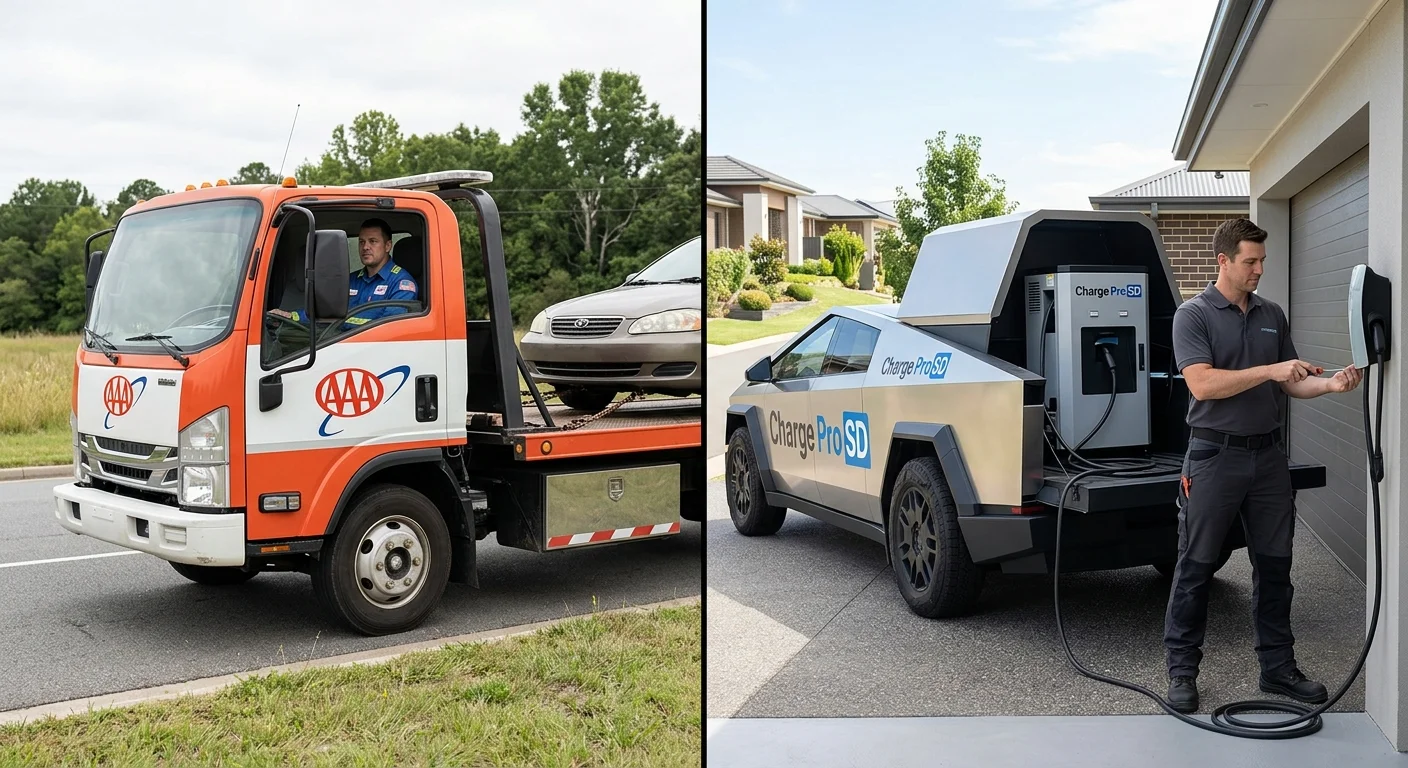
Washington has no DDOT patrol for a stalled Tesla
Maryland publishes CHART help on roads such as I-495. Drivers there can dial #77 on state primary roadways. CHART’s pages talk about tire changes, jumps, and traffic control. They don’t describe plugging 240 volts into an EV. Virginia’s VDOT Safety Service Patrol is the same kind of service. It covers incident clearance, debris, and short-term control. There’s no EV charging in the published description.
The District doesn’t mirror that motorist-patrol model. No DDOT motorist-assistance patrol was found in published District materials. MPD handles crashes, blocked lanes, and street hazards. On Rock Creek and Potomac Parkway, the National Park Service owns the road. A disabled vehicle there is reported to US Park Police at 202-610-7500. That’s their number, not Charge Pro DC’s.
Pepco is the electric utility in the District. Pepco EVsmart is about home and multifamily charging gear. None of those programs send a truck to a stranded Tesla. No utility EV page reviewed for this metro offers a stranded-car charge.
I-395 is where that absence gets sharp. Tunnels and median-only lanes leave nowhere safe to stop. The 395 Express Lanes are Transurban lanes with VDOT. Published guidance says pull to the nearest shoulder. Stay in the car until help arrives on those lanes. Express Assist handles minor mechanical issues and can call a tow. It doesn’t tow the car itself after that call. It also doesn’t charge an EV on the shoulder.
Give the quadrant or help goes to the wrong side
Washington addresses repeat across NE, NW, SE, and SW. Skip the quadrant and the street name is a four-way guess. New York Avenue NE is the US-50 approach. That’s not the same as a Northwest block with the same name. Massachusetts Avenue, North Capitol Street, and US-1 have the same trap. Say the quadrant before you name the cross street. Then give the garage name if you’re inside one.
Finding a silent Tesla still takes a precise pin. I-395, I-295, and the Anacostia Freeway slice the city. Rock Creek cuts through the northwest of the District. If you’re on an NPS parkway, say so. Those roads ban commercial vehicles and trucks over 10,000 lb. Shoulders on those parkways are narrow or missing. The operator needs a legal place to stop and work.
Arlington, Alexandria, Silver Spring, and Hyattsville sit against the District line. A stall on Virginia’s 395 Express Lanes is not a District street stall. Tell the matcher which jurisdiction you’re sitting in. Charge Pro DC serves Washington and those neighboring places. The operator still has to know which set of rules applies.
Where Washington Teslas sit until they won’t wake
Many Washington calls aren’t an empty traction pack. They’re a 12-volt that died after a long sit. Union Station’s parking garage is built for that pattern. So are the Nationals Park garages and Capital One Arena. The Southwest Waterfront, The Wharf, and RFK campus lots sit the same way. A Tesla that sat for days can look fully dead. The traction pack may still hold plenty of range. The 12-volt just can’t close the contactors.
Stationary climate control is the other District drain. This city sits at the fall line, Piedmont meeting coastal plain. Summers are hot and humid, with long stretches above 90F. Reagan National, just across the river, runs warmer and less snowy than the western suburbs. A Tesla idling in downtown gridlock with AC or heat on burns charge without moving. That’s an I-395 crawl and a downtown gridlock problem. The car burns charge while the block doesn’t move.
Home charging is uneven across older Washington housing. About 70.3 percent of Washington housing was built before 1980. Older rowhouses and apartments often have no dedicated Level 2. That’s the overnight plug limit at the building, not a public-charger claim. If you live without a home plug, a low arrival downtown has less margin. Washington’s charging and rescue page is the local hub for that setup.
Empty pack versus a dead 12-volt
Ask which failure you actually have before you call. An empty pack needs 240 volts at the charge port. A dead 12-volt needs a jump or an on-site replacement. Tesla’s 12-volt runs the computers, locks, and contactors. When it drops, a full pack can still refuse to wake. That’s the garage pattern after Union Station or a ballpark lot.
Operators in the network we use bring a 240-volt Level 2 source to the bumper. Teslas take a native NACS plug on that visit. Other EVs use a CCS or J1772 adapter. A typical session adds 10 to 20 miles of range. Plan on 15 to 30 minutes of charging time. That’s charging time only, not an arrival time. The same operator can jump or replace a 12-volt on site. Tesla is the common call in this District. Every major EV brand is still in scope.
AAA remains a membership club for mixed households. A Tesla at zero often gets a tow toward a plug. That’s a tow, not energy at the bumper. Tesla’s own roadside is a separate app or phone path. Read that policy in the Tesla app before you wait. Don’t assume it includes a mobile 240-volt charge. Charge Pro DC is a referral line, not a shop. We match stranded drivers with independent local operators. We don’t own trucks, and we don’t employ technicians. The operator quotes before work and bills you directly.
What to do, and who to call
If you’re on a live lane, hazards on, stay with the car. On the 395 Express Lanes, pull to the nearest shoulder. Don’t get out and walk the median. On Rock Creek and Potomac Parkway, call US Park Police at 202-610-7500. If the car still responds, cut climate and extra loads. This page doesn’t estimate distance to a charger.
If a tow is already rolling, DPW lists Blue Plains at 5001 Shepherd Parkway SW. Confirm the lot on dpw.dc.gov if the car leaves without you. Disabled-vehicle rules here don’t single out empty EVs.
We connect you with a local operator who quotes the visit. Mobile EV charging is the empty-pack job on site. Tesla roadside rescue covers Tesla 12-volt work too. For the wider metro, read EV roadside assistance in DC, Maryland, and Virginia. If you’ve used a club before, see when AAA can’t charge your EV. Tesla’s own menu is in what Tesla roadside covers. At true zero, stay with the car and call for 240 volts.
Don’t call Pepco for a stranded-car rescue. Don’t wait on a DDOT patrol that isn’t published. Name the quadrant, then say black screen or zero range. Northwest after a Convention Center event is usually a 12-volt failure. I-295 or the Anacostia Freeway is a live-traffic pack problem. If you crossed into Arlington or Alexandria, say so.
Charge Pro DC serves Washington, the rest of the DC area, Maryland, and Virginia. We don’t publish hours or arrival windows on this line. The operator on your visit sets the quote with you. Call (202) 629-0844 when you need a match. Give the quadrant, the corridor, and whether the Tesla won’t wake.