If your EV hits empty on the Capital Beltway, get out of the travel lane first. Stay with the car. Report the stop to the patrol that covers that stretch of I-495. Then call for a mobile 240-volt top-up. Maryland’s CHART trucks and the Express Assist vans won’t charge an EV. Sitting there with the climate on only burns what’s left.
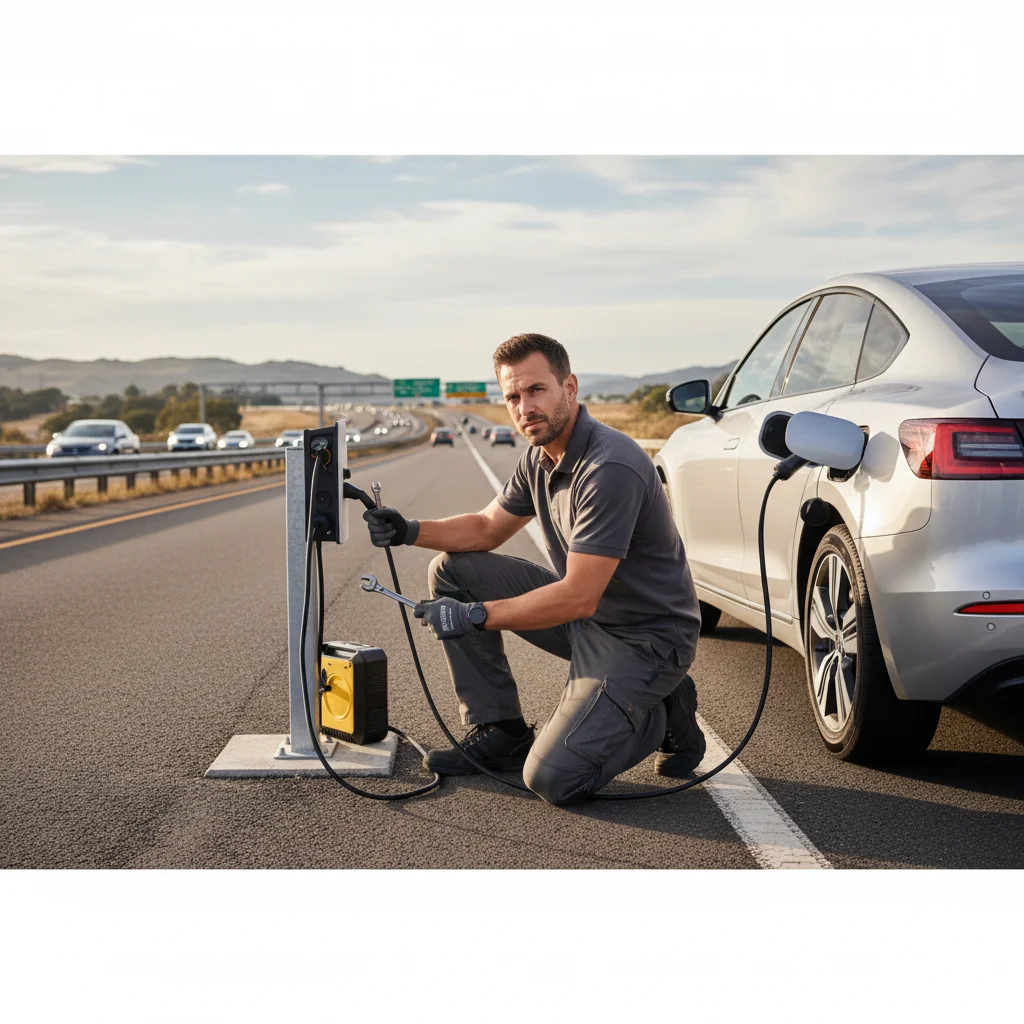
Idling on I-495 spends range you can’t replace
The Beltway is a stop-and-go loop, not an open run. Heat and AC pull from the traction pack while you sit. You aren’t covering miles. You’re draining the battery in place.
That’s the I-495 stall. It isn’t a long rural drive. It’s a crawl that spends charge without moving you.
Cabin heat is the winter version of the same trap. A Recurrent Auto study of more than 30,000 EVs measured typical retained range at about 80 percent at 32F. At 20F it falls to about 70 percent. Cars with a heat pump averaged about 83 percent retained. Cars without averaged about 75 percent. The pack is making the heat. The motor isn’t making miles.
Summer flips the load to AC. This metro sees humid stretches above 90F. A standstill with the cabin cold still spends range.
The region’s hard lesson sat on I-95, not on 495. On January 3 and 4, 2022, snow and a multi-truck crash shut about 50 miles of I-95 near Fredericksburg. The road closed around 5:30 p.m. on January 3. It reopened around 7:40 p.m. on January 4. Hundreds of drivers sat overnight. Some waited more than 36 hours with the heat on. A Beltway stall with climate control on follows the same physics.
If the gauge is already low, shut extra loads down. Keep the hazards on. Save the pack for the car’s systems and the flashers.
Western and northern suburbs run colder than the District. Dulles runs colder and snowier than Reagan National. Loudoun, upper Montgomery, and Prince William see more snow and harder freezes. That shows up on a Beltway commute more than a short city hop. Our note on heat, ice, and Beltway idling covers how that wear adds up.
I-495 is one loop with three rulebooks
The Capital Beltway is I-495. The general lanes are free. The 495 Express Lanes are not. Transurban runs those lanes with VDOT. E-ZPass and E-ZPass Flex are the tags. Flex set to HOV-3 rides free.
You can be in Maryland, in Virginia, or on a bridge between them. The patrol that answers changes with that line.
Maryland’s I-495 is a state primary roadway. MDOT SHA’s CHART Emergency Traffic Patrol covers it. Dial #77 to report a breakdown. CHART techs change tires. They jump 12-volt batteries. They pour about a gallon of gas. They add radiator water. Published CHART material doesn’t list EV charging.
Virginia drivers reach help through Virginia 511. VDOT’s Safety Service Patrol writes about incident clearance, debris, and short-term traffic control. It doesn’t describe charging a stranded EV. The published interstate list for that patrol names I-95, I-64, I-81, I-85, and I-66. It doesn’t name I-495. Don’t wait for a VDOT van to plug you in.
Inside the District, no DDOT motorist-assistance patrol turned up in the review. Drivers rely on MPD and private roadside plans.
None of the three codes reviewed has an empty-pack rule for EVs. The same stop-and-stand rules apply as they would to any car.
The two Potomac crossings are a separate mess. The American Legion Bridge carries I-495 between McLean, Virginia, and Montgomery County, Maryland. The Woodrow Wilson Bridge carries the Beltway between Alexandria, Oxon Hill, and the District. Both spans are high and wind-exposed. Shoulders are limited. A stall there can sit on a jurisdiction line. If you’re on the Wilson Bridge, read the Woodrow Wilson Bridge out-of-charge guide.
Patrols clear the lane, not the pack
This is the part most drivers get wrong.
CHART will try a 12-volt jump. That helps a car whose 12-volt battery died. It doesn’t add traction-pack miles. A gallon of gas does nothing for an EV.
Express Assist is the free roadside patrol on the 495, 95, and 395 Express Lanes. It handles minor mechanical issues at no charge. It’ll call a tow. It doesn’t tow. Published Express Lanes FAQs don’t describe EV charging.
A patrol can make you more visible. They can keep traffic off your bumper. They can line up a hook. They can’t deliver 240 volts to the charge port.
If the pack is empty, you still need a mobile EV charging operator. Or you need a tow to a place you can plug in. Those are different jobs.
Utility EV pages for Pepco, Dominion Energy Virginia, and NOVEC were reviewed too. None of them offers a charge-a-stranded-car service. Pepco EVsmart, Dominion’s Schedule 1EV, and NOVEC programs are about home and workplace charging. They won’t roll to I-495.
Pepco serves the District, Montgomery County, and Prince George’s County. Dominion Energy Virginia serves most of Northern Virginia. NOVEC covers parts of Loudoun and Prince William. Confirm the serving utility by address at home. On the shoulder, it doesn’t matter.
Shoulder rules change in the Express Lanes
If you still have a little motion, use it to leave the travel lane. Don’t roll to a stop between lanes.
On the 495 Express Lanes, pull to the left shoulder. Those lanes sit in the median. The left side is the published safe stop. Stay in the car until help arrives. That’s Transurban’s own safety note, not a guess.
For a stall already in those lanes, read dead EV in the 495 Express Lanes.
On the general Beltway lanes, get as far from moving traffic as the pavement allows. Hazards go on as soon as your speed drops. If you can, get out on the side away from live lanes. Don’t walk the shoulder toward an exit. Stay near the car. Stand behind the rear bumper, off the travel lane.
Give the patrol a real location. Direction of travel. Last exit you passed. A mile marker if you can see one. Whether the car still powers on.
If you still have a couple of miles, get off the freeway. Take the next exit you can actually reach. Meet help on a surface street. If the number is already near zero, stay put and wait.
McLean, Springfield, Tysons, and Alexandria sit on the Virginia side. Bethesda, Silver Spring, College Park, and Oxon Hill sit on the Maryland side. Inner-ring housing is older in a lot of those places. Takoma Park’s housing stock is about 90.0 percent pre-1980. Annandale is about 79.8 percent. Wheaton is about 73.1 percent. Washington is about 70.3 percent. Many of those buildings never got a driveway plug. Drivers start the Beltway on whatever the last plug left them. That’s how an I-495 commute ends at empty without a long trip.
A tow moves the car. It doesn’t charge it
A lot of people treat a tow as the default. On I-495 it may still be the right call. That’s true if the car won’t accept charge. It’s true if the 12-volt is dead and won’t hold. It’s true on a bridge with no room for a charging van.
Know what the tow doesn’t do. It relocates an empty EV. You then need a plug at the drop. You also need time to sit there.
Most EVs want a flatbed. Regenerative braking and AWD layouts don’t love a two-wheel pull. That’s a different truck than a van with a 240-volt source.
Virginia private-property tow rules are their own statute. They don’t set what a live interstate rescue costs. Maryland county ordinances vary by county. The District uses Title 50 and the DC Municipal Regulations. If a DC impound happens, DPW runs that process. The main lot is Blue Plains at 5001 Shepherd Parkway SW. None of those pages publish an EV-specific empty-pack rule. The codes don’t treat an empty EV as a special class.
Don’t assume a quoted tow includes charging. If the car can still take current, call for a mobile 240-volt visit. That’s the job that puts miles back in the pack. Compare that path with a tow in mobile charging versus a tow.
Charge Pro DC doesn’t own wreckers. We don’t set tow prices. Independent operators quote before they start. They bill you directly.
What a mobile rescue actually brings to the shoulder
Charge Pro DC is a referral line. We match you with independent local operators. We don’t run a fleet. We don’t employ technicians. We don’t hold a trade license for the work.
The operators in the network bring a 240-volt Level 2 source to the car. Tesla drivers get a native NACS plug. Other EVs use a CCS or J1772 adapter. A typical stop adds about 10 to 20 miles of range. That takes 15 to 30 minutes of charging. That’s charging time. It isn’t a promise of when someone arrives.
They can also jump or replace a dead 12-volt battery on site. That matters when the car won’t wake, even if the traction pack still has energy. Tesla and the other major EV brands are in scope. The non-Tesla EV rescue page covers CCS and J1772 in this metro.
Before any work starts, the operator quotes you. You hear the number. You accept or you don’t. Then they bill you. We don’t set that price.
When you call, have this ready:
- Direction of travel on I-495
- Last exit or the nearest cross route you can name
- Whether you’re in the general lanes or the Express Lanes
- Maryland, Virginia, or a named bridge
- Year, make, model, and color
- Displayed percent, or that the car is already off
- Whether doors still unlock and the charge port still opens
If you’re in the left shoulder of the Express Lanes, say that first. Access is different there.
If the dash is dark and the handles don’t work, say that too. That’s often the 12-volt, not an empty pack. If the car is on and the range reads zero, that’s the pack. Operators in the network handle both. Getting the story right saves a wasted connector guess.
I-270 meets this loop on the Maryland side. I-95 meets it at Springfield. I-66 meets the Beltway on the Virginia side. A drain that started on those roads often finishes on I-495. The idle in the merge is what finishes the pack.
Nearby Beltway places that turn a short buffer into a stall
You don’t need a long trip to run out on this loop. A work day in a garage, then a jammed merge, is enough.
Tysons office days are a common 12-volt pattern, even when the pack isn’t empty. Springfield is where I-95 and I-495 stack. McLean feeds the American Legion Bridge. Alexandria and Oxon Hill feed the Wilson Bridge. Silver Spring and Bethesda sit on the Maryland side of I-495. College Park and Greenbelt sit just inside that same Maryland ring.
Apartment drivers in Arlington, Alexandria, and the District often have no home plug. Silver Spring, Wheaton, Hyattsville, and Annandale follow the same pattern. Pre-1980 housing is the proxy. Those drivers live on public sessions and workplace plugs. The Beltway is where a thin buffer dies.
Ashburn, Gainesville, Centreville, and Germantown have much newer housing. Ashburn’s pre-1980 share is about 3.1 percent. Gainesville is about 3.8 percent. Centreville is about 11.1 percent. Germantown is about 14.1 percent. Home charging is far more common there. A commute plus cabin load can still empty the pack.
Frequently asked questions
What should I do first if my EV dies on I-495?
Get fully out of the travel lane. Lights on. Stay with the car. On the 495 Express Lanes, that means the left shoulder, then stay inside. On Maryland’s I-495, dial #77 for CHART. In Virginia, use 511. Then call for a mobile 240-volt top-up. Patrols won’t charge the pack.
Will CHART or Express Assist charge my EV on the Beltway?
No. CHART’s published help is tires, 12-volt jumps, a little gas, and water. Express Assist handles minor mechanical issues and they’ll call a tow. VDOT’s Safety Service Patrol write-up is clearance and traffic control. None of those programs describe charging an EV. Treat them as scene help, not a fill.
Can a mobile operator charge a non-Tesla on I-495?
Yes. Operators bring a 240-volt Level 2 source. They use a native NACS plug, or a CCS or J1772 adapter. Tesla, Rivian, Ford, Hyundai, Kia, GM, and other major brands are in scope. The operator confirms the connector before they start, then quotes the job.
If you’re stopped on I-495, or the range is falling, call (202) 629-0844. We’ll connect you with an independent operator. They’ll quote a 240-volt top-up at the car. They bill you directly. We don’t bill you.