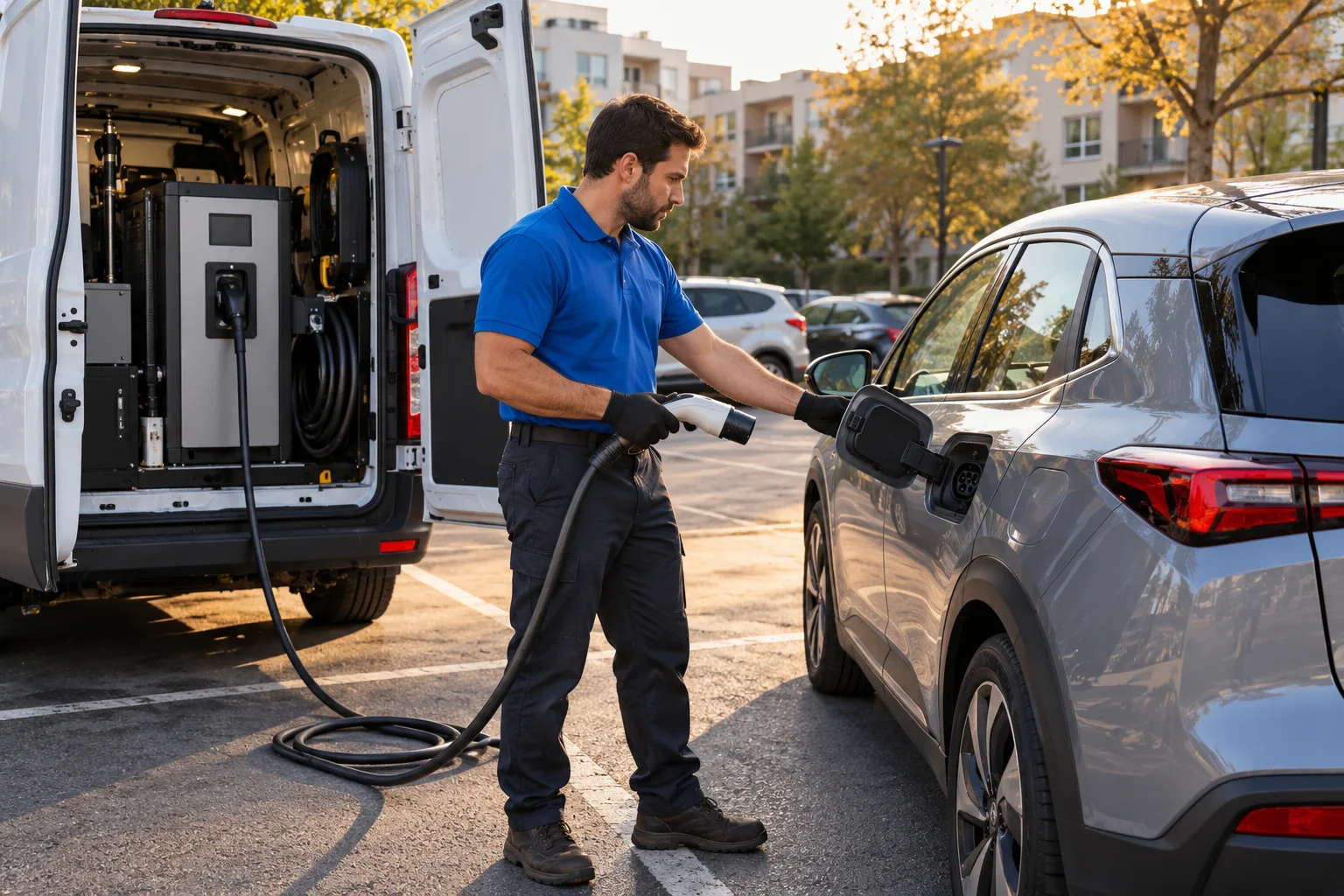
Mobile EV charging roadside assistance brings charging equipment to a stranded electric car. It may provide enough range to reach a nearby station without starting with a tow.
Charge Pro DC connects drivers with licensed, independent local operators. We don’t perform the charging, own rescue vehicles, or set the operator’s price.
What drivers mean by mobile EV charging roadside help
Drivers often search “mobile EV charging roadside assistance” as one service. They’re usually looking for help after the main battery gets too low to continue. The car may be parked at an apartment, beside an office, or along a DC-area road.
A mobile rescue charge isn’t the same as charging to full. Its immediate purpose is usually to add enough range for the next practical stop. The typical rescue charge in our approved service data adds 10 to 20 miles of range during 15 to 30 minutes of Level 2 charging. That time describes charging only. It isn’t an arrival estimate.
Results depend on the car and the charging setup. The U.S. Department of Energy says AC Level 2 equipment can operate across a broad power range. Actual charging time varies with battery level, battery capacity, equipment output, the vehicle’s onboard charger, and the available electrical service.
That makes the destination important. A driver near a working public charger may need only a modest rescue charge. Someone inside a restricted garage may need another recovery plan. An operator needs the car’s location and condition before deciding what’s practical.
Mobile charging is one part of EV roadside assistance. Roadside help may also involve a low-voltage battery issue, damaged tire, collision, locked charge port, or tow. If the main battery is simply depleted and the location is accessible, mobile EV charging may be the direct option to request.
What an independent operator typically brings
The independent operator brings a mobile power source, charging equipment, and the connector planned for the vehicle. Equipment differs between operators. Don’t assume every mobile unit supports every EV, connector, or charging rate.
Share the year, make, and model before anyone travels. Tell the operator whether the car uses its original inlet or an adapter. If you have an adapter, say which one and whether it’s inside the locked vehicle. A photo of the inlet or dashboard warning can help clarify the request.
The operator also needs to understand the physical setting. A surface parking lot is different from a low-clearance garage. A curbside space differs from a Beltway shoulder. Gates, access cards, parking controls, and garage height can affect whether the equipment can reach the car.
Describe what happened before the EV stopped. A battery display that fell to zero suggests a different problem from a car showing plenty of range but refusing to start. Likewise, a charging error at a public station doesn’t prove that the traction battery only needs energy.
Ask the operator to confirm three points:
- The proposed equipment matches the vehicle.
- The location can be accessed lawfully and safely.
- The planned charge should support a specific reachable destination.
Our guide to what mobile operators bring explains the information worth confirming. You can also read how a mobile EV charging rescue works before requesting service.
Charge Pro DC makes the referral. The matched operator determines the equipment, evaluates access, explains the proposed work, and performs the service.
Apartment lots, Metro garages, and Beltway shoulders
Location changes the entire roadside assistance decision in the DC area. Apartment-heavy parts of Arlington and Silver Spring often present access problems that don’t exist in an open retail lot. The driver may need a gate code, resident access, or permission from property management.
Don’t assume an operator can enter a private garage. Share the garage name, entrance, level, clearance signs, and exact parking space. Ask the property manager or garage operator whether outside roadside equipment may enter. No verified, system-wide Metro rule for mobile EV charging could be confirmed from the approved claims ledger. The parking facility controls access, so confirm its current policy directly.
A shoulder on I-495 is a different setting. It isn’t a normal charging bay. Tell the operator your direction of travel, nearest exit, roadway name, and visible marker. If the car is in an unsafe traffic position, contact emergency services first.
The 495, 95, and 395 Express Lanes have their own roadside procedures. Express Assist provides minor roadside help at no charge and can call a tow, but it doesn’t perform the tow. On the 495 Express Lanes, drivers are instructed to use the left shoulder because those lanes sit in the median. On the 95 and 395 Express Lanes, drivers should use the nearest shoulder and remain inside the car until help arrives.
Access can also change on National Park Service parkways. The Baltimore-Washington, George Washington Memorial, Clara Barton, Rock Creek, and Suitland parkways restrict commercial vehicles and may have narrow or absent shoulders. An independent operator must decide whether the location is accessible.
For more location planning, see our DC, Maryland, and Virginia mobile charging guide.
What this visit will not fix
A rescue charge addresses missing energy in the main battery. It doesn’t automatically correct every condition that leaves an EV unable to move.
The car may have a low-voltage battery problem. It may show a charging fault, damaged inlet, stuck connector, tire problem, collision damage, or another mechanical condition. Adding energy won’t necessarily clear those issues.
Start with the instrument display if it’s visible. Share the exact battery percentage, warning message, and any remaining range shown. Explain whether the doors unlock, screens turn on, and the charge-port door opens. Don’t remove panels or force a connector while waiting.
The location can also make charging unsuitable. A narrow shoulder, collision scene, restricted parkway, blocked garage aisle, or unsafe traffic position may require relocation or towing. Mobile charging shouldn’t be treated as a promise that every stranded EV can leave under its own power.
The destination matters too. Ten to 20 miles of added range may be useful when a confirmed charger is nearby. It’s less useful when the intended station is closed, occupied, incompatible, or beyond the expected rescue range. Check the station’s current status through its operator before choosing it as the next stop.
Tell the matched operator if the car failed while already connected to charging equipment. That detail may point away from a simple depleted-battery visit. Our comparison of a mobile charge and a tow can help frame that choice.
When charging isn’t appropriate, the operator can explain other recovery options. Charge Pro DC doesn’t diagnose the vehicle, authorize repairs, or promise that a rescue charge will resolve the underlying fault.
How a quote works before anyone rolls
Charge Pro DC doesn’t publish or set operator prices. The independent operator quotes the driver and bills the driver directly. No verified universal price for mobile EV charging roadside assistance appears in the approved claims ledger.
That means a credible quote should come from the operator handling the request. Ask for the amount and scope before accepting service. The operator should understand the location, vehicle, connector, battery condition, and requested outcome before quoting.
Provide these details at the start:
- Your exact location and direction of travel
- The parking level, space, gate, or nearest road marker
- The EV’s year, make, and model
- The displayed battery level and warning message
- The connector or adapter involved
- Whether the vehicle can shift, steer, or unlock
- The charging station you hope to reach
Ask what the quoted amount covers. Confirm whether it covers the planned charging visit, access conditions, and the stated charging goal. If conditions change after arrival, ask the operator to explain any revised work and price before proceeding.
Don’t rely on an online national average or an unsourced starting price. It may not reflect a garage in Arlington, a private lot in Silver Spring, or a shoulder along the Capital Beltway. The operator sets the actual quote for that specific call.
Also ask what happens if charging can’t proceed. A mismatched connector, inaccessible garage, unsafe roadside position, or vehicle fault could change the recovery plan. The operator should explain whether another service is needed. Our guide to the mobile charging quote process offers a closer look at that conversation.
When to call us
Call when the main battery is depleted, the EV is accessible, and a rescue charge may reach a confirmed charging stop. We’ll gather the location and vehicle details, then connect you with a licensed, independent local operator who sets the quote and performs the work.
Call us at (202) 629-0844 and we’ll connect you with a local EV rescue operator.