Your EV is at zero on a Beltway shoulder or an I-66 ramp. The choice is a quoted mobile charge or a flatbed. If the pack is empty, a quoted mobile EV charging visit puts miles back. If the car can’t take a charge, you want a tow to a shop. Virginia, Maryland, and the District use ordinary disabled-vehicle rules. Public patrols in Virginia, Maryland, and the District won’t charge that pack.
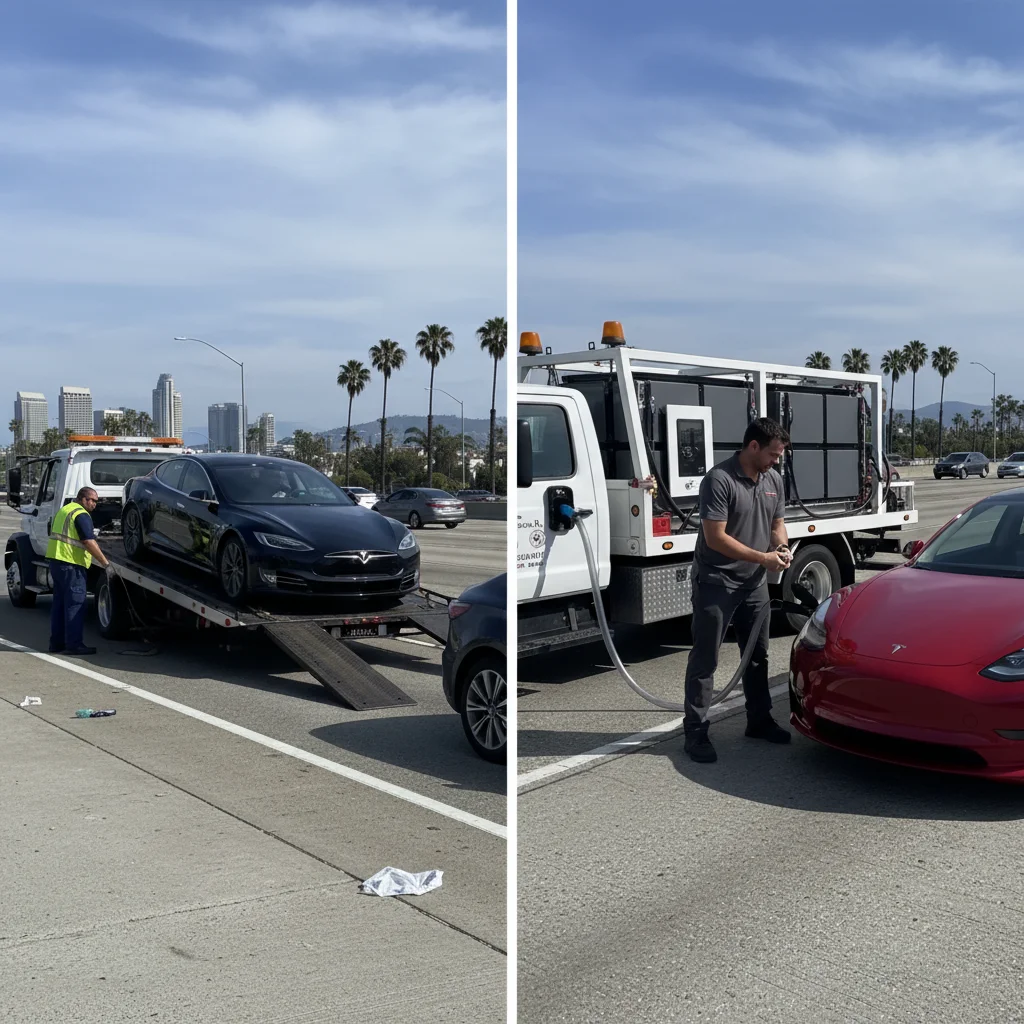
The patrol that stops won’t fill the pack
On Virginia interstates, VDOT’s Safety Service Patrol covers corridors such as I-95 and I-66. You reach that help through Virginia 511. VDOT’s published material covers incidents, debris, and short-term traffic control. It doesn’t describe charging an EV.
Maryland’s CHART Emergency Traffic Patrol covers the Baltimore/Washington area. On a state primary roadway you dial #77. That includes I-495, I-270, US-50, and MD-295. CHART technicians change tires, jump-start a car, pour about a gallon of gas, and add radiator water. Filling a traction pack isn’t on that list.
The District is different. No DDOT motorist-assistance patrol turned up in the public material we checked. Inside the city, drivers lean on MPD, a private roadside plan, or Park Police on the parkways.
The Baltimore-Washington Parkway, the George Washington Memorial Parkway, Clara Barton, Rock Creek, and Suitland Parkway are National Park Service roads. Commercial vehicles and trucks over 10,000 lb are banned. Shoulders are narrow or missing. Report a disabled vehicle on the Baltimore-Washington Parkway to the US Park Police at 202-610-7500. A charger truck still has to fit those rules. A heavy wrecker may not.
On Transurban’s 495, 95, and 395 Express Lanes, Express Assist is the free patrol. It helps with minor mechanical issues and will call a tow. It doesn’t tow the car itself. Published FAQs don’t describe charging an empty pack. On the 495 Express Lanes, pull to the left shoulder. Those lanes sit in the median. On the 95 and 395 Express Lanes, use the nearest shoulder. Stay in the car until help is there.
Virginia, Maryland, and DC don’t tow under one rule
Running out of charge isn’t a special offense in the three codes we reviewed. The disabled-vehicle rules that apply to a gas car apply to yours. The tow paperwork is where the jurisdictions split.
Virginia private-property towing sits in Va. Code § 46.2-1231, § 46.2-1233, and § 46.2-1233.1. Localities may cap fees by ordinance. The state sets a passenger-car hookup-and-initial-tow cap. It limits extra night and weekend fees. It bars a storage charge for the first 24 hours. Northern Virginia localities in Planning Districts 8 and 16 set a hookup-and-tow floor by ordinance. Arlington County, Alexandria, and the City of Fairfax aren’t the same paper. Confirm the ordinance that covers the lot before you pay. Fairfax County and the City of Fairfax are separate. Name the one you’re in.
Maryland’s stopping and disabled-vehicle rules live in Transportation Article Title 21. Private-property towing and county ordinances sit alongside 21-10A. Montgomery County and Prince George’s County each set their own. Don’t assume a Prince George’s invoice matches a Montgomery one. Ask for the ordinance citation on the slip.
The District tows and impounds under Title 50 and the DC Municipal Regulations. DPW’s impound facility is Blue Plains, 5001 Shepherd Parkway SW. There’s a second lot at 2115 Bryant St NE. The published number is (202) 541-6083. If a District tow takes the car, start there.
The Woodrow Wilson Bridge carries the Beltway between Alexandria, Oxon Hill, and the District. A stall there sits at a three-jurisdiction seam. The American Legion Bridge does the same between McLean and Montgomery County. These are high, wind-exposed spans with limited shoulder. Get the car out of live lanes first. Sort the invoice after you’re safe.
What you’re actually buying with a mobile charge
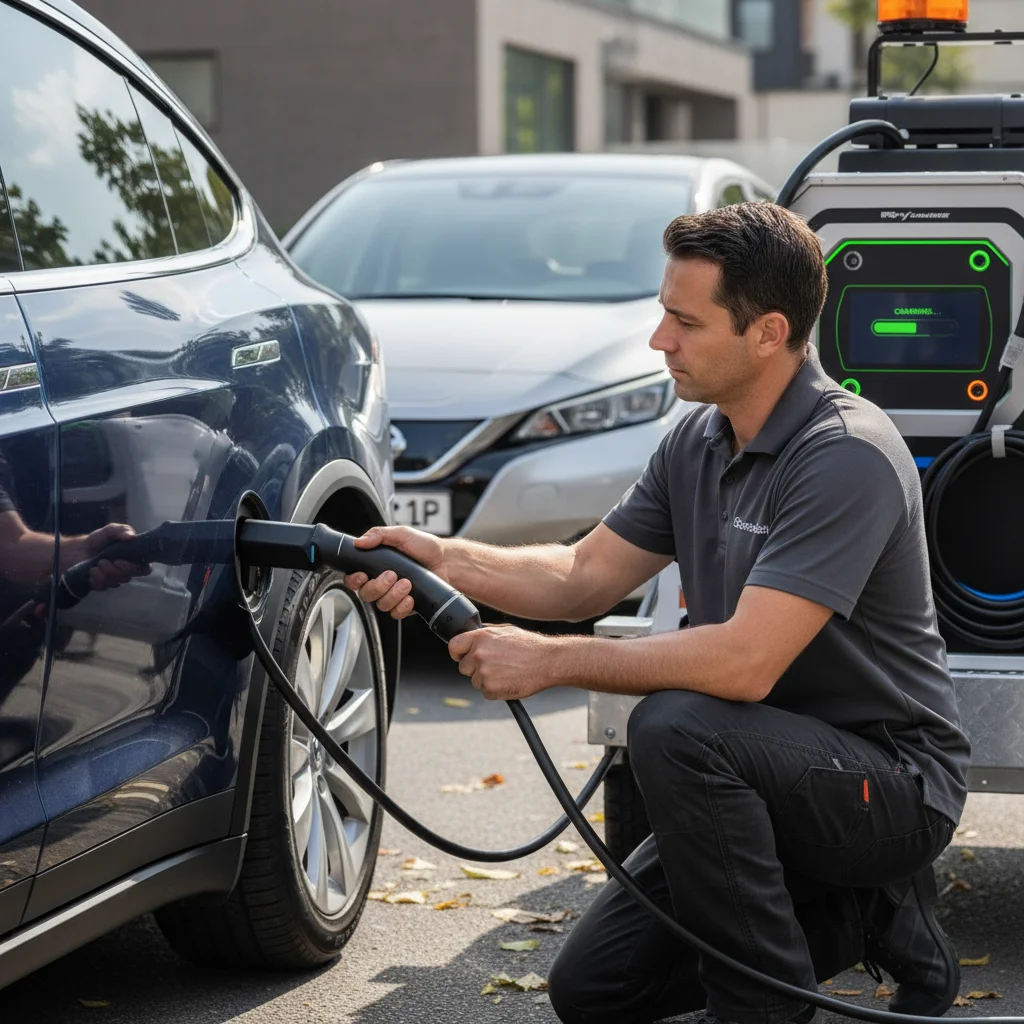
A mobile visit is a 240-volt Level 2 source brought to the car. Operators typically add 10 to 20 miles of range in 15 to 30 minutes of charging time. That clock is charging time, not a promise of when someone arrives. Tesla owners usually get a native NACS plug. Other EVs use a CCS or J1772 adapter. The point is enough range to roll to a charger or home.
Charge Pro DC is a referral line. We match you with independent local operators. We don’t own the truck. We don’t set the price. The operator quotes you before any work starts and bills you directly. That quote is how you compare mobile EV charging cost vs tow on a real shoulder.
The quote usually reflects dispatch, setup, and the energy delivered. It isn’t a per-mile taxi for the car. You’re paying to solve the empty-pack problem where you sit.
Pepco and Dominion Energy Virginia publish EV rate or rebate programs. NOVEC, BGE, SMECO, and the City of Manassas municipal utility serve other parts of the metro. None of the utility pages we reviewed offer a stranded-car charge. They won’t roll a truck to I-270.
The no-home-plug pattern is strongest in denser, older housing. That includes Arlington, Alexandria, the District, Silver Spring, Wheaton, Hyattsville, and Annandale. Commutes on I-270, I-66, and I-95 eat range in traffic, not just in miles. Sitting with climate control on is how a crawl becomes a shoulder stop. A quoted top-up solves that empty pack. A tow only moves it.
When the flatbed is the honest answer
Almost every EV maker, Tesla included, wants a flatbed. A hook-and-chain or a two-wheel dolly can damage the drive units. That’s why an EV tow is a different job from a gas car on a sling. It’s also why towing a dead EV in this metro gets messy fast. Miles, winching, and a shop stop all stack on the ticket.
A tow is the right call when the car isn’t merely empty. Red flags include powertrain failure and a high-voltage battery error. A 12-volt fault that won’t take a jump belongs here too. Feeding the pack won’t fix a broken powertrain. It can be unsafe. In that case, get the car on a bed to a qualified service center.
A tow is also right when you can’t stay with the car. It’s right when the site can’t host a charger truck. Tight garages, some Metro lots, and parkway pull-offs can force a winch and a bed. Tysons Corner Center garages, Arlington office decks, and long-dwell WMATA lots are common versions of that bind.
Understand what the tow buys. You wait for the bed. You wait through loading and tie-down. You ride the miles to a charger or a shop. Then you still have to charge, unless the destination is a dealer bay. For a healthy car that only ran out of range, you paid to relocate the same empty pack.
Distance and time punish a tow harder
On a tow ticket, distance is the part that keeps growing. Hookup is the start. Miles to the drop are the rest. A Beltway hop is one number. A run from Dale City on I-95 toward a shop inside the District is another. We won’t invent a per-mile rate. Ask the tower to quote hookup, miles, winching, and after-hours items before the bed moves.
A mobile charge is priced around the work on that car. The operator still has to reach you. The quote you accept is supposed to include that. You’re not watching a mileage clock while the car sits on someone else’s truck.
Time of day still matters. Virginia’s private-property rules allow a limited extra fee at night, on weekends, and on holidays. Maryland and the District follow their own ordinances. Get a number you accept before the work starts.
Demand spikes in storms and holiday traffic. Cabin heat comes from the pack. Gridlock on the Beltway or a crawl on I-66 drains range without covering miles. The January 2022 I-95 shutdown south of this metro is the local memory for that. A quoted mobile visit can’t erase a busy night. It can keep the bill from moving after you say yes.
Clubs, Tesla, and the insurance card
Many drivers assume a club or a policy will swallow the whole event. Read the benefit before you spend it.
AAA and similar clubs often include towing miles that look generous on paper. Don’t burn a long-haul benefit on a short hop to a charger. If the club sends a tow by default, you’re back in the flatbed math. See when AAA can’t charge your EV.
Tesla’s support page treats an out-of-charge event as the driver’s responsibility. When warranty roadside applies, it’s typically a limited-distance tow to the nearest public charger or Supercharger. Repeat events may not stay complimentary. A third-party mobile charge depends on local partnerships and isn’t a guarantee.
Confirm your roadside add-on with the carrier. Many are written as a towing allowance, not as an EV pack fill.
Empty pack or dead 12-volt: pick the right rescue
A lot of dead-EV calls are 12-volt failures after a long sit. The pack can still hold range while the car won’t wake. Reagan National lists complimentary EV charging on Level 1 of Parking Garages 1 and 2. Dulles lists Level 2 charging in Garage 1 and Garage 2. The Economy Lot is the largest on-airport option, reached by shuttle from Curb 2F. WMATA park-and-ride garages produce the same long sit. If the dash is dark, start with the 12-volt. A true zero-percent pack is out-of-charge recovery. If you’re unsure, read electric car died: should you charge, jump, or tow. Cabin heat in a Beltway stall comes from the pack.
How to choose on the shoulder
Stay out of live lanes. On the 495 Express Lanes, pull left. On an NPS parkway, call Park Police. Zero percent and no fault: take the mobile 240-volt top-up. Dark car: try the 12-volt path first. Red powertrain or battery-system fault: ask for a flatbed to a shop. Already empty on the Beltway: follow out of charge on the Capital Beltway. Don’t wait on Pepco, Dominion, or a patrol to fill the pack.
Call for a quote, not a mystery invoice
If the car is empty and the warnings are quiet, a quoted mobile charge is usually the cleaner bill. The operator who shows up is independent. They quote before they plug in and bill you. Charge Pro DC only makes the match. Call (202) 629-0844. Tell them where you are, what the dash says, and whether the car will accept a plug.