The Level 2 unit in your garage runs on Pepco or Dominion. That 240-volt circuit stays on the wall at home. It can’t reach a car already stopped on the Beltway, I-270, or I-66.
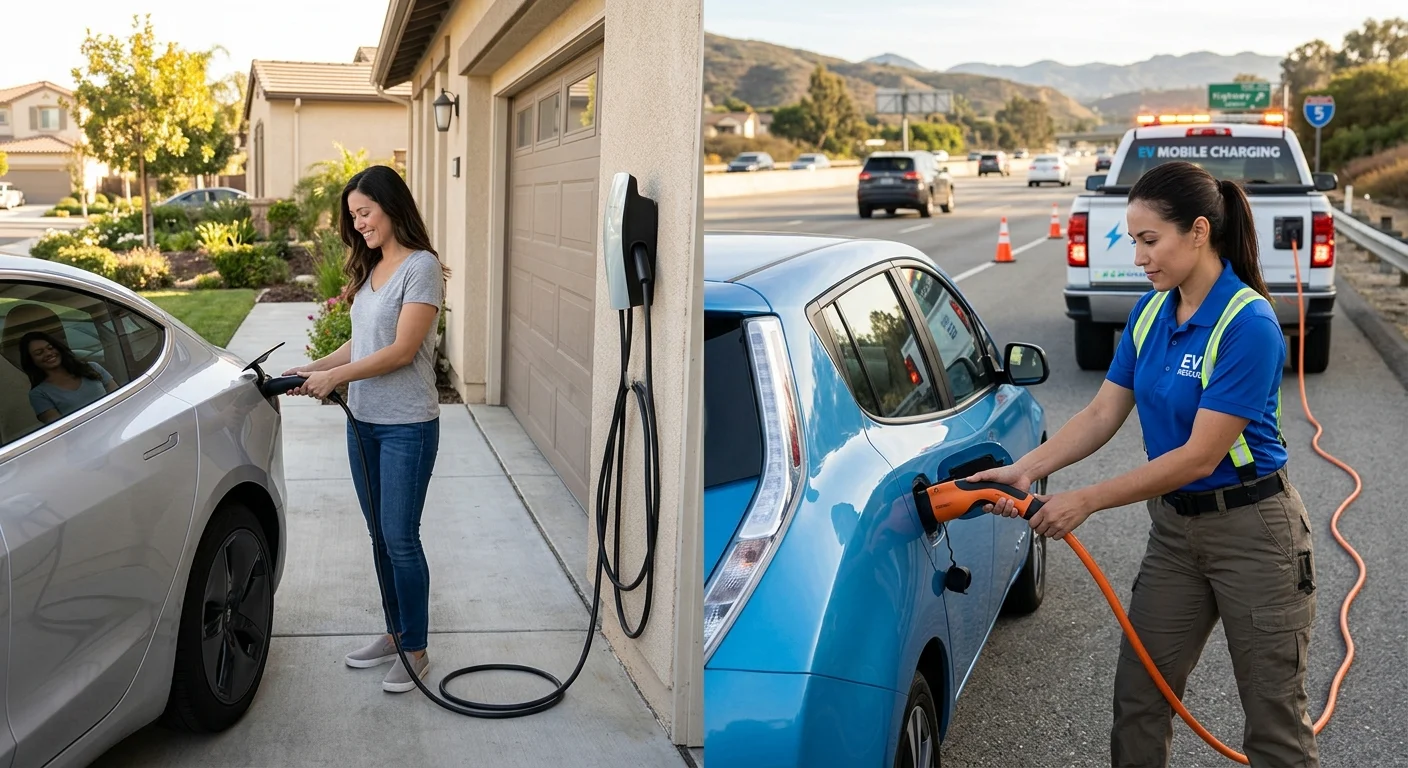
Home charging and a roadside top-up are different jobs
A 240-volt circuit can feed two very different services. One is planned overnight charging at a house or condo. The other is a short energy add at the car, wherever it stopped. They share a voltage class, not equipment, permits, or timing.
The US Department of Energy describes residential Level 2 as 240-volt service. Some commercial sites use 208 volts, so voltage alone doesn’t set the rate. The circuit, the charging equipment, and the car’s onboard charger all matter.
A home station exists so you can refill on a schedule. A roadside top-up exists so the car can move again. When the car is already down, those charging levels decide the next move.
What a 240-volt home setup is for
Routine charging starts with a parking spot you control. You have time, and you have a fixed electrical source. A licensed electrician checks the panel, the load, and the proposed equipment. Charge Pro DC doesn’t inspect panels or install stations. We match stranded drivers with independent local operators.
Pepco serves the District, Montgomery County, and Prince George’s County under its EVsmart program. In Maryland, Pepco lists a residential Level 2 rebate for Montgomery and Prince George’s addresses. Confirm the current amount on Pepco’s EVsmart pages before you budget anything. The District runs a separate alt-fuel infrastructure tax-credit path. Confirm that figure on the District side too.
Dominion Energy Virginia serves most of Northern Virginia. Named programs include residential EV rate Schedule 1EV. The voluntary Off-Peak Plan time-of-use rate needs a smart meter. Dominion also publishes EV Charger Rewards, a demand-response incentive. None of those programs roll a charger to a stalled car.
NOVEC covers parts of Loudoun and Prince William, including much of Sterling, Ashburn, and Gainesville. Confirm the serving utility by the service address, not a neighborhood name. We reviewed those utility EV pages, and none offer a stranded-car charge.
Census ACS 2019-2023 figures put Takoma Park at 90.0% pre-1980 housing. Washington is at 70.3%, so panel work often comes before Level 2. Ashburn is at 3.1% pre-1980 housing, and Germantown is at 14.1%. Newer panels still don’t move energy onto I-66.
The no-home-plug pattern is strongest in Arlington, Alexandria, and the District. Silver Spring, Wheaton, Hyattsville, and Annandale show the same squeeze. No dedicated circuit in Arlington means home 240-volt charging may never have been yours. A roadside stop then isn’t a botched home project. It’s charging you can actually get at the car.
Level 1 is a standard 120-volt household outlet, slower than Level 2. Our note on Level 1 overnight charging covers when that outlet is enough. For panel work versus a dead-car visit, read panel upgrade versus roadside charging.
The wall unit can’t follow you onto the road
Once the car is away from that circuit, the home station is irrelevant. A driveway in Rockville isn’t a shoulder on I-270. A garage in McLean isn’t the American Legion Bridge. A condo lot in Alexandria isn’t the Woodrow Wilson Bridge. That span is where the Beltway meets Virginia, Maryland, and the District at once.
On the 495 Express Lanes, pull to the left shoulder. Those lanes sit in the median, not the right edge. Pull to the nearest shoulder on the 95 and 395 Express Lanes. Stay in the car until help arrives. Transurban’s Express Assist can call a tow for a disabled car. It doesn’t tow, and published pages don’t describe EV charging.
VDOT’s Safety Service Patrol covers Virginia interstates, including the I-66 corridor. Drivers reach that help through Virginia 511. VDOT describes incident clearance and traffic control, not EV charging. On Maryland primary roads, dial #77 for MDOT SHA CHART. That includes I-495, I-270, US-50, and MD-295. CHART publishes tire changes, jump starts, gas, and water, not an EV charge. In the District, we didn’t find a DDOT motorist-assistance patrol. District drivers rely on MPD, private roadside plans, and US Park Police on the parkways.
National Park Service parkways here include the Baltimore-Washington and George Washington Memorial parkways. Commercial vehicles and trucks over 10,000 lb are banned, and shoulders are narrow or missing. A disabled vehicle on the Baltimore-Washington Parkway is reported to US Park Police at 202-610-7500.
None of the three local codes we reviewed has a special out-of-charge rule. Disabled-vehicle rules apply to an EV the same way they apply to any car. Don’t drag a household cable across a live lane.
Confirm the car before anyone plugs in
Start with make, model, and year, then read the owner’s manual on charging. Level 2 gear often uses J1772 or NACS, sometimes called J3400. The manufacturer still owns compatibility for your exact EV. Don’t pick an adapter from shape alone.
For a home install, a 240-volt outlet in the garage isn’t a complete answer. A licensed electrician still has to evaluate the circuit, the panel, and household demand. Charge Pro DC doesn’t perform that property work. Confirm permit forms with the office that has the address. Fairfax County and the City of Fairfax are separate jurisdictions.
For a roadside request, tell the operator the screen warnings, remaining charge, and connector. Give the exact location, plus whether the car can shift, steer, or accept a charge. The matched operator then decides whether a mobile 240-volt session or a tow fits.
A low traction pack isn’t the only way an EV sits still. A dead 12-volt battery can keep the car from waking, even with range showing. Operators we connect you with can jump or replace a dead 12-volt on site. If the car rejects charging or shows a fault, adding energy may not fix it.
A failed overnight charge at home isn’t automatically a roadside case. If the car is parked safely, the charger, breaker, or vehicle may need diagnosis. For a wall-unit fault, see what to do if the home charger fails. If you’re away from home and short on range, out-of-charge recovery is the path. Smoke, fire, a collision, or live traffic means you call emergency services first.
Weather, idle drain, and a short 240-volt add
This metro sits on the fall line, with hot, humid summers and stretches above 90F. Winters swing from mild weather to sudden ice. Dulles runs colder and snowier than Reagan National. Loudoun, upper Montgomery, and Prince William see more snow and harder freezes.
A Recurrent Auto study of more than 30,000 EVs tracked winter range. Typical cars keep about 80% of range at 32F, and about 70% at 20F. Most lose 20 to 35% in real cold. Sitting still with heat or AC on burns charge without covering miles. That’s the Beltway crawl and the I-95 standstill.
Airport parking is often a 12-volt story, not an empty pack. Reagan National has EV charging on Level 1 of Parking Garages 1 and 2. Dulles has Level 2 charging in Garage 1 and Garage 2. MWAA publishes no EV charging in the Economy Lot, the Terminal Lot, or valet. A week in the Economy Lot returns you to whatever the 12-volt has left.
A mobile 240-volt visit isn’t a copy of your home session. Independent operators bring a 240-volt Level 2 source to the car. Teslas take a native NACS plug. Other EVs use a CCS or J1772 adapter. Operators typically add 10 to 20 miles in 15 to 30 minutes of charging. That’s charging time, never an arrival time. The goal is enough movement to reach the place you choose, not a full pack.
Pick a top-up or a tow, then get the quote
Mobile charging may fit when the EV can accept compatible power where it sits. Access, traffic, and the connector all have to work.
Mobile EV charging is how we connect you with licensed, independent local operators. We don’t own trucks, employ technicians, or set prices. The operator quotes you before starting and bills you directly.
Transport may be the better path if the car won’t take power. It may also be the path if the location can’t support a mobile charge. The operator can assess a move to a charging site or a shop. Don’t pick a pin in an app and assume it fits your connector tonight. Confirm the destination with current network information and with the operator.
Ask what equipment they’ll use, what outcome they expect, and what you’ll pay. We couldn’t confirm one metro-wide price because the provider and the stop set the terms.
When to call us
Call when remaining charge won’t get you to a station you can use. You need an operator for a 240-volt top-up or a tow. Your home Level 2 on Pepco or Dominion can’t make that trip with you. Charge Pro DC connects stranded EV drivers with independent local mobile rescue operators. Call (202) 629-0844 and we’ll connect you with a local operator.