An EV charging truck is a van or pickup that stores power and brings it to your car. The operator plugs a 240-volt Level 2 cable into your port. Charge Pro DC doesn’t own that truck. Independent operators in the DC area do. The brand is a referral line that matches you with one of them.
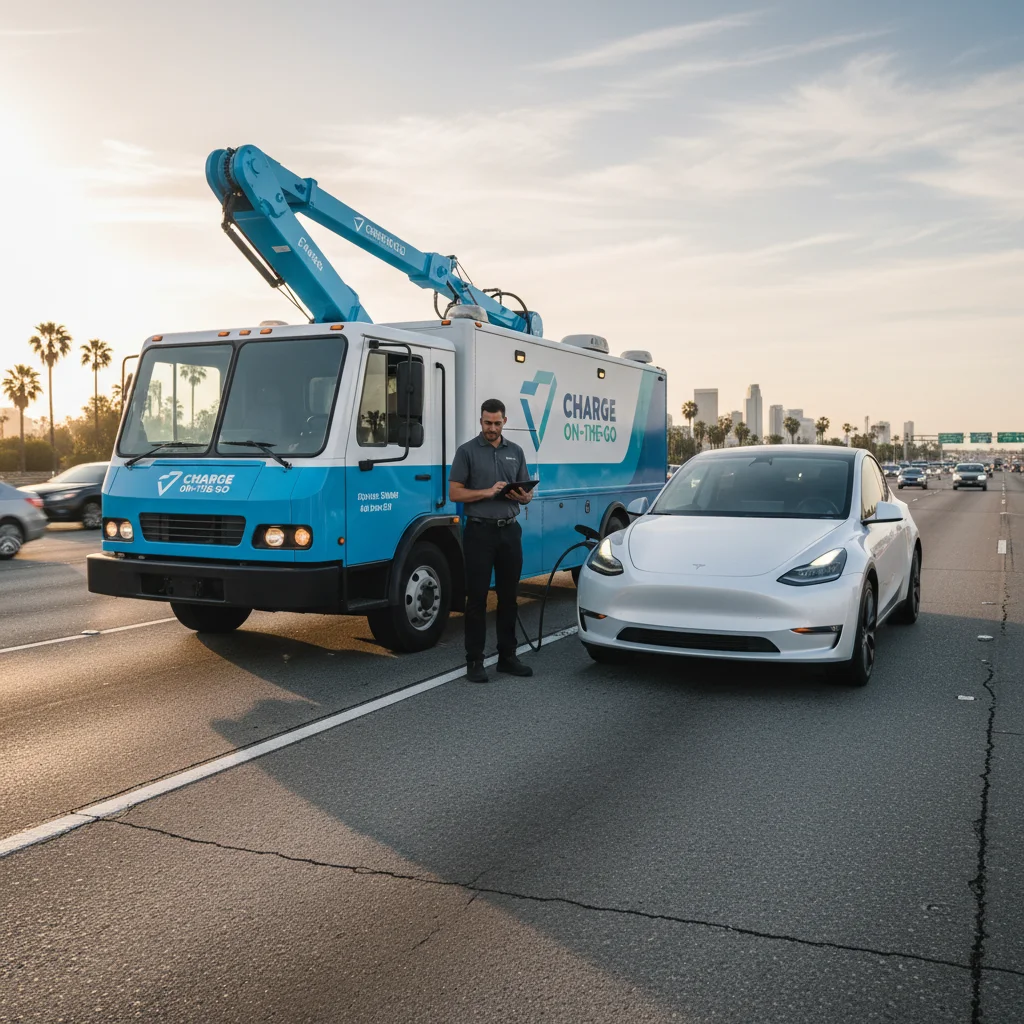
Search “ev charging truck” and you’ll picture a company fleet. That picture doesn’t match this service. Charge Pro DC holds no trucks, no chargers, and no yard. It employs no technicians. The person who rolls up is an independent local operator. They quote you before they start. They bill you directly.
What that truck is built to do
The visit is a rescue top-up, not a fill to full. You misread a commute on I-270 or I-66. The pack hits single digits on the Capital Beltway. You need enough range to move the car. Operators bring a 240-volt Level 2 source. Tesla drivers get a native NACS plug. Other EVs use CCS or a J1772 adapter. A typical session adds about 10 to 20 miles of range. That window is 15 to 30 minutes of charging. It’s charging time, not a promise of when someone arrives.
Towing used to be the default. Many EVs here are heavy and all-wheel drive. A bad load on a flatbed can strain the drivetrain. Keeping the car on its wheels is cleaner when a charge will wake it. If the car is dark with range still on the display, think 12-volt. Operators can jump a dead 12-volt on site. They can replace it when that’s the repair. They handle Tesla and every major EV brand.
This is the mobile EV charging work the referral line is built around.
Who owns the truck you see
Ownership is the part most pages skip. Charge Pro DC connects stranded drivers in the District, Maryland, and Virginia. It performs none of the work. It sets no prices. It publishes no business hours. The truck belongs to the operator who accepts your job.
That’s why the quote happens with them, not as a menu on this site. You’re not booking a yard in Rockville, Arlington, or Alexandria. You’re getting matched with a nearby independent. They decide if they can take it.
For the billing split, read what you pay for mobile EV charging, and who bills you.
Battery packs and generators, two different rigs
Not every rescue van makes power the same way.
Stored battery
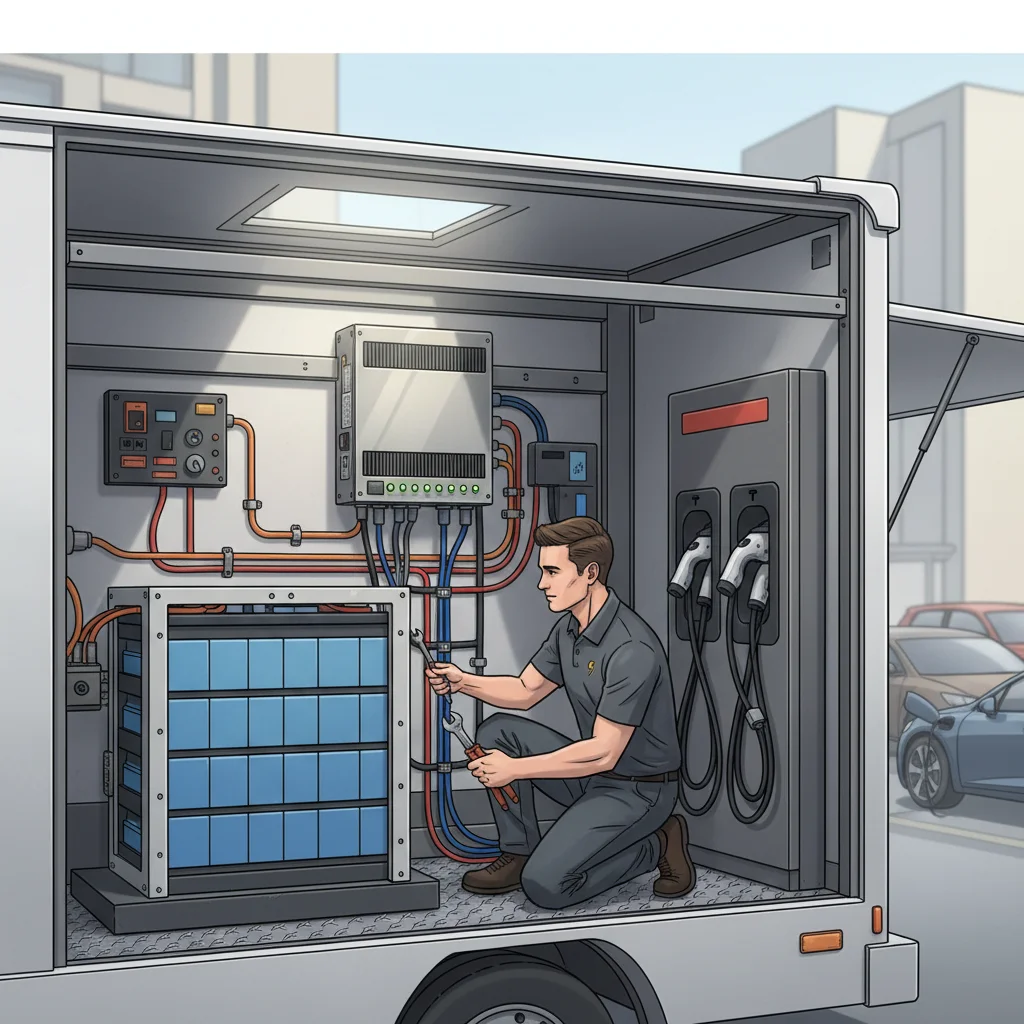
Some operators haul a large lithium pack in the cargo area. That pack is separate from whatever moves the van. They arrive with energy already stored. They invert it to 240-volt AC for your charge port. The session is quiet. That helps on a Takoma Park side street or in a Metro garage at night.
Generator on the truck
Other operators run a gasoline, diesel, or propane generator. It makes AC on the shoulder. That power still needs conditioning for your car. These rigs are louder. They burn fuel to put miles back in an EV. Some independents still use them. Charge Pro DC doesn’t choose the platform. The operator who takes your call does.
A longer gear walkthrough sits in what a mobile EV rescue vehicle actually brings.
How much range a stop puts back
Forget a Supercharger-style fill on the shoulder. The goal is enough motion to get you off the spot. Ten to twenty miles covers a lot of local recoveries. It can reach a public stall you already planned to use. It can cover the last stretch home in an inner suburb. A Model 3 uses that energy more efficiently than a heavy truck. Cold and cabin heat spend some of it before you roll.
Winter range is a real local factor. Recurrent Auto studied more than 30,000 EVs. A typical car keeps about 80 percent of range at 32F. It keeps about 70 percent at 20F. Most lose 20 to 35 percent in real cold. Cabin heating comes from the pack. Heat-pump cars averaged about 83 percent retained. Cars without a heat pump averaged about 75 percent. Dulles runs colder and snowier than Reagan National. Loudoun, upper Montgomery County, and Prince William see harder freezes than the District and the inner Virginia core. Idling with heat or AC on still drains the pack. You gain no miles in a Beltway jam or an I-95 standstill.
In January 2022, snow and a crash shut I-95 near Fredericksburg for more than a day. That stretch sits just south of this service area. It’s the region’s reminder that sitting in the cold with climate control on empties a pack. Save what charge you still have. Call while the car can still talk.
NACS, CCS, and J1772 on one visit
You shouldn’t have to name your port under stress. Operators bring a native NACS cable for Tesla and newer NACS cars. They bring CCS or J1772 adapters for everyone else. Roadside 240-volt charging is AC. The port that matters is the AC inlet, plus the right adapter. The operator handles the plug.
See what a roadside mobile EV charger is for the same idea with more gear detail.
Where these trucks get called in this metro
The District, Arlington, Alexandria, Silver Spring, Wheaton, Hyattsville, and Annandale have dense apartments and older houses. Takoma Park’s housing is about 90 percent pre-1980. Annandale is about 80 percent. Wheaton is about 73 percent. Washington is about 70 percent. The no-home-plug call is common in that older stock. Drivers use workplace garages and public stalls. A car that sat all day can fail on the 12-volt even with miles left in the pack.
Ashburn, Gainesville, Centreville, and Germantown have much newer housing. Home charging is more common there. The typical stall is a commute that used the buffer. I-270 between Rockville and Germantown. I-66 toward Centreville. I-95 through Woodbridge and Dale City.
Airport parking is its own pattern. Reagan National has EV charging on Level 1 of Parking Garages 1 and 2. Spaces are limited and first-come, first-served. The garages connect to the terminal. Dulles has Level 2 charging in Garage 1 and Garage 2, per MWAA. The Economy Lot is the large on-airport lot, reached by shuttle from Curb 2F. Drivers who leave an EV there for a week often return to a car that won’t wake. That’s usually the 12-volt, not an empty traction pack. Union Station’s garage and WMATA park-and-ride garages produce the same long-sit pattern.
Shoulders, parkways, and express lanes
On the 495 Express Lanes, pull to the left shoulder. Those lanes sit in the median. On the 95 and 395 Express Lanes, pull to the nearest shoulder. Stay in the car until help arrives. Transurban runs Express Assist on those lanes. It helps with minor mechanical trouble and will call a tow. It doesn’t tow. Its published FAQs don’t describe charging an EV.
The Woodrow Wilson Bridge carries the Beltway between Alexandria, Oxon Hill, and the District. A stall there sits in three jurisdictions at once. The American Legion Bridge links McLean and Montgomery County. Both spans are high, windy, and tight on shoulder.
National Park Service parkways follow a different rulebook. The Baltimore-Washington and George Washington Memorial Parkways are in that set. So are Clara Barton, Rock Creek, and Suitland. They ban commercial vehicles and trucks over 10,000 lb. Shoulders are narrow or missing. Tell the operator you’re on an NPS parkway before anyone rolls. A disabled vehicle on the Baltimore-Washington Parkway is reported to US Park Police. Check the current NPS page for how to report it.
I-270 and the Capital Beltway general lanes aren’t express lanes. I-66 inside the Beltway uses dynamic tolls in peak hours. MWAA operates the Dulles Toll Road. The Dulles Greenway is a separate private road west of the airport.
If you’re already empty on I-495, start with out of charge on the Capital Beltway.
Patrols and utilities won’t send this truck
Pepco serves the District, Montgomery County, and Prince George’s County. Its EV program is Pepco EVsmart. Dominion Energy Virginia serves most of Northern Virginia. Named programs include Schedule 1EV, the Off-Peak Plan, and EV Charger Rewards. NOVEC serves parts of Loudoun and Prince William, including much of Sterling, Ashburn, and Gainesville. BGE touches parts of Laurel. SMECO serves the southern edge toward Clinton. The City of Manassas runs its own municipal electric utility. Confirm yours by address. None of the utility EV pages reviewed offers a service that charges a stranded car.
VDOT’s Safety Service Patrol works Virginia interstates, including the I-66 corridor in Northern Virginia. Drivers request that help through Virginia 511. Published material covers incidents, debris, and short-term traffic control. It doesn’t describe EV charging.
MDOT SHA’s CHART Emergency Traffic Patrol works the Baltimore/Washington area. Technicians change tires, do jump starts, add about a gallon of gas, and put water in a radiator. On state primary roads such as I-495, I-270, US-50, and MD-295, you dial #77. That’s motorist assistance. It’s not a mobile EV charge.
No DDOT motorist-assistance patrol turned up for the District. DC drivers rely on MPD, private roadside plans, and US Park Police on the parkways.
DC, Maryland, and Virginia disabled-vehicle rules apply to an empty EV the same as any other car. None of the three codes reviewed has a special out-of-charge statute.
If the car can’t take a charge where it sits, a flatbed may still be the job. Mobile EV charging or a tow walks that choice.
How the match works
Call and say where you are, what you drive, and a callback number. A cross-street, an exit ramp, or a dropped pin is enough. Charge Pro DC matches you with an independent operator. There’s no branded fleet to ping. There’s no arrival time on this site.
The service area is the DC area: the District, Maryland, and Virginia. The hub at EV charging in the DC area maps the cities. The truck, if one comes, still belongs to the operator.
When to ask for a charging truck
Ask for a mobile charge when the traction pack is too low to roll safely. Ask for a 12-volt jump when the car is dark but the main battery still has energy. Airport lots, Tysons garages, and Metro parking produce that 12-volt case a lot. Ask for a tow when charging in place isn’t possible, or parkway rules block the operator’s vehicle.
Keep hazards on. Stay with the car on a live shoulder. On the 495 Express Lanes, that shoulder is the left one.
Charge Pro DC connects you with a local operator. Call (202) 629-0844. The operator quotes you before any charging starts.