You parked in Dulles Economy Lot for a week. You land, ride the shuttle from Curb 2F, and the Tesla won’t wake. The screen stays dark. The handles don’t present. The app stays quiet. Drivers in that stall search “tesla mobile charger near me” because they need the car to move. Sometimes the traction pack is empty and a 240-volt top-up is the right ask. More often the 12-volt sat through Loudoun cold and the pack is still fine.
Why Economy Lot parking hits the 12-volt first
Metropolitan Washington Airports Authority publishes where charging sits at Dulles. Level 2 stalls are in Garage 1 and Garage 2. MWAA says those stalls carry no extra charge for parking customers. Confirm current stall counts on the airport parking pages before you plan around them. MWAA also publishes that the Economy Lot, the Terminal Lot, and Valet don’t have EV charging.
The Economy Lot is the largest on-airport option. That’s why Tesla owners leave a car there for a trip. The shuttle picks up at Curb 2F. You come back days later to whatever the 12-volt still holds. The traction pack can still show a healthy percent and the car still won’t wake. The small battery feeds the computers, locks, and contactors that close the high-voltage system. When that battery is down, the pack you charged is locked behind a dead computer.
Dulles sits west of the District on the Loudoun side. It runs colder and snowier than Reagan National. A parked Tesla in a freeze still pulls on the 12-volt. Recurrent Auto studied more than 30,000 EVs in winter. A typical car keeps about 80 percent of range at 32F and about 70 percent at 20F. That’s traction-pack range, not a 12-volt spec. It still shows why a week in an open Loudoun lot is harder than a week in a DCA garage.
If you parked in Garage 1 or Garage 2, you may have had a Level 2 stall. That doesn’t mean the 12-volt is healthy. A week of sit still drains the small battery. The difference is you had a plug for the pack. In the Economy Lot you didn’t.
A week in that lot often comes back to a dead 12-volt, not an empty pack.
Sort an empty pack from a dead 12-volt before you call
A mobile Tesla charge helps when the traction battery is actually low and the car can take a plug. A 12-volt failure needs a jump or a replacement on site. Mixing those two requests wastes the operator’s trip and your time.
Walk the symptoms. Don’t name the failure for the operator.
Look at the last percent you remember. A car that sat a week after a low reading may be empty. A car that showed a mid-pack reading and now won’t unlock is pointing at the 12-volt. A black center screen and an app that can’t wake the car are 12-volt clues. A working screen with a charge warning is more of a pack clue.
Check whether the charge port opens. Check whether the doors respond. Check whether the car will shift if you can get in. Read every warning exactly as written. If the Tesla was still plugged in when it stopped responding, say that.
Our Tesla 12-volt jump service is the connection path when the small battery is the suspect. Drivers who want the model-by-model picture can read Tesla 12-volt versus the high-voltage pack. Neither page replaces an on-site read from the operator.
Don’t promise yourself that a mobile charger will fix every no-start. The operator still has to match the symptom to the truck.
Tell the operator you’re in the Economy Lot, not a garage
“Tesla at Dulles” isn’t enough. Garage 1, Garage 2, the Terminal Lot, Valet, and the Economy Lot are different access problems. The Economy Lot is a huge outdoor field. The operator needs a row, a stall number, and which side you walked from the shuttle.
Share the Tesla model and year. Share the last battery percent you saw. Share the exact warning text from the screen or the app. Share whether the phone app still talks to the car. Share whether you can open the charge port.
Add the access facts:
- Economy Lot, not Garage 1 or Garage 2
- Row letter and stall number if you have them
- Whether other cars block the stall
- Whether the charge port faces a curb or another vehicle
- Whether you can stay with the car or you’re still in the terminal
- Whether the car is locked with no app access
A map pin helps. It doesn’t replace the lot name. MWAA’s shuttle drops you at the Economy Lot from Curb 2F. If you’re still inside the terminal, say so. The operator can’t start a quote without a reachable car.
Photos of the stall and the screen help. Don’t text gate codes in a public thread. Send access details on the call the operator sets up.
Mention a bent charge port, standing water in the inlet, or visible crash damage. Report what you see. Don’t guess at a diagnosis.
Charge Pro DC is a referral line. We match you with an independent local operator. We don’t own trucks, we don’t set prices, and we don’t perform the work. The operator quotes you before starting and bills you directly. The pros we connect you with are licensed and insured.
When a mobile 240-volt charge is the right tool
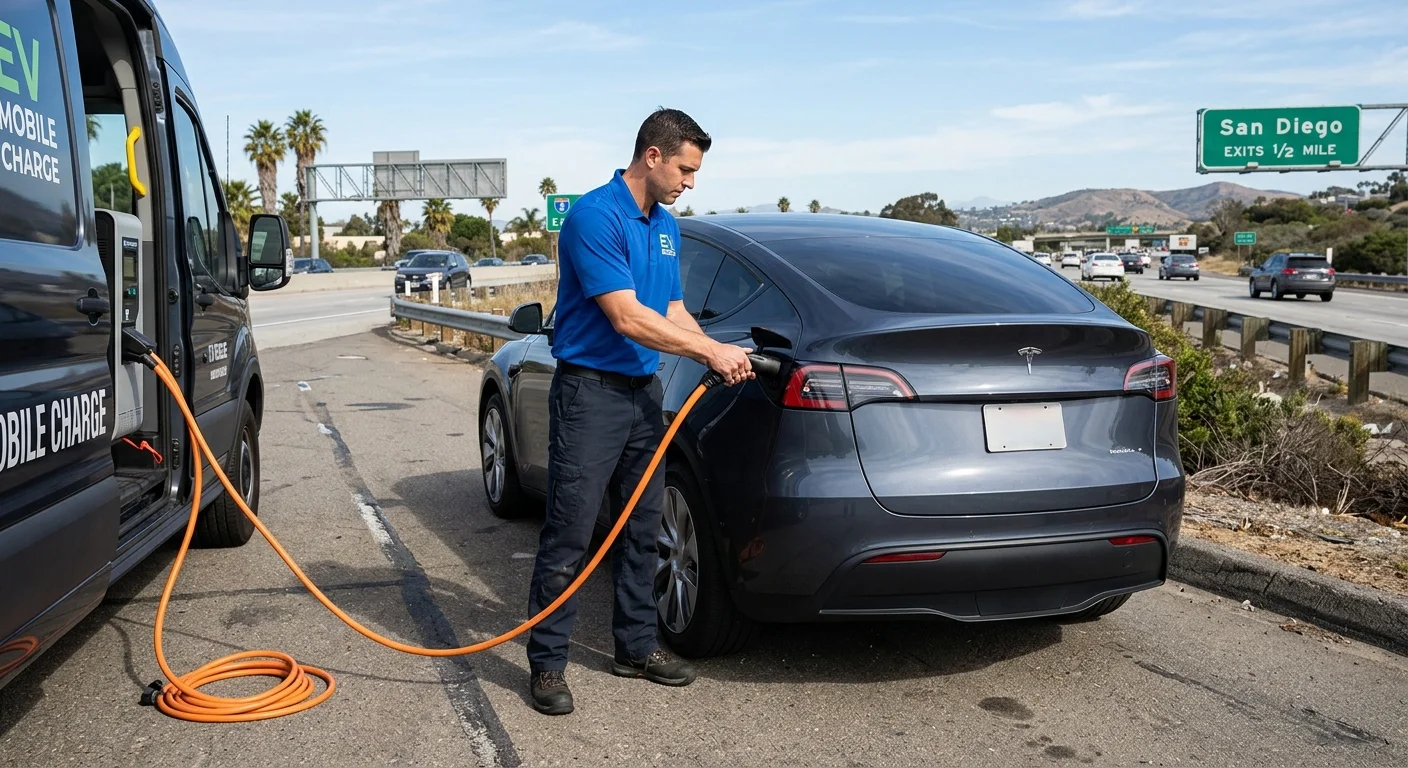
Mobile charging fits when the review points to an empty traction pack, the Tesla can take a plug, and the stall is reachable. The pros we connect you with bring a 240-volt Level 2 source. Tesla uses a native NACS plug. The U.S. Department of Energy lists J3400, also called NACS, as Tesla’s Level 2 connector. That standard doesn’t guarantee every roadside setup. The operator still confirms the car and the gear.
A typical roadside session adds about 10 to 20 miles of range in 15 to 30 minutes of charging. That’s charging time, not a promise of when anyone arrives. The point is usually to roll to a Supercharger or a home stall in Herndon, Sterling, or Ashburn. Tell the operator that goal. Don’t ask for a full pack at the stall.
Our Tesla roadside rescue page covers the Tesla-specific connection. The mobile EV charging page is the broader path if you aren’t sure which service name to use.
Ask the matched operator to confirm scope and price before any cable goes in. Charge Pro DC doesn’t set that price. No published rate for a Tesla mobile charge at Dulles could be confirmed for this page. Confirm it on the quote.
Herndon is a town just east of the airport. Sterling and Ashburn sit in Loudoun around the Dulles Toll Road, VA-267, which MWAA operates. Dominion Energy Virginia serves most of Northern Virginia. NOVEC serves parts of Loudoun, including much of Sterling and Ashburn. None of those utilities offers a charge-a-stranded-car service.
If you’re empty on the Dulles Toll Road, stay with the car. Don’t walk the shoulder. VDOT’s Safety Service Patrol covers Virginia interstates and I-66. It handles incident clearance, not EV charging. Reach them through Virginia 511.
When a jump or a tow is the better call
If the screen is black, the app is dead, and the last percent you remember was healthy, start with the 12-volt. A jump on site is often enough to wake the computers so you can drive to a shop. The operator decides after looking at the car.
Transport fits when charging won’t fix what you reported. Collision damage, a charge port that won’t open, or a car that still won’t accept charge after a 12-volt wake are tow conversations. The operator may start as a charge request and switch after the first look. That’s a service decision, not a failed referral.
If a tow is the recommendation, confirm the destination and how the Tesla will be loaded. Say whether it shifts, steers, rolls, or unlocks. Give the provider the Economy Lot row and stall, not a leftover pin from the terminal.
Virginia treats a disabled EV like any other disabled car. The codes reviewed for this page don’t have a separate out-of-charge rule. Confirm the current private-property tow rule with the locality before you pay a lot tow. Charge Pro DC doesn’t tow and doesn’t warrant another company’s work.
See also Herndon EV roadside assistance when the car will not wake at Dulles, Ashburn EV roadside assistance after Dulles economy parking, and what happens when an EV 12-volt dies on a trip.
Call with the lot, the model, and the last percent
Have the model, Economy Lot row, last percent, warning text, and access notes ready. Call (202) 629-0844. We’ll connect you with a local EV rescue operator. That operator quotes the work and bills you. We don’t.