When an EV dies on the Capital Beltway, you’re not waiting for gas. You need power at the car. A mobile EV charger truck is the vehicle that brings that power. Charge Pro DC doesn’t own that truck. We match stranded drivers with independent operators who do.
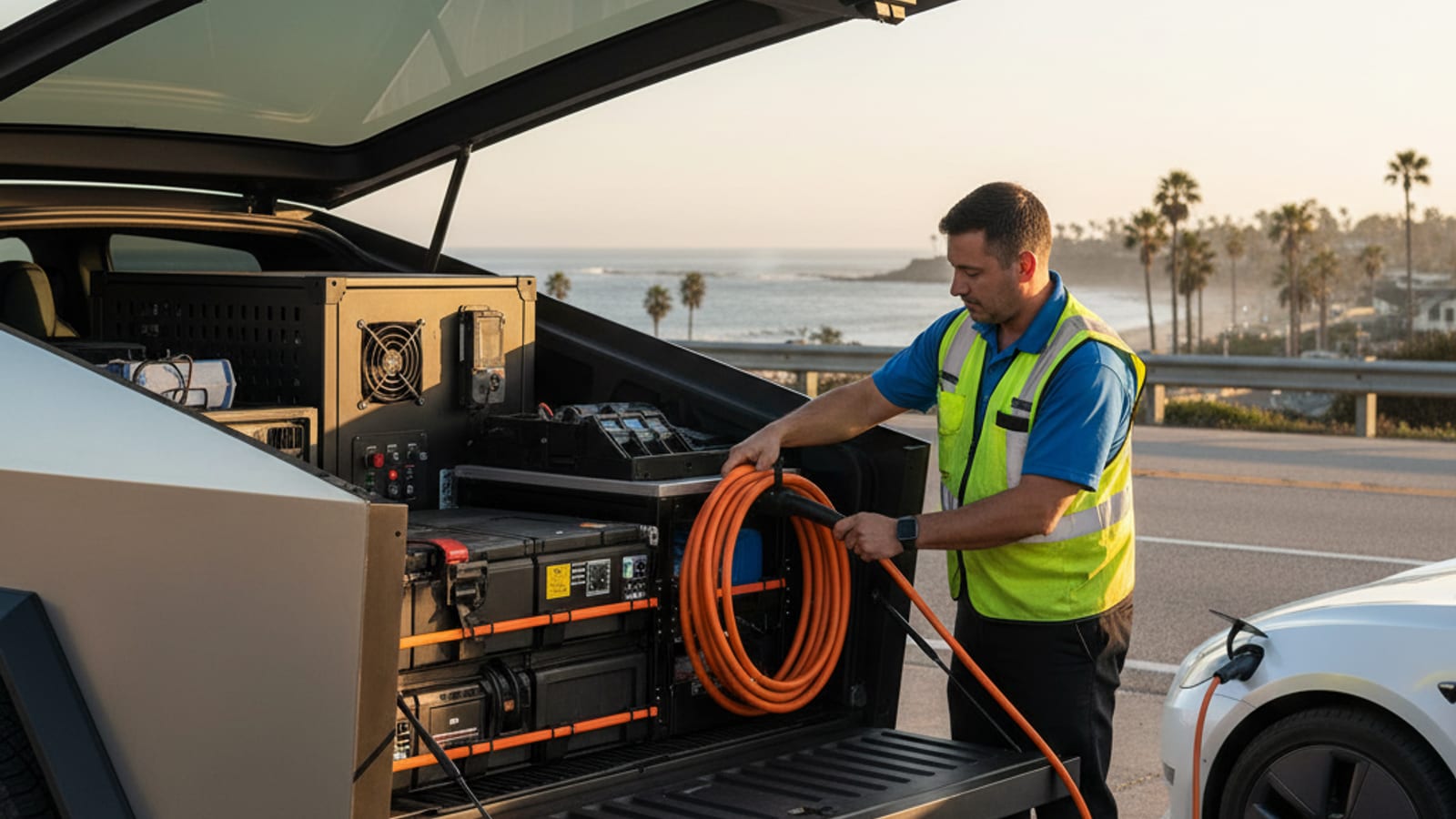
Those operators work across the District, Maryland, and Virginia. The truck that rolls up is theirs. The quote is theirs. The bill is theirs too.
What that truck actually carries
People picture a rolling Supercharger. That’s not what shows up. Matched operators bring a 240-volt Level 2 source to your charge port. Tesla cars take a native NACS plug. Most other EVs take a CCS or J1772 adapter. That mix covers Tesla and every major EV brand.
The job is a top-up, not a full pack. Typical charging time is 15 to 30 minutes. That window often adds about 10 to 20 miles of range. Those minutes are charging time. They’re not an arrival window. The operator quotes you before any cable goes in.
Many of the same operators can jump a dead 12-volt battery on site. They can also replace it. That kit is separate from the 240-volt charger. A car that won’t wake in a garage is often the 12-volt. A car that rolled to zero needs the Level 2 source. Mixing those two problems is how people wait for the wrong help.
For the short definition, read what a roadside mobile EV charger is. This page is the gear list.
Power, plugs, and what stays off the truck
The 240-volt outlet on the operator vehicle isn’t exotic. It sits in the same family as a strong home wall charger. It isn’t DC fast charging. It won’t fill a pack the way a Supercharger does. It’s meant to get you off a shoulder. It can also get you out of a garage or a long-stay lot.
You won’t find a utility hookup on the bumper. Pepco serves the District, Montgomery County, and Prince George’s County. Its published EV program is Pepco EVsmart. That program is about home and multifamily chargers. Dominion Energy Virginia serves most of Northern Virginia. Named programs include Schedule 1EV, the Off-Peak Plan, and EV Charger Rewards. NOVEC serves parts of Loudoun and Prince William. That includes much of Sterling, Ashburn, and Gainesville. Confirm the serving utility by address. None of the utility EV pages on record charge a stranded car. Home rates stay at the house. They don’t roll to I-66.
The truck also isn’t a tow truck. If the pack is empty, the goal is added range. That only works if the car can take charge. Towing is a separate call. For that fork, see mobile EV charging or a tow.
Charge Pro DC doesn’t send a fleet
Charge Pro DC is a referral line. We don’t hold a trade license for this work. We don’t employ technicians. We own no trucks. We don’t set prices. We don’t promise when someone will arrive. We publish no business hours.
You call. We try to match you with a local mobile rescue operator. That operator quotes before starting. That operator bills you directly. What’s an EV charging truck, and who actually owns it walks through the same split.
First-person “we” on this site means the matching service. It never means we plugged in your car.
Where these vehicles actually work in this metro
The Capital Beltway isn’t one kind of stop. General lanes on I-495 are free. So are the general lanes on I-270. The 495 Express Lanes sit in the median. Transurban operates them with VDOT. On the 495 Express Lanes, pull to the left shoulder. On the 95 and 395 Express Lanes, pull to the nearest shoulder. Stay in the car until help arrives. Express Assist is the free patrol on those lanes. It helps with minor mechanical issues. It will call a tow. It doesn’t tow. Published FAQs don’t describe EV charging.
I-66 is a different clock. Inside the Beltway it’s tolled dynamically at peak hours. Outside the Beltway it has Express Lanes. The Dulles Toll Road (VA-267) is MWAA. The Dulles Greenway is a private toll road west of the airport. None of that changes the charger on the truck. It changes which shoulder is the safe one.
A drained commute on I-270 between Rockville and Germantown is still a 240-volt job. A crawl on I-95 through Woodbridge and Dale City is the same gear. Sitting still with heat or AC on burns the pack with no miles. That’s a Beltway gridlock problem.
Bridges, parkways, and weight limits
A stall on the Woodrow Wilson Bridge sits at three jurisdictions at once. The span carries the Beltway between Alexandria, Oxon Hill, and the District. The American Legion Bridge carries the Beltway between McLean and Montgomery County. Both spans are high and wind-exposed. Shoulders are limited. An operator still brings the same 240-volt source.
National Park Service parkways are a tighter fit for large trucks. The Baltimore-Washington Parkway bans commercial vehicles. So do the George Washington Memorial and Clara Barton parkways. Rock Creek and Suitland Parkway have the same ban. They also ban trucks over 10,000 lb. Shoulders are narrow or missing. Report a disabled vehicle on the Baltimore-Washington Parkway to the US Park Police at 202-610-7500. If you stall there, stay with the car. A mobile rescue still has to respect those limits.
Airport lots, Metro garages, and a dead 12-volt
The most common long-dwell call here isn’t an empty traction pack. It’s a traveler who left an EV in parking for a week. The car won’t wake. That’s usually the 12-volt.
Reagan National (DCA) has EV charging on Level 1 of Parking Garages 1 and 2. It’s published for parking customers. Spaces are first-come, first-served, and limited. Those garages connect to the terminal.
Dulles (IAD) is a different layout. MWAA has Level 2 charging in Garage 1 and Garage 2. MWAA publishes no EV charging in the Economy Lot, the Terminal Lot, or Valet. The Economy Lot is the largest on-airport option. A shuttle runs from Curb 2F. Leave an EV in Economy for a week. You come back to whatever the 12-volt has left. That visit is often a jump or a replacement.
WMATA park-and-ride garages across the metro show the same week-long sit. Confirm charging at a named WMATA garage on that garage’s own materials. This page doesn’t have a verified inventory for every lot.
What a visit looks like from the driver’s seat
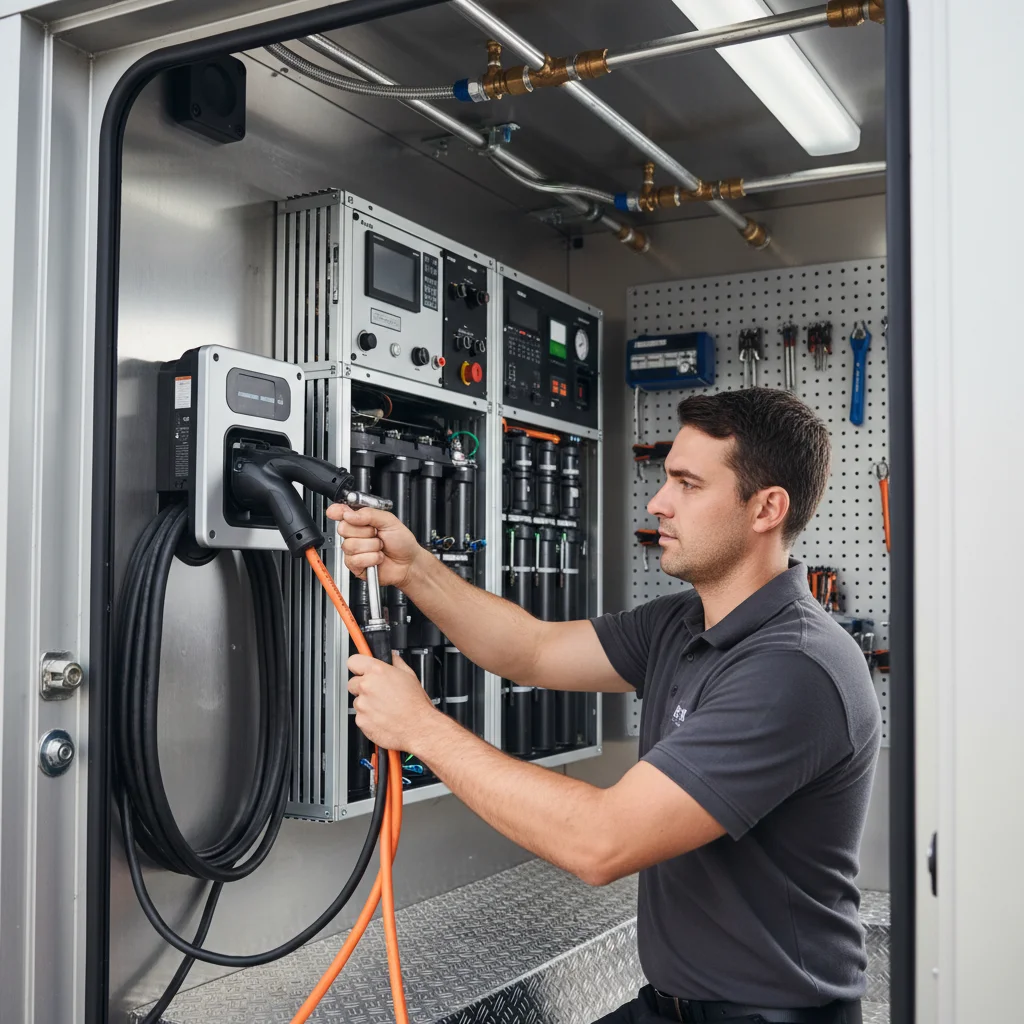
You don’t get a branded Charge Pro DC truck. You get a matched operator’s vehicle.
You share your location and your EV model. Model matters because the plug has to match. A Tesla wants NACS. A Hyundai, Kia, Ford, Rivian, or Chevy may need CCS. Older J1772 ports need that adapter.
The operator confirms they can take the job. They quote before they start. You accept or you don’t. Charge Pro DC doesn’t set that number. What you pay for mobile EV charging, and who bills you is the money walkthrough.
On scene, they check 12-volt versus traction pack. After a long sit in Tysons Corner Center, a silent car is often 12-volt. A car that drove to zero on I-95 needs the Level 2 cable. Office garages in Arlington and Merrifield show the same long-sit 12-volt pattern. So do Silver Line park-and-ride days in Reston.
If the pack is the issue, they connect 240-volt power. Charging runs about 15 to 30 minutes. The usual result is about 10 to 20 miles of range. That can get you off a freeway. It can get you to a wall plug you already have. It isn’t a full recharge.
They don’t hand you a private map of open stalls. Public station inventories weren’t pulled for this page. Don’t assume a named Supercharger is working. Check the car’s nav or a charging app before you roll. For the levels themselves, see EV charging levels that actually matter when you’re stranded.
Patrols and clubs don’t bring this truck
Drivers here still call the free patrols first. That’s rational. It’s also the wrong tool for an empty EV.
VDOT Safety Service Patrol covers Virginia interstates, including I-95 and I-66 in Northern Virginia. Drivers reach help through Virginia 511. Published material describes incident clearance, debris, and short-term traffic control. It doesn’t describe EV charging.
MDOT SHA CHART Emergency Traffic Patrol works the Baltimore/Washington metro. Technicians provide tire changes and jump starts. They also bring about one gallon of gas, plus radiator water. Dial #77 on state primary roadways. That includes I-495, I-270, US-50, and MD-295. CHART doesn’t publish EV charging as a service.
The District is thinner. No DDOT motorist-assistance patrol turned up in the sources checked for this page. DC drivers rely on MPD. They also use private roadside plans, and US Park Police on the parkways.
Disabled-vehicle rules in DC, Maryland, and Virginia apply to an EV like any car. None of the three codes reviewed for this page has a special out-of-charge section. You’re a disabled vehicle. You still need a 240-volt source.
Why this metro keeps calling for a truck that isn’t a tow
Housing stock is the quiet driver. Takoma Park’s housing is about 90 percent built before 1980. Annandale is about 80 percent. Wheaton is about 73 percent. Washington is about 70 percent. Older houses and dense apartments often mean no driveway Level 2. Arlington, Alexandria, Silver Spring, and Hyattsville show the same no-home-plug call pattern. That’s about the building. It isn’t a claim about a public stall we couldn’t verify.
Newer places look different. Ashburn’s pre-1980 share is about 3 percent. Gainesville is about 4 percent. Centreville is about 11 percent. Germantown is about 14 percent. Those streets more often have a wall box. The truck still gets called. The reason is usually a commute drain or a dead 12-volt.
Pepco EVsmart and Dominion’s EV rates don’t come to the shoulder. If the wall unit at home failed, the operator still brings 240 volts with them.
Weather does the rest. This metro sits on the fall line. Summers run hot and humid, with stretches above 90°F. Winters swing from mild to ice. Dulles runs colder and snowier than Reagan National. Loudoun, upper Montgomery, and Prince William take harder freezes. The District and the inner Virginia core stay milder. A Recurrent Auto study covered more than 30,000 EVs. A typical car keeps about 80 percent of range at 32°F. At 20°F it’s about 70 percent. Cabin heat comes from the pack. Cars with a heat pump averaged about 83 percent retained. Cars without averaged about 75 percent. Sitting still with heat on burns charge with no miles. That’s the Beltway crawl.
The region’s hard memory is January 3 and 4, 2022 on I-95 near Fredericksburg. About 14 inches of snow and a multi-truck crash shut a long stretch overnight. Hundreds of drivers sat more than 36 hours with the heat on. That event sits just south of the usual service map. A Level 2 top-up isn’t a snow-rescue plan. It’s a way to move once a lane is open.
A portable Level 1 brick isn’t this vehicle
Some owners keep a travel charger in the frunk. Most of those bricks are Level 1, 120-volt. They trickle. They’re not a live-shoulder tool. A mobile EV charger truck in this network is the 240-volt Level 2 job. Same family as a home charger.
Don’t expect DC fast charging from the operator vehicle. If you can still roll, a working public fast charger is a different play.
Tow versus charge, without invented fees
A tow moves the car. It doesn’t add range. Virginia private-property towing sits in Va. Code § 46.2-1231 and related sections. Localities may set fee limits by ordinance. Maryland counties set their own tow rules beside the Transportation Article. DC towing and impound sit under Title 50 and the DC Municipal Regulations. Confirm any current figure with the locality or the tower before you pay. Charge Pro DC doesn’t set tow prices. Charge Pro DC doesn’t perform tows.
If the car will take charge, stay for the 240-volt top-up. That’s about 10 to 20 miles. If the 12-volt is dead, a jump or on-site replacement may be enough. If the high-voltage pack itself has failed, charging won’t wake it. That’s a shop problem, not a roadside top-up.
Frequently asked questions
What does a mobile EV charger truck bring to the car?
A matched operator brings a 240-volt Level 2 source. Tesla cars get a native NACS plug. Other brands get a CCS or J1772 adapter. Typical charging time is 15 to 30 minutes. That often adds about 10 to 20 miles of range. Many operators can also jump or replace a 12-volt battery on site.
Does Charge Pro DC own the truck that shows up?
No. Charge Pro DC is a referral line. We match you with an independent local operator. That operator owns the vehicle and the chargers. They quote before work starts. They bill you directly. We don’t promise arrival time. We don’t publish hours.
Is this the same as a patrol, a tow, or a travel charger?
No. VDOT, CHART, and Express Assist don’t publish EV charging. A tow relocates the car. A travel charger is usually 120-volt Level 1. The operator vehicle is 240-volt Level 2 at the car.
If you’re already stopped, call (202) 629-0844. We’ll try to match you with a local operator. That operator quotes before anything starts. For the service itself, see mobile EV charging. I-495 drivers at zero can start with out of charge on the Capital Beltway.