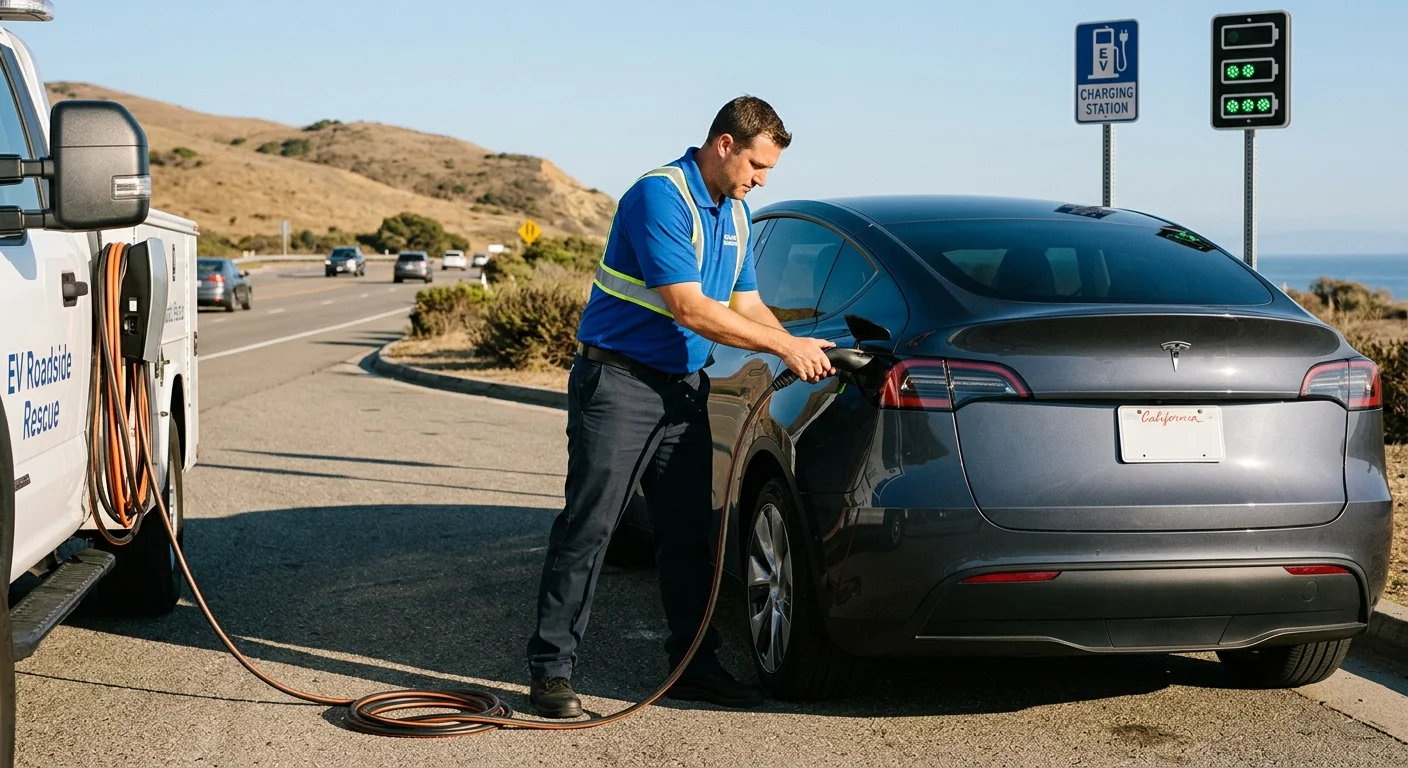
A Supercharger stall can push hundreds of kilowatts into a parked Tesla. The truck that meets you on I-495 doesn’t. A local operator brings a 240-volt Level 2 source to the car. That’s the charging level that actually matters when you’re already stopped.
Supercharger power stays at the stall
DC fast charging is the picture most drivers carry. Tesla Superchargers and other high-power cabinets sit on paved pads with heavy electric service. You drive to them. They don’t follow you onto a Beltway shoulder.
The Department of Energy’s Alternative Fuels Data Center lists DC fast gear. Some of that equipment can reach up to 500 kW. Some cars add about 100 to more than 200 miles in 30 minutes at a stall. Those numbers are equipment ceilings, not a promise to your pack. The car decides how much current it’ll take.
That stall power doesn’t ride in the rescue truck. Mobile EV charging in this metro is a 240-volt visit. Pepco serves the District, Montgomery County, and Prince George’s County. Dominion Energy Virginia covers most of Northern Virginia. NOVEC serves parts of Loudoun and Prince William. None of them send a truck to charge a stranded car.
The three levels, in the order you meet them
DC fast charging, the stall you hoped to reach
It’s high-voltage DC, not household AC. DOE’s connector list includes CCS, CHAdeMO, and J3400, Tesla’s NACS plug. If you’ve still got miles, a compatible stall is often the faster fill.
An empty pack on the Woodrow Wilson Bridge doesn’t get you there. That span carries the Beltway between Alexandria, Oxon Hill, and the District. A stall on the far bank doesn’t move the car. The American Legion Bridge between McLean and Montgomery County has the same limit. It’s a high, wind-exposed span with limited shoulder.
Level 2, the 240-volt source that comes to you
Level 2 uses 240 volts at a house, or 208 volts at many commercial sites. DOE puts the residential standard near 7.2 kW. The published range is about 2.9 to 19.2 kW. At that residential rate, DOE lists about 25 miles of range per charging hour. Plugs are J1772 on most non-Tesla EVs, and J3400 on Teslas.
A roadside operator isn’t installing a wall unit. The matched pro rolls up with a 240-volt Level 2 source. Native NACS for Tesla. A CCS or J1772 adapter for other brands. Charging time, never travel time, is typically 15 to 30 minutes. That session typically adds about 10 to 20 miles.
Home 240-volt charging and a roadside top-up share a voltage class. Home 240-volt charging vs a roadside top-up spells out the split.
Level 1, the 120-volt cord in the trunk
Level 1 is a common household outlet: 120-volt AC, SAE J1772, about 1.9 kW in the published spec. A travel charger doesn’t become a freeway tool just because it’s in the car. You still need a proper outlet and a legal place to sit. Check the owner’s manual first. What a Level 1 charger can do overnight is a home question, not a live-lane one.
Why packs run down before you reach a stall
Idling with heat or AC on burns charge without covering miles. That’s the Capital Beltway crawl, and the I-95 standstill through Prince William. Recurrent Auto’s winter study covered more than 30,000 EVs. A typical car keeps about 80 percent of range at 32F. It keeps about 70 percent at 20F. Dulles runs colder and snowier than Reagan National. Loudoun, upper Montgomery, and Prince William feel that more than the inner District.
The January 2022 I-95 shutdown is the local memory. Snow and a crash closed a long stretch near Fredericksburg, just south of this service area. Drivers sat with the heat on overnight. Range estimates from a moving commute don’t apply when the car isn’t moving.
The metro also rises from the tidal Potomac up the Piedmont. I-270 toward Frederick asks more of a low pack than a flat street in Northwest DC.
Where you’re sitting changes what Level 2 can do
A Model Y in the Tysons Corner Center garage is one scene. A Bolt on the 495 Express Lanes is another. Transurban operates those lanes with VDOT. On the 495 Express Lanes, pull to the left shoulder, because the lanes sit in the median. On the 95 and 395 Express Lanes, pull to the nearest shoulder. Transurban says stay in the car until help arrives. Express Assist handles minor mechanical issues and can call a tow. Published FAQs don’t describe charging an EV.
NPS parkways in this metro ban commercial vehicles and trucks over 10,000 lb. That includes the Baltimore-Washington Parkway, the George Washington Memorial Parkway, Clara Barton, Rock Creek, and Suitland Parkway. A disabled vehicle on the Baltimore-Washington Parkway is reported to the US Park Police.
Reagan National publishes complimentary EV charging on Level 1 of Parking Garages 1 and 2 for parking customers. Dulles publishes Level 2 charging in Garage 1 and Garage 2. The common call is a traveler who left a car in the Economy Lot for a week. That car often won’t wake. The 12-volt battery is the usual culprit, not an empty traction pack.
Census ACS 2019-2023 figures put Takoma Park at 90.0 percent pre-1980 housing. Ashburn sits at 3.1 percent. Older houses often never got a 240-volt circuit. Arlington, Alexandria, the District, Silver Spring, Wheaton, Hyattsville, and Annandale produce many calls from drivers with no plug at home. That’s a driveway problem. It isn’t a map of public stalls.
Connectors, adapters, and a dead 12-volt
Voltage class doesn’t prove the plug will fit. J1772 is the common AC inlet on many non-Tesla EVs. J3400, NACS, is Tesla’s native plug, and it now shows up on other new cars too. CCS adds DC pins. Tell the operator the make, the model, and what you see on the port.
A dark dash may not mean the traction pack is empty. The 12-volt battery runs computers, contactors, and door latches. Operators in this network jump or replace a dead 12-volt on site. They handle Tesla and every major EV brand. If the car won’t wake, say so. Charging levels don’t apply until the car will accept power.
Give the operator the displayed state of charge, the connector if you know it, and the exact spot. The operator quotes you before work starts and bills you directly. Charge Pro DC doesn’t set that price.
Patrols and codes won’t refill the pack
VDOT Safety Service Patrol covers Virginia interstates, including the I-66 corridor in Northern Virginia. Published material covers incident clearance. It doesn’t describe EV charging.
MDOT SHA CHART Emergency Traffic Patrol works the Baltimore/Washington area. Technicians change tires, jump-start 12-volt systems, and add about a gallon of gas. For a breakdown on Maryland primary roads, the published contact is #77. CHART’s pages don’t describe charging an empty EV pack.
No DDOT motorist-assistance patrol turned up for the District. DC drivers use MPD, private roadside plans, and Park Police on the parkways. Disabled-vehicle rules in DC, Maryland, and Virginia treat an empty EV like any other stopped car. None of the three codes reviewed adds a special out-of-charge section.
When 240 volts isn’t the next step
Mobile Level 2 fits when the traction pack is empty. The car also has to take the operator’s equipment, and the scene has to be reachable. Ask the operator what that truck can deliver to your model.
If the port won’t take the plug, or the car never starts charging, stop guessing. Out-of-charge recovery is the path when charging isn’t the right tool. Transport may be what’s left. EV tow methods are model-specific.
Charge Pro DC is a referral line. We match stranded drivers with independent local operators across the District, Maryland, and Virginia. We don’t own trucks, hold a trade license, or do the work. The pros we connect you with are licensed and insured. You contract with the operator, and you pay that operator. For the equipment itself, read what a mobile EV rescue vehicle actually brings.
What to do from the shoulder
Stay out of live lanes. On the 495 Express Lanes, that means the left shoulder. Tell the operator you need a 240-volt top-up. Ask for a 12-volt jump if the car won’t wake.
If you’re already at empty on the Beltway, start with out of charge on the Capital Beltway. For metro-wide charging context, use the DC-area EV charging hub.
When you want a local operator, call (202) 629-0844. We’ll connect you. The operator confirms equipment, compatibility, and the quote before anything starts.