Yes. Tesla says its United States roadside support is available 24/7. That means you can request help overnight, but it doesn’t promise a specific arrival time or guarantee access to every garage, parkway, or restricted road.
What Tesla publishes about after-hours help
Tesla’s North America roadside page says United States support is available 24/7. The listed roadside number is 877-798-3752. Tesla also directs owners to request assistance through the Tesla app.
That answers the main question. Tesla roadside assistance does run overnight in this metro, according to Tesla’s published information. However, 24/7 availability describes the support channel. It isn’t a universal promise about arrival time, service outcome, access, or financial coverage.
Tesla’s public roadside pages don’t publish one numeric arrival-time guarantee. They also say service on restricted roads and in restricted-access areas is decided case by case. That distinction matters around Arlington. A car in an open surface lot presents a different access problem than one behind a garage gate.
Tesla’s current public pages don’t establish one price for every roadside situation. They also don’t show that every tire problem, tow, depleted battery, or access issue will be handled without an owner charge. Confirm coverage and any cost before authorizing service.
For a broader look at eligible situations, read our guide to Tesla Roadside Rescue. You can also compare the official program with other options in our explanation of how Tesla roadside assistance works in the DC area.
If the vehicle is exposed to moving traffic or another immediate danger, contact emergency services first. Tesla’s own guidance places safety ahead of an app request.
Overnight Arlington: Pentagon, DCA, and I-66
An overnight Tesla problem in Arlington usually starts with location details. “Near the Pentagon” isn’t precise enough for someone trying to find a disabled car. Include the garage name, level, entrance, space, nearby sign, and gate instructions.
The same principle applies at Reagan National Airport. DCA provides EV charging on Level 1 of Parking Garages 1 and 2. Those garages connect directly to the terminal. Charging spaces are limited and available on a first-come basis.
If your Tesla is in a DCA garage, state which garage and level you’re using. Tell Tesla whether the vehicle can shift, unlock, or accept a charge. Mention clearance limits, ticket gates, and any need for parking staff to provide access. Don’t assume an outside vehicle can enter simply because the support request was accepted.
I-66 creates a different problem. VDOT’s Safety Service Patrol covers the Northern Virginia I-66 corridor. Its I-66 shoulder and express operation runs during weekday peak windows. That approved information doesn’t establish a universal overnight patrol response, so don’t treat it as one.
For an I-66 breakdown, use your exact direction and nearest exit. Identify whether you’re in a general lane, express lane, shoulder, or ramp. Share the map pin from your phone when possible. If your location is unsafe, contact emergency services before arranging roadside help.
Our Arlington EV roadside guide covers more local location details. Tesla support remains the first official option for many owners. A local operator can be considered if Tesla can’t complete the requested service.
Parkways and HOV rules that do not sleep
The DC area has several roads where roadside access isn’t straightforward. National Park Service parkways include the George Washington Memorial, Baltimore-Washington, Clara Barton, Rock Creek, and Suitland parkways. These limited-access scenic roads can have narrow or absent shoulders.
Commercial vehicles and trucks over 10,000 pounds are banned on those parkways. That rule can affect which roadside or towing vehicle may legally reach a stranded Tesla. A support agent may need to evaluate access before assigning help.
Don’t describe your location only as “on the parkway.” Give the parkway name, direction, nearest exit, mile marker if visible, and closest landmark. Say whether the car is fully outside the travel lane. These details help Tesla assess a restricted-road request.
Express lanes require similar precision. The 495, 95, and 395 Express Lanes are operated by Transurban with VDOT. They use dynamic tolling with E-ZPass. Vehicles meeting the HOV-3 requirement can ride free when an E-ZPass Flex is correctly set.
On the 495 Express Lanes, Transurban directs disabled drivers toward the left shoulder because the lanes sit in the median. On the 95 and 395 Express Lanes, drivers should use the nearest shoulder. Transurban also tells drivers to remain in the vehicle until help arrives.
Express Assist provides roadside patrol on those lanes. It can address minor mechanical issues and call a tow, but it doesn’t perform the tow itself. If Tesla support is also involved, tell both parties your exact lane system and shoulder location. That reduces confusion about which roadway controls access.
How to confirm hours in the Tesla app
Tesla publishes 24/7 United States roadside availability, but you should still confirm the current options shown for your vehicle. Policies, issue choices, and case details can differ. The app is where Tesla asks owners to begin a roadside request.
From the bottom of the app home screen, select Roadside. Choose the vehicle issue, confirm the details, and request help. Tesla says the request should contain information that helps locate you and describe the vehicle’s condition.
Before submitting, gather these details:
- Your exact map location and direction of travel
- The garage, level, entrance, or nearest roadway exit
- Whether the Tesla unlocks, shifts, or powers on
- Whether a charging cable is connected
- Any height limit, gate, security desk, or access restriction
- Whether the car sits near moving traffic
The available app choices are more reliable than guessing which service applies. A flat tire may require different equipment than a depleted high-voltage battery. A Tesla that won’t unlock may involve the low-voltage system instead. Don’t select an issue merely because it seems likely. Describe what the car actually does.
Ask Tesla to confirm the proposed service, destination, coverage, and any owner-paid amount. The approved information available for this page doesn’t establish one universal roadside fee or free-service rule. Tesla’s public pages also don’t promise one arrival window.
If you need the official contact route outside the app, see our guide to the Tesla roadside assistance phone number in the DC area. It explains when the app and published roadside line are useful.
A local operator as backup, not a time promise
Tesla’s program isn’t the only path when you’re stranded. A local EV rescue operator may be useful when Tesla declines the request, can’t access the location, or proposes a service that doesn’t fit the vehicle’s condition.
Charge Pro DC is a referral service. We connect drivers with licensed, insured, independent local operators. We don’t perform the roadside work, employ technicians, own rescue vehicles, set prices, or promise arrival times. The driver contracts with and pays the matched operator directly.
Start by identifying the actual problem. A depleted high-voltage battery may call for mobile charging or a tow. A failed low-voltage battery can prevent doors, screens, and drive controls from working even when the main battery has energy. Tire damage and restricted-garage access create different equipment needs.
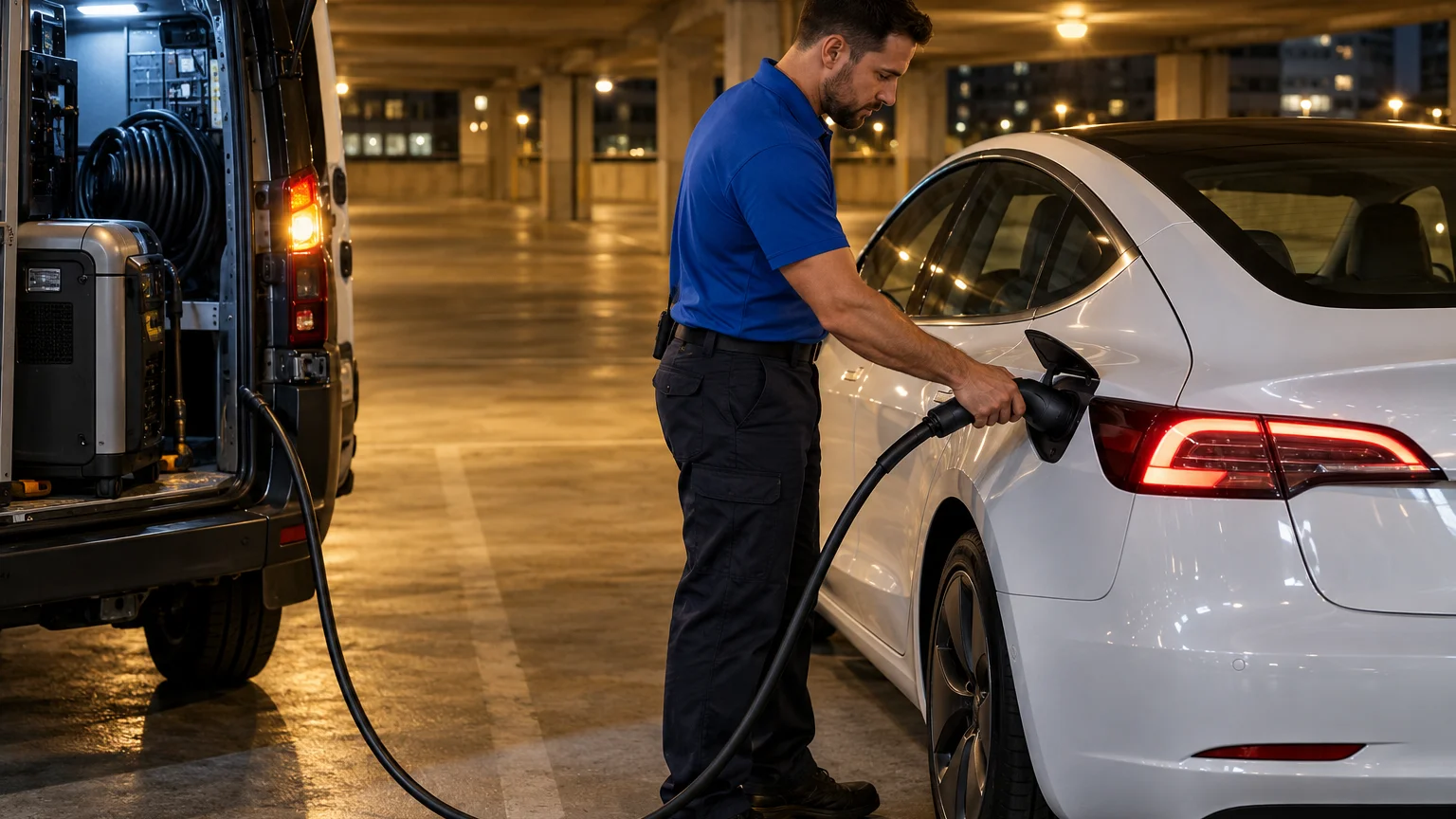
For a mobile charging request, the matched operator determines whether charging can be performed at that location. A typical rescue charge can add 10 to 20 miles of range during 15 to 30 minutes of Level 2 charging. Those figures describe charging time after equipment is connected. They aren’t an arrival estimate.
AC Level 2 equipment ranges from 2.9 kW to 19.2 kW. Actual charging depends on the vehicle, battery state, battery capacity, onboard charger, equipment output, and available electrical service. A short charge may be enough to reach a suitable station, but the operator must assess that on site.
Our emergency EV roadside assistance page explains the referral option. When speaking with an operator, confirm the service, access plan, price, and payment terms before authorizing work.
When to call us
Call when Tesla can’t complete the request and you need a mobile EV rescue operator around the DC area. We don’t promise an arrival time, but we can connect you with an independent local professional who will assess the vehicle and quote the work directly.
Call us at (202) 629-0844 and we’ll connect you with a local EV rescue operator.