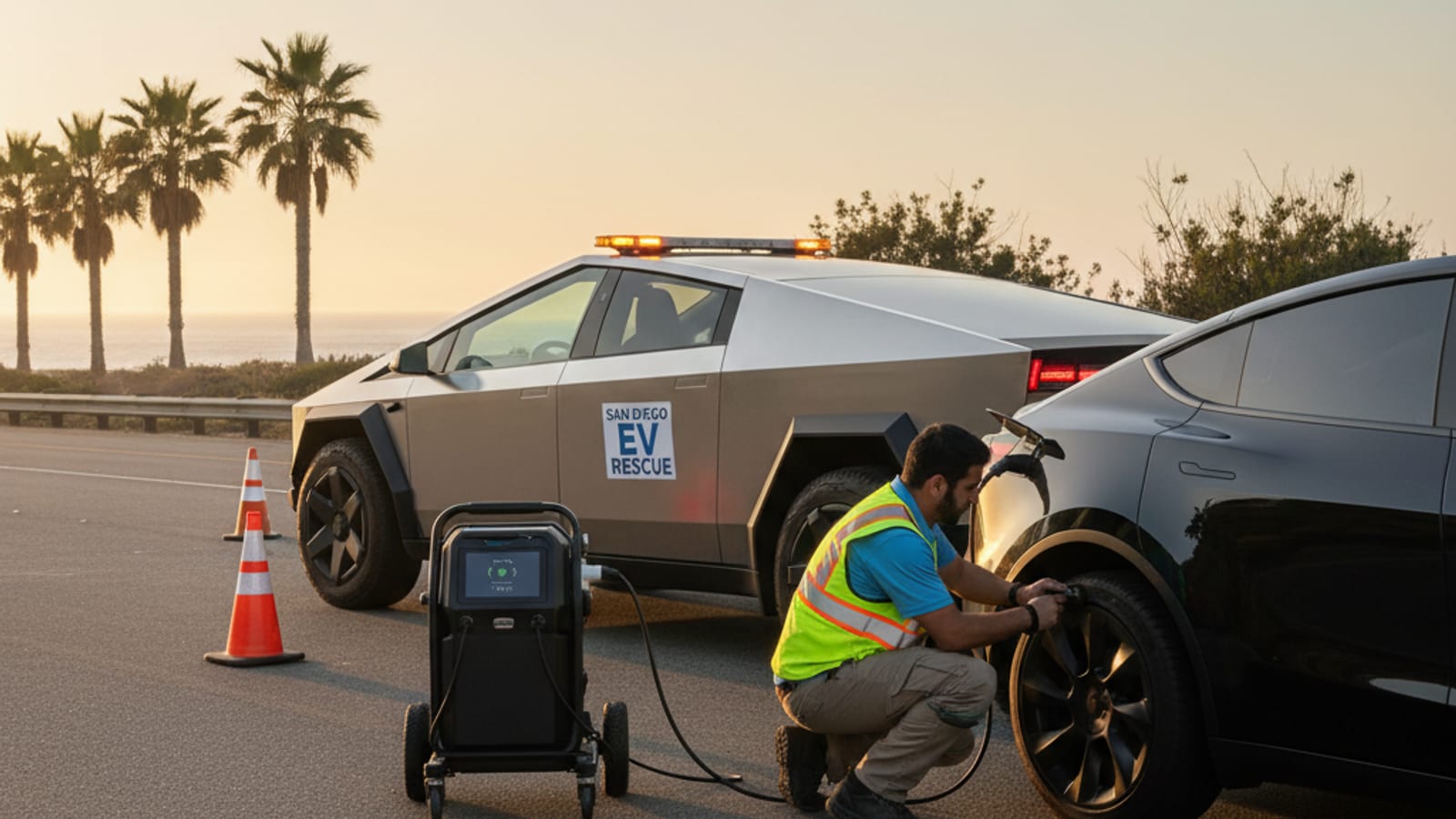
A mobile EV charger for roadside use is a 240-volt Level 2 source brought to your stranded EV. It’s not a Supercharger. It’s not a public DC stall. Operators here plug in NACS, CCS, or J1772 where the car already sits. They add about 10 to 20 miles of range. That takes 15 to 30 minutes of charging. That’s cable time, not a clock on when someone appears.
The search that mixes two different machines
People type “mobile ev charger for roadside use” after the car has already stopped. Some mean a suitcase unit from a store. Some mean a public fast stall they can drive to. Some mean a truck that comes to the bumper. Those are three different machines. Only one of them can charge you where you already are.
A public DC stall is a fixed cabinet. You drive the car to it. A Supercharger is Tesla’s version of that cabinet. A home wall unit is a 240-volt plug on a building you control. A roadside mobile charger is none of those. It’s a Level 2 source on an operator’s vehicle.
Charge Pro DC is a referral line. We match stranded drivers with independent local operators. We don’t own the trucks. We don’t employ the technicians. We don’t set prices. We don’t promise an arrival window. The operator quotes you before any cable goes in. The operator bills you directly.
What the operator actually brings
The useful version of a mobile EV charger for roadside use is a 240-volt Level 2 outlet on the operator’s vehicle. That’s the same voltage class as a dryer circuit. It isn’t the high-voltage DC used at a public fast stall. Native NACS handles Tesla. A CCS or J1772 path handles almost every other EV on the road here.
That plug set is the whole point. Tesla, Ford, GM, Hyundai, Kia, Rivian, BMW, and Mercedes don’t share one inlet. The operator who shows up has to match your port. You shouldn’t hope you packed the right cable. You can read what that truck actually carries in what a mobile EV rescue vehicle brings.
A Level 2 visit is a top-up, not a fill. Typical charging time is 15 to 30 minutes. Typical added range is about 10 to 20 miles. The goal is enough miles to leave the shoulder. Then you reach a place you already planned to plug in: home, work, or a public stall you can occupy.
If you want the service itself, that’s mobile EV charging. If the pack is empty and you need the car to roll, that’s out-of-charge recovery.
What a roadside mobile charger is not
It isn’t DC fast charging. A public CCS cabinet or a Supercharger can add range much faster than a 240-volt visit. The roadside unit isn’t that cabinet on wheels. Don’t wait for a stall-speed session on the shoulder. You won’t get it.
It isn’t the free patrol. VDOT’s Safety Service Patrol works Virginia interstates, including the I-66 corridor in Northern Virginia. Drivers reach that help through Virginia 511. Published VDOT material covers incident clearance, debris, and short-term traffic control. It doesn’t describe EV charging.
Maryland’s CHART Emergency Traffic Patrol covers state primary roadways such as I-495, I-270, US-50, and MD-295. Dial #77 from those roads. CHART techs change tires. They jump-start 12-volt batteries. They add about a gallon of gas. They top radiator water. That list doesn’t include charging an EV pack.
The District has no DDOT motorist-assistance patrol that we could confirm. DC drivers use MPD, a private roadside plan, or US Park Police on the parkways.
Express Assist on the 495, 95, and 395 Express Lanes is a free Transurban patrol. It helps with minor mechanical issues. It will call a tow. It doesn’t tow. Published FAQs don’t describe EV charging.
Pepco, Dominion Energy Virginia, and NOVEC all run home and workplace EV programs. Pepco EVsmart sits in the District, Montgomery County, and Prince George’s County. Dominion publishes Schedule 1EV, an Off-Peak Plan, and EV Charger Rewards in most of Northern Virginia. NOVEC covers parts of Loudoun and Prince William, including much of Sterling, Ashburn, and Gainesville. None of the utility pages we reviewed offer a visit that charges a stranded car. A rebate on a wall unit doesn’t roll to the Beltway.
It isn’t a tow. A flatbed moves the car. A Level 2 visit leaves the car where it sits and puts miles back into the pack. Those are different jobs. Pick the one that matches the failure.
Two ways an EV dies, and only one needs a charger
An empty traction pack and a dead 12-volt battery look similar from the driver’s seat. Both leave you in a quiet car that won’t go. They’re not the same job.
The traction pack moves the car. When it’s truly at zero, you need energy into the charge port. That’s the mobile EV charger for roadside use. The 12-volt battery runs computers, contactors, and door latches. When it fails, the big pack can still be full. A jump or an on-site 12-volt replacement wakes the car. Charging the port doesn’t.
Airport parking is the classic 12-volt pattern in this metro. Reagan National lists complimentary EV charging on Level 1 of Parking Garages 1 and 2. Those spaces are first come, first served. Dulles lists Level 2 charging in Garage 1 and Garage 2. Travelers who leave a car in long-term parking for a week often return to a car that won’t wake. That’s usually the 12-volt, not a drained pack. WMATA park-and-ride garages show the same week-long sit. So does the Union Station garage in the District.
If the dash is dark and the charge port won’t unlock, start with the 12-volt. If the car is awake and the range reads zero, you need a Level 2 top-up, not a jump.
How a quoted visit actually runs
You call. You give a location that a person can find. Use a Beltway mile marker, a garage level, a park-and-ride name, or a District street with its quadrant. Addresses in the District repeat across NE, NW, SE, and SW. Skip the quadrant and the operator is hunting the wrong corner of town. You also give the make and the inlet. Tesla is NACS. Most other current EVs are CCS. Older Level 2 inlets are J1772.
We connect you with a local operator. That operator quotes the job before the cable goes in. If you don’t like the quote, you don’t start. If you do, the operator bills you. Charge Pro DC doesn’t take that payment.
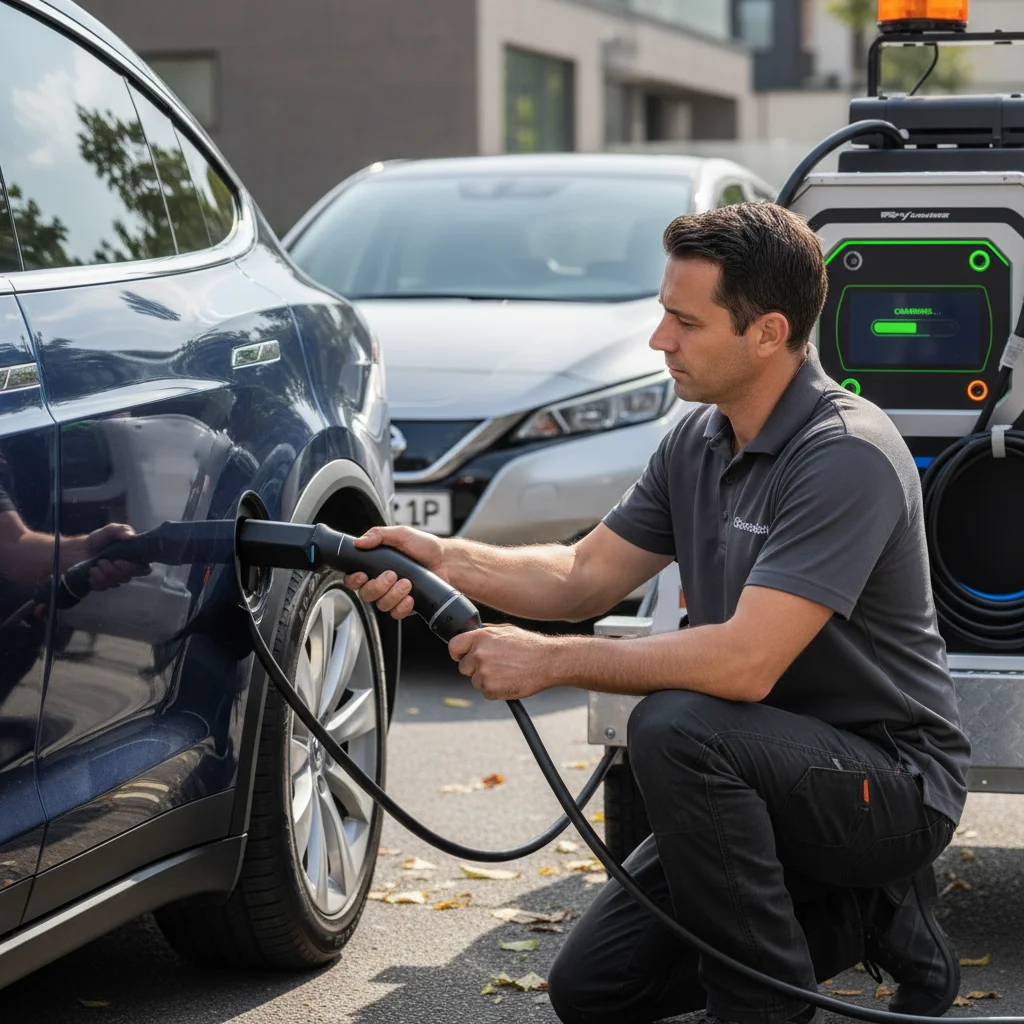
The operator stages the vehicle as a buffer, then plugs in. Charging runs 15 to 30 minutes for a typical 10 to 20 miles. You drive off under your own power. That sequence is the whole product. The longer walkthrough lives in what’s an EV charging truck, and who actually owns it.
We don’t publish business hours. We don’t publish an arrival clock. A referral line that promises those is inventing them.
Where cars actually sit in this metro
The Capital Beltway (I-495) general lanes are free. The 495 Express Lanes sit in the median, and they’re not. If you go empty in those Express Lanes, published Transurban guidance is to pull to the left shoulder. On the 95 and 395 Express Lanes, pull to the nearest shoulder. Stay in the car until help is with you.
I-270 and I-66 are the other long sits. I-270 between Rockville and Germantown burns range in traffic, not in miles. I-66 is tolled dynamically inside the Beltway at peak hours. Outside the Beltway, the I-66 Express Lanes add another priced path. The Dulles Toll Road (VA-267) is MWAA. The Dulles Greenway is a separate private road west of the airport. None of that changes the physics. Idling with climate control on spends charge while the odometer stays put.
The Woodrow Wilson Bridge carries the Beltway across the Potomac between Alexandria, Oxon Hill, and the District. A stall there sits at three jurisdictions at once. The American Legion Bridge does the same between McLean and Montgomery County. Both spans are high and wind-exposed. Shoulders are limited. Get out of the travel lane. Stay with the car if you can do it safely.
National Park Service parkways are their own problem. The Baltimore-Washington Parkway, the George Washington Memorial Parkway, the Clara Barton Parkway, Rock Creek, and Suitland Parkway ban commercial vehicles and trucks over 10,000 lb. Shoulders are narrow or missing. A disabled vehicle on the Baltimore-Washington Parkway is reported to US Park Police at 202-610-7500. Save that number before you need it. The disabled-vehicle rules in DC, Maryland, and Virginia treat an empty EV like any other stopped car. None of the three codes we reviewed writes a special rule for running out of electric charge.
Name the place with care when you call. Bethesda, Silver Spring, Tysons, Reston, McLean, and Springfield aren’t incorporated cities. Alexandria, Fairfax, Falls Church, Manassas, and Manassas Park are independent cities. Fairfax County and the City of Fairfax are separate jurisdictions. Say which one. National Harbor is a development in Oxon Hill, not a town.
Apartment and condo drivers show up in this call pattern for a different reason. Pre-1980 housing is a rough proxy for a house that never got a 240-volt circuit. Takoma Park, Annandale, Wheaton, and much of Washington sit on that older stock. Arlington, Alexandria, the District, Silver Spring, Wheaton, Hyattsville, and Annandale also concentrate apartments. Those drivers often charge at work or at a public stall. When the day runs long, the car is already low before the last mile home.
Maryland DOT has reported more than 60,000 registered electric vehicles in the state. Treat that as a reported milestone, not a live count. Virginia and the District publish their own figures. We didn’t pull those tables for this page. The practical point is simpler. Plenty of EVs now sit in the same traffic as everyone else.
If you’re already on the Beltway at zero, read out of charge on the Capital Beltway next. Levels themselves, and which one matters when you can’t move, are in EV charging levels that actually matter when you’re stranded.
Weather, heat, and sitting still
This metro sits on the fall line. Summers run hot and humid, with stretches above 90F. Winters swing from mild to ice. Dulles runs colder and snowier than Reagan National. Loudoun, upper Montgomery, and Prince William feel that difference. The District and the inner Virginia core often don’t.
Cold cuts range because the cabin heat comes from the pack. Recurrent Auto’s winter study of more than 30,000 EVs found a typical car keeps about 80 percent of range at 32F. At 20F it’s about 70 percent. Cars with a heat pump averaged about 83 percent retained. Cars without averaged about 75 percent. Don’t treat those as Tesla numbers. They’re fleet averages from that study.
Heat is the other tax. The battery management system spends energy cooling the pack. Climate control spends more. A Rockville to Germantown crawl on I-270 in July can drain a buffer you thought you had. So can a standstill on I-95 through Woodbridge and Dale City.
The region’s hard reference for sitting with the heat on is January 3 and 4, 2022. About 14 inches of snow and a multi-truck crash shut roughly 50 miles of I-95 in the Fredericksburg area, just south of this metro. The road closed about 5:30 p.m. on January 3. It reopened about 7:40 p.m. on January 4. Hundreds of drivers sat overnight for more than 36 hours. An EV in that situation spends pack energy on cabin heat with nowhere to roll. A mobile Level 2 visit helps when you can be reached. It doesn’t invent a lane through a closed interstate.
Land here isn’t mountain country. It isn’t flat either. The ground rises from the tidal Potomac in the District up the Piedmont. I-270 climbs toward Frederick. Loudoun and Prince William rise toward the Bull Run Mountains. Regenerative braking gives some of that energy back on the way down. It doesn’t give it back in a standstill.
The suitcase charger in your trunk is a different product
A personal portable charger is a cable you own. Level 1 plugs into a 120-volt household outlet. It adds a few miles per hour. That’s a guest-house overnight trickle. It isn’t a shoulder rescue. You still need a live wall outlet. You still need hours.
A personal Level 2 unit needs a 240-volt receptacle, the kind on a dryer or an RV pedestal. If you’re already in a driveway that has one, you may not need an operator. On I-66, in a Tysons garage aisle, or on a parkway shoulder, that receptacle isn’t there. A portable Level 2 without a socket is just a bag of copper.
Safety is the other limit. You’re on a live roadway. NHTSA’s general roadside guidance still applies. Make the car visible. Stay out of the travel lane. Don’t stand between vehicles. A trained operator stages a work vehicle as a buffer. A driver kneeling on the shoulder with a suitcase charger doesn’t.
So buy a portable unit if you visit friends with a dryer outlet. Don’t treat it as a mobile EV charger for roadside use. That phrase, in practice, means the operator’s 240-volt source. It doesn’t mean the kit in your trunk.
Charge on the spot, or tow the car
Towing an EV is a real job when the car can’t take a charge. It’s also the job when the inlet is damaged, or you’re on a parkway that can’t host the work. Virginia private-property towing sits under Va. Code § 46.2-1231 and related sections. Maryland puts disabled-vehicle rules in Transportation Article Title 21. DC towing and impound sit under Title 50 and the DC Municipal Regulations. The DC DPW impound lots are Blue Plains at 5001 Shepherd Parkway SW, and a second lot at 2115 Bryant St NE, at (202) 541-6083.
None of that’s a charging service. A tow takes the car somewhere else. Storage and hookup rules are a separate conversation with the tower. We’re not that tower.
When the pack is empty and the car can accept Level 2, staying put is usually the cleaner path. No flatbed. No winch. No second trip from a shop to a stall. Compare the two jobs in mobile EV charging vs a tow.
Don’t assume a patrol will choose for you. CHART and VDOT can stabilize the scene. Express Assist can call a tow. The Level 2 visit is a separate call.
Older houses, apartments, and the last-mile drain
Home charging is the quiet default for people with a garage circuit. Dominion’s time-of-use options and Pepco’s EVsmart gear assume you plug in on your own property. A lot of this metro doesn’t live that way.
Takoma Park’s housing stock is about 90 percent pre-1980. Annandale is about 80 percent. Wheaton is about 73 percent. Washington is about 70 percent. Those figures come from Census ACS 2019-2023. They’re not a charger map. They’re a reason many driveways never got a 240-volt drop.
On the other end, Ashburn, Gainesville, Centreville, and Germantown skew new. A wall unit is common there. Those drivers still stall. The I-270 and Dulles Toll Road commutes will empty a pack that left home full. So will a long sit on the Beltway. So will a cold morning in Loudoun.
The City of Manassas runs its own municipal electric utility. BGE touches parts of the Maryland ring around Laurel. SMECO serves the southern edge toward Clinton. Confirm the serving utility by address before you chase a home-charger program. None of them will charge the car on the shoulder.
What to do in the first minutes
Put the car in a livable, legal spot if you can still roll. On the 495 Express Lanes, that means the left shoulder. On the 95 and 395 Express Lanes, the nearest shoulder. On a parkway, take the first safe pull-off. Call US Park Police if you’re on the Baltimore-Washington Parkway.
Hazard lights on. Stay in the vehicle if traffic is fast and the shoulder is thin. Don’t cross live lanes for a cabinet you can’t actually reach on the remaining miles.
Decide which failure you have. Dark car, no unlock, no screens: 12-volt. Awake car, zero miles, charge port ready: empty pack. Mixed symptoms: tell the operator both.
Then call for the job you need. A jump isn’t a charge. A charge isn’t a tow. A patrol isn’t a Level 2 source.
Compatibility without the marketing fog
Tesla takes NACS. Most other brands in this metro take CCS on DC and J1772 on AC. A roadside Level 2 visit is AC. The operator’s NACS cable feeds a Tesla. The CCS or J1772 path feeds the rest. That’s how one visit covers Tesla and every major EV brand. It doesn’t pretend the inlets are the same.
Rivian, Lucid, Ford, Chevy, Hyundai, Kia, BMW, Mercedes, Audi, Volkswagen, and Nissan still need the matching plug. So do the luxury EVs that sit in McLean and Potomac driveways. Ask for that plug in the first minute of the call. Don’t find out at the bumper.
Frequently asked questions
What is a mobile EV charger for roadside use?
It’s a 240-volt Level 2 source on an operator’s vehicle, brought to your car. It isn’t a public DC fast stall. It isn’t a Supercharger. In this metro the operator uses NACS, CCS, or J1772. You get about 10 to 20 miles in 15 to 30 minutes of charging.
Can a personal portable charger replace that visit?
Only if you’re already next to a live outlet that matches the unit. Level 1 needs 120 volts and hours. Level 2 needs 240 volts. A shoulder, a parkway, and most garage aisles don’t have that outlet. The roadside product is the operator’s power, not a cable in your trunk.
Does a highway patrol or my utility bring one?
No. VDOT, CHART, Express Assist, Pepco, Dominion, and NOVEC don’t publish a stranded-EV charging visit. Patrols clear scenes, jump 12-volt batteries, or call a tow. Utilities sell home rates and wall-unit programs. The Level 2 rescue is a separate operator, quoted before the work starts.
If the car is empty on a DC-area road, call (202) 629-0844. We’ll connect you with a local operator who quotes the job and bills you directly.