A stranded Tesla near Springfield creates one immediate concern: when will roadside help arrive? Tesla doesn’t publish a guaranteed arrival time for the DC area, so there isn’t one verified number that answers every request.
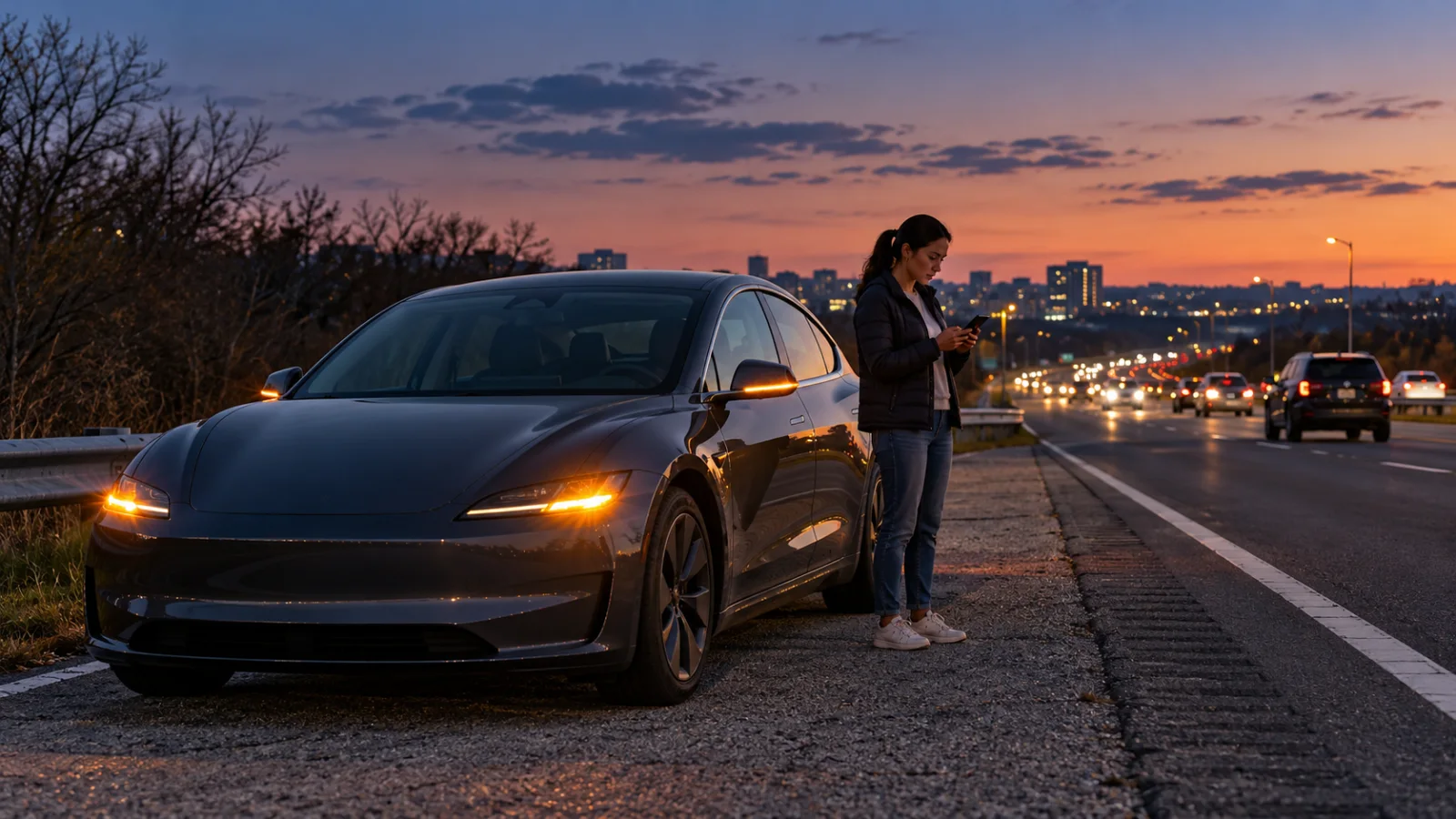
Tesla does not publish a guaranteed DC-area ETA
The direct answer is that Tesla publishes no universal roadside arrival time. Its public roadside pages explain how to request service and say assistance is available around the clock. They don’t promise a specific wait for Springfield or anywhere else in the DC area.
That distinction matters when you’re searching “how long does Tesla roadside assistance take.” Availability means you can submit a request. It doesn’t establish when a roadside provider will reach your vehicle.
Tesla says drivers can start a request at the bottom of the app’s home screen. Select Roadside, choose the vehicle issue, confirm the details, and request help. Include information that identifies your location and describes the vehicle’s condition.
The final timing can depend on the location and the help required. A Tesla with an empty main battery presents a different need than a flat tire or low-voltage problem. Restricted roads and restricted-access areas are handled case by case, according to Tesla.
That means a discussion thread, another driver’s experience, or an old receipt can’t establish your wait. It describes one incident under different road and provider conditions.
Our guide to how Tesla roadside assistance works in the DC area explains the request process in more detail. You can also review Tesla roadside coverage limits before deciding whether its available service fits your situation.
Charge Pro DC doesn’t set Tesla’s estimate or promise an arrival time. We connect drivers with licensed, independent local operators when they want another option.
Why Springfield, I-95, and the Mixing Bowl slow a truck
Springfield sits beside the Mixing Bowl and several heavily used highway approaches. A roadside vehicle may need to reach the correct ramp, carriageway, lane, or shoulder. Being geographically close doesn’t mean it has a direct path to you.
An app pin can also hide an important detail. “Near Springfield” might mean a local parking lot, a general-purpose lane, an Express Lane, or a ramp between major roads. A provider approaching from the opposite side may need a different route.
The 95 and 395 Express Lanes introduce their own access details. Those lanes are operated by Transurban with VDOT. They use dynamic tolling with E-ZPass. An E-ZPass Flex set for HOV-3 permits qualifying vehicles to ride free, but that rule doesn’t create open access for every roadside vehicle.
Shoulder instructions also change by road. On the 495 Express Lanes, Transurban directs disabled drivers to the left shoulder because the lanes are in the median. On the 95 and 395 Express Lanes, drivers should use the nearest shoulder. Transurban says to remain in the vehicle until help arrives.
Other DC-area roads create different constraints. National Park Service parkways can have narrow shoulders or no shoulder. Commercial vehicles and trucks over 10,000 pounds are banned on listed NPS parkways. A roadside request involving one of those roads may require case-specific handling.
These details explain why no honest local article can turn distance into an arrival promise. Our Springfield EV roadside guide covers the local setting without assigning a made-up wait time.
When submitting a request, name the road, travel direction, nearby exit, lane type, and shoulder side. Those details help the responding operator understand where the Tesla is located.
What the in-app estimate is, and is not
If the Tesla app displays an estimate after your request, it applies to that request. It isn’t a standing DC-area promise from Tesla, and it isn’t an estimate from Charge Pro DC.
Tesla’s public roadside pages reviewed for this topic don’t explain a universal formula for calculating arrival times. They also don’t publish a guaranteed maximum wait. Because those details couldn’t be confirmed, you shouldn’t treat one displayed estimate as a rule for future incidents.
Use the app to follow the active request and provide accurate information. Tesla instructs drivers to select the issue, confirm the request details, and include information that helps locate the vehicle. If your location or safety conditions change, keep the request information current through the available Tesla support channel.
The estimate also shouldn’t be confused with charging time. A mobile Level 2 rescue charge can add about 10 to 20 miles of range during 15 to 30 minutes of charging. That figure describes charging after suitable equipment reaches the vehicle. It says nothing about travel or arrival time.
The type of fault matters too. An empty high-voltage battery may call for out-of-charge EV recovery. A Tesla that has charge but won’t wake may have a separate low-voltage issue. A damaged vehicle or unsafe roadside position may need another response entirely.
Don’t cancel a confirmed request solely because another driver’s online account reports a shorter wait. Compare the options available for your current location, problem, access conditions, and vehicle state.
What you can do while you wait
Start by checking whether the vehicle is in a safe location. Tesla says an unsafe location calls for emergency services. Don’t remain focused on an app if traffic, fire, smoke, collision damage, or another immediate danger changes the situation.
For an active roadside request, verify the facts a provider needs:
- Road name and travel direction
- Nearest exit, ramp, or visible landmark
- General-purpose lane or Express Lane
- Left shoulder, right shoulder, parking level, or lot section
- Tesla model and visible warning message
- Whether the car is out of charge, won’t wake, or has physical damage
- Whether the vehicle can shift into a transport mode specified by Tesla
Describe only what you can observe. “The screen is dark” is more useful than guessing that the main battery failed. A Tesla can be immobilized by different problems, and the required equipment may differ.
Preserve your phone battery and keep notifications available. If you’re in a garage, confirm the level, entrance, clearance, and stall area. If you’re on a ramp, don’t replace a precise travel direction with a broad label such as “the Mixing Bowl.”
Follow the road operator’s instructions where they exist. On the 495 Express Lanes, the disabled-vehicle shoulder is on the left. On the 95 and 395 Express Lanes, use the nearest shoulder and remain in the car until help arrives. Express Assist can address minor mechanical issues and call a tow, but it doesn’t perform the tow.
If the problem is simply an empty traction battery, a mobile operator may determine whether a rescue charge is suitable. Our Tesla roadside rescue service connects drivers with licensed, independent local operators. The operator evaluates the vehicle, quotes the work, and bills the driver directly.
A quoted local operator if Tesla cannot commit
Tesla roadside may remain your first request. If it can’t provide a firm option for your location, you can also ask an independent local operator for a quote. That creates another path without assuming the operator will arrive sooner.
When requesting a quote, give the same location and vehicle details provided to Tesla. Ask what service the operator proposes, what it costs, and whether the proposed equipment fits the problem. The operator, not Charge Pro DC, sets the price and service terms.
Be clear about the outcome you need. A small roadside charge may provide enough range to reach a suitable charger. It isn’t a full recharge. The approved rescue benchmark is about 10 to 20 miles of range during 15 to 30 minutes of Level 2 charging, once charging begins. Battery state, vehicle limits, equipment output, and other conditions affect charging.
A quote also isn’t an arrival guarantee. Springfield traffic, ramp access, Express Lane positioning, parking restrictions, and the vehicle’s condition can still affect the response. Ask the operator directly about current availability before authorizing work.
Avoid booking two providers without understanding each cancellation policy. Charge Pro DC doesn’t set those policies, Tesla’s terms, or an independent operator’s terms. Confirm them with the party handling each request.
The useful comparison isn’t a guessed citywide average. It’s the actual option offered for your vehicle at that moment. Compare scope, quoted cost, access plan, and the proposed next step. If mobile charging isn’t suitable, the operator may explain that the vehicle needs transport instead.
When to call us
Call when a stranded Tesla needs a mobile EV rescue assessment and Tesla can’t commit to a workable option. We can connect you with a licensed, independent local operator, but we don’t promise an arrival time or set the operator’s price.
Call us at (202) 629-0844 and we’ll connect you with a local EV rescue operator.