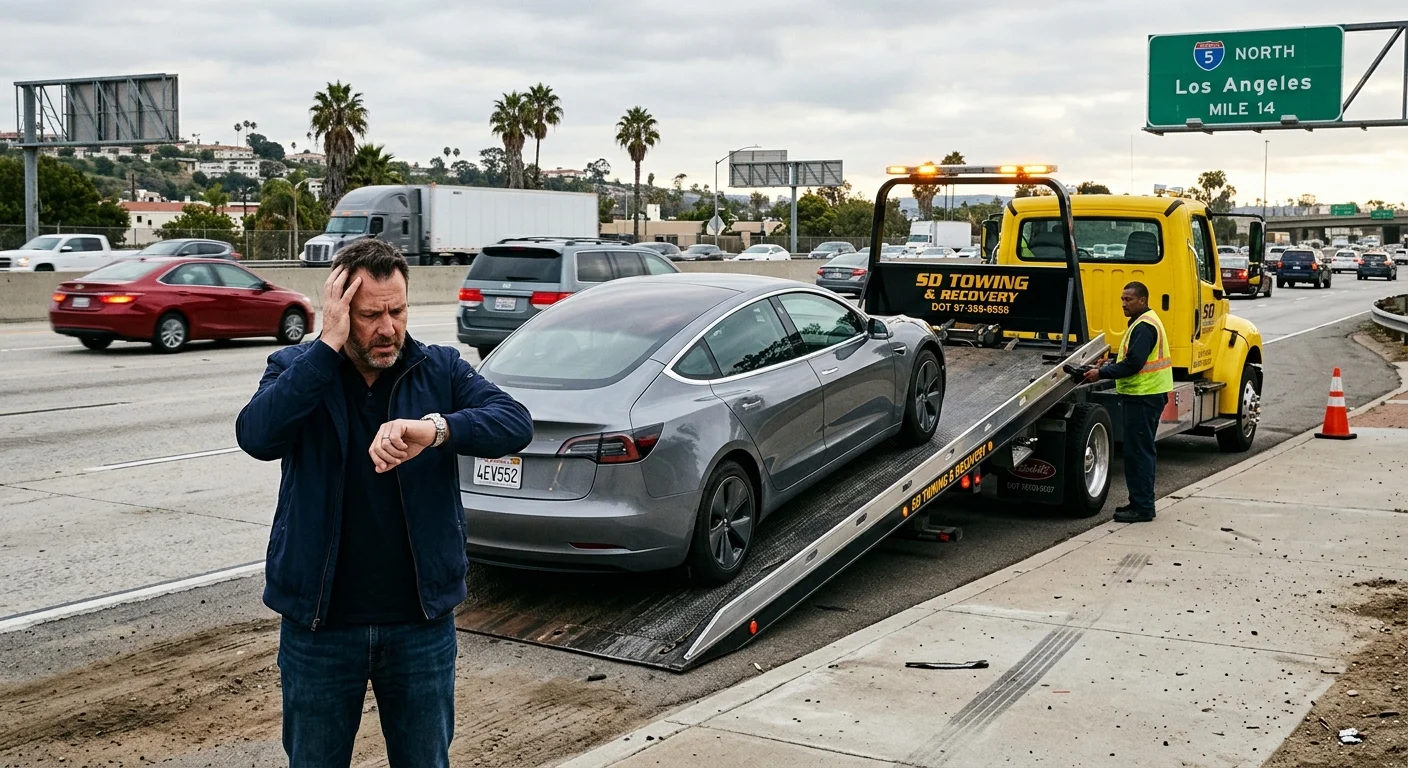
An empty traction pack doesn’t get a special tow rate here. Virginia, Maryland and the District treat a stalled EV as a disabled vehicle. That’s the same class as any other car that won’t roll. The cost to tow an EV still climbs after the hook. Storage, a second trip, and hours on the shoulder all stack.
The codes don’t single out an empty EV
The three codes reviewed here don’t write a special rule for an empty pack. Virginia private-property towing sits in Va. Code § 46.2-1231, with § 46.2-1233 and § 46.2-1233.1 beside it. Localities may set fee limits by ordinance under those sections. Maryland puts stopping and disabled-vehicle rules in Transportation Article Title 21. Private-property towing and county ordinances sit with 21-10A. Montgomery County and Prince George’s County write their own. The District handles tows and impounds under Title 50 and the DC Municipal Regulations.
An empty EV doesn’t get a cheaper hook under those rules. Confirm the current rate with the yard before you pay. Virginia publishes a statewide cap on the first passenger-car hook and tow. Night, weekend and holiday add-ons are allowed, two at most. The statute also bars storage for the first 24 hours on those private-property tows. Northern Virginia localities in Planning Districts 8 and 16 set a hookup-and-tow floor by ordinance. The exact Northern Virginia ordinance numbers weren’t re-pulled for this page. Maryland county amounts weren’t confirmed in the sources reviewed. Ask the county or the yard, and don’t guess from a neighbor’s last bill.
Who rolls up depends on the road
A stall on I-66 in Virginia isn’t a stall on Suitland Parkway. VDOT’s Safety Service Patrol covers Virginia interstates, including I-95 and I-66 in Northern Virginia. Drivers reach that help through Virginia 511, not a charging dispatch. Published VDOT pages describe incident clearance, debris and short-term traffic control, not EV charging.
Maryland’s CHART Emergency Traffic Patrol works the Baltimore/Washington metro on state primary roadways. That list includes I-495, I-270, US-50 and MD-295. CHART crews change tires and jump-start 12-volt batteries. Dial #77 from a breakdown on those state roads. CHART doesn’t publish an EV charge as part of that help.
In the District, no DDOT motorist-assistance patrol turned up in the sources reviewed. DC drivers lean on MPD, private plans, or US Park Police on the parkways. NPS bans commercial vehicles and trucks over 10,000 lb on its parkways. That includes the Baltimore-Washington Parkway and the George Washington Memorial Parkway. Clara Barton, Rock Creek and Suitland Parkway sit under the same ban. Shoulders on those roads are narrow or missing. A disabled vehicle on the Baltimore-Washington Parkway is reported to the US Park Police. The Park Service lists that contact on its parkway pages.
Express lanes, bridges and a DC lot
The 495, 95 and 395 Express Lanes are Transurban roads with VDOT. Express Assist is a free patrol on those lanes. It handles minor mechanical trouble and will call a tow. It doesn’t tow the car off those lanes. On the 495 Express Lanes, pull to the left shoulder. Those lanes sit in the median, not the right edge. On the 95 and 395 Express Lanes, pull to the nearest shoulder. Stay in the car until help arrives, per Transurban’s published safety note. It isn’t a promise of when a wrecker shows.
A stall on the Woodrow Wilson Bridge sits at three jurisdictions. Alexandria, Oxon Hill and the District meet on that span. The American Legion Bridge carries the Beltway between McLean and Montgomery County. The invoice can follow the yard, not the mile marker you remember.
If DPW tows you in the District, the car doesn’t sit at a plug. The published impound lot is Blue Plains, 5001 Shepherd Parkway SW. A second lot sits at 2115 Bryant St NE. Quadrant matters in DC, and Bryant Street NE isn’t SW. Confirm hours, release rules and what DPW bills on dpw.dc.gov before you ride over. A tow to Blue Plains doesn’t plug the car in. You still need a charge or a 12-volt jump after you pay. That second move is how a simple tow becomes two invoices.
The hook is only the first line
People budget for the hook and skip what follows. Mileage after the first interval still adds up. Night and weekend add-ons still stack on that mileage. Storage after the free window is its own line. A drop at a shop that can’t charge you starts a second job. Virginia’s first-day storage bar helps on private-property tows there. It doesn’t pay the second truck or unlock a public stall. Maryland and DC storage rules are local, so confirm them before the car sits overnight.
A wrecker may take you to the nearest garage, not to a working plug. The garage you land at may be closed. The stall you hoped for may be occupied, down, or on an app you don’t have. It’s what happens when nobody verified the destination before the hook. Then you pay for another tow, and that’s the expensive pattern. For the boost-versus-hook choice, read mobile EV charging or a tow when you’re stranded.
A dead EV often needs a flatbed
Towing an EV isn’t the same as dragging a gas car on two wheels. Many electric drivetrains can’t roll on the ground while the car is off. A wheel-lift that leaves drive wheels spinning can stress motors and the parking pawl. When the pack is empty, you often can’t set the manual’s tow mode. A flatbed that lifts all four wheels is the usual safe method. Read the glovebox label before anyone hooks a strap. A dolly that still lets a motor turn isn’t a workaround. Repair after a bad tow is its own bill. That risk is why a flatbed quote runs higher than a two-wheel lift. See how to tow a Tesla with no power across DC, Maryland and Virginia.
Hours on the shoulder don’t show on the hook
The wrecker has to reach you, load you, and roll. Beltway traffic doesn’t care that your pack is at zero. Neither does I-95 through Woodbridge and Dale City, or I-270 through Rockville and Germantown. You still wait for the wrecker, then at the destination, then on a charge. Sitting with heat or AC on burns pack with no miles gained. That’s the gridlock drain, not a distance problem.
Cold hits the outer suburbs harder than the inner core. Dulles runs colder and snowier than Reagan National. Recurrent Auto studied more than 30,000 EVs in winter. A typical car keeps about 80 percent of range at freezing. At 20F, retained range is about 70 percent. Cabin heat is the drain, not the motors. The January 2022 I-95 shutdown around Fredericksburg is the region’s reminder. Drivers sat more than 36 hours with heat on and no miles. That stretch sits just south of this service area.
On the Beltway, start with what to do when you run out of charge on the Capital Beltway. On the median lanes, a dead EV in the 495 Express Lanes is a pull-left problem first.
Charge at the bumper, or still call a tow
A tow is the right call when the car can’t roll. It’s also right when a tire is shredded. A crash unit may also want the car moved. An empty pack on an otherwise healthy car is a different job. The pros we connect you with bring 240-volt Level 2 to the bumper. They use a native NACS plug, or a CCS or J1772 adapter on non-Tesla cars. Typical charging time adds about 10 to 20 miles in 15 to 30 minutes. That’s plug time, never an arrival time. The operator quotes you before work starts and bills you directly. Charge Pro DC doesn’t own the truck and doesn’t set the price.
That on-site boost skips the yard, the impound lot, and the second hook. Mobile EV charging is the service page for that visit. Mobile EV charging vs a tow walks the choice in plainer terms. Charge, jump, or tow helps when you aren’t sure which failure you have. Pepco, Dominion Energy Virginia and NOVEC don’t publish a stranded-car charge.
What to do before anyone hooks up
Stay with the car if you can do it safely. On the 495 Express Lanes, that means the left shoulder. Keep the hazards on while you wait. If you’re on an NPS parkway, use the Park Service contact path. Don’t wave in a random heavy truck that may not be allowed there.
Ask the tow operator where the car will go. Ask whether that place can charge your connector. Ask how storage starts on the ticket. In Virginia private-property tows, first-day storage isn’t billed under the statute reviewed here. Confirm that with the yard anyway, because statutes get amended.
If you want a quoted mobile charge instead, start with Charge Pro DC. It’s a referral line for the District, Maryland and Virginia. It matches you with an independent local operator. Call (202) 629-0844 when you want that match. The operator quotes you before starting any work. Nobody here can promise when a truck will arrive.