A Level 2 top-up keeps you off a DC-area shoulder. A tow is for a car that won’t take charge. Those are different jobs, and mixing them up wastes a night on the Beltway.
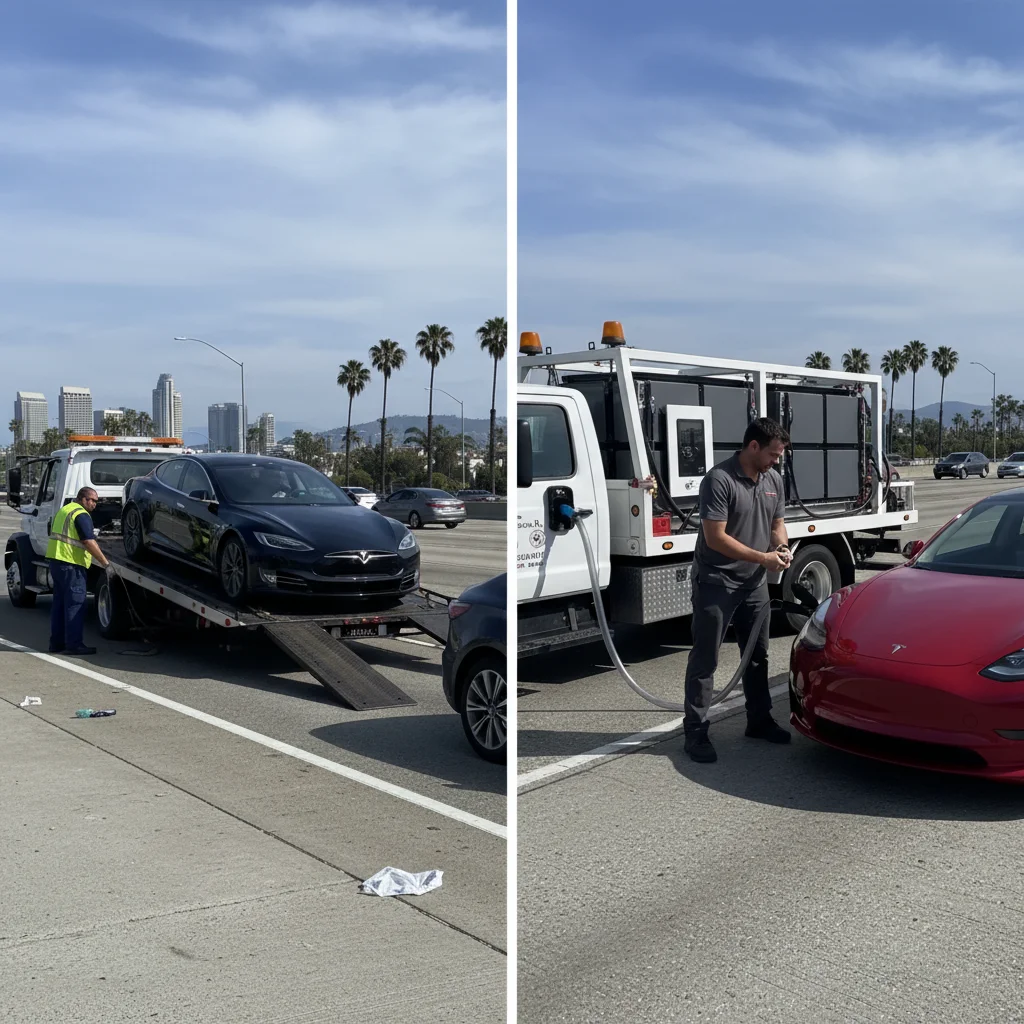
The pack can be empty and the car still fine. The 12-volt can be dead while the pack still holds range. Or the car can be hurt in a way no plug will fix. Match the help to the failure, not the wrecker habit from gas-car years.
Charge Pro DC is a referral line that matches you with independent local operators. The operator quotes you before work starts and bills you directly. We don’t own trucks, and we don’t set prices.
Empty pack, dead 12-volt, or a car that can’t roll
Most shoulder stops here look the same at a glance. Hazards are on, and the screen is dark or yelling to charge. Fast traffic punches past you on I-495 every few seconds.
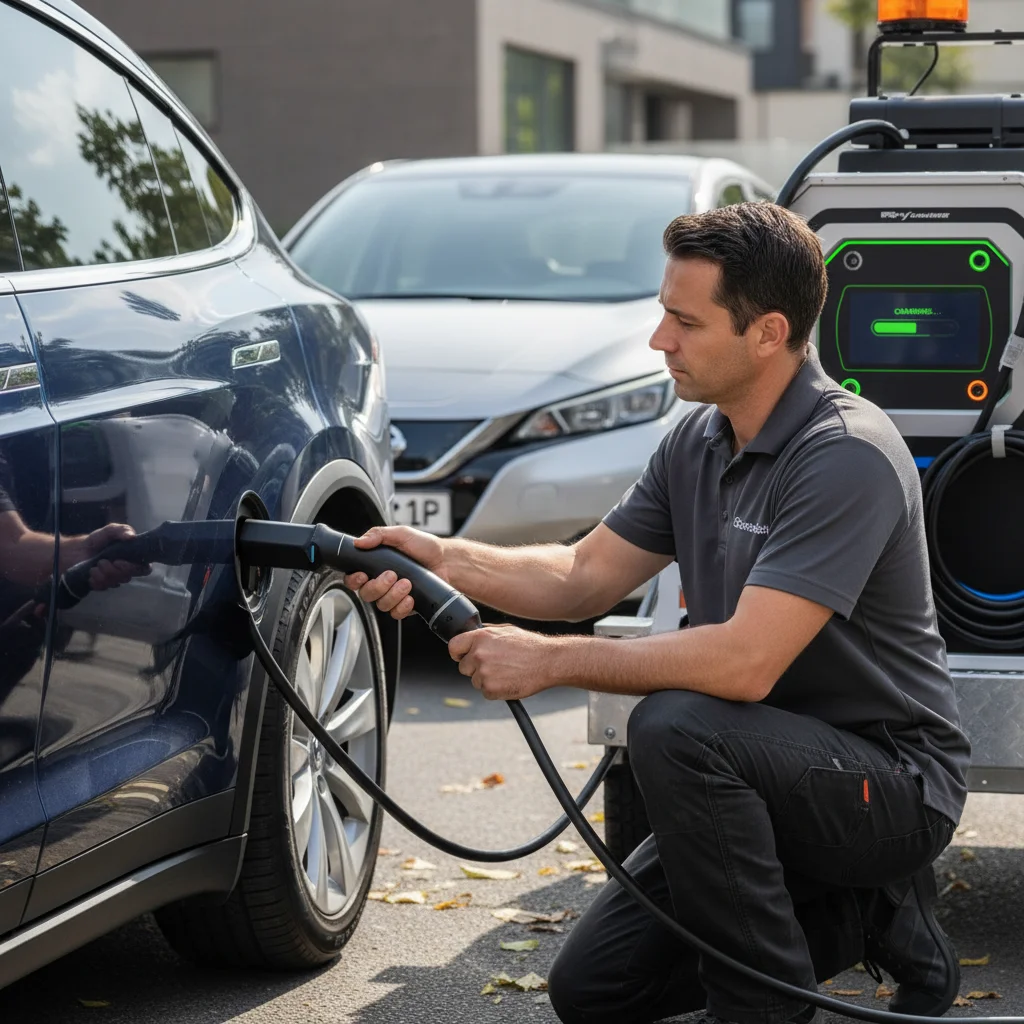
Start with what still works on the car. If the car will take a plug and then drive, mobile EV charging fits. The operator brings a 240-volt Level 2 source to your car. Tesla uses a native NACS plug at the car. Other EVs use a CCS or J1772 adapter. They typically add 10 to 20 miles of range. That takes 15 to 30 minutes of charging. That’s charging time, never an arrival time.
If the screens are dark and the doors act strange, it’s often the 12-volt. The traction pack may still hold plenty of range. A jump or an on-site 12-volt swap can wake the car. Then a short top-up gets you off the lot. That pattern shows up after a long sit in a garage. You’ll also see it at a Metro park-and-ride or Dulles parking.
If the car won’t take a charge, you need a flatbed. If it can’t roll even with range, you need one too. Collision damage and a high-voltage warning are tow jobs. So are smoke, a leak, and a motor fault that blocks drive. Towing a dead EV in this metro is the right call for a broken car.
What a Beltway stall usually is
An empty EV on the Capital Beltway is usually a range problem, not a wreck. You sat in a crawl with the cabin heat running. The wheels barely moved, and the pack bled down without covering miles. That’s the same drain you get in an I-95 standstill. It’s also the I-66 peak crawl inside the Beltway.
Out of charge on the Capital Beltway is the same night in a different lane. You’ll see it on I-270 between Rockville and Germantown. You’ll see it on I-95 through Woodbridge and Dale City. The car coasted to a shoulder with nothing leaking. There’s no dash triangle beyond the charge warning.
A flatbed still works if you want one. It also means a load, a haul, and a wait at the other end. A Level 2 visit leaves the car where it sits. It adds enough range to reach a working public charger or home. Then you drive yourself the rest of the way.
On the 495 Express Lanes, pull over to the left shoulder. Those lanes sit in the median, not on the right. On the 95 and 395 Express Lanes, pull to the nearest shoulder. Stay in the car until help is there. Transurban’s Express Assist can help with minor mechanical issues. It can call a tow, and it doesn’t tow the car itself. Its published material doesn’t describe charging an EV.
The Woodrow Wilson Bridge carries the Beltway between Alexandria, Oxon Hill, and the District. The American Legion Bridge carries it between McLean and Montgomery County. Both are high, wind-exposed spans with limited shoulder. A stall on the Wilson sits at a three-jurisdiction line. The Legion Bridge sits between Virginia and Maryland. Disabled-vehicle rules still apply the same to an EV as to any car. None of the three codes we checked has a special out-of-charge statute.
Parkways, patrols, and who won’t charge the pack
The Baltimore-Washington Parkway and the George Washington Memorial Parkway are National Park Service roads. So are Clara Barton, Rock Creek, and Suitland Parkway. Shoulders on those roads are narrow or missing. Commercial vehicles and trucks over 10,000 lb are banned. Report a disabled vehicle on the Baltimore-Washington Parkway to US Park Police at 202-610-7500. That call gets traffic control and a path off the parkway. It doesn’t plug an EV in on site.
Virginia’s Safety Service Patrol covers interstates including I-95 and I-66. Drivers reach them through Virginia 511 on those roads. VDOT describes incident clearance and short-term traffic control, not EV charging.
Maryland’s CHART Emergency Traffic Patrol covers the Baltimore/Washington metro on state primary roads. Dial #77 on I-495, I-270, US-50, or MD-295. Technicians change tires and jump 12-volt batteries. They add about a gallon of gas and radiator water. They don’t publish an EV pack charge.
The District has no DDOT motorist-assistance patrol in the material we checked. DC drivers lean on MPD, private roadside plans, and Park Police on the parkways.
Pepco serves the District, Montgomery County, and Prince George’s County. Dominion Energy Virginia serves most of Northern Virginia. NOVEC covers parts of Loudoun and Prince William. Their EV pages talk about home chargers and rates. None of those pages offers a visit to charge a stranded car. A home rebate doesn’t roll a truck to the shoulder.
Garage, airport, and apartment sit-downs
A lot of dead-EV calls here aren’t highway calls at all.
You left the car in a garage all day. Plenty of drivers also leave one in airport parking for a week. Nothing on the car wakes when you come back. Travellers coming back to Dulles hit this often. MWAA puts Level 2 charging in Garage 1 and Garage 2. There’s no extra charge for parking customers on those stalls. There’s no EV charging in the Economy Lot, the Terminal Lot, or Valet. The Economy Lot is the large, cheap on-airport option. You reach it by shuttle from Curb 2F. A week there is a 12-volt story more often than an empty-pack story.
Reagan National has a different parking layout for EVs. Complimentary EV charging sits on Level 1 of Parking Garages 1 and 2. Those stalls are first-come, for parking customers only. A stall at DCA is still often a 12-volt that sat too long.
WMATA park-and-ride garages across the metro produce the same long sit. Union Station’s garage is a long-dwell lot too.
Older housing stock makes overnight plugging much harder. Takoma Park, Annandale, and Wheaton have a high share of pre-1980 homes. A large share of District housing does too. Arlington, Alexandria, Silver Spring, and Hyattsville add apartment density. If you don’t have a reliable overnight plug, you sit closer to empty. A driveway charger in Ashburn or Gainesville changes that math. That’s housing stock, not a claim about public charging.
An operator can jump the 12-volt and add a short Level 2 top-up. That pair of jobs is one visit, not two. A tow to a shop solves neither if the car only needed a wake-up.
When a tow is the only honest answer
Don’t argue with a high-voltage warning on the dash. Don’t wait for a charge if you smell burning or see smoke. Fluid on the pavement is a tow too. Front-end or suspension damage needs a flatbed tow. Airbags out or a tire you can’t change need a flatbed. A motor or inverter fault that blocks drive needs one too.
A car that won’t take a plug after a 12-volt jump is a tow. So is a pack that won’t take current. When an electric car dies, the order is charge, jump, then tow. Skip to the tow when the first two are off the table.
Loading an EV has rules the wrecker has to follow. The car needs neutral and the right transport mode. Use the right dollies if the car has no power. That’s why towing a Tesla with no power is its own checklist. It isn’t a shortcut for an empty pack that would have taken a plug.
Confirm the current tow rule with the locality before you pay. If the car can drive after a charge, you still don’t need the wrecker.
Cold, climbs, and sitting still
Dulles runs colder and snowier than Reagan National. Cabin heat on an EV comes from the pack. A typical EV keeps about 80 percent of range at freezing. It keeps about 70 percent at 20F per Recurrent Auto. I-270 climbs as you head toward Frederick. Those climbs cost range on a low pack.
How the operator visit actually goes
You call, and we connect you with a local independent operator. They quote the job before they start any work. You accept or you don’t, and they bill you directly. Out-of-charge recovery is the empty-pack version of that visit. There’s a longer note on what’s an EV charging truck and who owns the gear.
Pick in this order
If the car would drive with 10 to 20 miles, you want the charge. For the empty, otherwise fine car, a Level 2 visit gets you moving. The flatbed is the tool for a car that won’t take charge.
If you’re stranded now, call (202) 629-0844 for a match. We’ll match you with an operator who’ll quote before any cable goes in.