How to tow a Tesla with no power in this metro starts with a flatbed. Transport Mode has to be on if the screen can wake. The harder part here is where you stalled. National Park Service parkways ban heavy trucks. The 495 Express Lanes want you on the left shoulder. The Woodrow Wilson Bridge sits in three jurisdictions at once. Those facts change who can reach you, and how the car gets moved.
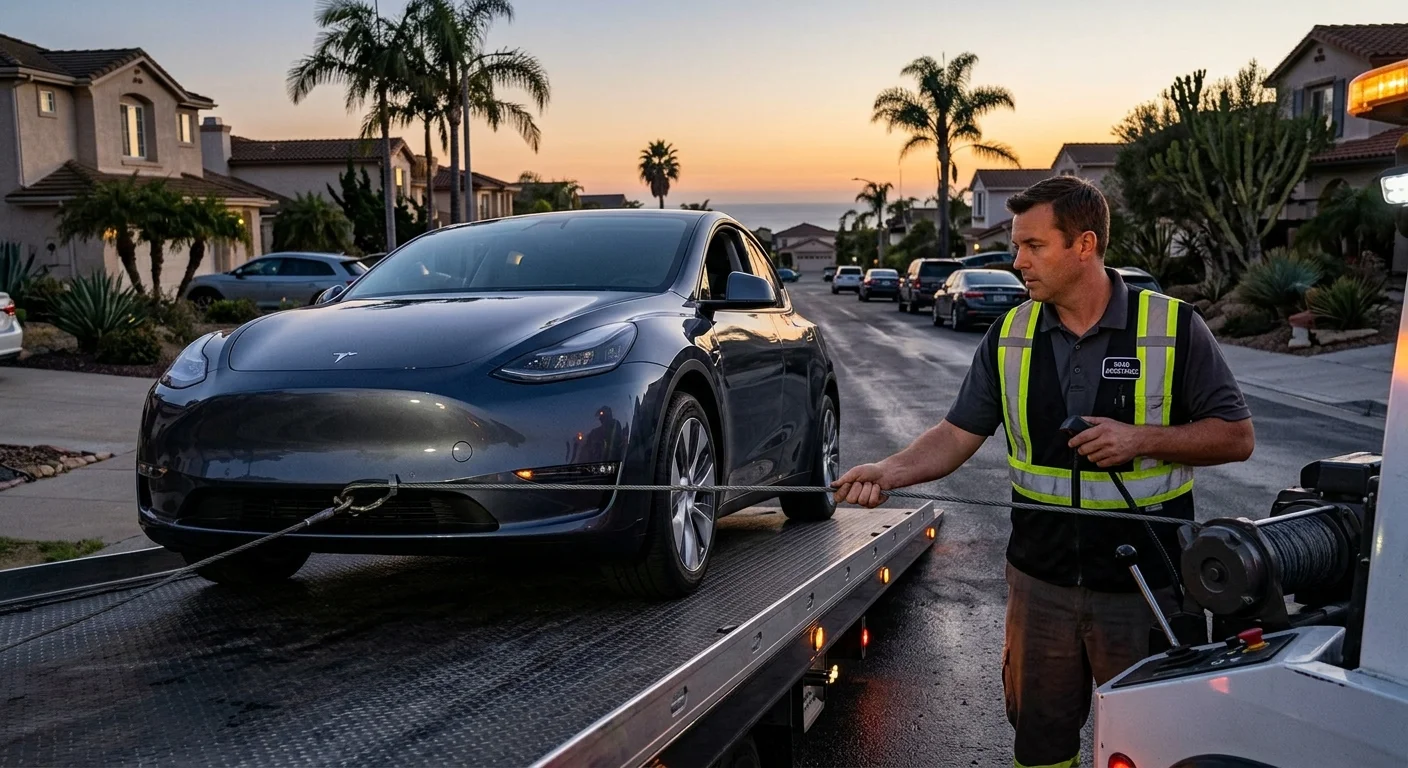
Parkway truck bans change the recovery first
This metro’s National Park Service parkways are not ordinary freeways. They include the Baltimore-Washington Parkway and the George Washington Memorial Parkway. Clara Barton, Rock Creek, and Suitland Parkway follow the same pattern. They’re limited-access scenic roads with narrow shoulders, or none. Commercial vehicles and trucks over 10,000 pounds are banned on them. A heavy wrecker may not be allowed to enter at all.
If you stall on the Baltimore-Washington Parkway, the published report path is US Park Police. The number is 202-610-7500. We found no DDOT motorist-assistance patrol for the District. District drivers rely on MPD or a private roadside plan. On the parkways, Park Police is the documented contact. That call doesn’t brief anyone on Tesla Transport Mode. You still have to tell the person who moves the car what it needs.
Park Police pages we reviewed don’t name the wrecker class they’ll escort onto those roads. Confirm the move with them before anyone hooks a strap. Stay with the car. Keep the wheels straight. Don’t let anyone drag the Tesla to a wider pull-off.
A stall near College Park or Laurel is the same Tesla problem as a garage stall. The access rules are not. If you stalled on that parkway, start with Ran out of charge on the Baltimore-Washington Parkway: next steps. The George Washington Memorial Parkway has the same truck ban and the same tight shoulders. Stalled on the George Washington Parkway with nowhere to pull off covers that stretch.
Left shoulder on 495 Express Lanes, nearest on 95 and 395
The 495, 95, and 395 Express Lanes are operated by Transurban with VDOT. On 495, those lanes sit in the median. Published safety guidance is specific about the stop. Pull over to the left shoulder on the 495 Express Lanes. On the 95 and 395 Express Lanes, pull to the nearest shoulder. Stay in the car until help arrives.
Express Assist patrols those lanes. It helps with minor mechanical issues and will call a tow. It doesn’t tow. It doesn’t charge a Tesla. VDOT Safety Service Patrol covers Virginia interstates, including the I-66 corridor in Northern Virginia. Published pages describe incident clearance, debris, and short-term traffic control. They don’t describe EV charging.
Maryland’s CHART Emergency Traffic Patrol covers the Baltimore/Washington metro on state primary roads. That list includes I-495, I-270, US-50, and MD-295. Dial #77 from a breakdown on those roadways. CHART techs publish tire changes, jump starts, fuel, and radiator water. They don’t publish a Tesla flatbed procedure.
If the pack hit empty in the Express Lanes, pull left first. Then read Dead EV in the 495 Express Lanes: pull left, then call. Treat the car like a Tesla after that. It isn’t a gas car that can ride a dolly.
Three jurisdictions on one span
The Woodrow Wilson Bridge carries the Beltway across the Potomac. It links Alexandria, Oxon Hill, and the District on one deck. A dead Tesla there isn’t in one state. Police and tow lists shift with your exact point on the span. The American Legion Bridge does the same between McLean and Montgomery County. Both spans are high and wind-exposed, with limited shoulder.
None of the three codes we reviewed names an empty EV pack. Disabled-vehicle rules apply the same way they apply to any car. That doesn’t make the recovery simple. You still follow Tesla’s towing steps, then the local road’s rules on top. If you stalled on the Wilson Bridge, Dead EV on the Woodrow Wilson Bridge: who responds, what you do covers the split.
Oxon Hill is the Maryland landing. Alexandria is the Virginia landing. The District is in the mix on that crossing too. Say which end you’re closer to before a truck is dispatched. A unit staged for the wrong bank isn’t a Tesla problem. It’s a three-jurisdiction problem.
Wake the 12-volt before anyone talks about a hook
A black screen is often the 12-volt battery, not an empty traction pack. The 12-volt runs the computer and the display. Without it, Transport Mode stays out of reach. Transport Mode releases the parking brake. It lets the wheels roll without driving the motors.
You turn it on from Controls, then Service, when the screen is alive. When the screen is dead, jump the 12-volt at the front bumper posts. Pop the tow-eye cover on the passenger side of the nose. That jump only wakes low-voltage electronics. It doesn’t refill the high-voltage pack.
Charge Pro DC connects you with independent operators for that jump. See Tesla 12-volt battery jump. They quote you before they start, and they bill you directly.
Why the motors make a rolling tow a bad idea
Tesla motors sit on the drive wheels through a single-speed gearbox. They’re not a gas engine you can disconnect with a shifter. If those wheels spin while the car is off, the motors generate current. That current has nowhere safe to go. Heat builds in the motor and the inverter. Regenerative braking can also grab when you didn’t ask it to.
A dolly that leaves two wheels on the pavement is the usual mistake. All-wheel-drive Teslas have motors at both ends. There’s no safe pair of wheels to drag. A hook-and-chain pull is worse. The method that keeps the motors quiet is a flatbed. All four wheels stay in the air.
If Transport Mode won’t enable, don’t improvise a roll. Tell the operator the car can’t go into Transport Mode. They should confirm that model’s recovery steps before a strap moves. Tesla’s designated tow points sit in the bumper structure, not the control arms. Chains on suspension pieces bend parts they aren’t meant to carry. Keep the wheels pointed straight while the winch pulls. Say all of that before anyone tensions a cable.
What you say before a strap touches the car
Lead with the car, then the road. It’s a Tesla. It has to ride on a flatbed. No dolly. The 12-volt is dead. We’ll need a jump before Transport Mode can turn on. Then name the place in local terms.
If you’re on an NPS parkway, say the truck-weight ban out loud. A unit that can’t legally enter wastes the stop. On the 495 Express Lanes, say you’re on the left shoulder in the median. On the Wilson or Legion Bridge, say which end you’re closer to. Virginia, Maryland, and the District aren’t interchangeable from the deck.
The Tesla roadside rescue operators in this network treat that briefing as the job, not a debate. If an operator wants to drag wheels, stop the work. You’re protecting the motors.
When a 240-volt visit beats the flatbed
Towing is the right call when a part has failed. It’s also the call when a wheel won’t roll. It’s the wrong first call when the car only needs energy.
A dead 12-volt can be jumped in the lane or in a garage. A Tesla that sat a week in airport parking often has a dead 12-volt. That isn’t the same as an empty traction pack. An empty pack is a different job. Charge Pro DC matches you with independent operators for that job. They bring a 240-volt Level 2 source to the car. Teslas take a native NACS plug. Typical charging time is 15 to 30 minutes. That usually adds 10 to 20 miles of range. That’s charging time, never an arrival time.
Pepco, Dominion Energy Virginia, and NOVEC publish home-charger programs. None of the utility EV pages we reviewed offer a stranded-car charge. CHART, VDOT patrols, and Express Assist also don’t fill a Tesla pack. If you need miles in the battery, ask for a mobile 240-volt visit. You can drive to a charger you choose once you have range. Compare the two paths in Mobile EV charging or a tow: which one you need when stranded.
I-270 and the Beltway general lanes are ordinary pavement with the usual shoulders. I-66 inside the Beltway is a different toll regime. The Dulles Toll Road is run by MWAA. Tesla’s towing rules don’t change on a toll road. The people allowed to stop might.
Frequently asked questions
How do you tow a Tesla with no power in this metro?
Use a flatbed, and turn on Transport Mode if the screen can wake. Tell the operator if you’re on an NPS parkway with a truck ban. Tell them if you’re on a left-shoulder Express Lane stop. Tell them if the bridge sits in more than one jurisdiction.
What if Transport Mode won’t turn on?
Don’t roll the wheels on the pavement. Say Transport Mode is unavailable. The operator should confirm that model’s recovery steps before a winch takes load.
Does a black screen mean I need a tow?
Not always. A 12-volt jump may restore the display. That can let you enable Transport Mode, or even drive. It doesn’t recharge the traction pack. If the pack is empty, a 240-volt top-up on site is cleaner.
Call before anyone drags a wheel
Charge Pro DC is a referral line. It matches stranded Tesla drivers with independent local operators across the District, Maryland, and Virginia. It doesn’t own the truck, set the price, or run the winch. The operator quotes you before work starts and bills you directly. Need a 12-volt jump, a 240-volt boost, or a proper flatbed recovery. Call (202) 629-0844.