When an electric car died on a DC-area freeway, treat it like any stalled car. Maryland, Virginia, and the District don’t write a special out-of-charge exception. Your dash still decides which service comes next. You may need a mobile charge, a 12-volt jump, or a tow. In the District, that tow can end at Blue Plains.
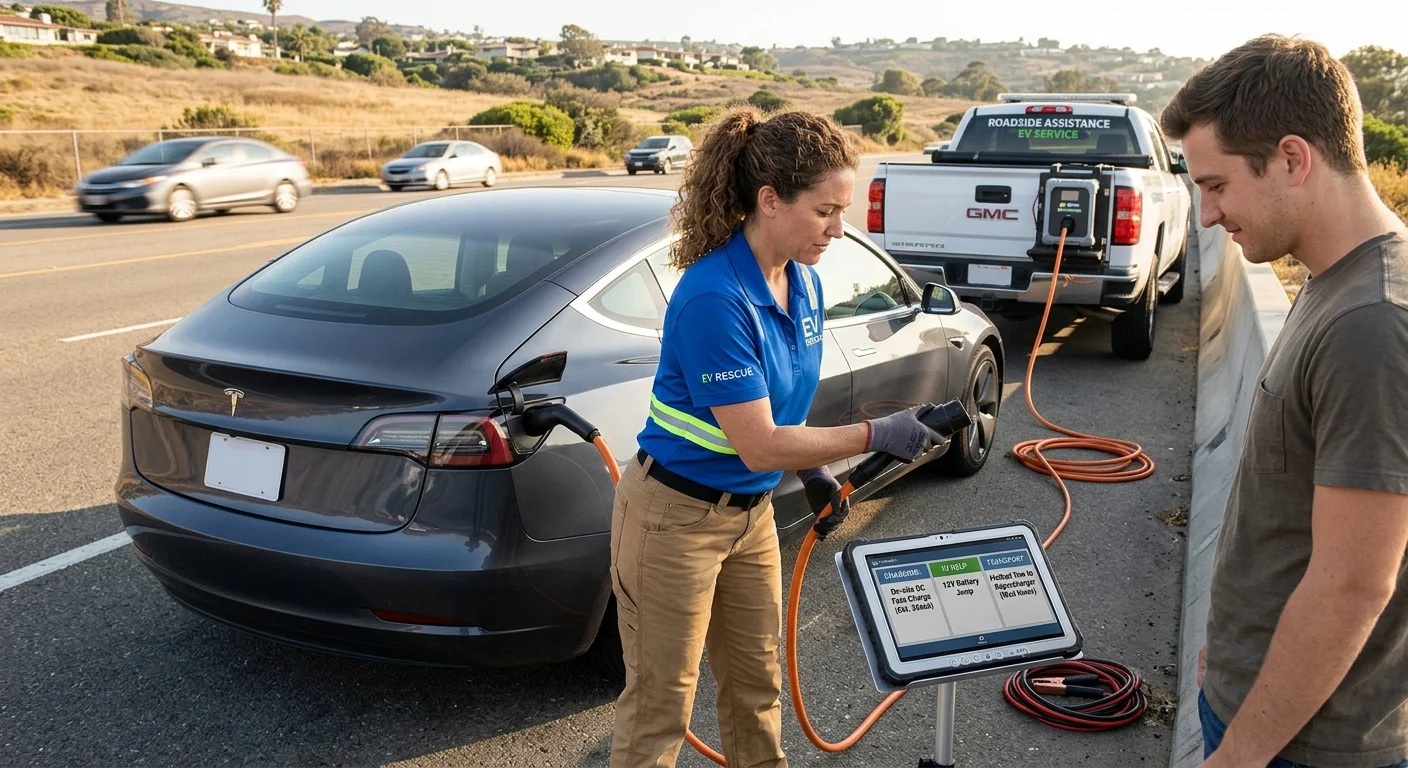
A stalled EV follows the same tow rules
None of the three codes we reviewed names an out-of-charge offense. The disabled-vehicle rules still apply to an EV. Crews treat a stalled EV in a lane like any other car.
In the District, DPW towing and impound sit under Title 50. The main DPW impound lot is Blue Plains, at 5001 Shepherd Parkway SW. A second lot sits at 2115 Bryant St NE. Confirm the current lot and release steps with DPW before you pay or travel. Give the quadrant on any District address, because NE, NW, SE, and SW repeat.
Virginia private-property tows follow Va. Code § 46.2-1231, § 46.2-1233, and § 46.2-1233.1. Localities may set those fee limits by ordinance. We couldn’t confirm the current Arlington, Alexandria, or Fairfax ordinance numbers in this research. Ask the locality or the operator for the current cap before you authorize a hook. Maryland’s stopping rules sit in Transportation Article Title 21. Montgomery County and Prince George’s County set their own tow ordinances. Confirm the current county figure before you pay.
Read the dash before you pick a service
The word “died” doesn’t name the failed part. One driver sees an empty driving-battery warning on the cluster. Another finds dark glass, silent locks, and no app connection. Those reports need different questions from an operator.
Read the dash message word for word to the operator. Note whether the cluster, lights, locks, app, or charge port still respond. If a remaining percent is on screen, share that number as shown. Say whether the car quit while moving, or wouldn’t wake after a park.
An empty-pack warning supports a talk about out-of-charge recovery. Blank screens may lead the operator toward the 12-volt system. That still isn’t permission to open a battery cover.
Use the owner’s manual for your exact model and year. If you don’t have it, say so before any work starts. Our 12-volt trip guide helps you sort symptoms, not diagnose this car.
Get clear of traffic, then describe the stop
Traffic exposure comes first on a Beltway or parkway stop. If people are in danger, call emergency services and follow them.
If the car still rolls, follow the on-screen warnings and the maker’s instructions. If it won’t move, don’t invent a push, a roll, or a neutral release. Tell the operator where it sits and which controls still work.
Name the road, the direction, and the nearest exit. “Northbound I-270 near Rockville” is useful to the operator. “Somewhere in Montgomery County” isn’t enough. Use that same precision on I-66, I-95 through Woodbridge, and the Capital Beltway. The Woodrow Wilson Bridge meets Alexandria, Oxon Hill, and the District. The American Legion Bridge sits between McLean and Montgomery County.
On the 495 Express Lanes, pull to the left shoulder. Those Express Lanes sit in the median. On the 95 and 395 Express Lanes, pull to the nearest shoulder. Stay in the car until the next unit arrives. Transurban’s Express Assist patrol handles minor mechanical issues at no charge. It will call a tow, but it doesn’t tow. Its published material doesn’t describe charging a stranded EV.
NPS parkways here ban commercial vehicles and trucks over 10,000 lb. That includes the Baltimore-Washington and George Washington Memorial Parkways. Clara Barton, Rock Creek, and Suitland Parkway fall under the same rule. Shoulders on those parkways are often narrow or missing. Report a disabled car there to the US Park Police at 202-610-7500.
Maryland drivers on I-495, I-270, US-50, or MD-295 can dial #77 for CHART. CHART publishes tire changes, jump starts, and about one gallon of gas. CHART doesn’t publish a charge for a stranded EV. Virginia drivers reach VDOT Safety Service Patrol through Virginia 511. VDOT describes incident clearance, not EV charging. We found no DDOT motorist-assistance patrol in the District. DC drivers lean on MPD, private plans, and Park Police on the parkways. If officers are already managing the scene, their directions outrank phone troubleshooting.
Match the service to what the car is actually doing
The right branch depends on the symptoms, the manual, and the stop. “My electric car died” starts a call, and it doesn’t finish one.
Talk charging when the traction pack looks empty. Share the make, model, year, percent, warning text, and charge-port status. The operator then checks whether a compatible mobile visit can reach that car.
Operators typically bring a 240-volt Level 2 source to the car. Teslas take a native NACS plug on that visit. Other EVs use a CCS or J1772 adapter. That visit typically adds 10 to 20 miles of range. The clock on that boost is 15 to 30 minutes of charging. That’s charging time, never an arrival time. Pepco, Dominion Energy Virginia, and NOVEC publish home EV programs. None of the utility EV pages we reviewed offers a charge for a stranded car. Mobile charging still isn’t a fit behind a gate or at a dead port. Our comparison of mobile EV charging or a tow lays out those questions.
Talk a jump only after low-voltage trouble is in view. Dark glass is a clue, not a green light. The operator should match your symptoms to the maker’s steps.
A week in a long-term lot is a common 12-volt pattern here. Travelers often return to a car that won’t wake at Dulles or Reagan National. The 12-volt is usually the part that quit, not an empty traction pack. Reagan National publishes complimentary EV charging on Level 1 of Parking Garages 1 and 2. WMATA park-and-ride garages show the same long-sit pattern.
Talk transport when on-site service doesn’t fit. That can be an unknown cause or a car that can’t accept a charge. It can also be a maker that requires a tow. Collision damage belongs in the first sentence of the call. So does a stall that a service vehicle can’t legally reach. The tow method has to follow the current instructions for that exact vehicle. Our note on towing a dead EV in this metro covers why that method matters.
Charge a confirmed empty pack, then consider a maker-approved 12-volt jump. Use a tow when the stop or the fault rules out work on site.
Tell the operator the car, the pin, and the access
Start with make, model, year, and the displayed charge. Read the warning text as written. Don’t swap in your own diagnosis on the call. Say what happened right before it quit, and list the controls that still work.
Give the operator a precise location pin. Include the road, direction, nearest exit, garage level, or space marker. If you’re in Washington, Arlington, or Alexandria, name that place. Don’t call Bethesda, Silver Spring, Tysons, or Reston a city. Alexandria and Fairfax are independent cities, not counties. Arlington is a county with no incorporated towns. Fairfax County and the City of Fairfax are separate jurisdictions, so say which one.
Mention gates, height bars, tight ramps, or a security desk. Apartment garage access is a common issue in Arlington, Alexandria, and the District. State whether you have the keys and who can approve the work. After this stop, see the DC-area charging hub for later plug planning.
How Charge Pro DC connects you with an operator
Charge Pro DC is a referral line for stranded EV drivers. We match you with independent local mobile rescue operators. We don’t diagnose the car, perform the work, own trucks, or tow. The pros we connect you with are licensed and insured. We serve the District of Columbia, Maryland, and Virginia.
When you call, share the car and the pin you’ve gathered. The independent operator reviews the symptoms and checks compatibility. That operator explains whether charging, a 12-volt jump, or transport fits. Our EV roadside assistance page covers that referral. You contract with the operator, and you pay the operator. Charge Pro DC doesn’t set the price or promise an arrival time. Ask the operator to confirm the scope and current quote before you authorize work.
If the cause isn’t confirmed, say that up front. If the chosen service can’t fix it, ask what the maker requires next.
Call when the car has stopped or won’t power up. Call when the dash shows a message you can’t classify. Call (202) 629-0844 and we’ll connect you with a local operator.