There isn’t one verified, universal Tesla roadside flat-tire price for every DC-area driver. The amount could not be confirmed from the approved public research, so check the Tesla app and request the full owner-paid amount before authorizing service.
What Tesla’s published flat-tire policy actually says
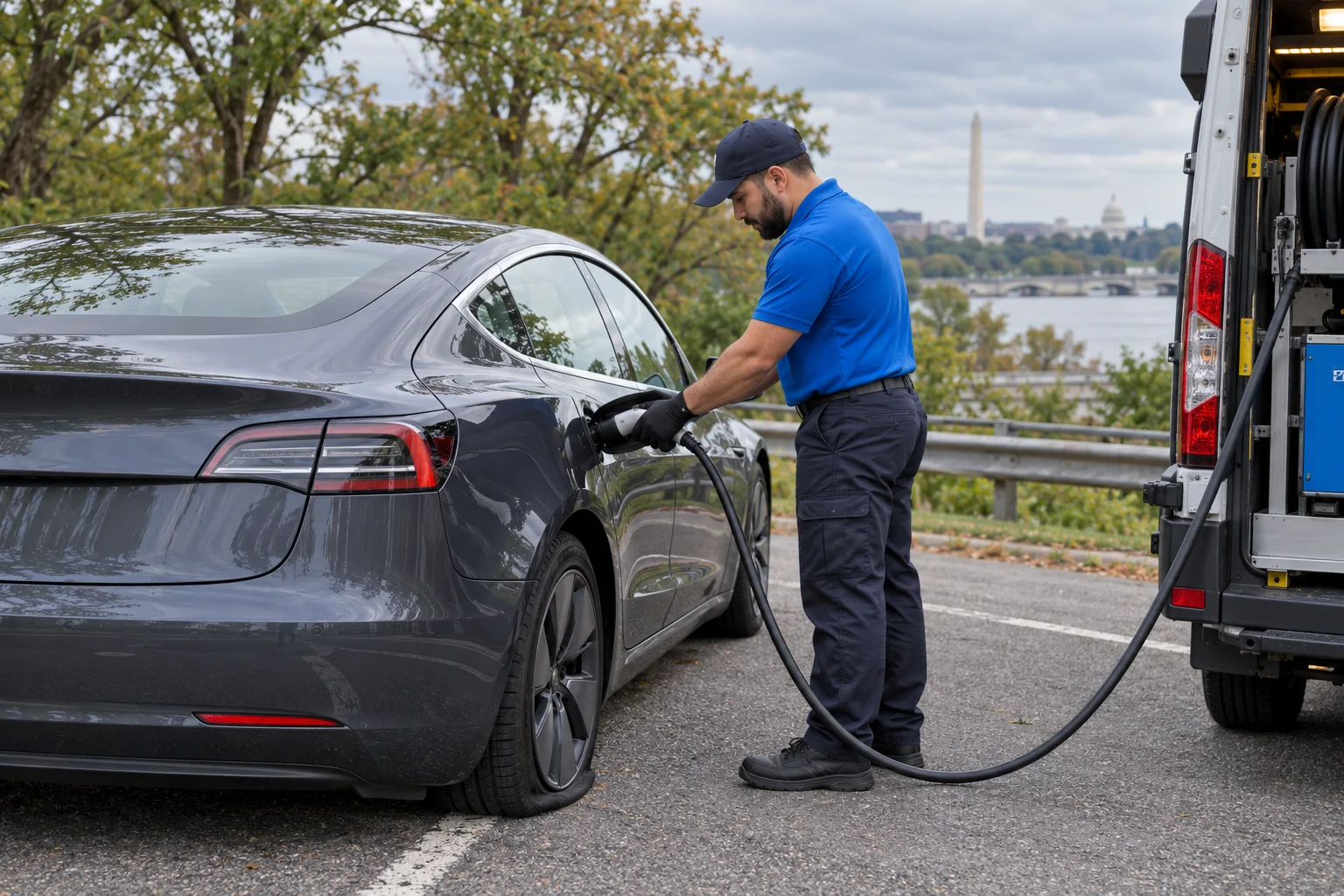
Tesla provides a roadside request channel through its app. From the bottom of the app home screen, select Roadside, choose the vehicle issue, confirm the details, and request help. Include enough information to identify your location and the vehicle’s condition.
Tesla’s North America roadside page also publishes around-the-clock availability. That statement describes access to the request channel. It doesn’t establish that every flat-tire service is free, available at every location, or financially covered.
The approved research didn’t confirm a current public flat-tire fee. It also didn’t confirm a universal free-service rule for tire damage. Drivers asking, “Is Tesla roadside assistance free for a flat tire?” should treat the app’s current offer as the controlling answer for that incident.
Before accepting, look for clear answers to these questions:
- What service is being offered?
- Is any part financially covered?
- What amount will you pay?
- Does the quote include the tire work?
- Is towing separate from repair or replacement?
- Where will the vehicle go if it needs a tow?
- Can the provider legally and safely reach your location?
Save the app confirmation or take a screenshot before approving the request. If the displayed terms aren’t clear, ask for clarification through Tesla’s current support channel.
Our guide to how Tesla roadside help works in the DC area explains the request process. You can also review the broader Tesla Roadside Rescue service when the problem may involve charging or another EV-specific issue.
Plug, mobile tire service, or a tow: the real fork
A flat-tire request can lead to different types of service. Those choices shouldn’t be treated as one interchangeable job. The work offered, the destination, and the amount due may change with each option.
A plug is a tire repair. Whether it fits your situation must be decided by the tire professional inspecting the damage. Don’t assume every puncture can receive the same repair. Ask exactly what work is proposed before approving it.
Mobile tire service means a provider comes to the vehicle for tire-related work. Confirm whether the quoted amount covers the visit, labor, repair materials, and any replacement tire. Also ask what happens if the tire can’t be repaired at the vehicle’s location.
A tow moves the Tesla to another location. It doesn’t automatically include the tire repair or replacement. Confirm the tow destination and each owner-paid amount before the vehicle moves. A quote that covers transportation may not answer what the tire shop will charge later.
Don’t assume your Tesla has a usable spare. Check the equipment supplied with your specific vehicle and consult its current owner’s information. If you have compatible equipment, tell the provider what is actually inside the car.
The first useful description isn’t simply “flat tire.” State whether the tire is losing air, fully deflated, damaged at the curb, or inaccessible in traffic. Mention garage clearance, gate access, and lane position.
A tire problem also differs from an empty high-voltage battery. Our comparison of a Tesla flat tire versus charge rescue helps separate those calls. That distinction matters because mobile EV charging won’t repair a tire.
Parkways with no shoulder change the job
Location can decide whether roadside tire work is practical. That matters on the George Washington Memorial Parkway, Suitland Parkway, Baltimore-Washington Parkway, Clara Barton Parkway, and Rock Creek parkways.
The National Park Service describes these as limited-access scenic roads with narrow or absent shoulders. It also bans commercial vehicles and trucks over 10,000 pounds on those parkways. Those restrictions can affect which provider or vehicle may reach you.
Tesla says service in restricted roads or restricted-access areas is considered case by case. It also directs drivers in unsafe locations to contact emergency services. The public Tesla pages reviewed for this topic don’t promise that a tire provider can work wherever the car stops.
Give Tesla or any proposed operator the exact roadway, travel direction, and nearest safe reference point. State whether the car is in a travel lane, a narrow shoulder, a pull-off, or another restricted space. Don’t describe a parkway stop as an ordinary parking-lot call.
Access and tire work are separate decisions. A provider might handle the tire but lack lawful access to that road. Another response may focus first on moving the vehicle away from traffic. Ask what is being arranged and who is responsible for each charge.
The same principle applies outside the parkways. A Tesla inside a secured garage in Arlington isn’t the same job as one beside I-66. Clearance, gates, ramps, traffic controls, and property rules can change the available next step.
For more local context, see our guide to EV roadside help on the George Washington Memorial Parkway. It explains why a familiar route can still be a difficult service location.
Fees you must confirm before you pay
The exact Tesla roadside assistance flat tire cost couldn’t be confirmed as a single public figure for this metro. Charge Pro DC doesn’t set Tesla’s prices, and it doesn’t set an independent operator’s prices. The party providing the service must quote and bill the driver directly.
Get the quote in writing when possible. The quote should identify the actual service, not just say “roadside assistance.” Ask whether it covers the visit, tire work, replacement parts, transportation, destination, and any conditions that could change the amount.
Use a short confirmation script:
Please state the service you’re offering, what is financially covered, the total amount I authorize now, and what could be billed separately.
Then compare that answer with what appears in the app. If the provider can’t confirm the total, ask which part remains unknown and who sets it. A tow company, tire provider, and repair location may each control a different part of the final bill.
Avoid relying on an old forum post or another driver’s receipt. Neither proves what applies to your vehicle, location, coverage status, or current request. The approved research found no verifiable universal amount that can safely replace a live quote.
Ask for the proposed destination before approving a tow. Also confirm whether payment for transportation settles only the tow or includes any tire work. These details answer the real cost question better than an unsupported average.
Our article about what Tesla tire assistance may skip covers the gaps to check. The safe rule is simple: don’t interpret roadside availability as automatic financial coverage.
When a local operator is the better next call
A local operator may be the better next call when Tesla can’t serve the location, the app doesn’t offer a workable option, or the problem isn’t actually tire-related. A driver can have a flat tire and a separate EV issue at the same time.
For example, the vehicle may also have an empty high-voltage battery or another condition that affects movement. Describe every symptom before requesting help. Don’t order mobile charging solely because the vehicle won’t move. Charging doesn’t repair tire damage.
Charge Pro DC is a referral service. We connect drivers with licensed, independent local EV operators. We don’t repair tires, tow vehicles, dispatch our own trucks, set prices, or perform roadside work.
The matched operator quotes and bills you directly. Confirm the scope and price with that operator before authorizing anything. If tire service is still required, ask whether you must arrange it separately.
A local EV operator can make sense when the immediate need is EV-specific. That may include enough mobile charging to reach a suitable charging location, when the vehicle and location allow it. The typical rescue charge listed in our approved records provides 10 to 20 miles of range during 15 to 30 minutes of Level 2 charging. That is charging time, not an arrival estimate.
Our emergency EV roadside assistance service explains the referral process. It doesn’t replace Tesla’s roadside program or a tire professional. It gives drivers another route when they need an independent local EV operator.
When to call us
Call when the Tesla also needs mobile EV charging, or when Tesla’s offered option doesn’t resolve the EV-specific problem. We’ll connect you with a local operator, while tire work and any tow must be confirmed separately.
Call us at (202) 629-0844 and we’ll connect you with a local EV rescue operator.