A gas car dies next to you on the Capital Beltway. The hood goes up, and the other driver looks at your Tesla. They want a jump, and you’re the nearest 12-volt source. That’s the wrong read of what your car is for. The 12-volt in a Tesla is not a donor pack. The risks of using a Tesla to jump start a gas car start there. Clip cables to a dead starter and you can damage the EV. You can also fail to crank the gas engine at all.
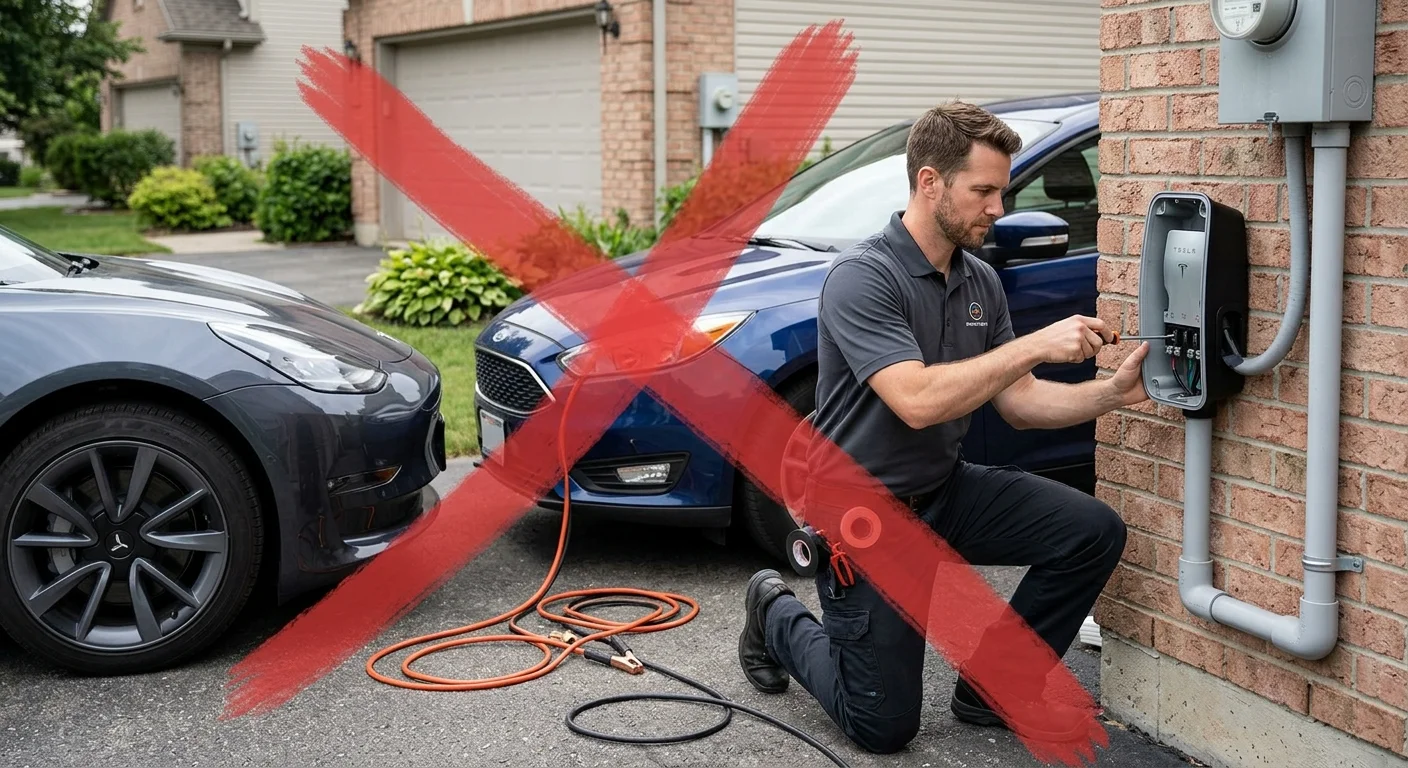
The 12-volt battery was never a booster pack
Every Tesla still carries a small 12-volt battery. It runs locks, lights, screens, and the pack contactors. Those are light, steady loads, not a starter motor. The traction pack holds the energy that moves the car. A DC-DC converter tops up 12 volts from the traction pack. It’s not an alternator, and it’s not a jump box.
A gas car’s 12-volt system is built around cranking an engine. The starter pulls a short, violent current spike. The alternator then shoves charge back into that battery. Your Tesla doesn’t have that hardware at all. You can take a jump on a dead 12-volt. You shouldn’t use the Tesla as the donor. Kindness on the shoulder doesn’t rewrite the wiring.
What the gas starter actually asks of your car
A dead gas battery looks like a 12-volt problem. It’s one, but the current demand is the issue. Cranking a four-cylinder or a V6 is a huge, brief load. Your Tesla’s 12-volt circuit isn’t sized for that spike. The surge hits the Tesla first, then the dead car. Fuses can open, and the converter can fault. Modules that share that 12-volt bus can glitch too. Then you’ve got two silent cars on the same shoulder. The gas car often still won’t start, and your Tesla may not wake.
Newer Model 3 and Model Y cars use a lithium 12-volt pack. That chemistry is even less of a lead-acid donor. It’s light, efficient, and easy to protect with software. It’s a poor source for the amps a starter wants. Check the model-by-model 12-volt guide for your car.
Why a Beltway jump is worse than a driveway one
In a driveway you’ve got room, time, and a stable surface. On I-495 you don’t have any of that. Transurban runs the 495, 95, and 395 Express Lanes with VDOT. On the 495 Express Lanes, pull over to the left shoulder. Those lanes sit in the median, so the left side is the out. Stay in the car until help arrives on those lanes. Now add jumper cables between a Tesla and a gas sedan. You’re standing in a live electrical experiment, with traffic on both sides.
The American Legion Bridge and the Woodrow Wilson Bridge are worse. Both are high, wind-exposed spans with limited shoulder. The Wilson Bridge meets three jurisdictions at once. Don’t linger on that shoulder with cables in your hands.
NPS parkways leave even less room to work. NPS parkways ban commercial trucks over 10,000 lb. That list includes the Baltimore-Washington and George Washington Memorial parkways. Clara Barton, Rock Creek, and Suitland parkways follow the same rule. Shoulders on those roads are narrow or missing. On the Baltimore-Washington Parkway, call US Park Police at 202-610-7500. Don’t turn your Tesla into a donor on those roads.
Tesla already told you not to be the donor
Tesla owner’s manuals vary by model and year, but the pattern doesn’t. They walk you through receiving a jump on a dead 12-volt. They don’t publish steps for using the car as a donor. That silence is the policy, not a gap in the index. Damage after an outbound jump can be treated as improper use. Warranty coverage on those parts can be denied. You’d then pay a shop for a converter that was never a booster. Confirm the exact wording in your glovebox manual. Don’t argue it from a forum post on the shoulder. The same no is in can your EV jump-start a gas car on the Beltway.
Who should jump the gas car in this metro
The gas car needs a tool built to crank an engine. Your Tesla isn’t that tool, no matter how full the pack is.
MDOT SHA CHART Emergency Traffic Patrol covers Maryland state primary roads. That patrol covers I-495, I-270, US-50, and MD-295. Dial #77 from the breakdown on those roads. CHART technicians change tires, jump-start cars, and add about a gallon of gas. They don’t publish an EV charging service for a dead pack. For a gas car with a flat 12-volt, that jump matches the job.
On Virginia interstates, VDOT Safety Service Patrol works I-66 and I-95, among other corridors. Reach them through Virginia 511 from the car. Published material covers incident clearance and short-term traffic control. It doesn’t describe charging an EV, or using one as a jumper.
On the Express Lanes, Express Assist is a free roadside patrol. It helps with minor mechanical issues and calls for a tow. It doesn’t tow the car, and it isn’t a Tesla jump pack.
Inside the District, no DDOT motorist-assistance patrol turned up in the records we checked. Drivers there use MPD, a private roadside plan, or Park Police on the parkways.
Pepco serves the District, Montgomery County, and Prince George’s County. Dominion Energy Virginia serves most of Northern Virginia. NOVEC covers parts of Loudoun and Prince William. Their EV pages cover home charging programs, not a stranded-car jump. None of the utility pages we reviewed offer a service that charges a stranded car.
Help the other driver without clipping onto the Tesla
Keep a portable lithium jump starter in the glovebox. Those packs are built for starter current, not cabin electronics. They never touch the Tesla’s 12-volt bus. That’s the clean answer in an Arlington garage or a Tysons office lot.
If another gas car can pull over safely, use that as the donor. Clip positive to positive, then negative to a solid ground on the dead car. Do that only where you have space. Skip it on a parkway with no shoulder.
A roadside plan or insurance add-on is built for this crank. The gas car gets a start, and your Tesla stays out of the circuit. If the stranded vehicle is an EV, jumper cables usually won’t add range. Then you want a quoted mobile charge, not a jump. Don’t assume AAA will charge an EV. Read when AAA can’t charge your EV before you assume one truck does both.
Don’t sit on the Beltway with climate control blasting while you wait. Heat and AC drain the pack without covering miles. That’s a gridlock problem, not a jump-start problem. If your own pack is already low, stay with the car. Don’t drain it further trying to help a gas engine.
If the dead 12-volt is the Tesla
A Tesla that won’t wake is often the 12-volt, not an empty pack. Long sits in Metro garages and airport lots make that obvious. A weak 12-volt dies in the dark, even if the pack still has range.
Don’t use a gas car as your donor unless you follow Tesla’s receive-a-jump steps. Wrong polarity can take out the same converter. Use the Tesla 12-volt jump steps, or have an operator do it.
Charge Pro DC is a referral line, not a shop with trucks. We don’t own equipment, and we don’t perform the work. We match stranded drivers with independent local operators. They bring a 240-volt Level 2 source to the car. They typically add 10 to 20 miles in 15 to 30 minutes of charging. That window is charge time, never an arrival time. They can jump or replace a dead 12-volt on site. They handle Tesla and every major EV brand. The operator quotes you before starting and bills you directly.
If the Tesla won’t wake after a long sit, call (202) 629-0844. We’ll connect you with a local operator who quotes before the work starts.
Frequently asked questions
What are the risks of using a Tesla to jump start a gas car?
The 12-volt battery and DC-DC converter aren’t built to crank a starter. The surge can open fuses, fault the converter, or stress modules on that bus. Tesla manuals describe receiving a jump, not giving one. Damage from that use can fall outside warranty.
Can a Beltway good-Samaritan jump wreck the Tesla?
Yes, the electrical load matches a driveway jump. The setting on I-495 makes it more dangerous. Limited shoulders on the Express Lanes and NPS parkways leave you exposed. You can disable the EV and still leave the gas car dead.
What should you use instead of the Tesla?
Use a portable jump pack, another gas car, or a patrol that jump-starts engines. In Maryland, CHART is reached at #77 on state primary roads. In Virginia, start with 511 from the car. If your Tesla’s own 12-volt is dead, ask for a Tesla 12-volt jump. Don’t pull cables from a combustion car to wake it.