A Tesla that sat in Dulles Economy parking for a week often won’t wake. The handles stay flush and the screen stays black. The traction pack can still hold a usable charge. The 12-volt battery is what actually died. Drivers type do teslas have a 12v battery after a stall like that. Yes, every Tesla in this metro still has one. That’s true for Model 3, Model Y, Model S, Model X, and Cybertruck. It’s the small battery that wakes computers, contactors, and door handles. It isn’t the pack that turns the wheels.
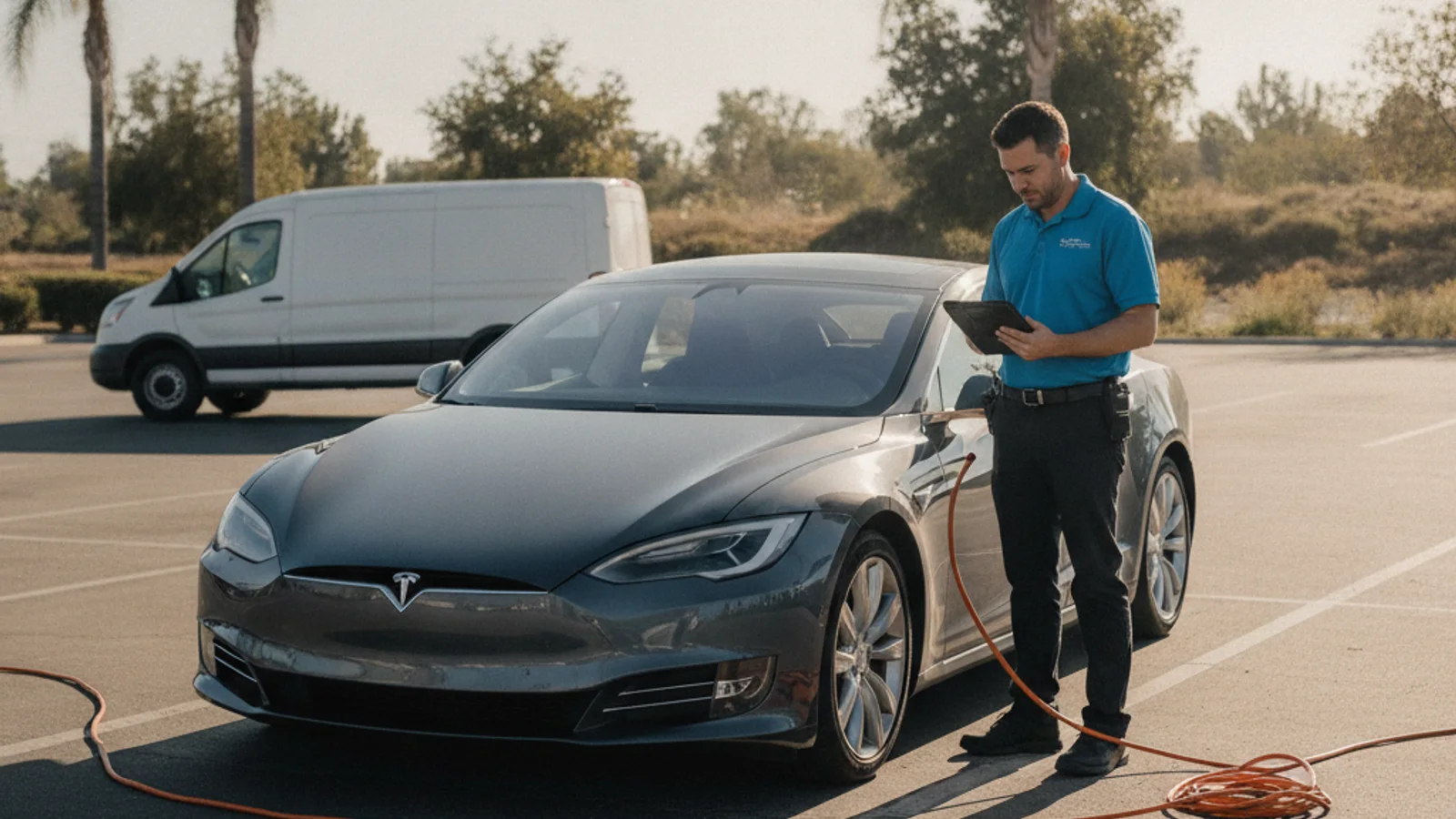
Two batteries, and only one wakes the car
A Tesla runs two power systems, not one shared pool. The traction pack drives the motors and sets the sticker range. A much smaller 12-volt-class battery runs the rest of the car. That list includes the touchscreen, cameras, door handles, and contactors.
Those contactors are heavy-duty relays on the high-voltage pack. They close only after low-voltage power is already present. Without the 12-volt, the main pack can’t come online. The small battery has to wake the computers first.
This layout isn’t unique to Tesla or to this metro. Nearly every production EV still keeps a low-voltage battery beside the traction pack. Cabin electronics and airbag modules are built around familiar 12-volt parts. Door locks and cabin lights aren’t designed for hundreds of volts.
While the car is awake or plugged in, a DC-DC converter feeds the 12-volt. It steps voltage down from the traction pack and keeps the small battery charged. Once the Tesla is asleep, that small battery works on its own. It powers Sentry Mode, app pings, and the always-on monitors. That’s why a parked car can go dark with a healthy pack.
What changes from Model 3 to Model X
Chemistry, location, and access aren’t the same on every Tesla. Some Teslas still use a lead-acid 12-volt. Others use a lithium low-voltage battery that fails in a different pattern. They aren’t diagnosed or replaced with the same steps.
Tesla has moved that battery more than once across the lineup. Model S, Model 3, Model X, and Model Y don’t share one cutoff year. A mid-year running change can beat any blog table you saved. This page won’t publish amp-hour ratings or a year-by-year chemistry chart. Those charts go stale the moment a factory swaps a supplier. The wrong part number leaves you with a battery that doesn’t fit.
Your owner’s manual for that VIN is the first reference. Tesla’s current service notes override anything a general article says. If you drive a newer Model 3 or Model Y, read our lithium 12-volt guide. For Model 3 layout, see where the 12-volt and pack sit. Cybertruck still has a low-voltage battery of its own. Don’t copy a Model S jump video onto a different body style.
On some Teslas you can picture the 12-volt from the frunk. On others, interior trim has to come off first. Some need access from underneath, which isn’t a driveway job. Tell the operator the exact model, year, and trim. Don’t guess the chemistry and treat it as fact.
Why long-stay lots around here drain it
The most common version of this stall isn’t an empty pack on I-270. It’s a traveler who left a Tesla in long-term parking. A week later the car won’t wake at all. That’s parasitic draw on the 12-volt, not a Supercharger issue.
Dulles is the usual setting for that return. MWAA publishes Level 2 charging in Garage 1 and Garage 2. Many drivers still park in the Economy Lot for the trip. It’s the largest on-airport option, with a shuttle at Curb 2F. A Tesla that sits there for a week leans on the 12-volt the whole time. For that stall, see mobile Tesla charging at the Dulles Economy Lot.
Reagan National is the closer airport for a lot of District and Arlington drivers. MWAA lists complimentary EV charging on Level 1 of Parking Garages 1 and 2. Those spaces are first-come, first-served, and the stall count is limited. A car that never got a plug still sits on its 12-volt all week.
Union Station’s garage is the same pattern after a rail trip. WMATA park-and-ride decks across the metro do it on commute days too. This page didn’t confirm which WMATA garages publish EV charging. Check WMATA’s own garage pages before you count on a stall.
Office parking in Tysons and North Bethesda adds a workday version of the sit. The car sleeps for hours with Sentry Mode armed. That background draw is what the 12-volt has to cover alone.
Weather makes a long sit harder on the western side of the metro. Dulles runs colder and snowier than Reagan National. Loudoun, upper Montgomery, and Prince William see harder freezes than the inner District. Older housing inside the Beltway often never got a wall connector. Takoma Park’s housing stock is about 90% pre-1980, per Census ACS 2019-2023. Annandale is about 79.8%, Wheaton about 73.1%, and the District about 70.3%. A Tesla on those streets still leans on the 12-volt overnight.
Dark and silent versus awake and empty
A dead 12-volt and an empty pack don’t look the same. Sort that out before anyone clips a cable to the car.
A failed 12-volt usually means total silence from the cabin. The screen stays black and the handles don’t present. The mobile app can’t reach the vehicle at all. Owners describe a car that looks shut down for good. The traction pack behind it is often still fine.
An empty traction pack usually still lets the car wake. The screen comes on and you get a range warning. If the app opens and shows a percent, it isn’t a dead 12-volt.
That split matters on a shoulder as much as in a garage. A dark Model 3 on the American Legion Bridge is a 12-volt suspect. A Model Y showing zero percent on I-66 is a pack problem. Same brand, but it’s a different rescue.
Maryland’s CHART Emergency Traffic Patrol lists jump starts among its assists. Dial #77 from a breakdown on a state primary roadway. That list includes I-495, I-270, US-50, and MD-295. CHART describes tire changes, jump starts, about a gallon of gas, and radiator water. Published CHART material doesn’t describe EV charging. Whether a given truck will jump a Tesla 12-volt isn’t confirmed here. Ask the technician before anyone attaches clamps to your Tesla.
VDOT’s Safety Service Patrol covers Virginia interstates, including I-66 in Northern Virginia. Published material covers incident clearance and short-term traffic control, not EV charging. The District has no DDOT motorist-assistance patrol that we could find. DC drivers rely on MPD, private roadside plans, and US Park Police on the parkways.
For a fuller symptom split, use our Tesla 12-volt diagnosis guide. For trip parking, see what happens when an EV 12-volt dies on a trip.
What to confirm before anyone opens a panel
Give the operator the model, year, and trim before they start. That trio decides chemistry, location, and how they reach the battery. Don’t send a Model X procedure to a Model 3. Don’t treat a lithium 12-volt like a lead-acid one.
Skip the video from a different model year. A routine frunk job on one Tesla is the wrong move on another. If you aren’t sure which system you have, say so. Guessing the part is how people buy the wrong battery.
Charge Pro DC is a referral line for stranded Tesla drivers. We match you with independent local operators. We don’t hold a trade license and we don’t own trucks. We don’t set the price or promise an arrival window. The operator quotes you before work starts and bills you directly.
The pros we connect you with can jump a Tesla 12-volt on site. They also handle broader Tesla roadside rescue if the pack is the problem. A mobile 240-volt visit typically adds 10 to 20 miles of range. That’s 15 to 30 minutes of charging time, never an arrival time.
Disabled-vehicle rules in DC, Maryland, and Virginia aren’t written just for EVs. The same pull-off rules apply as they do to any car. On NPS parkways, shoulders are narrow or missing. Report a disabled vehicle on the Baltimore-Washington Parkway to US Park Police.
If yours went dark after a long sit
Call when the Tesla is unresponsive, even if last week’s range looked healthy. That mismatch usually points at the 12-volt, not the pack. We’ll connect you with a local operator who confirms your car’s low-voltage setup first. Reach Charge Pro DC at (202) 629-0844 when the car stays dark.