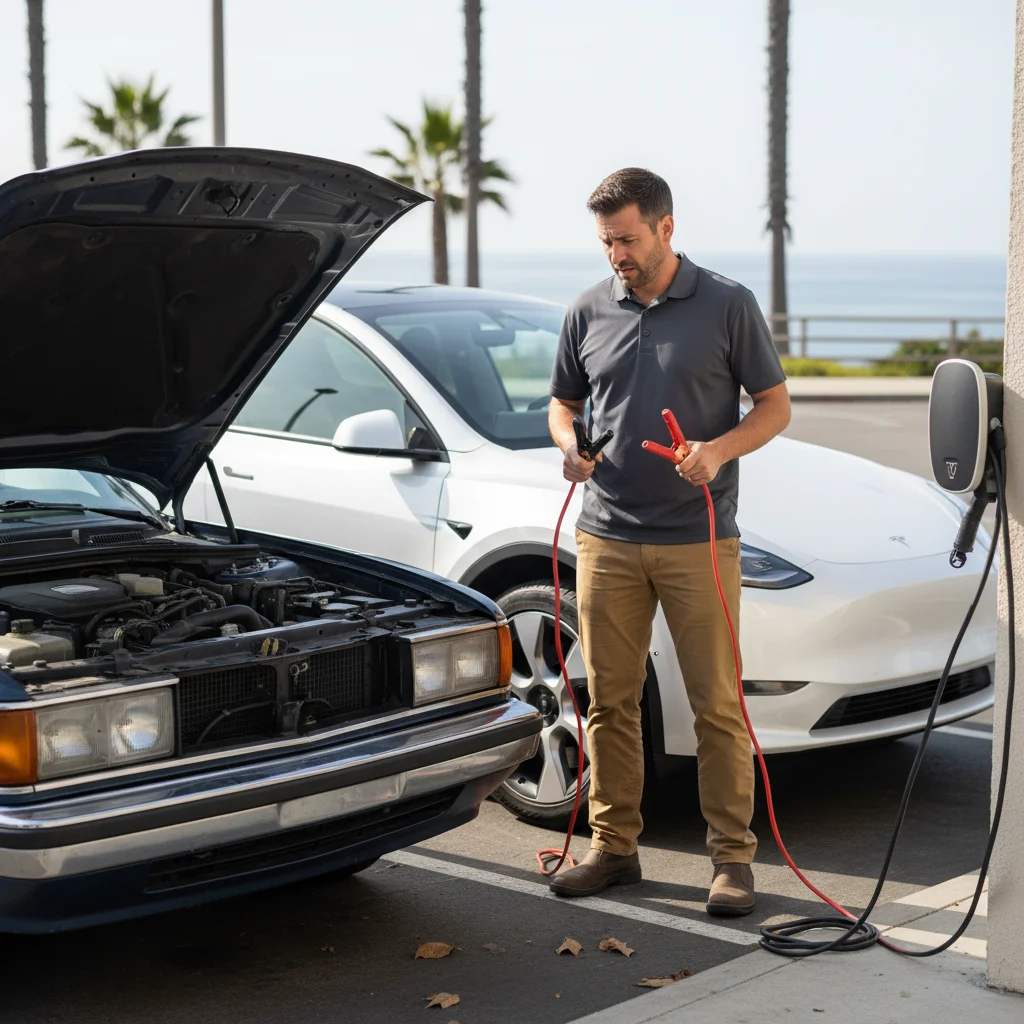
A Tesla can’t jump-start another car, even when that car is stuck on the Woodrow Wilson Bridge. The 12-volt posts in the frunk are inbound only. They wake your computers and close the contactors. They aren’t a donor pack for a stranger.
Why people still reach for cables here
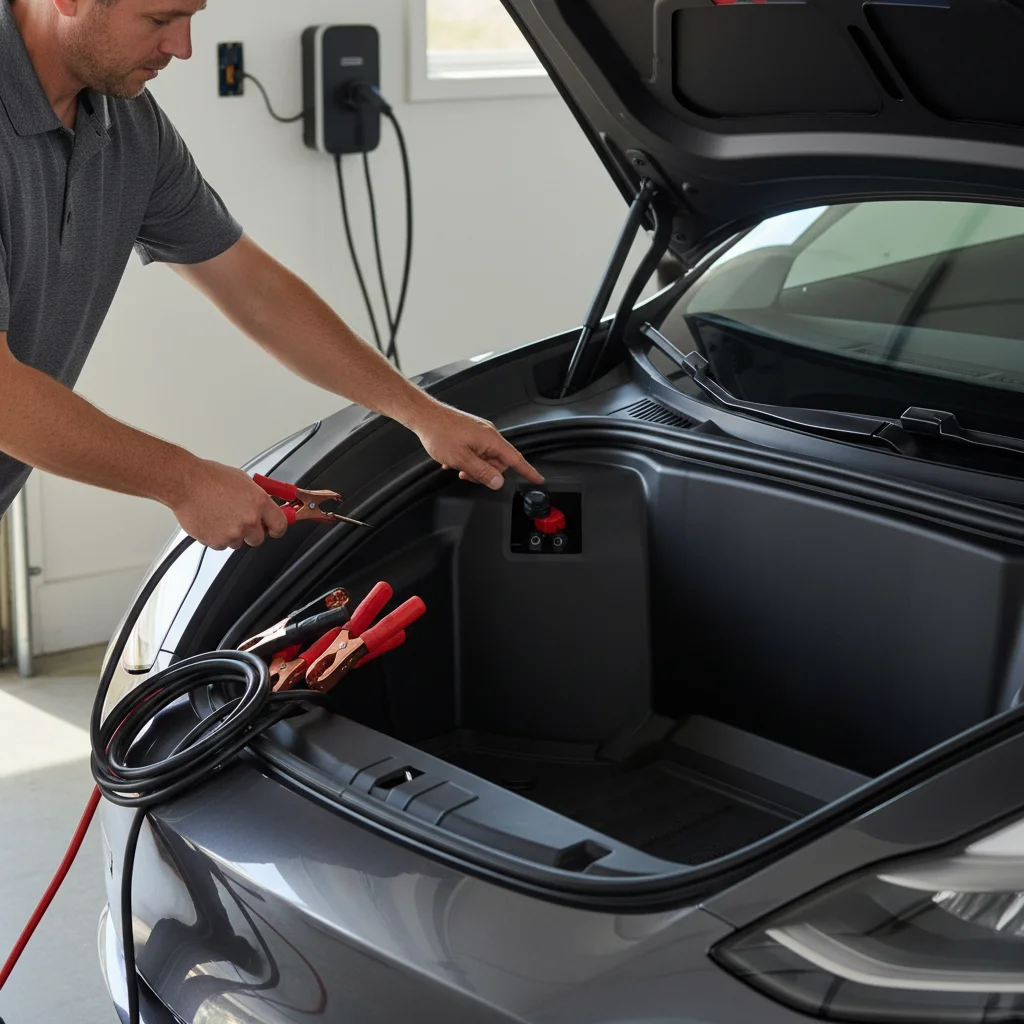
A dead battery used to mean jumper cables. Two gas cars and a set of clamps were the whole ritual. Teslas still hide 12-volt terminals under a frunk panel. The hardware looks familiar. The job isn’t.
That mix-up happens on this metro’s tightest shoulders. The Woodrow Wilson Bridge carries the Capital Beltway across the Potomac. It links Alexandria, Oxon Hill in Prince George’s County, and the District. A hood up on that deck sits at three jurisdictions at once. Shoulder space is thin. Wind on the span is real. Clipping your Tesla to their starter still isn’t the right help.
The American Legion Bridge is the other high, exposed Beltway crossing. It runs between McLean and Montgomery County. Both spans leave little room to work. Adding a second car and a cable set makes a small shoulder smaller.
What Tesla’s 12-volt system is built to do
In a gas car the 12-volt battery is a cranking tool. It dumps a short, violent current into a starter motor. That pack is sized for a few seconds of heavy draw.
A Tesla’s 12-volt battery is a gateway. It runs locks, lights, the screen, and the computers. Most important, it closes the contactors. Those contactors connect the high-voltage pack to the drive unit. If that low-voltage system is asleep, the traction pack stays isolated. The car looks fully dead even with miles left in the pack.
Tesla keeps that small battery topped off through a DC-to-DC converter. The high-voltage pack feeds a steady, modest current. The design assumes a quiet draw. It doesn’t assume a starter motor on the other end of jumper cables.
Older Teslas used a lead-acid 12-volt. Many newer Model 3 and Model Y cars use a lithium 12-volt. Chemistry doesn’t change the role. Neither pack is a donor battery. If your own Tesla is the dead one, those posts exist so power can come in. Jumping a Model 3, Y, S, or X is an inbound job. Sending power out is the part Tesla tells you to skip.
What happens if you treat it like a donor
Cables from your Tesla to a dead gas car reverse the design. You ask a small, protected circuit to behave like a starter battery. The draw can spike past what the converter and modules were sized for.
A few failures keep showing up:
- The DC-to-DC converter can take a reverse surge it was never built for.
- The 12-volt battery itself can be damaged by that dump.
- Voltage sag can confuse the computers that run the car.
- Tesla’s manuals warn that jumping another vehicle can damage yours.
We don’t publish a repair bill here. Confirm any quote with Tesla or a shop that has the car.
The other car doesn’t have to be gas. Most EVs use their 12-volt system as a wake-up gateway too. They don’t want a brute dump from your frunk either. For the wider question, see whether an EV can jump-start a gas car on the Beltway. The risks of jumping a gas car from a Tesla don’t change on a quiet street.
What Tesla’s manual actually forbids
Tesla’s published owner’s manuals for Model 3, Model Y, Model S, and Model X explain how to receive a jump. They also tell you not to use the car to jump another vehicle. The line is a notice. Damage is the stated risk.
That matches the hardware. The accessible posts are an inbound path. A proper jump pack can re-energize the low-voltage system. Then the car can close contactors and talk to the high-voltage pack. Those terminals aren’t a public outlet.
Procedures differ a bit by model and year. Check the manual for your exact car before you touch a terminal. The rule against jumping another vehicle doesn’t change.
Who actually jump-starts cars on these roads
A stranded gas car on a Maryland freeway can still get a conventional jump. MDOT SHA CHART Emergency Traffic Patrol works the Baltimore/Washington area. Technicians change tires, jump-start cars, add about a gallon of gas, and top radiator water. On state primary roads such as I-495, I-270, US-50, and MD-295, drivers reach them at #77. CHART material doesn’t describe charging an EV.
In Virginia, VDOT Safety Service Patrol covers interstates including I-95 and I-66. Published pages talk about incidents, debris, and short-term traffic control. They don’t describe EV charging. Drivers request that help through Virginia 511.
The 495 Express Lanes are their own layout. Transurban’s Express Assist patrol helps with minor mechanical issues. It will call a tow. It doesn’t tow. If you stall in those median lanes, pull to the LEFT shoulder. Stay in the car until help arrives. On the 95 and 395 Express Lanes, pull to the nearest shoulder.
The District is different. No DDOT motorist-assistance patrol turned up in the sources we checked. Drivers in DC lean on MPD, a private roadside plan, or parkway help. On the parkways, that means the National Park Service and US Park Police. A disabled vehicle on the Baltimore-Washington Parkway is reported to US Park Police at 202-610-7500. The George Washington Memorial, Clara Barton, Rock Creek, and Suitland parkways follow the same limited-access pattern. They ban commercial vehicles and trucks over 10,000 lb. Shoulders are narrow or missing.
The Wilson Bridge is the seam of Virginia, Maryland, and the District. Confirm which agency is already on scene before you add a second car to the shoulder. Disabled-vehicle rules still apply the same to an EV as to any car. DC, Maryland, and Virginia codes we checked don’t have a special out-of-charge rule. Pepco, Dominion Energy Virginia, and NOVEC publish home-charging programs. None of the utility EV pages we reviewed offer a charge-a-stranded-car service.
Safer ways to help without using your car
You can still help. You just shouldn’t become the power source.
A portable lithium jump pack belongs in the frunk for this. It’s built to crank a gas car. It stays isolated from your Tesla’s electronics. Connect the pack to their battery. Don’t connect your car to theirs.
If you don’t carry a pack, help them call. CHART at #77 is the Maryland freeway path for a conventional jump. Virginia 511 reaches VDOT patrol. On an NPS parkway, US Park Police is the documented number. If they have a club or insurer plan, stay with them while they place that call.
A ride off a live lane can be the most useful offer. That matters on the Wilson Bridge and the American Legion Bridge. It also matters on a Beltway shoulder with little room. Get to a safer lot. Then they can wait for a jump, a tow, or a shop. Your Tesla is a car, not a generator.
If the other driver is in an EV, check the 12-volt. They may need an inbound jump or a replacement. They don’t need a dump from your posts. If their traction pack is empty, they need a mobile 240-volt top-up, not jumper cables. Those are different failures.
When your own Tesla is the one that won’t wake
The 12-volt in a Tesla does fail. When it does, the car can look fully dead. Doors may not unlatch. The screen stays black. The app may already have shown a 12-volt service warning. Our 12-volt dead checklist walks through the signs.
That pattern is common after a long sit. Dulles International’s Economy Lot is the version travelers hit. MWAA lists Level 2 charging in Garage 1 and Garage 2. Its parking guides don’t list EV charging in the Economy Lot, the Terminal Lot, or Valet. Leave a Tesla in Economy for a week. You return to whatever the 12-volt has left. Reagan National is a different layout. EV charging sits on Level 1 of Parking Garages 1 and 2, first-come, first-served, for parking customers. MWAA has 2026 electrical upgrades expanding capacity there. Confirm current stall details with MWAA before you plan around them.
WMATA park-and-ride garages across the metro see the same long-sit 12-volt pattern. Confirm which garage publishes EV charging before you count on a plug overnight.
Apartment and condo garages create the same sit without an airport shuttle. Pre-1980 housing is a rough proxy for no home plug. Takoma Park, Annandale, Wheaton, and Washington show the oldest stock in Census ACS 2019-2023 figures. The no-home-plug call pattern is strongest where apartments cluster. That’s Arlington, Alexandria, the District, Silver Spring, Wheaton, Hyattsville, and Annandale. A Tesla that sat dark in those garages often needs a 12-volt wake. It often doesn’t need a public fast charge.
Western and northern suburbs add cold to the sit. Dulles runs colder and snowier than Reagan National. Loudoun, upper Montgomery, and Prince William see harder freezes than the District. A weak 12-volt may survive a mild week in the District. It may not survive a freeze in Leesburg or Germantown.
Don’t treat a black screen as an empty pack. Don’t clip another Tesla to yours as the donor. Receive power from a proper source. Follow the inbound steps for your model, or skip the DIY. Independent operators in the network jump or replace a dead 12-volt at the car. They also bring a 240-volt Level 2 source when the traction pack is the problem. Native NACS for Tesla. CCS or J1772 adapters for other EVs. A Level 2 visit typically adds 10 to 20 miles. That’s in 15 to 30 minutes of charging time. That’s plug time, never an arrival promise. The operator quotes you before work starts and bills you directly.
If you’re already stopped on the Wilson Bridge with an empty pack, stay with the car. Then read what to do on that span. If the 12-volt is the failure, the matching call is a Tesla 12-volt jump. Charge Pro DC is a referral line. It doesn’t own trucks. It doesn’t perform the work. The pros we connect you with are licensed and insured. They handle Tesla and every major EV brand.
Frequently asked questions
Can a Tesla jump start another car?
No. A Tesla shouldn’t jump-start another car. The 12-volt system is built to receive a wake-up, not to donate cranking current.
Can a Tesla jump start a gas car on the Wilson Bridge?
No. Don’t clip a Tesla to a gas car there, or anywhere else. Use a portable jump pack, or help them reach CHART, VDOT, or a roadside plan.
Can you jump a Tesla from another car?
A Tesla with a dead 12-volt can receive external power. Use a proper jump pack or a trained operator. Check your model’s manual before you connect anything.
If your Tesla won’t wake, don’t turn it into a donor. Same if you’re stuck in the District, Maryland, or Virginia. Call (202) 629-0844. We’ll connect you with an independent local operator.