You jump start an electric car on the 12 volt, not the traction pack. Use a lithium pack on the marked posts. Don’t clamp a running gas car onto those leads. A week in a Metro lot or airport garage is why that small battery dies. The traction pack can still read a healthy range. Clip red to the marked positive and black to the marked ground. Then let the car come up before you unhook.
Why a long sit here kills the 12 volt
You left the car at Dulles and rode the shuttle from Curb 2F. You flew for a week and came back to a silent app. MWAA lists Level 2 charging in Garage 1 and Garage 2. Reagan National puts EV charging on Level 1 of Parking Garages 1 and 2. Those stalls are first come, first served, with limited spaces. They don’t revive a 12 volt that sat dark somewhere else.
Union Station’s garage follows the same long-dwell pattern. So do WMATA park-and-ride decks across the metro. The car sleeps for days while telematics still sip power. Cold nights in Loudoun hit harder than a night along the inner Potomac. Dulles runs colder and snowier than Reagan National. You walk up and the handles stay flush. The last range number on the app still looked fine. That’s a 12 volt death after a trip, not an empty pack.
The same no-wake failure shows up at Greenbelt and Largo Metro parking. It shows up in Reston Silver Line lots too. The decks at Tysons Corner Center see it after a long shop. A crawl on I-270 between Rockville and Germantown can empty the big pack. A week of sitting empties the small one. A Tesla that won’t wake after economy parking still needs a live 12 volt.
Arlington, Alexandria, Silver Spring, Wheaton, Hyattsville, and Annandale stack a lot of apartment living. A large share of Takoma Park housing dates before 1980. Driveway Level 2 isn’t a given on those older blocks. The car sits unplugged more nights, then sits again at a Metro lot.
The 12 volt is what actually wakes the car
Every EV still has a 12 volt battery. It runs the screens, the locks, and the contactors that close the high-voltage pack. If it’s flat, the car is a brick with a full traction pack. Jumping that battery is how you wake the car. It isn’t how you add miles for the Beltway.
Pepco, Dominion Energy Virginia, and NOVEC publish home charging programs, not a stranded-car visit. Pepco covers the District, Montgomery County, and Prince George’s County. Dominion Energy Virginia covers most of Northern Virginia. NOVEC covers parts of Loudoun and Prince William.
MDOT SHA’s CHART patrol works the Baltimore/Washington metropolitan area. On I-495, I-270, US-50, and MD-295 you dial #77. Published help includes a tire change and a conventional jump start. That published list doesn’t describe charging an EV. VDOT’s Safety Service Patrol covers Virginia interstates, including the I-66 corridor, through Virginia 511. The published job is incidents and debris, not EV charging. In the District, no DDOT motorist-assistance patrol turned up in reviewed sources.
So how to jump start an electric car is a 12 volt job. It isn’t a utility truck, and it isn’t a freeway patrol filling the pack.
Don’t borrow a gas car’s electrical system
A running gas car holds a charging voltage well above a resting 12 volt. It can also spike for a moment under load. Gas electrical systems tolerate that kind of spike. An EV’s 12 volt feeds a DC-DC converter, body modules, and the battery management system. A spike or reversed leads can damage those parts. Tesla tells owners not to jump from another vehicle. Rivian, Ford, and Hyundai service information points the same way. Use a dedicated jump pack for this job. Don’t stretch cables across a garage aisle from a running SUV.
Use a lithium pack with polarity protection
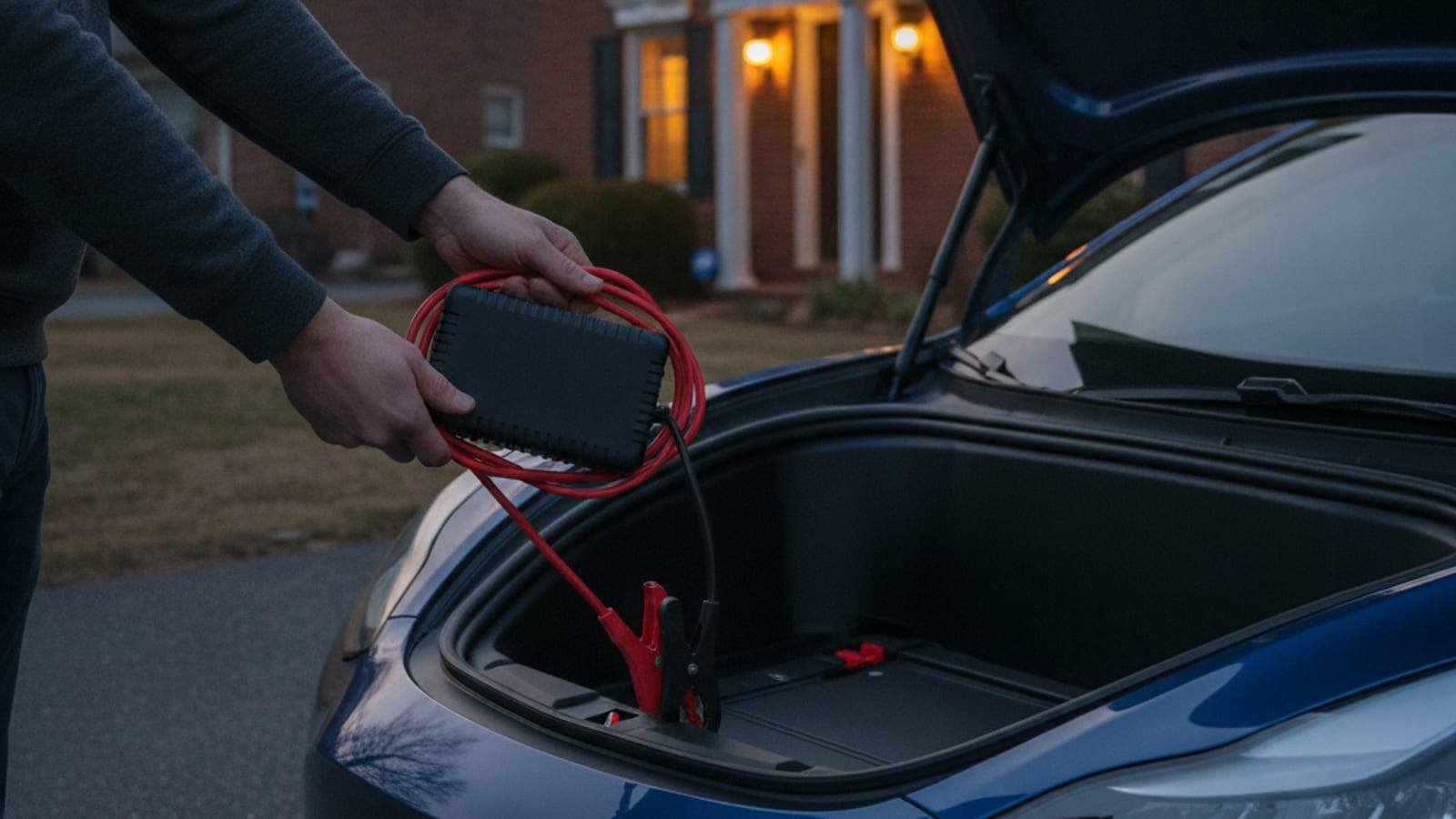
A lithium jump pack is a small battery with leads built on. It puts out a controlled 12 volts, not an alternator surge. That’s enough to wake a dead 12 volt. Pick a pack with reverse-polarity protection built in. Keep it in the frunk or the cargo hold.
The sequence that keeps the DC-DC converter intact
Follow your owner’s manual for waits and button presses. Polarity isn’t optional on these 12 volt systems.
- Check that the pack itself has charge on its LEDs.
- Find your model’s 12 volt access before you clip.
- Clip red to the positive post or the marked red pigtail.
- Clip black to the marked ground, not a random metal edge.
- Give the posts a short pause so voltage can settle.
- Wake it with a handle, the app, or the driver’s door.
- Leave the pack connected after it wakes so the DC-DC converter can take over.
- Pull the black lead first, then the red.

Clip red only to the marked positive, and black only to the marked ground. A newer pack may refuse to fire if you swap them. An older pack or loose cables won’t catch that mistake. Reverse polarity is how the DC-DC converter gets hurt. If the leads don’t match the labels, stop. Have an operator finish the jump for you.
If the lid won’t open, start at the bumper
Tesla Model 3, Y, S, and X
On a Model 3 or Y, pop the driver’s-side tow-eye cover on the bumper. Two pigtails sit behind it, red for positive and black for ground. Start the jump on those two pigtails first. When the frunk unlatches, you can finish on the real 12 volt terminals inside. Model-by-model Tesla jump points walk that access in more depth.
On Model S and Model X from 2021 on, use the front-door manual releases. Inside, pull the frunk release under the carpet and jump the terminals in the frunk. Older S and X cars use the bumper tow-eye pigtails.
Rivian and the F-150 Lightning
The fob’s power frunk needs a live 12 volt. On an R1T or R1S that’s dead, the manual cord is behind the grille. The 12 volt sits under a passenger-side panel in the frunk. Use the positive post and a marked ground stud. On a Lightning, look under the front bumper for a small pull loop. Once the frunk opens, the 12 volt sits on the driver’s side.
When the 12 volt lives in the back
Ioniq 5, EV6, and EV9 hide the 12 volt under the rear cargo floor. They still give you front jump posts in the front bay. You’ll see a red positive and a ground bolt. Jump from those front points, not the rear pack. The Chevrolet Bolt keeps the 12 volt under the rear load floor. Front-access posts sit in the under-hood bay too. Look for a red positive under a cap and a ground stud. The Mustang Mach-E parks the 12 volt in the rear cargo area. Labeled jump posts sit in the frunk instead. Try the app if it still answers you. If it doesn’t, a manual cable sits behind a kick plate on the driver’s-side floor. Polestar 2 keeps the 12 volt in the frunk. If the lid won’t move, a manual cable sits behind the driver-side headlight housing.
After the car comes back
Once it’s awake, drive it or plug it in. Either path lets the DC-DC converter recharge the 12 volt the right way. Don’t treat a jump as a rebuild of that battery. If the 12 volt dies again within a day, the battery is likely finished.
The pros the line connects you with can jump a Tesla 12 volt on site. They can also replace a tired 12 volt at the car. They quote before they start, and they bill you directly.
On the Baltimore-Washington Parkway, report a disabled vehicle to US Park Police at 202-610-7500. If you stall in the 495 Express Lanes, pull to the left shoulder. Whether a roadside crew can jump an EV is a 12 volt question. It isn’t a charge of the traction pack.
When you want an operator instead of a pack
Skip the DIY if you don’t have a pack, or if the jump won’t hold. Independent operators in this network bring a lithium jump pack. They can replace a dead 12 volt on site. Once the car accepts charge, they can add a 240 volt Level 2 top-up. It typically adds about 10 to 20 miles in 15 to 30 minutes of charging. It isn’t a promise of when someone arrives.
EV roadside assistance is the general path if you aren’t sure which job you need. For a quoted local operator in the District, Maryland, or Virginia, call (202) 629-0844.