The yellow truck on I-66 will not put miles in a Tesla. VDOT, Maryland’s CHART, and Express Assist all stop for disabled cars. They clear debris, jump a 12-volt, or radio for a tow. They don’t charge an empty traction pack. Shop for the best roadside assistance for Tesla cars here and start with that fact. The free patrols are real, and they’re the wrong tool for 0%.
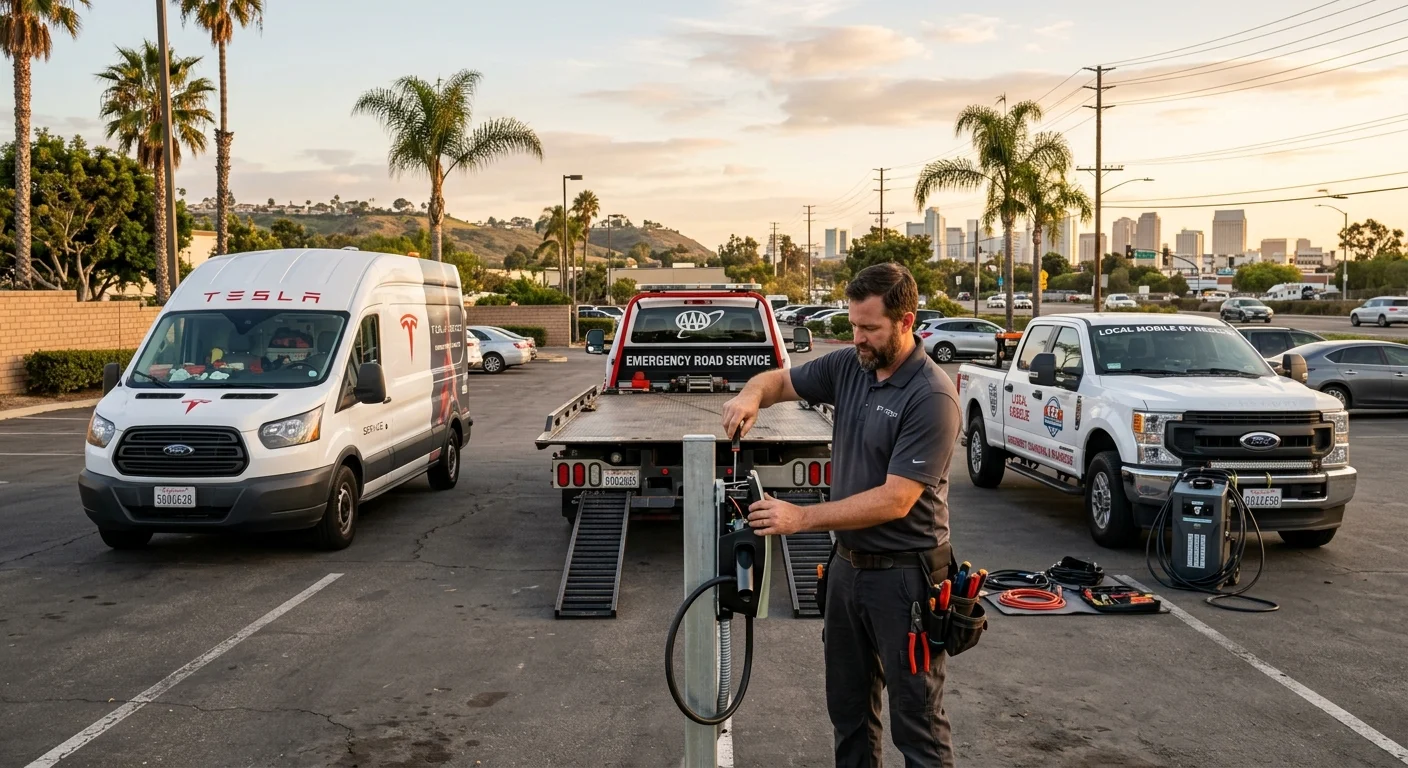
What the free patrols actually do in DC, Maryland, and Virginia
Stall on a Virginia interstate and you’ll likely meet VDOT’s Safety Service Patrol. It works I-95, I-66, and the rest of the interstate system. You reach it through Virginia 511. VDOT’s own pages describe incident clearance, debris, and short-term traffic control. They don’t describe plugging into an EV.
Maryland’s version is MDOT SHA’s CHART Emergency Traffic Patrol. It works the Baltimore and Washington area. On I-495, I-270, US-50, and MD-295, you dial #77. CHART techs change tires and jump-start 12-volt batteries. They add about a gallon of gas and radiator water. That’s a gas-car toolkit, not a Tesla pack fill. If the 12-volt was never the problem, the Tesla still sits empty.
The District is the odd one out. No DDOT motorist-assistance patrol showed up in the records we checked. Inside the District, help is MPD, a private plan, or Park Police.
Transurban runs Express Assist on the 495, 95, and 395 Express Lanes with VDOT. That patrol handles minor mechanical trouble and will call a tow. It doesn’t tow, and it doesn’t charge. If you’re stuck on the 495 Express Lanes, pull to the left shoulder. Those lanes sit in the median. On the 95 and 395 Express Lanes, take the nearest shoulder. Stay in the car until someone arrives.
Pepco serves the District, Montgomery County, and Prince George’s County. Dominion Energy Virginia covers most of Northern Virginia. NOVEC covers parts of Loudoun and Prince William. That includes much of Sterling, Ashburn, and Gainesville. Each one publishes home EV programs. None of them send a truck to charge a stranded car.
So the public safety net here is built for flats, overheating, and empty gas tanks. An empty Tesla pack is a private-plan problem.
Empty pack and dead 12-volt are not the same call
A Tesla that won’t wake is not automatically out of range. The 12-volt battery runs the computers, the contactors, and often the latches. When that small battery dies, the high-voltage pack can still be full. CHART’s jump, a club-plan jump, and Tesla roadside all know that job. Our guide to a dead Tesla 12-volt walks through the checks.
An empty traction pack is a different failure. Jumper cables don’t fill it. A gallon of gas doesn’t apply. DC, Maryland, and Virginia treat a stalled EV like any other disabled car. None of the three codes we reviewed add a special out-of-charge section. You’re a disabled vehicle. You still need miles.
A tow toward a Supercharger can solve that. You’re waiting for a hook, then waiting in a queue. A mobile 240-volt Level 2 visit adds range where the car already sits. Operators we connect you with typically add 10 to 20 miles. That’s 15 to 30 minutes of charging time on the cable. It’s not an arrival window.
Cold makes the pack question worse. Dulles runs colder and snowier than Reagan National. Loudoun, upper Montgomery, and Prince William see harder freezes than the inner core. A typical EV keeps about 80% of range at freezing. It keeps about 70% at 20F, per Recurrent Auto’s winter study. Cabin heat comes from the same battery that has to move the car. Sitting in Beltway gridlock with the heat on burns miles you never drove. That’s the I-95 standstill problem.
Tesla roadside: the factory file, not a rolling charger
Tesla roadside is included with a new car through the warranty period. The people on the phone know the model. They can see what the car is reporting. Use that channel for a flat, a lockout, or a service-center tow. What Tesla roadside covers is the longer version.
What Tesla often doesn’t roll is a 240-volt source that stays with you. Out-of-charge help is frequently a tow toward a Supercharger. It’s not a top-up in the lane you’re already in. Warranty roadside also ends. An older Model 3 or Y may already be on a paid extension. It may be on nothing at all.
Tesla also sends contractors. The person at the bumper may be a local tow operator Tesla called, not a Tesla employee. That’s normal, and it’s still a contractor. It’s also why a second number in your phone isn’t a snub. It’s backup for the hour Tesla can’t send anyone. Tesla roadside versus a quoted local operator is the side-by-side.
Club plans: the long tow, not a promise of 240 volts
AAA and the other club plans earn their keep on distance. People keep the card in the Model Y for the long tow. If the car needs a ride across Fairfax County, that network is the point. Same for a Prince William commute into Montgomery County.
Some of those plans sell an EV add-on. Treat it as extra language on a tow membership. It’s not a dedicated charging fleet parked in Arlington tonight. Ask the dispatcher what they can actually send. That might be a jump, a wrecker, or a 240-volt source. If they only offer a tow, read when AAA can’t charge your EV.
Club techs are usually fine on a 12-volt. That matches CHART. It doesn’t match a Tesla at 0% on I-66 inside the Beltway. It also doesn’t match I-270 between Rockville and Germantown.
Local mobile rescue: miles where the car sits
Charge Pro DC is a referral line. We match stranded drivers with independent local operators. We don’t hold a trade license for the work. We don’t own the trucks or employ the technicians. We don’t set the price or quote an arrival clock. The operator quotes you before a cable goes in. They bill you directly.
On site, the job is a 240-volt Level 2 source at the car. Tesla takes a native NACS plug. Other EVs take a CCS or J1772 adapter. Fifteen to thirty minutes on the cable is typically 10 to 20 miles. That’s enough to roll to a charger you already chose. They can also jump or replace a dead 12-volt without dragging the car.
That’s Tesla roadside rescue when the badge is Tesla. It’s mobile EV charging when the badge isn’t. It isn’t a long wrecker ride. Keep the club plan for the long hook. Call a mobile operator for the empty pack the patrols won’t fill.
Choose by the shoulder you’re on
Interstates and the Express Lanes
Get out of the travel lane and put the hazards on. On the 495 Express Lanes, that’s the left shoulder. Then name the failure. A 12-volt no-start can wait for CHART, Tesla roadside, or a club jump. An empty pack on the Capital Beltway needs a charge. A tow to a charger is the other option. The patrol won’t do the charge.
I-270 and the Beltway’s general lanes are free. I-66 inside the Beltway is tolled at peak. None of that changes the physics. Zero is zero in a travel lane.
Parkways
The Baltimore-Washington and George Washington Memorial Parkways are NPS roads. So are Clara Barton, Rock Creek, and Suitland Parkway. Shoulders are narrow or missing. Commercial vehicles and trucks over 10,000 lb are banned. Call US Park Police at 202-610-7500 for a stall on the Baltimore-Washington Parkway. Arrange charging once you’re in a legal, safe spot. Don’t do it in a live parkway lane.
The two Potomac bridges
The Woodrow Wilson Bridge carries the Beltway across the Potomac. It sits between Alexandria, Oxon Hill, and the District. A breakdown there sits on three jurisdictions at once. The American Legion Bridge carries the Beltway between McLean and Montgomery County. Both spans are high, windy, and short on shoulder. Don’t argue about which code applies from the car. Get to a safe position. Then call for a 12-volt jump or a pack top-up.
Garages, Metro lots, and the airports
A lot of dead Teslas here never made it to a freeway. They sat long enough for the 12-volt to die. Reagan National has complimentary EV charging on Level 1 of Parking Garages 1 and 2. Those spaces are first come, first served. Dulles has Level 2 charging in Garage 1 and Garage 2. A week in a garage still kills 12-volts. WMATA park-and-ride lots produce the same pattern. So do apartment and condo buildings in Arlington, Alexandria, and the District. Silver Spring, Wheaton, Hyattsville, and Annandale see the same morning no-start. Much of that housing predates a wall connector. Takoma Park’s stock is about 90% pre-1980. Annandale is close behind at about 80%. That’s a driveway-plug problem that shows up as a no-start.
If you keep only one, match it to the failure
Tesla roadside is the right first call when the car is under warranty. Use it when the issue looks like Tesla’s problem. That’s a flat, a lockout, a diagnostic, or a tow toward service. It’s a weaker first call when the pack is empty. You need miles in the lane you’re in.
A club plan is the right first call when you need a long tow. It’s weaker when the dispatcher is still hunting for 240 volts.
A local mobile operator is the right first call when the pack is empty. It’s also right for a dead 12-volt that you want fixed here. It’s the wrong first call when you need a wrecker across three counties.
In 2026, the best roadside assistance for Tesla drivers here is still a stack. Tesla for the factory file. The club for the long hook. A local 240-volt operator for the nights VDOT, CHART, and Express Assist can’t fix.
When the pack is empty, get a quote
If the Tesla is at zero, we connect you with a local operator. Same if the 12-volt won’t wake the car. They quote before they start, then bill you. Call (202) 629-0844.