You land, ride the shuttle, and walk back to the stall. The Tesla looks untouched from the aisle. Then the handles stay flush and the glass stays dark. The app says the car is offline. You didn’t drain the pack before the trip. A week at Reagan National or Dulles is enough. A Metro garage sit does the same. The 12 volt battery is usually what died.
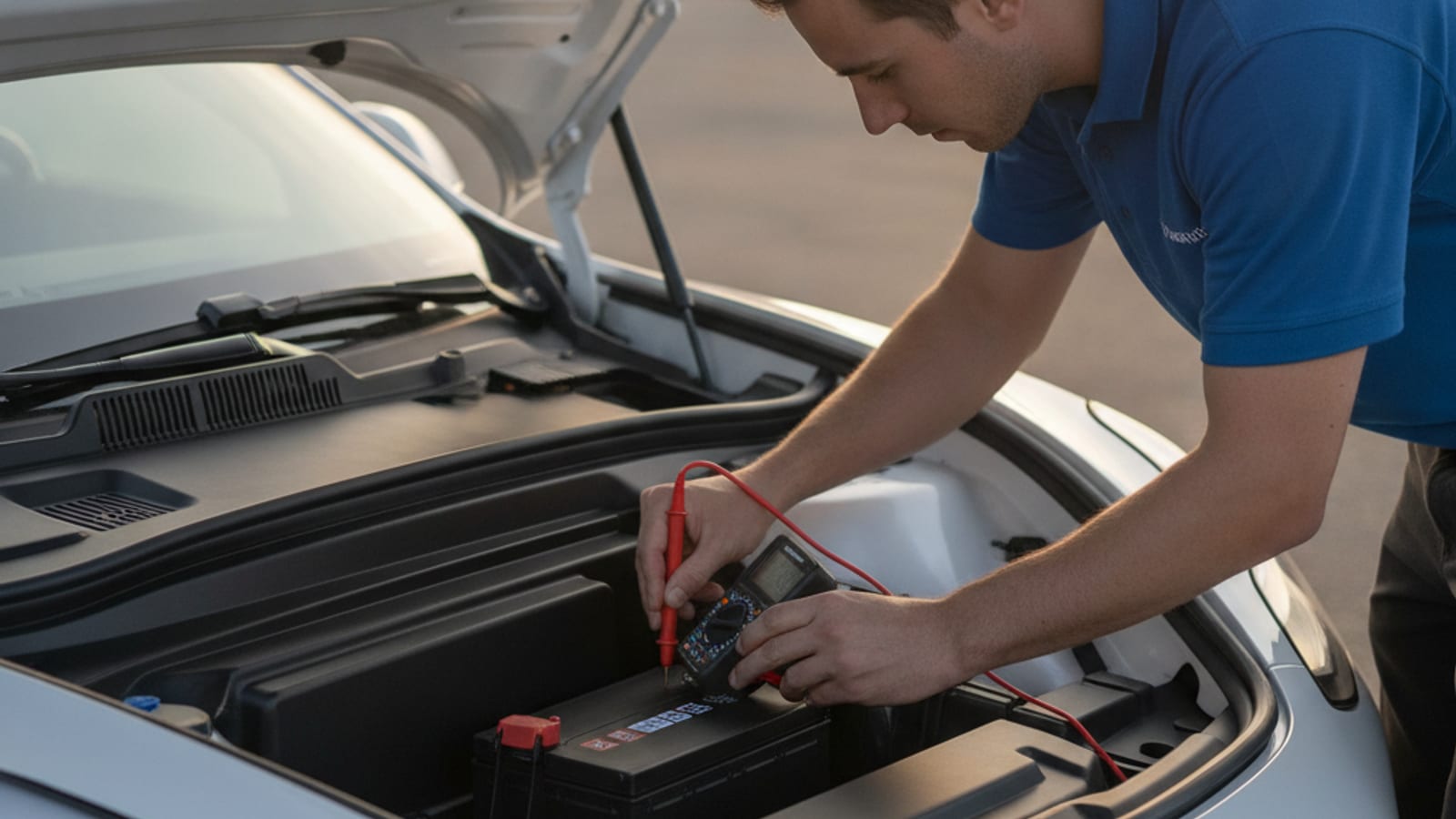
That’s the local failure. Long sits at DCA, Dulles, and Metro park-and-ride decks starve that small battery. It’s the battery that wakes everything else. The traction pack can still show a healthy percent. Until the 12 volt closes the contactors, the pack cannot help. None of that energy reaches the locks, screens, or charge port.
Why long-stay parking here kills the 12 volt
Travelers in this metro leave Teslas sitting for days. They come back to a car that won’t wake. Reagan National puts complimentary EV charging on Level 1 of Parking Garages 1 and 2. Those stalls are first come, first served, and they connect straight to the terminal. Dulles has Level 2 charging in Garage 1 and Garage 2. Many people still park in the Economy Lot. It’s the largest on-airport option, and the shuttle picks up at Curb 2F. Union Station’s garage runs the same week-long sit. So do WMATA decks in Reston, Arlington, and Silver Spring. Office garages around Tysons Corner Center do a shorter version of the same sit. The car can run Sentry all day in the deck. You come back after work and the handles stay flush.
Sentry mode is the quiet drain. The car keeps cameras awake the whole time you’re gone. That load hits the 12 volt. The traction pack can recharge it. That only works while the pack still has enough energy. Cabin overheat protection does the same in summer. Climate cycles to protect the interior. A humid stall above 90F will keep asking. Dulles runs colder and snowier than Reagan National. A lead-acid 12 volt can collapse after a freeze in Herndon or Ashburn. That can happen even if you plugged in before you flew.
Age finishes the job. Older Teslas used a lead-acid 12 volt. It wears out after years of heat and long sits. Newer Model 3, Y, S, and X cars use a lithium 12 volt. It lasts longer. It still dies. A weak cell can look fine at rest. It drops the moment a handle tries to present.
How to tell it’s the 12 volt
Read it as a dead 12 volt when most of these stack:
- Center screen black through the windshield
- Handles never present for the phone key
- App shows the car offline after a recent charge
- Frunk command in the app does nothing
- Lights, horn, and turn signals stay dead
- Charge port won’t open or light
If the screen is alive and only one handle fails, check that door first. A driver’s handle that presents while the others stay flush is a door module. That’s not the 12 volt.
Every Tesla still has this small battery beside the traction pack. It runs the computers, locks, lights, and contactors. The contactors have to close before the pack can power the car. That’s why a Tesla that won’t wake is so often the 12 volt. It can happen at 80 or 90 percent on the big pack.
Jump from a lithium pack, never from another car
Don’t clip jumper cables from a running gas car onto a Tesla. An alternator feed is a harsh, high-amp 14-volt dump. Tesla 12 volt electronics are not built for it. Use a dedicated lithium jump pack at 12 volts. Another vehicle can damage the DC-DC converter.
Model 3 and Model Y
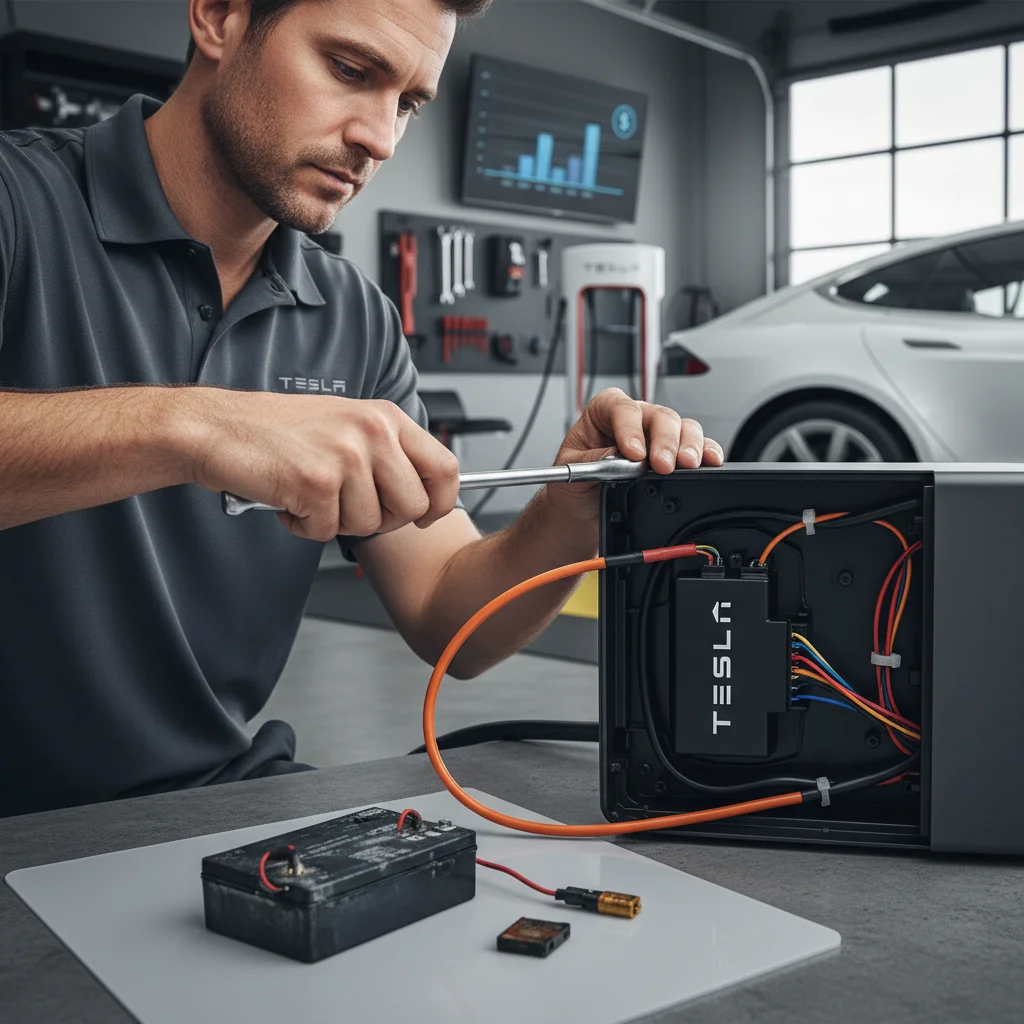
Emergency jump terminals sit behind a small cover on the front fascia, driver side. That’s Tesla’s path when the frunk won’t open. Press the rectangular insert until it pops. A thin card under the top edge helps if it sticks. You’ll see a red positive lead and a black ground. Clip red to positive, black to ground. Wait about 30 seconds. The frunk should unlatch. Open it if you need the real battery terminals for a cleaner clamp.
Model S and Model X, 2021 and newer
Refreshed S and X cars moved the 12 volt toward the rear. There’s no front tow-eye jump point. Use the mechanical door release by the window switch on a front door. Once you’re in, find the frunk release under the carpet or in the footwell. Jump terminals are in the frunk after it opens.
Older Model S and Model X
The 12 volt lives in the frunk. Front fascia jump points work like the Model 3 path. Same leads, same lithium pack, same short wait before latches wake.
See how to jump a Tesla Model 3, Y, S or X for clip order by model. If no door will open at all, stop prying. That’s a lockout, and an operator should take it from there.
Once it wakes, replace it or charge the pack
Two checks, in that order.
First, how worn is the 12 volt. Tesla often shows a low 12 volt warning in the service screens. That can appear weeks before a full death. If you already saw that message, the jump only bought you a wake. Schedule a replacement. The independent operators we connect you with can jump a Tesla 12 volt on site. They can replace it there when the battery is done.
Second, did the traction pack sag while you were gone. A car at a few percent for weeks may shut systems down. Plug into Level 2 if you can reach it. After a stretch of charging, the car should hold the 12 volt up. If you’re still in the stall, a mobile 240-volt visit can still help. Operators typically add 10 to 20 miles of range. That takes 15 to 30 minutes of charging. That window is charging time, not an arrival time.
Lead-acid 12 volts on older cars are the repeat offenders. They take a jump, then die overnight. Lithium 12 volts on newer cars fail less often, and they still fail. If it dies again the next morning, stop jumping. Replace it.
Skip the tow when a jump and a short charge will move the car. Towing a Tesla with no power is a separate job. That holds across the District, Maryland, and Virginia. Wake the 12 volt first when you can.
When a quoted operator is the better move
Call if you can’t pop the frunk. Call if you already jumped it and it died again. Call if the car wakes into a stack of service alerts. Call if you’re in a long-term stall at Dulles or DCA. Call if you have no jump pack. The same applies in a Metro garage after a work week. That includes the lots people use in Arlington and Herndon.
Charge Pro DC is a referral line. It matches stranded EV drivers with independent local operators. They cover the DC area, Maryland, and Virginia. The operator quotes you before work starts and bills you directly. The brand doesn’t own trucks and doesn’t do the work. The pros we send jump or replace a dead 12 volt on site. They can also bring a 240-volt Level 2 source. It uses a native NACS plug, plus CCS or J1772 adapters.
For a wider Tesla stall, see Tesla roadside rescue. If the car sat in the Economy Lot after a flight, mobile Tesla charging at Dulles covers that stall pattern.
A dead 12 volt after a long sit at DCA or Dulles is not a ruined pack. A Metro garage sit is the same failure. Check the small battery. Jump it with a lithium pack. Replace it if it won’t hold. If you can’t get in, call (202) 629-0844. An operator can quote a jump or a replacement on site.