Tesla roadside assistance is bundled with the Basic Vehicle Limited Warranty. That window is four years or 50,000 miles, whichever comes first. After that window, Tesla bills the dispatch. A public 2026 fee table couldn’t be confirmed on tesla.com. You check the Tesla app and tesla.com/support before you authorize a call. In the DC area, the independent operator who takes a local job still quotes you first. That quote comes before any work starts. Then that operator bills you directly.
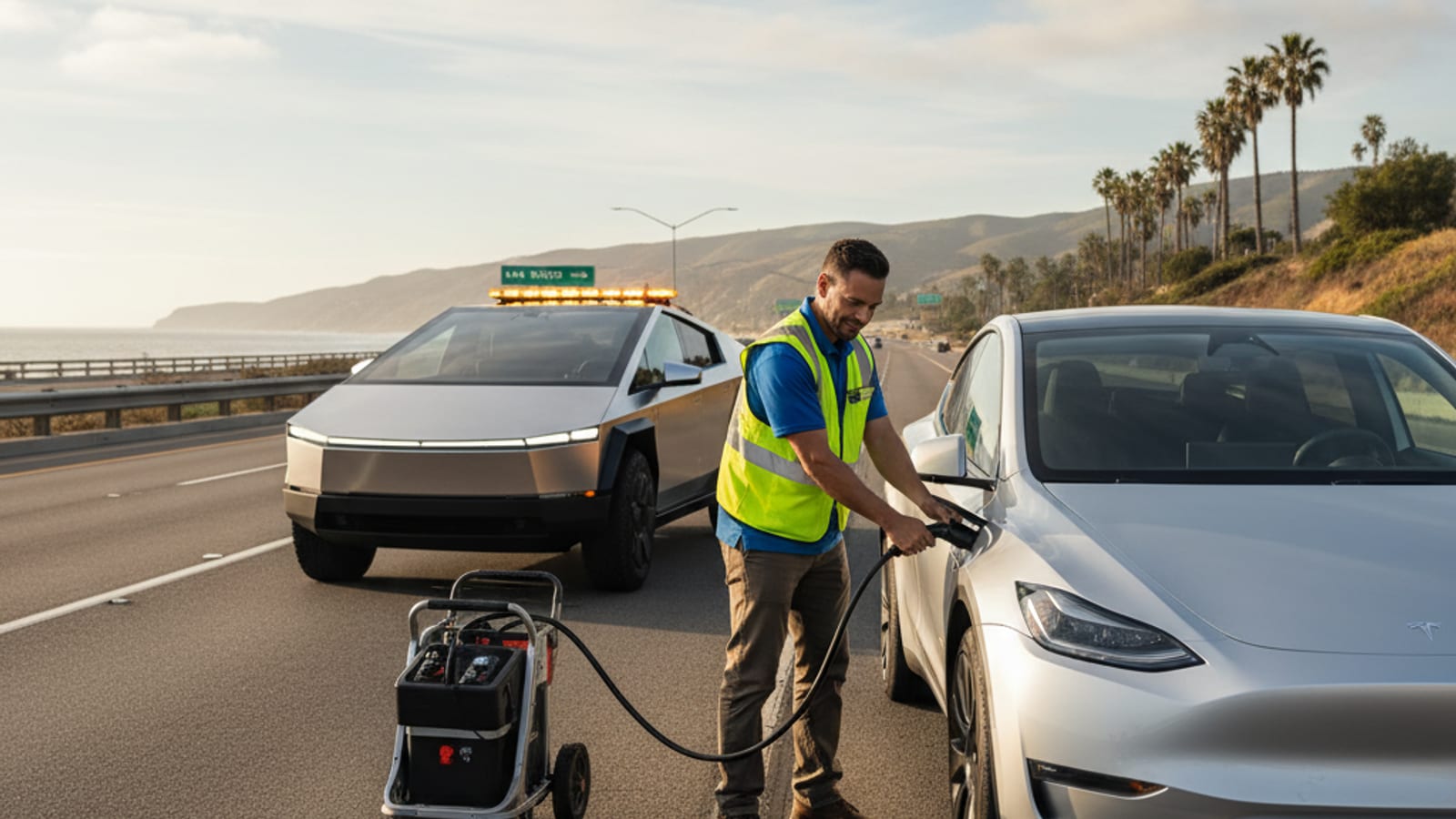
Tesla’s plan is national. Your stall is local.
Tesla roadside is the same program in every state. Coverage doesn’t change because you emptied the pack on I-270 through Rockville. It also doesn’t change on I-66 inside the Beltway. What changes is the pavement and the patrol that can stop. A tow might not even be the help you need.
A Model Y that won’t wake in a WMATA garage is often a dead 12-volt. It isn’t always an empty traction pack. A Model 3 that hits zero on the Woodrow Wilson Bridge sits at a three-jurisdiction line. That’s Virginia, Maryland, and the District. Tesla’s national script still starts the same way. Who can actually reach the car might not.
Confirm your warranty dates in the Tesla app. Confirm current roadside terms on Tesla’s support site. An Extended Service Agreement or a Certified Pre-Owned contract can change the window. Don’t assume the Basic Vehicle Limited Warranty still applies.
What Tesla roadside usually covers
Tesla’s published roadside help, while you’re inside that warranty, typically includes a short list of stalls. Check tesla.com/support for the live wording.
Flat tires
Tesla can send someone to plug a tire or tow the car to a shop. Tesla doesn’t typically carry a matching spare. If the tire can’t be repaired on the shoulder, the next step is a tow.
Lockouts
If the phone key dies or the car won’t unlock, Tesla can often open it remotely. A mobile charging operator is the wrong call for a lockout.
An empty traction pack
Tesla may arrange a tow to the nearest Supercharger when the pack is depleted. A Tesla Service Center is the other drop. Tesla’s support language treats that help as limited. Tesla’s published path is a tow, not a charge at the car. Tesla generally doesn’t send a mobile charger.
A dead 12-volt
The 12-volt, or low-voltage, battery wakes the screens, the locks, and the high-voltage contactors. When it dies, the car looks fully dead. Tesla may jump it or replace it.
A warranty defect that leaves the car stuck
If a covered defect makes the car inoperable, Tesla tows it to the nearest service center. Tesla sets the bill for issues outside the warranty. Charge Pro DC doesn’t.
See Is Tesla roadside assistance free, and what it won’t cover for the national plan’s limits.
What Tesla won’t do on the Beltway
Tesla’s national path still ends at a contractor. For an empty pack, that usually means a flatbed. That’s a hard fit on several roads here, even when the warranty is live.
On the 495 Express Lanes, Transurban’s published safety rule is to pull to the left shoulder. Those lanes sit in the median. On the 95 and 395 Express Lanes, pull to the nearest shoulder. Stay in the car until help arrives. Express Assist is a free patrol on those lanes. It helps with minor mechanical issues at no charge and will call a tow. It doesn’t tow. Published FAQs don’t describe EV charging.
VDOT’s Safety Service Patrol covers Virginia interstates, including I-95 and I-66 in Northern Virginia. You reach that help through Virginia 511. VDOT describes incident clearance, debris, and short-term traffic control. It doesn’t describe charging a stranded EV.
Maryland’s CHART Emergency Traffic Patrol covers the Baltimore/Washington metropolitan area. That includes I-495, I-270, US-50, and MD-295. Dial #77 from a breakdown on those state primary roadways. CHART technicians change tires and jump-start 12-volt batteries. They also add about a gallon of gas and bring radiator water. CHART doesn’t describe a charge for an empty EV pack.
In the District, no DDOT motorist-assistance patrol turned up in the sources we checked. Drivers there lean on MPD, a private roadside plan, or US Park Police on the parkways.
NPS parkways are their own map. The Baltimore-Washington Parkway and the George Washington Memorial Parkway ban commercial vehicles. They also ban trucks over 10,000 lb. Shoulders are narrow or missing. A disabled vehicle on the Baltimore-Washington Parkway is reported to US Park Police at 202-610-7500. Tesla can still log the request. When Tesla roadside assistance can’t help a DC-area driver walks through those stalls.
The three jurisdictions’ vehicle codes we reviewed have no special rule for an empty EV pack. Disabled-vehicle rules apply to an EV the same way they apply to any car.
How much Tesla roadside costs after warranty
Tesla’s out-of-warranty price doesn’t have a clean public answer.
Tesla doesn’t publish a current per-service fee table on tesla.com. We couldn’t verify a 2026 public price list. Third-party roundups quote dollar figures. Those figures couldn’t be confirmed against Tesla’s own support pages, so they aren’t repeated here. Out of warranty, Tesla bills the call. The amount depends on the service, the miles, and what Tesla’s contractor can do. You see the charge in the Tesla app or on the card Tesla has on file. Check that screen before you tap to dispatch.
Extended coverage and Certified Pre-Owned contracts can keep roadside in the bundle longer. They can also exclude events Tesla treats as owner error, including an empty pack. Read the contract. If the wording is unclear, Tesla Support is the authority, not a blog.
A local operator is a separate bill. Charge Pro DC doesn’t set prices, doesn’t take the payment, and doesn’t own the truck. The operator who accepts the job quotes you before starting and bills you directly. For how that quote works, see What you pay for mobile EV charging, and who bills you.
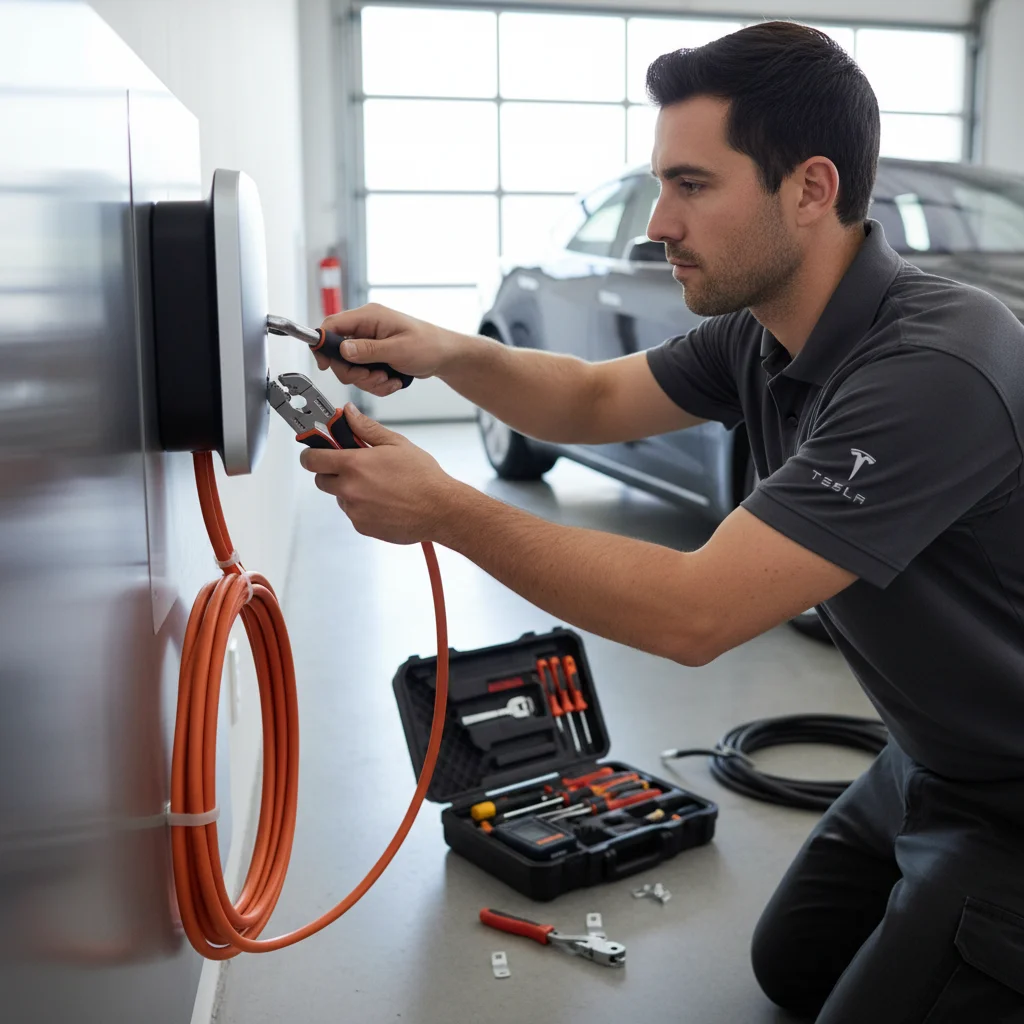
Empty pack, dead 12-volt, or a tire
You ran the traction pack to zero
Cabin heat and air both come from the pack. Recurrent Auto studied more than 30,000 EVs in winter. A typical car keeps about 80 percent of range at freezing. It keeps about 70 percent at 20F. Don’t treat those as Tesla-only numbers.
Dulles runs colder and snowier than Reagan National. Loudoun, upper Montgomery, and Prince William feel that first. Sitting still with the climate on burns charge without covering miles. That’s the Beltway crawl and the I-95 standstill.
Tesla’s usual answer to a zero pack is a tow. The tow goes to a Supercharger or a service center. The operators we connect you with bring 240-volt Level 2 to the car. Native NACS for Tesla. CCS or J1772 adapters for other EVs. They typically add 10 to 20 miles of range. That takes 15 to 30 minutes of charging. That’s charging time, not an arrival time. Out-of-charge recovery is the name for that visit. So is mobile EV charging.
Pepco serves the District, Montgomery County, and Prince George’s County. Dominion Energy Virginia serves most of Northern Virginia. None of the utility EV pages we reviewed offers a service that charges a stranded car. Those programs are for home equipment. They won’t meet you on the American Legion Bridge.
The car won’t wake
Long sits kill 12-volts. Travelers coming back to Reagan National can plug in on Level 1. That charging sits in Parking Garages 1 and 2, complimentary for parking customers. Dulles has Level 2 charging in Garage 1 and Garage 2. Union Station’s garage and WMATA park-and-ride lots produce the same week-long sit. The car looks dead. The traction pack may still hold miles.
Older housing tracks with no driveway plug. Takoma Park, Annandale, Wheaton, and Washington all have high shares of pre-1980 stock. The operators we connect you with can jump or replace that 12-volt on site. See Tesla 12V battery jump.
The tire is flat
Tesla roadside may still be the right first call for a tire. That’s a Tesla dispatch to a tire vendor or a tow. Charge Pro DC matches drivers with mobile charging and 12-volt help. It isn’t a tire shop network.
When a local operator is the better second call
Call Tesla first when you’re inside warranty and the stall matches their list. That means a covered defect or a remote lockout. It also means a tire Tesla will handle, or a tow they’ll authorize. Then call a local operator if Tesla can’t send mobile charging. Call if you’re on a parkway or an Express Lane. A bridge with a flatbed is a poor fit too.
Tesla roadside rescue is how Charge Pro DC labels that match. The brand doesn’t hold a trade license, doesn’t own trucks, and doesn’t employ technicians. It refers you to independent local operators across the District, Maryland, and Virginia. The pros we connect you with are licensed and insured. Those operators quote before they start.
Charge Pro DC is a referral line. Call (202) 629-0844 and we’ll connect you with a local operator. That operator quotes the job before any cable goes in, and bills you directly.
Frequently asked questions
How much is Tesla roadside assistance?
It’s included while the Basic Vehicle Limited Warranty is in force. That window is four years or 50,000 miles, whichever comes first. After that, Tesla bills per dispatch. A verified 2026 public fee table couldn’t be confirmed on tesla.com. Check the Tesla app and tesla.com/support for the amount Tesla will charge you. A DC-area operator is a separate quote, given before work starts.
Is Tesla roadside assistance free?
It’s bundled with the Basic Vehicle Limited Warranty. Some Extended Service Agreements and Certified Pre-Owned contracts keep it too. Confirm your car’s dates in the app. Out of warranty, Tesla bills the service. Tesla Support is the source for that line, not a guess.
What does Tesla roadside cover, and when do you still call us?
Typical coverage is flat tires, lockouts, and 12-volt help. It also covers towing for a covered defect. At Tesla’s discretion, they may tow you to a Supercharger when the pack is empty. Tesla generally doesn’t charge the car on site. The operators we connect you with quote a 240-volt top-up or a 12-volt jump before they start.