You walked back to a Ford Mustang Mach-E that won’t start. The screen stays dark after a week in a Reagan National or Dulles garage. Start with the 12-volt battery, not the traction pack. The small battery that wakes the car is what died in the lot.
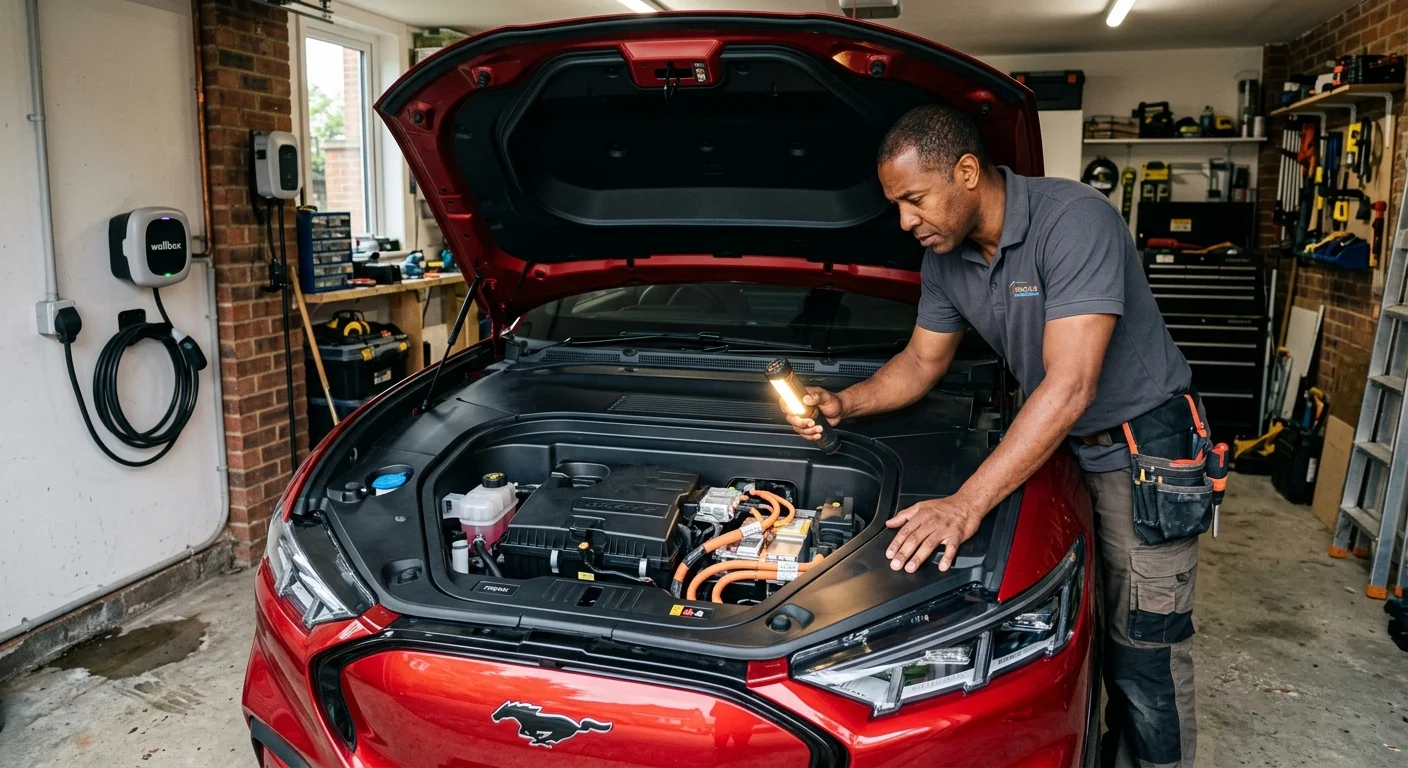
Airport parking is a long sleep for a Mach-E 12-volt
A Mach-E can sit with plenty of range and still refuse to wake. The 12-volt runs the computers, locks, lights, and contactors. Those contactors are what connect the high-voltage pack. If the 12-volt is flat, the pack never gets a chance to work.
Reagan National keeps EV charging on Level 1 of Parking Garages 1 and 2. Those stalls are complimentary for parking customers, and they’re limited. They’re first-come and first-served, with 2026 electrical upgrades expanding capacity. Garages 1 and 2 connect directly to the terminal. A car on a non-charger stall still sits all week. Accessory drain doesn’t wait for a free stall one floor down.
Dulles has Level 2 charging in Garage 1 and Garage 2. Many travelers still pick the Economy Lot for a long trip. It’s the largest on-airport option, reached by shuttle from Curb 2F. Leave a Mach-E in that lot for a week. You come back to whatever the 12-volt still held. The drive home often hits the Dulles Toll Road, then I-66. A Mach-E that won’t wake never makes that exit. The same long-dwell pattern shows up in WMATA park-and-ride garages.
Dulles runs colder and snowier than Reagan National. Loudoun, upper Montgomery, and Prince William take harder freezes than the District. Cold makes a weak 12-volt slower to boot the modules. A car that never wakes is still the 12-volt. See this garage 12-volt guide for the same airport-lot pattern.
A blank cabin isn’t the same as an empty pack
People treat a dead Mach-E like a gas car that’s out of fuel. Check the two batteries as two separate jobs. The traction pack sits under the floor and moves the wheels. The 12-volt is a small auxiliary battery Ford still needs. It boots the car before the pack can do any work. No 12-volt means no wake, even at a high state of charge.
A low traction pack usually lets the car come on. You’ll see a low-charge warning on the display. Drive may lock out, and power may feel capped. You can still read the screen, which is the tell.
A dead 12-volt looks like nothing at all. The display stays blank, and there’s no chime. The fob doesn’t get an answer from the car. You might hear a single click under the hood. The door handles may ignore you in the garage. A charge cable never starts a session if the car never woke.
If it powers on and then won’t move, think traction or a drivetrain fault. If it won’t power on at all, start with the 12-volt.
Read the message before you call a tow
Stand at the door and write down what you see. That snapshot beats a guess on the phone later.
A shutdown-to-save-battery notice points at the 12-volt battery. The car is protecting the last bit of auxiliary power. A key-fob warning can be the coin cell in the fob. It can also be a weak 12-volt that can’t run the receivers. Swap the fob battery if you have a spare. Then treat the car as a 12-volt suspect if nothing changes.
A dark cabin with no warning at all is the classic flat 12-volt. There isn’t enough power to draw a screen.
A Stop Safely Now alert is a heavier message than a 12-volt warning. It usually flags the high-voltage system or another critical module. Don’t keep trying to drive on that alert. A Service Vehicle Soon light is a general flag on the dash. It doesn’t always block a start on its own. Get it scanned once you’re moving again, not in the lot.
None of those alerts is an automatic wrecker. They tell you whether a 12-volt jump is even in play. If you’re choosing among a charge, a jump, or a hook, pause. Start with the charge, jump, or tow guide before you call a wrecker.
Find the 12-volt in the frunk, then test it
Ford hid the Mach-E 12-volt under the hood, in the front trunk. It’s on the passenger side under a plastic cover. If the fob still talks to the car, open the frunk. Use the fob button or the interior release. Pop the cover clips and lift the shield. You’ll see a conventional 12-volt battery, a bit smaller than a gas-car unit.
A multimeter on DC volts is the right check. Put the red probe on positive and the black probe on negative. A rested, healthy 12-volt typically reads a bit above 12.5 volts. A number under 12 volts means it’s discharged or failing. Confirm those steps in your owner’s manual before you clamp. The labels in the frunk beat a guess in a dim garage.
A low reading isn’t always a ruined battery. It may take a jump and then hold a charge. If it dies again after a short sit, plan on a replacement. The operators we send can jump or replace a dead 12-volt on site. For clamp order and safety, use how to jump start an EV.
Jump the marked terminals, not the high-voltage pack
You’re only waking the 12-volt system on this car. Use a portable jump pack or another 12-volt vehicle. Keep both off until the clamps are set.
Ford puts dedicated jump terminals in the frunk. Look for a positive post under a red cap. Use the marked negative ground nearby, usually a bolt or bracket. Don’t clamp onto painted metal around the bay.
Hook the Mach-E positive first, then the Mach-E ground. Then attach the donor positive, then the donor ground. If you’re using another car, let it idle a few minutes. If you have a pack, turn the pack on next. Then try to start the Mach-E from the fob.
When it wakes, pull the cables in reverse order. Leave the Mach-E on so the system can recover. Drive it or plug it in so the DC-DC converter can refill the 12-volt. It pulls that charge from the traction pack. Your manual is the last word for your model year.
If the frunk won’t open, stop right there. A dead 12-volt can lock you out of that front trunk. That’s a roadside job, not a garage experiment. Some plans will only jump a 12-volt and nothing else. They won’t charge the pack if that’s the real problem. Read whether roadside can jump an EV first. Don’t wait on a truck that can’t help this car.
When the car wakes, then dies on the next trip
A jump that fades by morning is a failing battery. Heat, ice, and long sleeps all shorten 12-volt life. A Dulles week in January hits that battery harder. Repeated jumps without a replacement just strand you again.
If the car wakes and then shows a low traction warning, you’ve got two jobs. The 12-volt let you in, and the pack still needs energy. A mobile 240-volt Level 2 visit typically adds about 10 to 20 miles. That happens in 15 to 30 minutes of charging on the car. That’s time on the plug, never an arrival time. Operators bring a native NACS plug, plus CCS or J1772 adapters for a Mach-E.
Don’t treat a dark car as an automatic tow. Airport garages are private property, not a highway shoulder.
Highway patrols don’t cover a stall in airport parking
A breakdown on a Maryland primary road is a different call. MDOT SHA’s CHART Emergency Traffic Patrol can change a tire and jump a 12-volt. Dial #77 on I-495, I-270, US-50, or MD-295. Published CHART material doesn’t describe charging an EV.
VDOT Safety Service Patrol covers Virginia interstates, including the I-66 corridor. Reach them through Virginia 511 if you’re on those roads. VDOT describes incident and debris clearance, not EV charging.
No DDOT motorist-assistance patrol turned up in the District material we reviewed. Drivers there rely on MPD, a private plan, or US Park Police on the parkways. None of those patrols will replace a 12-volt in a DCA or Dulles garage.
Pepco serves the District, Montgomery County, and Prince George’s County. Dominion Energy Virginia serves most of Northern Virginia’s grid. NOVEC covers parts of Loudoun and Prince William, including much of Sterling and Ashburn. None of the utility EV pages we reviewed offer a stranded-car charge. The person who shows up is an independent operator.
Charge Pro DC is a referral line, not a shop with a fleet. We match stranded EV drivers with local mobile rescue operators. We don’t own trucks, and we don’t employ technicians. We don’t set prices on the operator’s work. The operator quotes you before work starts and bills you directly. The pros we connect you with are licensed and insured.
Get a quoted rescue if the Mach-E still won’t wake
If you’re in Arlington after a Reagan National trip, stay with the car. An operator on non-Tesla EV rescue can jump the 12-volt. They can also bring 240-volt charging if the pack is the real problem. For more on that side of the river, see EV roadside assistance in Arlington.
If you’re on the Dulles side, the same 12-volt death shows up after a flight. You’ll see it in Herndon, Sterling, and Ashburn. Herndon EV roadside assistance covers that Dulles-side stall.
Call (202) 629-0844 when the Mach-E won’t start. Don’t guess in a dark frunk if you’re not sure. Tell the coordinator you’re at DCA, Dulles, or a nearby garage. Say whether the screen is blank, and whether the fob works. That’s enough to match you with the right operator.