A dead EV in Alexandria doesn’t always need the same service. Before requesting AAA EV roadside assistance, identify whether you need a 12-volt jump, mobile charging, or a tow.
What AAA of the National Capital Area publishes for EVs
The current EV coverage rules for AAA of the National Capital Area couldn’t be confirmed from the approved sources available for this page. That includes mobile charging availability, covered towing distance, vehicle eligibility, fees, and service limits.
Check the terms attached to your membership before requesting help. The answer may depend on your plan and the service available at your location. A national AAA page or an older article may not describe what can be sent in Alexandria today.
Ask AAA these questions when opening the request:
- Does my membership include this specific roadside service?
- Can you provide mobile EV charging at my exact location?
- If charging isn’t available, where can the vehicle be towed?
- Does my plan cover the full tow to that destination?
- Are there restrictions for garages or limited-access roads?
- Will the responding provider have equipment suitable for my EV?
Describe what happened instead of saying only that the battery is dead. Tell the representative whether the dashboard turns on, whether the doors unlock, and whether the car reports an empty traction battery. Mention any warning message shown on the screen.
AAA roadside assistance for a Tesla also needs the same careful description. A Tesla with no usable driving charge presents a different request from one that won’t wake or unlock. Don’t assume that asking for a jump will bring equipment that adds driving range.
If the representative can’t confirm mobile charging, decide whether towing or a local rescue quote makes more sense. Our guide comparing AAA with mobile EV charging explains that choice without assuming every AAA request receives the same response.
Jump, tow, and charge: three different jobs
“Dead battery” is too broad for an accurate EV roadside request. A 12-volt jump, a tow, and a mobile charge are separate jobs. Tell the dispatcher which result you need.
A 12-volt jump
Request a 12-volt jump when the problem appears to involve the vehicle’s low-voltage system. Useful details include dark screens, doors that won’t respond, or a car that has driving range but won’t start normally.
Don’t describe this as needing more driving range. A 12-volt service request isn’t the same as adding energy to the high-voltage traction battery. Our Alexandria EV roadside guide helps drivers sort the symptoms before selecting a service.
A tow
Ask about towing when roadside charging isn’t offered or the vehicle shouldn’t continue under its own power. Confirm the destination before accepting the tow. It might be a compatible charger, a repair facility, or another location approved by the vehicle manufacturer.
AAA’s current Alexandria towing distance and fee rules couldn’t be confirmed here. Check your membership terms and request a clear explanation before authorizing the tow. Don’t assume the nearest charger is compatible, accessible, or able to accept the vehicle.
A mobile charge
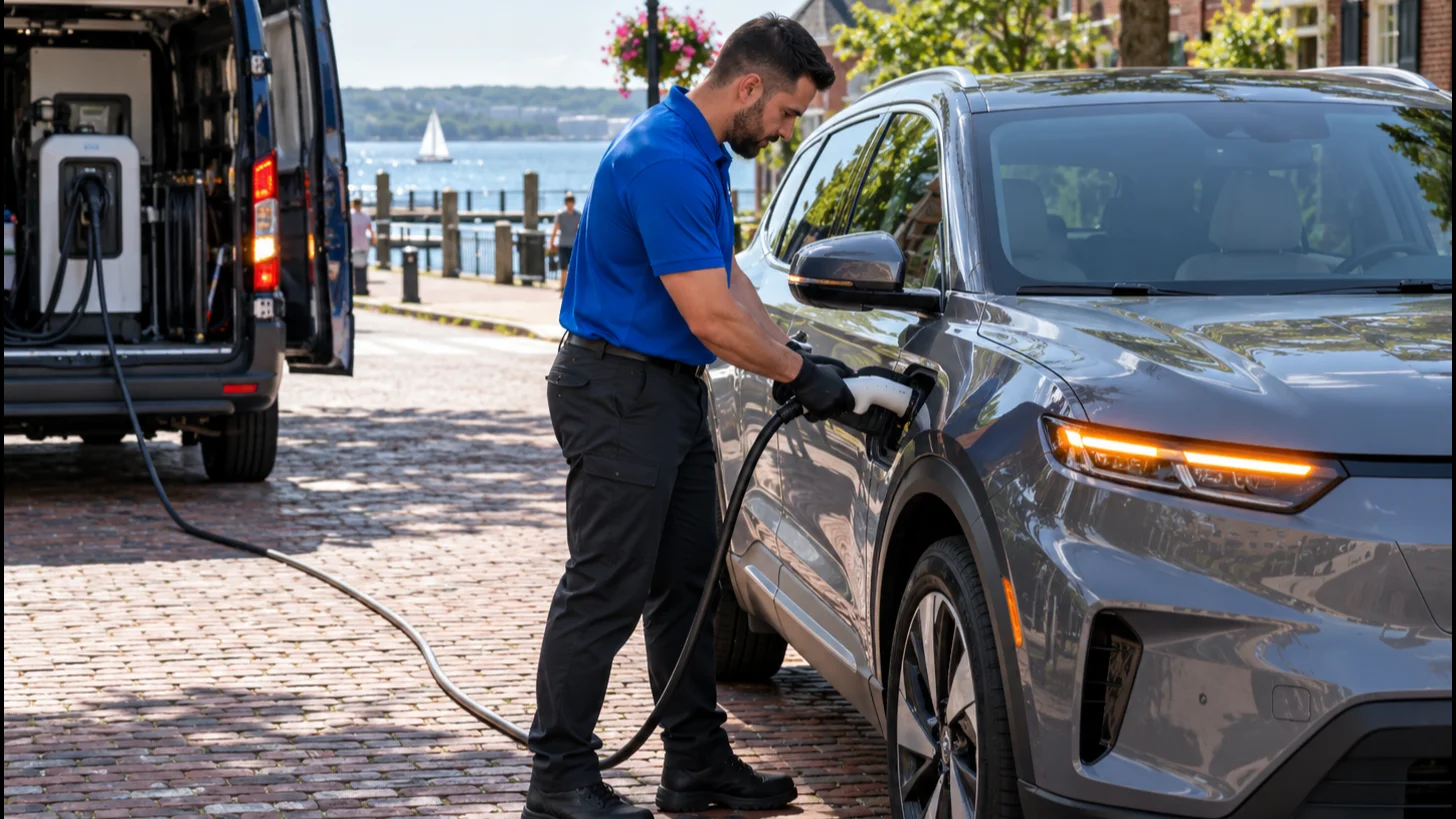
Request mobile charging when the traction battery lacks enough energy to continue. The approved typical rescue charge is 10 to 20 miles of range after 15 to 30 minutes of Level 2 charging. Those figures describe charging time, not operator arrival.
That range isn’t a promise from AAA or Charge Pro DC. The result can differ by vehicle and conditions. Confirm the connector, vehicle model, battery state, and charging need with the responding operator. You can also review how mobile EV charging fits into an out-of-charge recovery.
The U.S. Department of Energy provides general background about electric vehicles. Your vehicle manual remains the better source for model-specific handling instructions.
Old Town, I-395, and the Wilson Bridge constraints
Alexandria location details can change the roadside plan. “Near Alexandria” isn’t precise enough for a garage, express lane, parkway, or bridge approach. Share your direction of travel and an exact location marker.
In an Old Town garage, provide the garage name, entrance, level, space, and any posted access limits. Don’t assume a roadside vehicle can reach your parking space. Ask the garage operator what access is allowed, then relay that information to AAA or the local operator.
The George Washington Memorial Parkway presents a different access issue. National Park Service parkways have narrow or absent shoulders. Commercial vehicles and trucks over 10,000 pounds are banned on these parkways. Those rules can affect which vehicle may legally reach the scene.
If you’re stopped on that route, identify it by name. Don’t report it simply as a nearby Alexandria street. Our guide to EV roadside help on the George Washington Memorial Parkway covers that setting in more detail.
The 395 Express Lanes are operated by Transurban with VDOT. Express Assist provides free roadside patrol help for minor mechanical issues and can call a tow, but it doesn’t perform the tow. On the 395 Express Lanes, drivers are directed to use the nearest shoulder and remain inside the vehicle until help arrives.
Near the Woodrow Wilson Bridge, report the roadway, direction, and your position relative to the bridge. Don’t use “Wilson Bridge” as the entire location description. AAA’s specific EV charging availability there couldn’t be confirmed from the approved sources. Ask whether the assigned provider can enter your location and perform the requested job.
Our Woodrow Wilson Bridge EV guide offers a more focused location checklist. If the vehicle is exposed to moving traffic or the location feels unsafe, contact emergency services first.
When AAA is not the right call
AAA may still be your first membership call. It isn’t automatically the best match for every dead-EV problem.
Consider another route when AAA can’t confirm mobile charging at your location. A local operator may be able to quote the requested service directly. Compare the destination, access plan, connector needs, and payment terms before choosing.
A roadside charging request also isn’t appropriate for every vehicle problem. Warning messages, collision damage, heat, smoke, exposed components, or instructions to stop driving call for guidance from emergency services or the vehicle manufacturer. Don’t treat added charge as a repair.
For a Tesla, the Tesla app provides a roadside request process. Select Roadside, choose the vehicle issue, confirm the details, and submit the request. Include information that helps locate the vehicle and describe its condition. Tesla says access to restricted roads or restricted areas is decided case by case.
A tow may be the practical choice when mobile charging isn’t available or won’t resolve the reported problem. Before accepting it, confirm the destination and how the vehicle will be handled. Follow the towing instructions in the owner’s manual.
Don’t approve work based on a vague promise. Ask who will perform it, what service was quoted, and what happens if the initial diagnosis changes. If AAA’s representative can’t confirm a plan-specific benefit, check your membership documents. The exact answer couldn’t be verified for this page.
Drivers who need a separate referral can request emergency EV roadside assistance from a local operator. Charge Pro DC makes the connection. It doesn’t provide the physical roadside work.
How a local operator quote fits as a backup
A local operator quote gives you another option when AAA can’t confirm the needed service. It also helps you compare mobile charging with towing before authorizing either one.
Start with the vehicle’s year, make, and model. Report your displayed charge level, warning messages, connector type, and whether the car powers on. Then give the operator the exact Alexandria location.
For Old Town, include garage access details. For I-395, state whether you’re in regular traffic lanes or the Express Lanes. Near the Wilson Bridge, provide the roadway and direction. On the George Washington Memorial Parkway, mention the parkway by name because access rules differ.
Ask the operator to explain the proposed work. If it’s charging, confirm the equipment and expected charging session. If it’s a jump, confirm that the request concerns the 12-volt system. If it’s towing, confirm the destination and vehicle-handling plan.
Request the full quote before work begins. Charge Pro DC doesn’t set the price, collect payment, promise an arrival time, or provide a warranty. The independent operator quotes and bills the driver directly.
Don’t cancel an existing roadside request until you understand both options. Avoid creating overlapping service calls without telling each provider. Clear information helps everyone understand who is responding and what work was requested.
A local quote isn’t proof that charging is better than towing. It’s a way to compare two concrete plans. The right choice depends on the vehicle’s condition, roadside access, and what each provider can confirm.
When to call us
Call when AAA can’t confirm mobile charging, or when you want a local operator quote before choosing a tow. Charge Pro DC connects drivers with licensed, independent local operators and doesn’t perform the roadside work itself.
Call us at (202) 629-0844 and we’ll connect you with a local EV rescue operator.