Maryland’s CHART patrol will jump a 12-volt battery. It won’t refill a dead traction pack. On I-270 or the inner Beltway, that split is the whole answer.
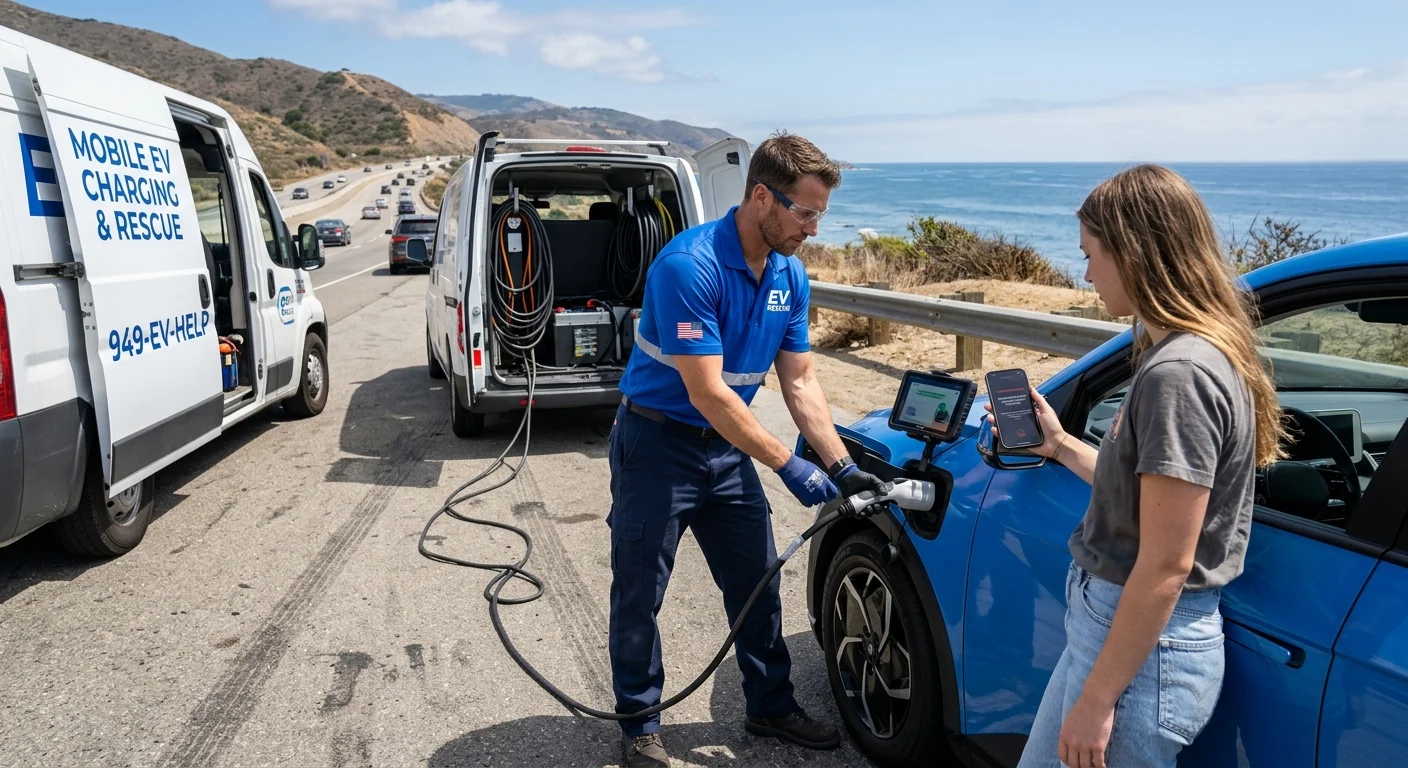
CHART can jump a 12-volt. It can’t fill the pack
The search is “can you jump start an EV.” Maryland is the jurisdiction that lists a jump in plain language.
MDOT SHA’s CHART Emergency Traffic Patrol works the Baltimore/Washington area. Emergency Response Technicians change tires. They jump-start 12-volt batteries. They add about one gallon of gas or radiator water. Dial #77 from a state primary roadway. That list includes I-495, I-270, I-695, US-50, and MD-295.
That jump is the same 12-volt boost a gas car gets. It wakes locks, computers, and high-voltage contactors. It doesn’t put miles into the traction pack.
If the car still showed driving range, then went dark, a 12-volt request may fit. If you watched the percentage hit zero, cables won’t help. You need a mobile 240-volt top-up or a tow.
CHART’s published duties don’t include charging an EV. A gallon of gas doesn’t either. Don’t ask that patrol to refill a pack it never listed.
Virginia and the District follow other playbooks
VDOT’s Safety Service Patrol covers Virginia interstates, including the I-66 corridor and I-95. You reach that help through Virginia 511. VDOT’s published pages talk about incident clearance, debris, and short-term traffic control. They don’t describe EV charging.
Inside the District, no DDOT motorist-assistance patrol showed up in public pages. DC drivers use MPD, a private plan, or US Park Police on the parkways. We couldn’t verify a District-run patrol that jumps cars.
Transurban runs Express Assist on the 495, 95, and 395 Express Lanes. The patrol helps with minor mechanical trouble. It will call a tow. It doesn’t tow the car itself. On the 495 Express Lanes, pull to the left shoulder. Those lanes sit in the median. On the 95 and 395 Express Lanes, pull to the nearest shoulder. Stay in the car until help arrives.
NPS parkways ban commercial vehicles and trucks over 10,000 lb. That includes the Baltimore-Washington and George Washington Memorial Parkways. Clara Barton, Rock Creek, and Suitland Parkway follow the same NPS truck ban. Shoulders are narrow or missing. Report a disabled vehicle on the Baltimore-Washington Parkway to US Park Police at 202-610-7500.
A Woodrow Wilson Bridge stall sits at Alexandria, Oxon Hill, and the District. The American Legion Bridge does the same between McLean and Montgomery County.
Pepco, Dominion Energy Virginia, and NOVEC publish home-charging programs. None of the utility EV pages we reviewed offer a stranded-car charge. Don’t call the utility for a jump.
Private roadside plans are a separate question. Ask what equipment is rolling. For club dispatch versus a mobile charge, see AAA versus mobile EV charging.
Two batteries. Only one takes jumper cables
Every current EV still has a small 12-volt battery. Tesla, Rivian, Ford, Hyundai, Kia, and Chevy all do. That battery runs the screens, the computers, and the contactors that connect the traction pack. When it dies, the car can look fully dead with range still left.
The traction pack is the big battery under the floor. Superchargers and public DC fast chargers refill that one. A roadside jump doesn’t touch it. Tesla owners can read the split in our Tesla 12-volt versus pack guide.
This is why a week in airport parking fools people. You walk back to the Dulles Economy Lot and the car won’t wake. The same long-sit 12-volt death shows up in WMATA park-and-ride garages. At Reagan National, Level 1 of Parking Garages 1 and 2 has EV charging. A dead 12-volt still blocks the car from taking a plug.
Office garages do the same after a full workday. A car that sat at Tysons Corner Center can lose the 12-volt. A Silver Line garage in Reston can do it too. Older lots in Takoma Park, Wheaton, Annandale, and the District produce the same stall. The car slept without a home plug, then the 12-volt quit.
A drained traction pack looks like a range problem you watched happen. The percentage fell on I-270 between Rockville and Germantown. You sat in Beltway heat with the climate on. You crawled I-95 through Woodbridge and Dale City. Sitting still with heat or AC running drains charge without covering miles. That’s a standstill problem, not a jump-start problem.
Cold shortens the pack, and it doesn’t empty it by itself. Recurrent Auto studied more than 30,000 EVs in winter. A typical car keeps about 80 percent of range at 32F. It keeps about 70 percent at 20F. Cabin heat is the draw. Dulles runs colder and snowier than Reagan National. The January 2022 I-95 shutdown near Fredericksburg is the local memory of that.
DC, Maryland, and Virginia codes we reviewed have no special empty-EV rule. Disabled-vehicle rules apply the same way they would to any car.
Report the last screen, not the word dead
Don’t diagnose the pack on the call. Report what you can still see.
Give the last charge number the car showed. Read every warning word for word. If the screen is black, say the screen is black. Don’t relabel it as a dead battery.
Then describe the start attempt. Say whether the display lights. Say whether the key is recognized. Say whether the car enters Drive.
Make, model, and year belong in the first sentence. Jump points and 12-volt chemistry aren’t identical. A newer Tesla lithium 12-volt isn’t an older Model 3 lead-acid unit. A Hyundai Ioniq 5 isn’t a Chevy Bolt. The operator needs the exact vehicle before they choose a jump or a charge.
Keep the owner’s manual or the in-app copy handy. Our guide to jumping an EV’s 12-volt is extra reading. It doesn’t replace the pages written for your VIN.
Name the road, the lot, and the access
The DC area is too large. Name the freeway, the garage, or the side street.
A stall on I-270 in Rockville isn’t a stall on US-50 in Bowie. A car in a gated McLean driveway isn’t an Express Lanes stall. The left shoulder of the 495 Express Lanes is its own problem. A vehicle on the George Washington Memorial Parkway has a different police force. Shoulder room there is scarce.
Tell the operator about gates and height clearance. Say whether you’re on a parkway that bans heavy commercial trucks. Mention heat, smoke, a recent crash, or standing water.
For an empty pack on I-495, start with our Beltway out-of-charge guide.
When a jump is the wrong request
Ask for a jump only when the 12-volt looks like the failure. An empty traction pack needs a charge or a tow.
Skip the jump when the warning doesn’t point at low voltage. An unfamiliar message, or a model the operator can’t support, should pause the work. Guessing is how 12-volt electronics get damaged.
If the pack is empty, matched operators can bring 240-volt Level 2 to the car. Native NACS for Tesla, and CCS or J1772 adapters for other brands. That stop typically adds 10 to 20 miles of range. Charging time is usually 15 to 30 minutes. That’s charging time, never an arrival time. Charge Pro DC doesn’t promise when anyone arrives.
If a charge doesn’t fit, the operator may talk through a tow. Charge, jump, or tow lays out that fork.
Charge Pro DC doesn’t pick the procedure. We don’t own trucks, and we don’t jump, charge, or tow. The matched operator reviews the car, quotes you before work starts, and bills you.
How the referral call works
Charge Pro DC is a referral line for the District, Maryland, and Virginia. We match stranded EV drivers with independent local mobile rescue operators. The pros we connect you with are licensed and insured. We hold no license and own no trucks.
When you call, lead with make, model, year, warning text, last charge, and exact location. Say whether the car still showed range before it went dark.
We forward that to an operator who can review it. They decide if a jump, a 240-volt top-up, or transport fits. You approve the quote with them. We set no prices and we don’t warrant the work.
Call when the car won’t start and you need that on-site review. Reach us at (202) 629-0844 and we’ll connect you with a local operator.