Zero in Arlington usually starts in a shared garage, not on a freeway shoulder. A Ballston renter wakes up to a car that won’t move. A Crystal City driver comes down from a late I-66 night with nothing left. A traveler back at Reagan National finds a dark dash after a week away. That’s EV roadside assistance in Arlington. A local operator can charge or jump the car where it already sits.
Why a zero call in this county starts in a garage
Arlington is a county, not a driveway suburb. Census ACS 2019-2023 counts 235,463 people on just under 26 square miles. That’s the Virginia bluff above the Potomac, packed into high-rises. 53.1 percent of housing here was built before 1980. Ballston Quarter, Crystal City, National Landing, and Pentagon City sit in that dense core. They hold one of the metro’s highest apartment shares. A huge number of EV owners here have no dedicated plug.
That’s the standing pattern for renters. You live on public charging and an assigned stall. You leave for I-66 or I-395 with whatever you found overnight. You get home late. The pack is already thin. It doesn’t recover in a shared garage.
Reagan National’s long-term garages sit in this county. MWAA publishes complimentary EV charging on Level 1 of Parking Garages 1 and 2. It’s first come, first served, with limited spaces. Those garages connect to the terminal. A week of sitting still kills the 12-volt more often than the pack. You return from a trip. The car won’t wake. You’re in a stacked lot with a suitcase.
The Pentagon and Pentagon City garages run the same long-dwell pattern.
Dominion Energy serves Arlington County. Dominion publishes Schedule 1EV, a residential EV rate. It also lists an Off-Peak Plan and EV Charger Rewards. None of those programs roll a charger to a stranded car. If you’re already at zero, the rate plan isn’t the tool.
Empty pack versus a 12-volt that won’t wake
Zero on the range gauge and a car that won’t boot are different jobs.
When the high-voltage pack is low, most EVs drop into a restricted mode. Some cars still hold a small reserve after the gauge reads empty. That reserve is for creeping to a safer stall. It isn’t for climate control while you wait.
True zero on the pack is heavier. Contactors open, and you may not shift to neutral. Hazard lights can fail. Doors may need a mechanical release. The car becomes a several-thousand-pound object. It won’t roll on command.
A dead 12-volt looks like the same brick. At DCA it’s the more common one. The 12-volt runs computers, locks, and the contactors that let the big pack talk. After days in a garage, it can sag while the traction pack still holds charge. Jumping or replacing that 12-volt on site is often the whole rescue. That’s the pattern in a 12-volt failure after a long sit. It isn’t the same call as an empty pack on the freeway.
Tesla, Rivian, Ford, Hyundai, Chevy, and the rest all split this way. The operators we connect you with handle Tesla and every major EV brand. They bring a 240-volt Level 2 source with a native NACS plug. Non-Tesla cars get a CCS or J1772 adapter.
If you’re still rolling, get off the travel lane
If the car is still moving, coast to a shoulder or a legal garage stall. Turn hazards on if they still work. Stay belted inside on a fast road. The cabin is better cover than the pavement, especially at night or on ice.
Don’t try to push it. Traction packs make these cars much heavier than the gas model they replaced. Arlington’s corridors don’t give you a wide berm. I-395 and I-66 through the county run tight. US-50, Arlington Boulevard, and US-1, Jefferson Davis Highway, squeeze the same inner core.
The George Washington Memorial Parkway is an NPS road with narrow shoulders. Commercial vehicles and trucks over 10,000 lb are banned there. A disabled vehicle on that parkway is a US Park Police matter. Their published number is 202-610-7500. Call 911 if you’re blocking live traffic. Call 911 if you’re sitting in a blind curve. Corridor detail is in stalled on the George Washington Parkway.
On the 495 Express Lanes, Transurban tells drivers to pull to the left shoulder. Those lanes sit in the median. On the 395 Express Lanes, pull to the nearest shoulder. Stay in the car, not in the lane. Express Assist can help with minor mechanical issues and will call a tow. It doesn’t charge an EV. VDOT’s Safety Service Patrol covers Virginia interstates, including the I-66 corridor. Published VDOT material on that patrol doesn’t describe EV charging. Virginia 511 is how you reach that patrol.
If you already stopped on I-66, use the steps in stranded EV on I-66.
Why a quoted mobile charge beats an unplanned tow
A tow is sometimes the right tool. A car in a travel lane that won’t shift may need a wrecker. Virginia private-property towing sits under Va. Code § 46.2-1231 and related sections. Localities may set fee limits by ordinance. The exact Arlington ordinance figures weren’t confirmed in this research. Confirm the current cap with the county before you sign a ticket. None of the three codes reviewed writes a special rule for an empty EV. Disabled-vehicle law treats yours like any other car.
What a tow doesn’t do is put electrons back in the pack. Improper towing can damage a single-speed EV drivetrain. That’s especially true with a dead 12-volt and no neutral. It still leaves you at a lot with the same empty battery.
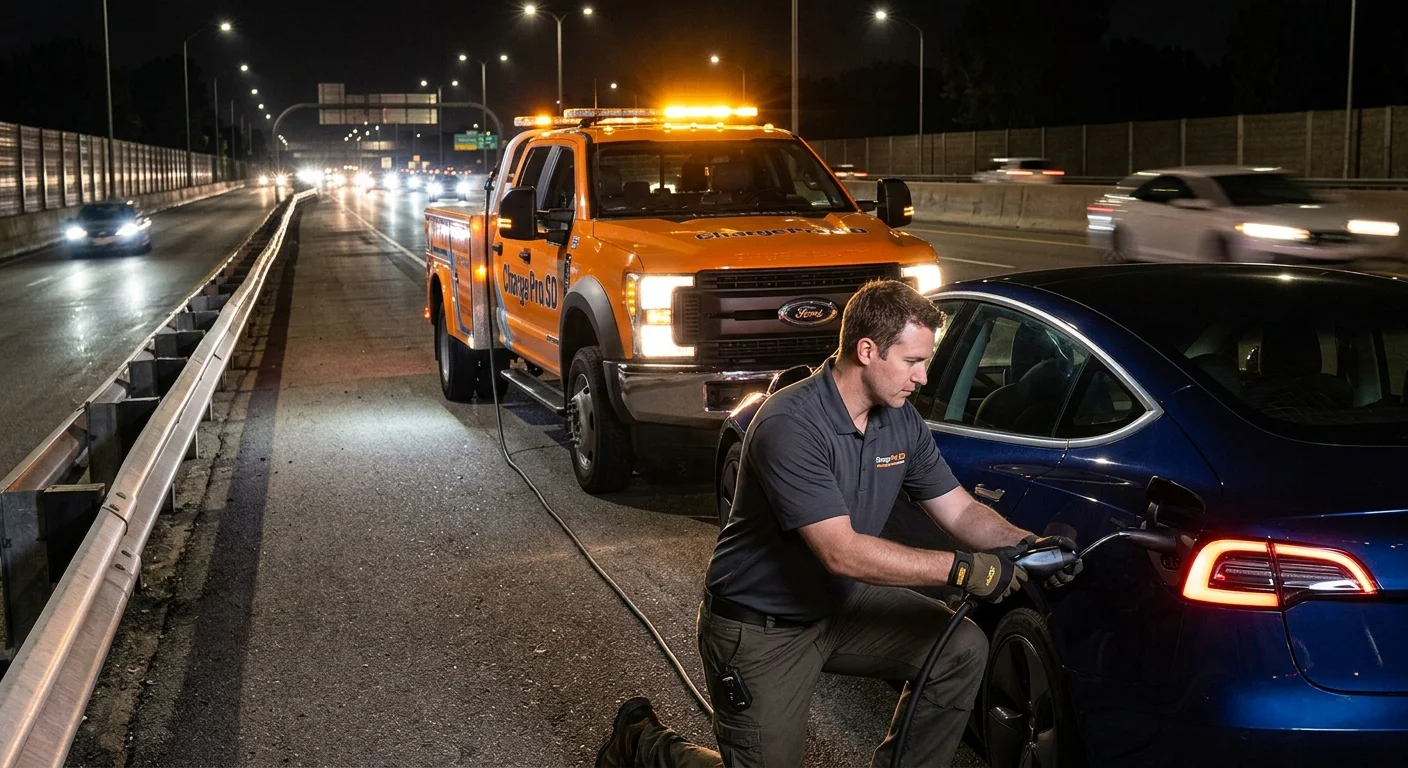
Mobile EV charging sends the charge to the stall. Charge Pro DC is a referral line. We don’t own trucks, employ technicians, or set prices. We match you with an independent local operator. That operator quotes you before any work starts and bills you directly.
The typical on-site job is a 240-volt top-up. That’s about 10 to 20 miles in 15 to 30 minutes of charging. That number is charging time. It isn’t a promise of when someone arrives. The point is enough range to drive to a charger you already planned. It isn’t a full pack fill in a Pentagon City aisle.
Renters without a home plug are the standing pattern here. Read mobile EV charging when you live in Arlington without a plug.
What the operator actually does on site
You call with a location, make, model, and a number that rings. We match that to an operator covering Arlington County and the inner Virginia core. The operator confirms the quote with you first.
On arrival they check that the car is in a safe spot. In a DCA or Crystal City garage that means clearance from adjacent stalls. Then they attach the Level 2 source. Tesla takes native NACS. Other brands take CCS or J1772 through an adapter.
If the dash is dark, they treat the 12-volt first. A jump can close the contactors so the pack will accept charge. If the 12-volt is the only failure, you may not need a traction boost.
Arlington sits on the humid Potomac bluff. Winters swing from mild to sudden ice. Cabin heat is the winter thief. Recurrent Auto studied more than 30,000 EVs in winter. A typical car keeps roughly 80 percent of range at freezing. At 20F it’s about 70 percent. Sitting in I-395 traffic with the climate on burns that remainder without moving you. Inner Arlington is milder than Dulles in winter. A stall with no assigned charger still leaves you close to empty most mornings.
When this is the right call
Call when the car won’t wake in a Ballston or Crystal City garage. Call when you get back to DCA and the 12-volt is silent. Call when a pack that won’t pull leaves you on I-395 or I-66.
Don’t wait in a travel lane hoping a patrol truck carries a 240-volt source. Stay with the car on a high-speed road. If you’re in a garage, stay where the operator can find the stall number.
Arlington-specific matching runs through EV roadside assistance. Charge Pro DC connects Arlington drivers with local mobile rescue operators. Call (202) 629-0844 and the operator quotes you before starting.