A Mercedes EQS 12v battery dead after a long sit still looks like a total failure. You tap the fob. The handles stay flush. The Hyperscreen never wakes. The traction pack can still show a healthy percent. That’s the usual picture after a week in the Union Station garage, or in an airport lot around this metro. The 12-volt ran out of voltage the control units need. The miles in the pack are still there. This page is about waking that EQS on site. You don’t need a tow. You don’t need to guess at the high-voltage pack.
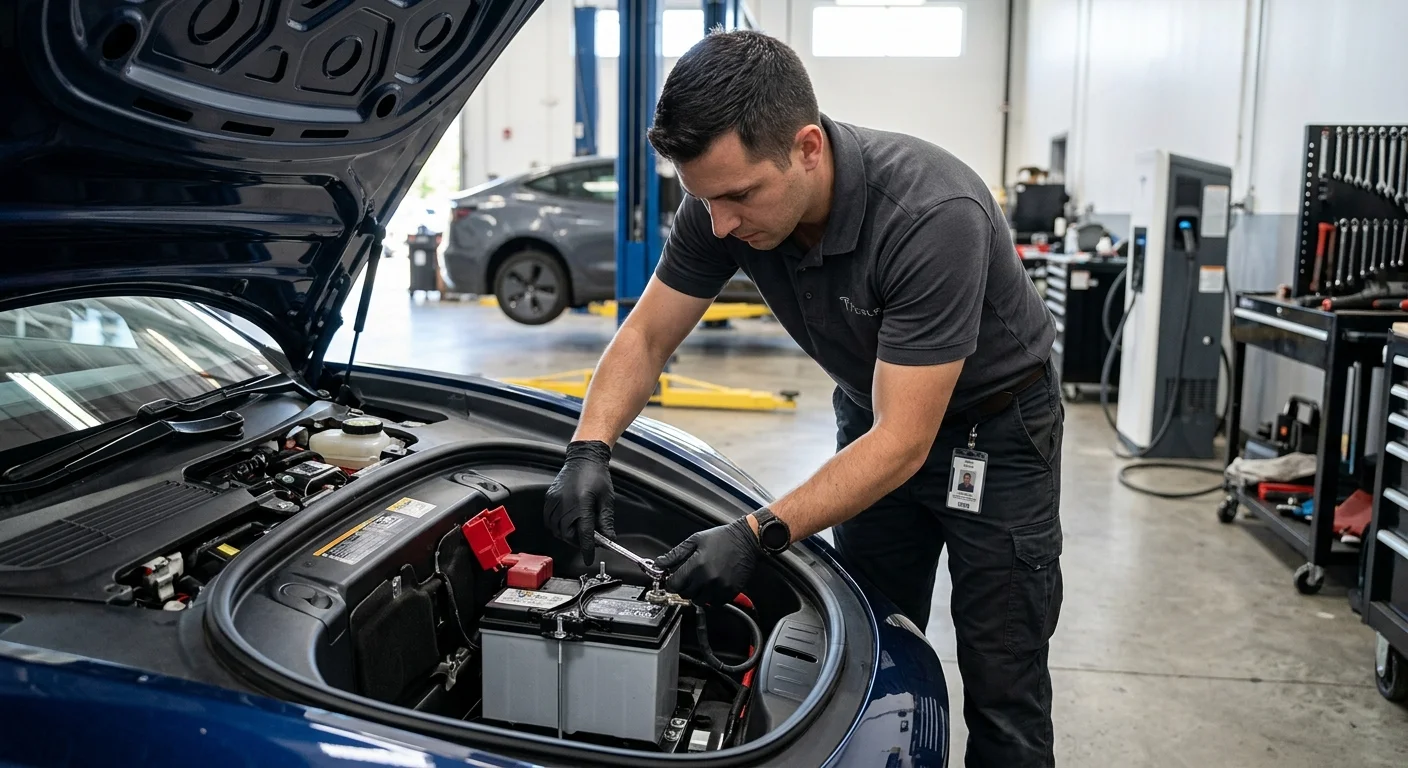
What a dead EQS 12-volt looks like
The EQS hides a small lead-acid battery behind all that glass. That 12-volt unit runs the low-voltage network. Powered door handles, the Hyperscreen, air suspension, and digital mirrors all drink from it. So do pre-conditioning and the modules that connect the high-voltage pack to the motors.
When voltage sags, the car doesn’t limp. It goes dark. You may see one of three signatures.
The fob does nothing. No lights. No lock click. The cabin is silent.
The screen lights, then sticks on “vehicle being prepared, please wait.” The boot starts and never finishes.
A 12-volt warning flashes. The Hyperscreen dies before Ready mode.
All three point at the same handshake failure. The pack didn’t go empty. The 12-volt side couldn’t finish its job. For the broader version of this stall, see what happens when an EV 12 volt dies in a garage or airport lot.
Long parking is how it dies here
This metro parks luxury EVs for days, then expects them to wake on command. Union Station’s garage is a classic long-dwell lot. You leave for a rail trip. The car sits under the building. Modules keep a low drain running. Radar, the connectivity gateway, MBUX ambience, and over-the-air update hardware can poll overnight. Two quiet weeks is often enough.
Airport parking is the other regular trigger. Reagan National puts complimentary charging on Level 1 of Parking Garages 1 and 2. Those stalls are first come, first served, with limited spaces. They help if you actually plug in. Plenty of EQS drivers still leave the car on a regular level for a flight. They come back to a brick.
Dulles is the longer-haul version of the same week. MWAA publishes Level 2 charging in Garage 1 and Garage 2. Leave an EQS in the Economy Lot for a week and you return to whatever the 12-volt has left. That’s not an empty pack. It’s a battery that sat, in heat or in a freeze, while the car was “off.”
WMATA park-and-ride garages across the District, Maryland, and Northern Virginia repeat the pattern. Office structures in Tysons and along the Silver Line do it on a shorter clock. You park at 8 a.m. Pre-conditioning and cabin electronics nibble all day. At 7 p.m. the car won’t enter Ready. A Potomac driveway without a Level 2 plug has the same drain. The car looks stored. The modules still poll.
Summer makes the draw worse. The metro’s humid stretches above 90F keep standby electronics warm. The EQS was built around climate-controlled storage. A garage that is only shade still cooks the 12-volt. Winter on the Loudoun and upper Montgomery side is the other stress. Dulles runs colder and snowier than Reagan National. Cabin heat, if anything is still trying to run, comes from the pack. The 12-volt still has to keep the computers alive while you’re gone.
Mercedes flagged an elevated self-discharge rate on early EQS years. That covered roughly the 2022 and 2023 builds. Dealers pushed software to quiet background modules. Patched cars still drain if they sit. A battery that has never been load-tested after year three is the usual weak point.
What that 12-volt actually feeds
Think of the high-voltage pack as the fuel. Think of the 12-volt as the ignition, the locks, and the screens. No 12-volt, no handshake, no Ready.
The EQS uses an AGM 12-volt battery. Capacity is typically in the 90 to 95 amp-hour range, depending on year and spec. That’s a large AGM by passenger-car standards. It has to be. Parasitic draw on this platform is high.
Always-on modules are the tax. The Hyperscreen alone is a big 12-volt load when it tries to boot. Power-extending handles need voltage just to let you in. The air-suspension compressor and digital-mirror controllers sit on the same network. None of that is optional once you want to drive.
If you’re comparing platforms, the EQE shares the drain problem. It doesn’t share the same underhood layout. Use the Mercedes EQE 12 volt fix for that car. The EQB and EQA sit on a different architecture again.
Where the battery sits, and where you jump
The EQS doesn’t put the 12-volt under the hood. The battery lives in the trunk, under the load floor on the driver’s side. You won’t reach it in a parking stall. Replacement means pulling the trunk liner and the floor board. That’s a shop job. A new unit usually needs registration on the car’s computer.
You still jump the car from the front. Mercedes put dedicated jump posts in the engine bay for exactly this stall.
| Battery detail | Mercedes EQS |
|---|---|
| 12-volt location | Trunk, driver’s side under the load floor |
| Jump posts | Engine bay, driver’s-side fuse box |
| Typical spec | 12-volt AGM, about 90 to 95 Ah |
| Common stall | Parasitic draw after long parking |
| ”Vehicle being prepared” | 12-volt handshake, not an empty pack |
| Replacement | Shop work: trunk disassembly and registration |
On-site steps when the EQS will not wake
Start with access. If the handles stay dead, slide the mechanical key out of the fob. Open the driver’s door with that key. Don’t force the powered handle.
Check for any 12-volt sign. Dome light, hazards, a faint lock chirp. Total silence means you need a jump, not a public charger.
The hood release at the driver’s sill is still a cable. Pull it. Open the hood.
On the driver’s side up front, find the black fuse and relay box. Lift that cover. Under a red cap is the positive jump stud. That’s the only positive you should use.
For negative, pick an unpainted metal bolt or bracket on the chassis or strut-tower area. Don’t run the negative clamp to the trunk battery. Use chassis ground.
Cable order is the usual one. Positive to the EQS stud. Positive to the donor or jump pack. Negative to the donor. Negative to EQS chassis ground last.
Wait two full minutes. Let the control units recover. Then try to start. The Hyperscreen should run its boot and go to Ready.
If a 12-volt fault stays on after a clean jump, the battery is done. Driving may wake the DC-DC converter enough to limp home. Plan a shop replacement. Don’t keep jumping the same failed AGM.
The safe sequence for any EV, not only this one, is in how to jump start an EV without frying the 12 volt system.
What a local operator does, and what they don’t
Charge Pro DC is a referral line. We match you with an independent mobile rescue operator in the District, Maryland, or Virginia. We don’t own trucks. We don’t hold a shop license. We don’t set the price. The operator quotes you before any work starts and bills you directly.
On an EQS, that visit is almost always a 12-volt jump at the underhood posts. Operators in this network also bring a 240-volt Level 2 source for cars that are actually empty. They use a native NACS plug, or a CCS or J1772 adapter. Typical charging time on a low pack is 15 to 30 minutes. That usually adds about 10 to 20 miles of range. That’s charge time, not a promise of when someone arrives. A dark EQS with a healthy pack percent doesn’t need that boost. It needs the 12-volt.
Non-Tesla EV rescue is the service path for the EQ lineup. That covers EQS, EQE, EQB, EQA, and AMG EQ variants.
Highway patrols here won’t charge the car. VDOT’s Safety Service Patrol covers Virginia interstates, including the I-66 corridor. Published material describes incident clearance and short-term traffic control, not EV charging. Maryland’s CHART Emergency Traffic Patrol will change a tire and jump a battery. Dial #77 on I-495, I-270, US-50, or MD-295. Confirm with them that they’ll use the EQS underhood posts, not a bumper clamp. No DDOT motorist-assistance patrol turned up in District materials. Inside DC you’re looking at MPD, a private plan, or a quoted operator.
On a National Park Service parkway, commercial trucks over 10,000 lb are banned. A disabled vehicle on the Baltimore-Washington Parkway is reported to US Park Police at 202-610-7500.
After it starts: hold, or replace
Once Ready is on, drive. The DC-DC converter should refill the 12-volt from the main pack while you move. A healthy AGM recovers. A sulfated or internally failed one doesn’t.
If the car dies again the next morning, stop jumping it. Book the trunk battery. Read EV 12-volt replacement: signs it’s failing and what to do before you sit in another garage overnight.
Don’t treat a public stall as the fix for this failure. Plugging in charges the pack. It doesn’t always raise a 12-volt that has already dropped below the handshake. Wake the car first. Then plug in if you also need miles.
For a car left at Dulles, the same long-sit pattern shows up on Teslas in economy parking. The EQS version is the 12-volt, not a NACS cable. The local backup path is still a quoted operator. See mobile charging when a car will not wake at Dulles if your stall is on that campus and you need the airport layout.
Before you call from the garage
Have the mechanical key in hand. Know which level you’re on. Union Station, a DCA garage, or a Dulles structure all have poor cell pockets. Step toward a ramp if the call drops.
Tell the operator it’s an EQS, not a gas S-Class. Ask them to jump the underhood positive stud and a chassis ground. Mention the frozen “vehicle being prepared” message if that’s what you see. That keeps someone from hunting bumper posts that aren’t there.
If you’re on the 495 Express Lanes, pull to the left shoulder. Those lanes sit in the median. On the 95 and 395 Express Lanes, use the nearest shoulder. Stay in the car until help is with you. Express Assist will work a minor mechanical issue and call a tow. It doesn’t charge an EV.
If you’re in Washington near the station, the same steps apply. A McLean or Arlington garage sit uses the same 12-volt posts. Geography changes the lot. It doesn’t change the posts.
When you want a local operator, call (202) 629-0844. Charge Pro DC will match you with someone who quotes the jump before they start.
Frequently asked questions
How do you jump a Mercedes EQS on site?
Use the dedicated positive stud under the hood, inside the driver’s-side fuse box cover. Clamp positive there. Clamp negative to chassis ground, not the trunk battery. Wait two minutes, then start. The 12-volt itself stays under the cargo floor and isn’t a parking-lot swap.
What does “vehicle being prepared, please wait” mean on an EQS?
Control units started their boot and couldn’t finish the handshake. Voltage on the 12-volt side is almost always the reason. The pack can still read fine. A jump on the underhood posts usually clears the loop.
Where is the Mercedes EQS 12-volt battery?
Under the trunk load floor on the driver’s side on most builds, not in the engine bay. You wake the car from the front posts. The powered tailgate won’t help you here.