A Mercedes EQE that won’t start is almost always a dead 12 volt battery. It’s not a failed drive pack. The screen stays dark. The flush handles stay flush. Ready never comes on, even when the traction battery still reads a healthy percentage. The computers never finish their handshake. Jump the dedicated terminals under the hood. Wait two minutes. Most cars then reboot and drive.
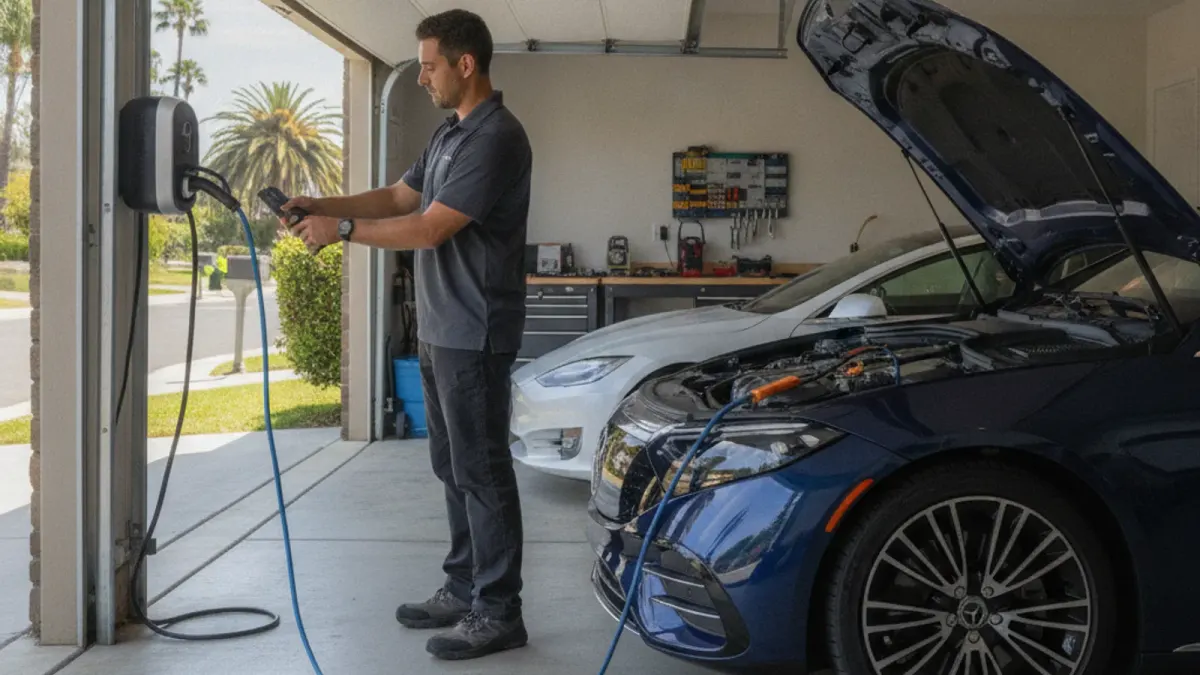
Inner Fairfax garages are where this car goes quiet
Luxury EVs in this metro sit still more than owners plan for. Inner Fairfax EQEs often sit a full workday in a staff garage. Then they sit again overnight in a driveway. Hospital shift parking is the same pattern, only longer. A hospital deck is worse than an office deck. Shifts run longer than a workday. The EQE can sit through a night rotation without moving a mile. It doesn’t have to be empty of range. It only has to lose the 12 volt. The traction pack barely cycles. The small 12 volt battery still feeds modules that never fully sleep.
The City of Fairfax and Fairfax County are not the same jurisdiction. The city is its own independent city. The county wraps around it. Both have office decks and medical campuses with all-day parking. Those decks feel indoor and safe. Heat still builds under them in a humid summer. A stretch above 90F cooks a parked EQE. Standby electronics keep cycling. The 12 volt sags while the car looks fine.
Merrifield’s office and mall decks see the same all-day sit. If that’s where you’re stuck, start with EV roadside assistance in Merrifield. Tysons Corner Center garages add a workday plus dinner. A car can wait there for eight or ten hours without turning a wheel. For that deck, read what to do in a Tysons garage.
Falls Church is an independent city next door. McLean is unincorporated. The parking pattern is the same: a staff garage, a hospital deck, a mall structure. You come back and the fob does nothing.
WMATA park-and-ride decks add the week-long version. None of this means the drive battery is empty. The low-voltage side ran out of voltage to wake the car.
For a City of Fairfax garage, use our Fairfax City EV roadside page.
Dominion Energy Virginia serves most of Northern Virginia, including much of this inner ring. Pepco covers the District, Montgomery County, and Prince George’s County. Neither utility publishes a service that charges a stranded car. Their EV pages are about home chargers and rates. They aren’t a rescue line.
Why the EQE looks dead while the pack is full
The EQE keeps two electrical systems. The big one moves the car. The small 12 volt AGM battery runs everything that has to boot first. Flush door handles run on it. So does MBUX. So do the ambient lights and the driver-assistance sensors. The units that close the high-voltage contactors also live on that 12 volt side.
When voltage drops too far, those units never complete startup. The car sits silent. The traction pack can still show 80 percent. Nothing’s wrong with the expensive battery. The small one never delivered enough voltage to let the expensive one work.
Parasitic drain is the usual cause. The connectivity gateway stays partly awake. Radar and camera modules sip current. The over-the-air update system does the same. MBUX electronics add to the load. Mercedes pushed software updates on early EVA2 cars to quiet that background draw. Updated cars still sag if they sit for two weeks without a drive. A battery a few years old, never load-tested, is the one that strands you first.
Humid summer heat makes the sit worse. The metro’s summers stack days above 90F. A closed staff garage traps that heat around the car. The EQE is happier when it’s driven. The DC-DC converter can then top the 12 volt back up. A car that only moves on weekends never gets that recharge cycle. Office and hospital parking in Inner Fairfax is built for that exact idle.
The EQE shares the EVA2 platform with the EQS. The low-voltage layout is the same. It fails the same way. It gets rescued the same way. The Mercedes EQS 12 volt guide walks the sibling car. Non-Tesla EV rescue is how you reach operators for the Mercedes EQ lineup.
The EQE SUV uses this same jump layout. The EQB and EQA sit on a different platform. A dead 12 volt still needs a correct jump.
What the dash is trying to tell you
The EQE doesn’t have one single 12 volt message. How far the voltage has fallen changes what you see.
| What you see | What it means |
|---|---|
| No lights, handles stay in, fob does nothing | 12 volt is fully flat and needs a jump |
| Screen starts, then freezes or dies before Ready | Voltage is enough to begin, not enough to finish |
| A 12 volt electrical-system warning, then a black display | Voltage dropped under the control-unit threshold |
| Unlocks, but will not leave park or enter drive | Low-voltage modules cannot connect the high-voltage pack |
None of those rows mean the traction battery failed. All of them mean the 12 volt side cannot bring the car online.
A dark MBUX screen is the tell owners miss. That display runs on 12 volt, not on the drive pack. When the low-voltage network drops out, the screen goes with it. So do the powered handles. So do the exterior lights and the startup sequence. The pack is untouched. The car still cannot move until the 12 volt recovers.
The battery is in the trunk. You jump it up front.
This is the part that catches people. The actual 12 volt battery isn’t under the hood. It sits in the rear, under a trunk floor panel. Swapping it means pulling the cargo liner and the load floor. That’s shop work, not parking-lot work. The powered tailgate may already be dead. That makes the rear even less useful in a garage stall.
For a jump, you never touch that rear battery. Mercedes put dedicated jump terminals in the engine bay for this exact failure.
| Battery detail | Mercedes EQE |
|---|---|
| 12 volt battery location | Rear cargo area, under the trunk floor panel |
| Jump terminal location | Engine bay, driver’s-side fuse box cover |
| Typical battery type | 12 volt AGM lead-acid |
| Common failure pattern | Parasitic draw from MBUX, radar, and update modules |
| Dark screen | 12 volt system, not the high-voltage pack |
| Replacement | Workshop job with rear disassembly and battery registration |
One line, because this is the mix-up. The battery lives under the trunk floor. The terminals you actually use live under the hood, inside the driver’s-side fuse box. Those are two different places. That split is what strands owners who start at the cargo area.
How to jump the EQE without guessing
If you’re standing next to a silent EQE, work in this order.
- See whether the doors answer the fob. If they don’t, use the mechanical key blade in the fob on the driver’s door.
- Look for any 12 volt sign: a dome light, hazards, a flicker on the screen. Nothing at all means you need a jump.
- Pull the interior hood release by the driver’s door sill. It’s a mechanical cable, so it still works with the 12 volt dead.
- Open the hood. On the driver’s side you’ll see a black plastic fuse and relay box.
- Lift the fuse box cover. A marked positive (+) stud sits under a red cap. That’s jump positive.
- For negative, use an unpainted chassis bolt or a strut-tower ground. Don’t run the negative lead to the rear battery.
- Connect positive to the EQE stud, then to the donor. Connect negative to the donor, then to the EQE chassis ground.
- Wait two full minutes so the low-voltage side can recover, then start. The display should boot and the car should enter Ready.
Don’t clamp onto the rear battery in a garage stall. You will not reach it cleanly. You don’t need it for the jump.
A longer walkthrough that covers other EVs is in how to jump start an EV.
Airports, I-66, and who will not charge you
Inner Fairfax is the weekday version. Airports are the week-long version.
Travelers return to Dulles and find an EQE that will not wake. MWAA puts Level 2 charging in Garage 1 and Garage 2 at Dulles. There’s no extra charge to parkers for those stalls. Reagan National puts complimentary charging on Level 1 of Parking Garages 1 and 2. Those are the published on-airport plugs. The Economy Lot at Dulles is the largest, cheapest on-airport option. You reach it by shuttle from Curb 2F. A week in that lot is a classic 12 volt sit. The car isn’t being driven. The modules keep sipping.
I-66 through Fairfax County is the rolling version of the same drain. You stop for a short errand after a crawl. Then the EQE will not come back to Ready. A silent car after the stop is still usually the 12 volt.
VDOT Safety Service Patrol covers Virginia interstates, including the I-66 corridor. Drivers reach that help through Virginia 511. Published material covers incident clearance, debris, and short-term traffic control. It doesn’t describe EV charging. On the 495, 95, and 395 Express Lanes, Express Assist helps with minor mechanical issues. It will call a tow. It doesn’t charge an EV. On the 495 Express Lanes, pull to the left shoulder. Those lanes sit in the median. Stay in the car until help arrives.
Maryland’s CHART patrol can jump a conventional 12 volt on state primary roads. Dial #77 on I-495 and I-270. That’s a gas-car style jump, not a Level 2 charge. The District has no DDOT motorist-assistance patrol in the material we reviewed. DC drivers use MPD, private plans, and US Park Police on the parkways.
A disabled EV follows the same disabled-vehicle rules as any other car. None of the three codes reviewed adds a special out-of-charge rule.
Almost none of these EQE no-starts need a tow. A correct jump and two minutes of recovery, and the car moves. Towing a dead EV across DC, Maryland, and Virginia is a different, heavier job. Save a tow for a pack that will not take a charge. Save it for a car that still will not boot after a proper jump.
After it starts, decide if the battery will hold
Once you’re moving, the 12 volt recharges from the main pack through the DC-DC converter. That’s enough if the battery is healthy and merely empty. If the battery is old or failed inside, it will not hold. The EQE will go dark again in a few days. It often dies in the same garage.
If a 12 volt fault remains after the jump, treat the battery as failed. It’s not a weak jump. Replacement is a workshop job. The pack is in the rear. It usually needs registration on the car’s battery management system. Get the jump first so you can drive to the appointment. Then book the replacement with a Mercedes dealer or an independent EV shop.
Our EV 12 volt replacement guide covers the signs and the sequence. The next long sit should not strand you again.
Charge Pro DC is a referral line. We match you with independent local operators. We don’t own trucks. We don’t set the price. The operator quotes you before any work starts and bills you directly. Operators bring the gear to jump EQE terminals safely. They can also bring a 240 volt Level 2 source for an empty traction pack. That typically adds 10 to 20 miles of range. Plan on 15 to 30 minutes of charging time, not an arrival time.
If the EQE is still silent, call (202) 629-0844 and say where you are. Give the operator room to reach the hood.
Frequently asked questions
How do you jump start a Mercedes EQE?
Jump it at the dedicated positive stud under the hood, inside the driver’s-side fuse box cover. Connect positive there. Connect negative to a chassis ground, not to the rear battery. Wait two full minutes, then start. The real 12 volt battery stays under the trunk floor. You don’t need to reach it for a parking-lot jump.
Where is the 12 volt battery in a Mercedes EQE?
It sits in the rear, under a trunk floor panel, not under the hood. You wake the car through the underhood jump terminals. That’s a red-capped positive stud in the engine bay and a nearby chassis ground. That split matters when a dead 12 volt has already killed the powered tailgate.
Why won’t my Mercedes EQE turn on if the main battery is charged?
The starter battery and the drive battery are not the same pack. The high-voltage battery can read 80 percent or more. The small 12 volt battery still has to power the handles and the screen. It also powers the control units. If that 12 volt is dead, the EQE will not start. Jump it, and it wakes up.