You fly home after a week on the road. Your EV is waiting in Dulles economy parking. The pack still shows a healthy chunk of miles. The screens stay dark, and the car won’t wake. That’s a failing 12-volt, not an empty traction battery. Another jump only buys you a short drive. EV 12V battery replacement is what stops the next stall.
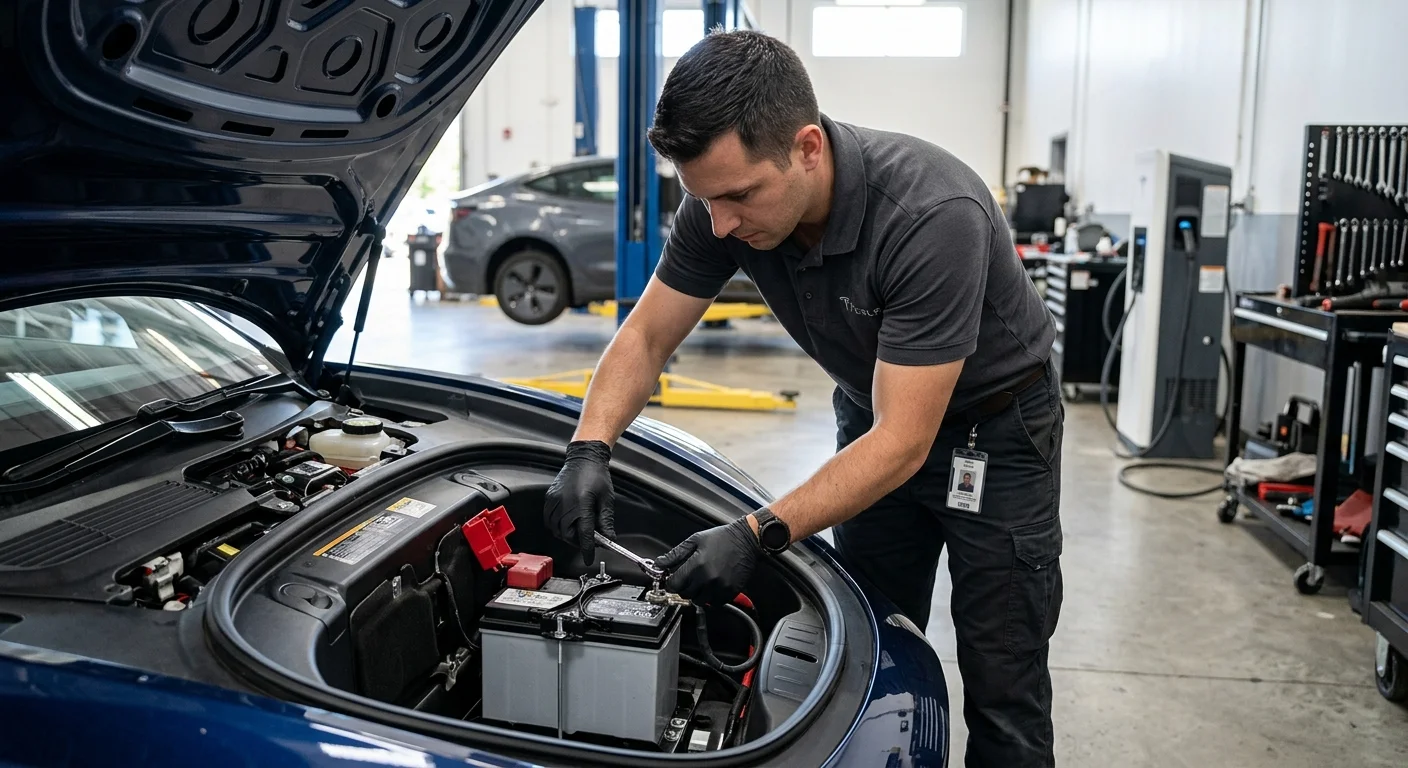
Why a weak 12-volt shuts the whole car down
Your EV runs two electrical systems at once. The big pack moves the wheels, and the small 12-volt runs the brains. Locks, lights, screens, and computers all draw from that little battery. So do the contactors that connect the pack to the car.
If the 12-volt can’t hold voltage, those computers never boot. Drive mode never comes up, and the charge port may stay locked. On some models the doors and the frunk won’t power-release. The dash can go blank or throw a pile of unrelated errors. It looks like a dead pack, and it usually isn’t.
The 12-volt is a wake-up battery, not a cranking battery. It only has to wake the computers so they can close those contactors. When it can’t, the car is a parked object. You’re not out of range, only out of low-voltage power.
See this 12-volt stall guide for the garage version.
Dulles economy parking is where this call starts
MWAA publishes Level 2 charging in Garage 1 and Garage 2 at Dulles. The Economy Lot is the large long-stay lot. You reach it by shuttle from Curb 2F. Drivers leave a car there for a week and come back to a silent cabin.
The traction pack can still hold a usable charge. Alarms, modules, and keep-alive loads nibble the 12-volt the whole time. Cold makes that drain worse. Dulles runs colder and snowier than Reagan National. Western Loudoun feels that swing more than the District does.
Ashburn and Sterling sit in that western pattern. They’re census-designated places in Loudoun County, not incorporated cities. Herndon is a town next door. A lot of those cars live near the airport. Many spend a week in the Economy Lot. The Ashburn roadside pattern is the same sit-and-die story. The car slept, then it wouldn’t wake.
Most airport drivers reach that lot off the Dulles Toll Road. MWAA operates the Dulles Toll Road, VA-267. The Dulles Greenway is a separate private toll road west of the airport. Leesburg traffic often comes in that way. Leesburg is a town, not a city. The roads aren’t the failure. The long sit in the lot is.
Reagan National is a different layout. MWAA lists EV charging on Level 1 of Parking Garages 1 and 2. Those spaces are first-come for parking customers. Garages 1 and 2 connect to the terminal. A short DCA trip is a milder 12-volt test. A week in Dulles economy parking is harder on the 12-volt.
None of that means the pack is empty. The common metro call is a 12-volt that won’t wake the car.
Signs your 12-volt is failing, not the pack
Catch it before the airport week if you can. The car often warns you, and sometimes it doesn’t.
Alerts that name the 12-volt
Many Teslas put a replacement message on the screen. Other brands say 12V battery low, electrical system, or a generic service warning. Don’t clear it and keep driving like nothing changed. That message is the car telling you the wake-up battery is tired.
A newer Model 3 or Model Y may use a lithium 12-volt. Older cars often use an AGM unit. The chemistry changes. The failure mode doesn’t. The computers still need that small battery to boot. Rivian, Mach-E, and Ioniq 5 cars still need a 12-volt to wake.
Cabin electronics that stutter
The center screen takes a long time to light. It goes black, then comes back. Door handles don’t present every time. The fob works on the third try. Interior lights flicker, and windows crawl. Headlights look dim at dusk.
Those are low-voltage symptoms. They aren’t a traction-pack range problem. They also show up after a workday in a Tysons garage. A Vienna Metro deck does the same thing. Vienna is a town in Fairfax County. Tysons is a census-designated place. A car that sat all day can fail the same way.
The car won’t wake at all
You press the brake and get no chime and no drive mode. That’s the late stage. The 12-volt can’t start the boot sequence. You may also see a cascade of unrelated module errors. Every control unit is starving.
If a jump already got you home, treat replacement as the job. A second death a week later is the same battery. Read our note on an EV that dies again after a jump.
A jump is a bridge. Replacement is the repair
A jump feeds the 12-volt system from outside. Designated jump points sit behind a bumper cover or in the frunk. That’s true on many Teslas, Rivians, and Mach-E models. You connect a 12-volt pack to those points. You don’t connect anything to the orange high-voltage system.
Once the computers wake, the car can recharge its own 12-volt. That charge comes from the traction pack. That’s why a jump can let you drive. It’s also why people think the problem is gone. The weak cell is still weak. The next long sit kills it again. Dulles economy parking is a long sit.
If you want the connection steps, use the owner’s manual for your exact model. Our how to jump start an EV 12-volt walkthrough is the general version. Tesla owners can also read jump on site or go to a shop.
Replacement means a new 12-volt goes in, and the old one leaves. After that, the wake-up path is stable again. That’s the difference between another Economy Lot surprise and a real start.
A fresh 12-volt doesn’t add range. It doesn’t fill the traction pack. It only lets the car boot so the pack can do its job. If the pack is also low, you still need a Level 2 top-up.
Who quotes the work, and who doesn’t
Charge Pro DC doesn’t set prices. Independent operators quote you before they start. They bill you directly. A shop will quote parts and labor for your make. We couldn’t confirm a published metro parts list for this job. Ask the shop or the operator for the current figure.
Don’t use a blog number as a quote. Newer lithium 12-volt packs are a different part than the older AGM style. Confirm the part your model uses.
Pepco serves the District, Montgomery County, and Prince George’s County. Dominion Energy Virginia serves most of Northern Virginia. NOVEC covers parts of Loudoun and Prince William, including much of Sterling and Ashburn. Confirm the serving utility by address. Those utilities publish home-charging programs. None of the utility EV pages we reviewed offer a stranded-car charge. A home rate doesn’t cover a battery sitting in airport parking.
On-site swap versus towing to a shop
Some drivers want the car at a service center. That only works if the car can wake and roll. A dead 12-volt may not open the charge port. It may not shift into drive. It may not release the parking brake the way you expect. Towing a silent EV across this metro is its own project.
Virginia, Maryland, and the District each handle disabled vehicles under ordinary traffic rules. None of the three codes we reviewed has a special out-of-charge section. A dead EV is still a disabled car. Fairfax County and the City of Fairfax are separate jurisdictions. Say the right place when you call, because the response path isn’t the same.
If you’re already in a lot, an on-site jump avoids a tow hook. An on-site 12-volt replacement does the same. Operators in this network jump or replace a dead 12-volt on site. They also handle Tesla and every major EV brand. They bring a 240-volt Level 2 source when the pack itself is low. That typically adds 10 to 20 miles of range. Plan on 15 to 30 minutes of charging. That window is charge time, not a promise of when someone arrives.
A shop visit still makes sense when you want a dealer part. We don’t publish warranty coverage here. Confirm that with the manufacturer or the selling dealer. For the stranded part, a quoted local operator can wake the car. Then you can drive to that appointment.
Skip the garage-floor swap if you aren’t set up for it
Battery location changes by brand and year. Many Model 3 and Model Y units sit under the frunk cowl, behind trim. A Mach-E may hide the 12-volt in the frunk. Some years put it under a rear seat. Hyundai and Volkswagen layouts differ again. The owner’s manual is the map. A random clip on your phone isn’t.
EVs also want a service mode before you open the 12-volt circuit. Get that wrong and you can stack faults. Charge Pro DC is a referral line. We don’t perform the work. We don’t walk you through a live disconnect on the phone. If you aren’t equipped, wait for a tech.
If it dies away from the airport
The Economy Lot is the headline. It isn’t the only long sit. Tysons office garages and Silver Line lots in Reston leave cars dark all day. Reston is a census-designated place, not an incorporated city.
Pre-1980 housing is common in Takoma Park, Annandale, Wheaton, and much of Washington. Takoma Park’s share sits at 90.0 percent. That’s a proxy for homes that never got a Level 2 plug. That’s a charging-habit problem more than a 12-volt problem. The airport pattern is the opposite.
Ashburn’s pre-1980 share is 3.1 percent. A plug at home doesn’t save a battery that already failed in the lot.
On a Virginia interstate, VDOT Safety Service Patrol covers corridors including I-66. Reach that help through Virginia 511. It doesn’t describe EV charging or a 12-volt replacement.
In Maryland, dial #77 for CHART on I-495 and I-270. The list also includes US-50 and MD-295. CHART lists tire changes, jump starts, about one gallon of gas, and radiator water. It doesn’t describe a mobile EV charge.
The District has no DDOT motorist-assistance patrol in the material we reviewed. On the Baltimore-Washington Parkway, report a disabled vehicle to US Park Police at 202-610-7500. NPS parkways ban commercial vehicles and trucks over 10,000 lb.
On the 495 Express Lanes, pull to the left shoulder. Those lanes sit in the median. On the 95 and 395 Express Lanes, pull to the nearest shoulder. Stay in the car until help arrives. Transurban’s Express Assist helps with minor mechanical issues and will call a tow. It doesn’t tow, and it doesn’t publish EV charging.
What to do in the Economy Lot right now
Stay with the vehicle if the lot rules allow it. Note the lot name, the row, and the shuttle stop. Tell the operator you’re in the Economy Lot, not Garage 1 or Garage 2. Economy parking is a shuttle ride from Curb 2F.
A dark cabin with a recent healthy range reading points at the 12-volt. A car that woke yesterday and sat a week points at the 12-volt.
Don’t keep retrying the fob until the 12-volt is fully flat. Don’t try to jump from the orange high-voltage hardware.
Charge Pro DC matches you with an independent local operator. The operator quotes before starting and bills you. We own no trucks and we send no in-house crew. For a Tesla-specific 12-volt jump, see Tesla 12-volt battery jump. For the airport sit, see mobile Tesla charging in Dulles economy parking.
After it starts, replace it before the next trip
Once the car is awake, don’t park it for another week. Drive to a shop, or have the 12-volt replaced where it sits. The next long dwell might be another Economy Lot stay. It might be a Silver Line garage. It might be your driveway in a hard freeze.
Western Loudoun freezes harder than the inner core. Dulles snow isn’t Reagan National snow. Recurrent Auto’s winter study is about traction range, not the 12-volt. A typical EV keeps about 80 percent of range at 32F. The 12-volt still has to wake the car so that heat can run.
When you should call
Call when the car won’t wake, or a jump already failed you once. Call when you’re in Dulles economy parking and the screens are dark. Call when you’d rather replace the 12-volt on the spot.
We serve the District of Columbia, Maryland, and Virginia. The pros we connect you with are licensed and insured. They quote the job, and you approve it.
For a local operator, call (202) 629-0844. That number is how you reach the referral line. It isn’t a promise of when someone arrives.