The car sat in a George Mason garage all week. Now it won’t wake, unlock, or roll. That’s EV roadside assistance in Fairfax City in its most common form. A dead 12-volt after a long sit, not an empty pack. The City of Fairfax is its own city. It’s not a Fairfax County neighborhood. The operator who comes is an independent mobile rescue pro we match you with. It’s not a municipal truck, and it’s not us doing the work.
Fairfax City is not Fairfax County
Maps print one word. Dispatch needs two. Fairfax is an independent Virginia city, 6.241 square miles on the Census Gazetteer point. The ACS 2019-2023 count puts the population at 24,478. It sits inside the Fairfax County ring. It isn’t the county. The Fairfax County government complex is nearby, across that legal line. Tow postings, garage contracts, and the interstate shoulder all follow the split.
If you parked at George Mason’s main campus, you’re in the city. If you parked along Main Street in Old Town Fairfax, you’re in the city. If you already rolled west toward Centreville, or south toward Burke, you’ve left it. Tell the operator “City of Fairfax.” Don’t say only “Fairfax.” That extra word changes the roads they use.
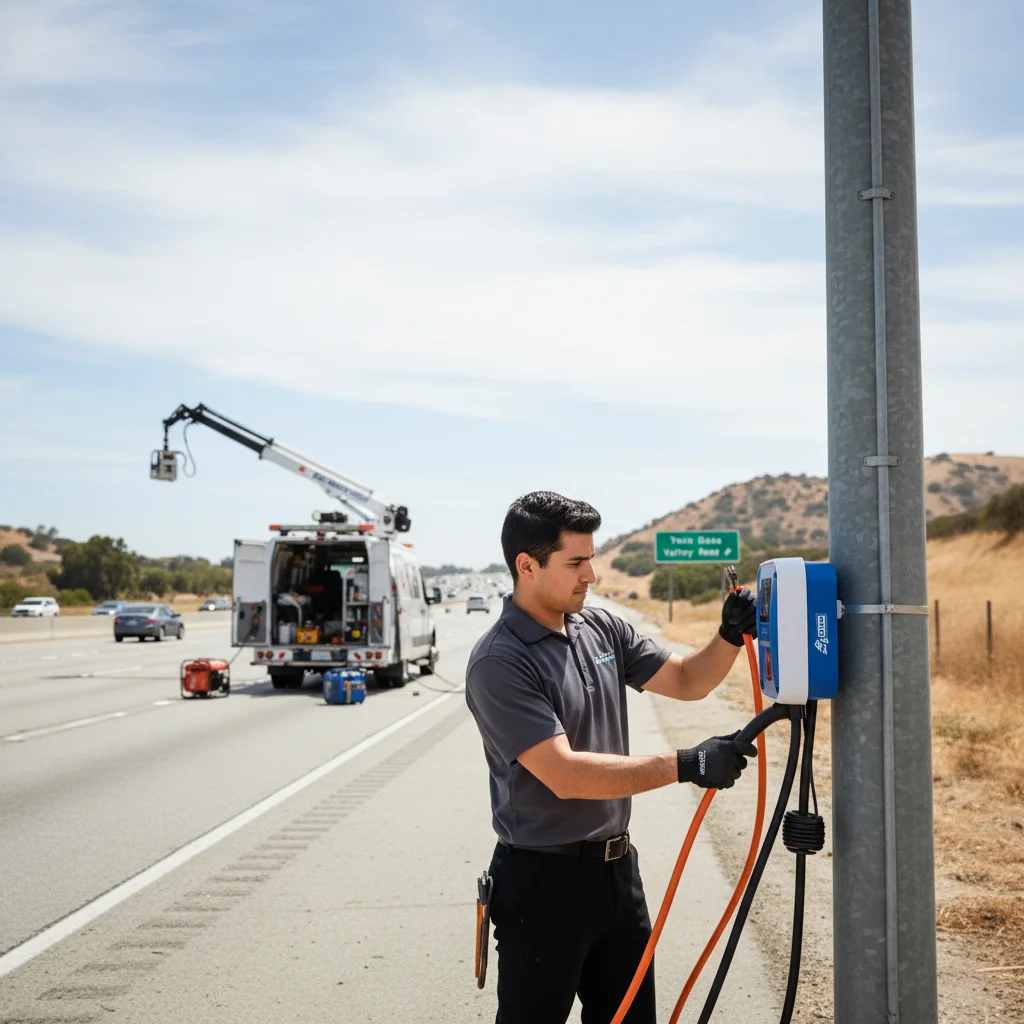
I-66 runs through the middle of town. So does US-50, signed here as Fairfax Boulevard. VA-123 is Chain Bridge Road. VA-236 is Main Street. VDOT’s Safety Service Patrol covers Northern Virginia interstates, including I-66. You reach that help through Virginia 511. Published VDOT pages describe incident and debris clearance, plus short-term traffic control. They don’t describe charging an EV. A patrol can make an interstate shoulder safer. That’s not the call for a dark campus garage.
Virginia treats a stalled EV like any other disabled car. The metro codes reviewed for this page add no out-of-charge statute. You still need a safe pull-off. You still need flashers. You still need a plan that actually moves the car.
Why city garages still kill the 12-volt
The high-voltage pack can still hold a commute’s worth of miles. The 12-volt wakes the computers, latches, and contactors. Leave the car dark in a garage for days. That small battery is what fails first. Teslas do this. So do the other major EV brands the operators we send handle on site.
George Mason’s main campus sits at the heart of the city. Student and staff garages are long-dwell by design. A car can sit through a weekend, a conference, or exam week. That’s the classic 12-volt failure setup. Metro park-and-ride garages across this metro show the same long sit.
Humid summers and icy winters both punish a sitting 12-volt. Parasitic drain continues while the car looks off. Recurrent Auto studied winter range on more than 30,000 EVs. A typical pack keeps about 80 percent of range at freezing. It keeps about 70 percent at 20F. That’s traction-pack range in the cold, not 12-volt health. In a garage the pack may be fine. The car still won’t boot.
Most Fairfax City housing is older. ACS 2019-2023 table B25034 puts the pre-1980 share at 68.3 percent. Old Town Fairfax still carries a lot of that stock. Street parking is common in the older core. Many drivers use public charging when they’re home. Newer edges of the city are more likely to have a wall unit. Neither setup helps if the 12-volt is already dead. A cable in the port does nothing for a car that won’t wake.
Dominion Energy serves Fairfax City. Named programs include Schedule 1EV, the voluntary Off-Peak Plan, and EV Charger Rewards. Confirm current terms on Dominion’s site. None of the utility EV pages reviewed offer a stranded-car charge. The utility bills the house. It doesn’t roll to a Mason stall.
I-66 and Fairfax Boulevard when the pack is actually empty
Not every dead EV here is a 12-volt. I-66 cuts through town. Fairfax Boulevard does too. A crawl with heat or AC on burns miles without covering them. That’s a traction-pack problem. Gridlock on those corridors is idle drain, not a distance problem.
If the dash still lights and the car will roll, you may only need electrons. A mobile EV charging visit brings a 240-volt Level 2 source to the bumper. Operators typically add 10 to 20 miles of range in 15 to 30 minutes of charging. That’s charging time. It isn’t an arrival window. Teslas take a native NACS plug. Other EVs use a CCS or J1772 adapter.
If nothing lights, start with the 12-volt. A jump or on-site replacement isn’t a pack top-up. The Tesla 12-volt jump page walks through that split. The same operators handle non-Tesla EVs. Make and model shouldn’t be why you wait for a flatbed.
If you’re on I-66, pull to a shoulder when you can. Stay in the car until the scene is controlled. VDOT and 511 are for the traffic problem. The mobile operator is for the electrical one. They’re not the same call.
What the operator brings, and who bills you
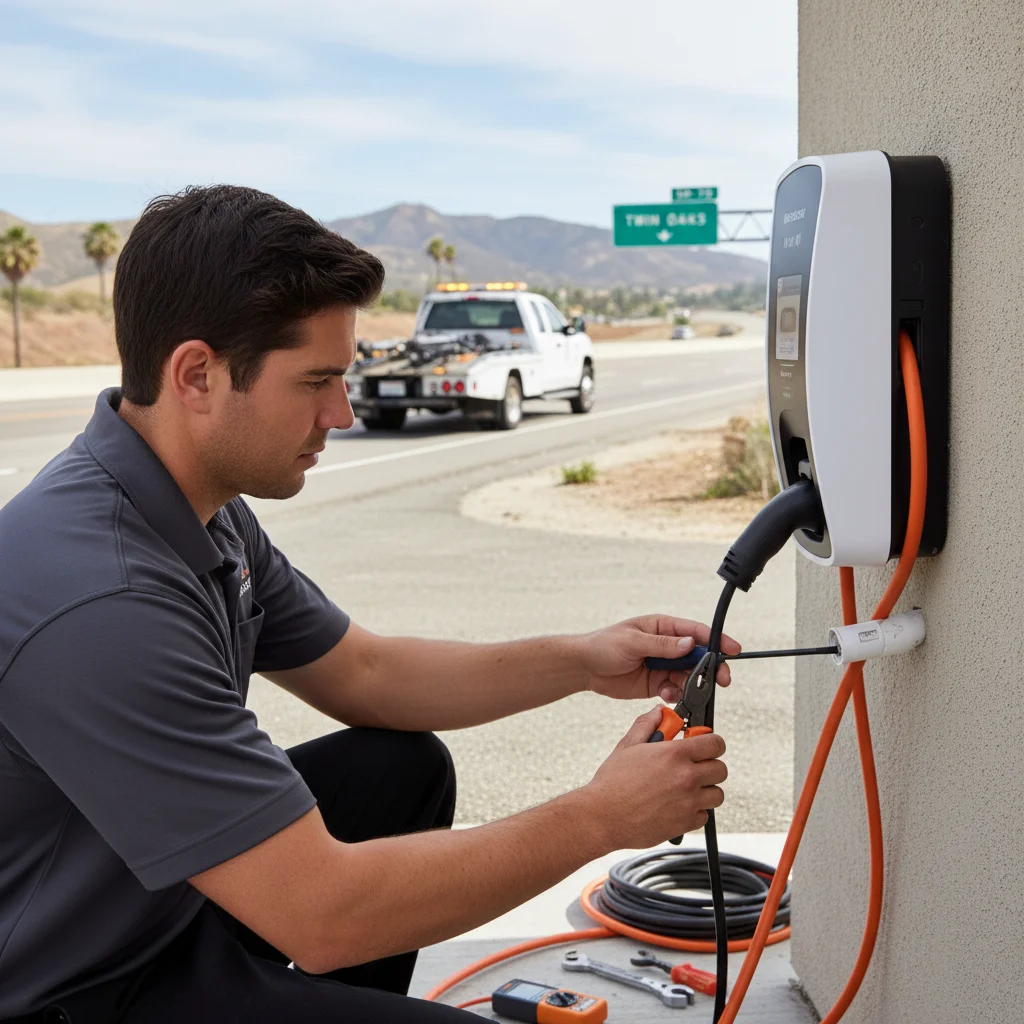
Charge Pro DC is a referral line. We match stranded drivers with independent local mobile rescue operators. We don’t own the truck. We don’t employ the technician. We don’t set the price. The operator quotes you before any work starts, then bills you directly.
What they bring is simple. A 240-volt Level 2 source for a short, usable top-up. Jump gear, and a replacement 12-volt when that’s the failure. Coverage for Tesla and every major EV brand. You stay with the car. You confirm the quote. Then they start.
The metro-wide EV roadside assistance page is the clean outline of the call. Fairfax City is on the DC-area map, with Maryland and Virginia. We can match you with a pro who works the city. That doesn’t mean a branded fleet is staged on Chain Bridge Road.
Jump, charge, or tow
A dark car that clicked once is usually the 12-volt. Jump it. Confirm it holds. Drive to a shop if it sags again. If the car wakes with a sliver of range, you still need a top-up to get home. Crash damage, a bent wheel, or a charge port you can’t free needs a tow.
Towing an EV isn’t like towing a gas car. Many EVs can’t be flat-towed without drivetrain risk. A flatbed is the safer default. Virginia lets localities set private-property tow rules by ordinance, under Va. Code sections 46.2-1231, 46.2-1233, and 46.2-1233.1. Statewide passenger-car limits exist in that code. The exact City of Fairfax ordinance amounts were not confirmed in this research. Ask the tower for posted rates before you authorize a hook. Don’t guess the bill.
Read mobile charging versus a tow before you’re on the shoulder. Empty or asleep is often solvable on the spot. Broken isn’t.
Nearby, once you’ve already left town
Fairfax City is small. You can leave it in minutes. Vienna sits to the northeast. Merrifield is along the commercial edge toward the Beltway. Burke is south. Centreville is west along I-66. If the car died after you crossed those lines, say so on the call. The Vienna garage 12-volt pattern is close kin to a Mason lot. Burke garage deaths follow the same small-battery script.
Old Town Fairfax is compact and older. The university runs on a different clock. Class blocks, overnight stays, and full garages set that rhythm. Fair Oaks Mall is nearby. Don’t use the mall as a stand-in for your actual stall. Give the operator the garage level or the nearest campus building. Or give the Fairfax Boulevard cross street. Vague “I’m in Fairfax” wastes the first minutes of the call.
Winter ice and summer humidity both belong in that first sentence too. Say the car has sat since Friday in the Mason garage. That’s more useful than “the battery is dead.”
When to call
Call when the car won’t wake in a city garage. Call when the 12-volt died after a long sit on Main Street. Call when I-66 left the pack too low to finish the trip. Same if it happened on Fairfax Boulevard. Don’t wait for a utility visit that isn’t coming. Don’t assume a VDOT patrol carries a charger.
Tell the operator you’re in the City of Fairfax, not Fairfax County. Name George Mason, Old Town, or the corridor. Say whether the dash is dark or the range is just gone. They’ll quote the work. Then they’ll do it, or they’ll tell you that you need a tow instead.
Charge Pro DC matches you with that operator. Call (202) 629-0844 when you’re ready. Stay with the car. Keep the scene safe. Confirm the quote before any cable goes on.