A Lexus RZ that won’t start after a day in an inner Fairfax garage is usually a dead 12-volt. It’s not an empty traction pack. The fob goes quiet. The cabin stays dark. The pack can still show plenty of miles. The small battery that wakes the computers is the one that failed.
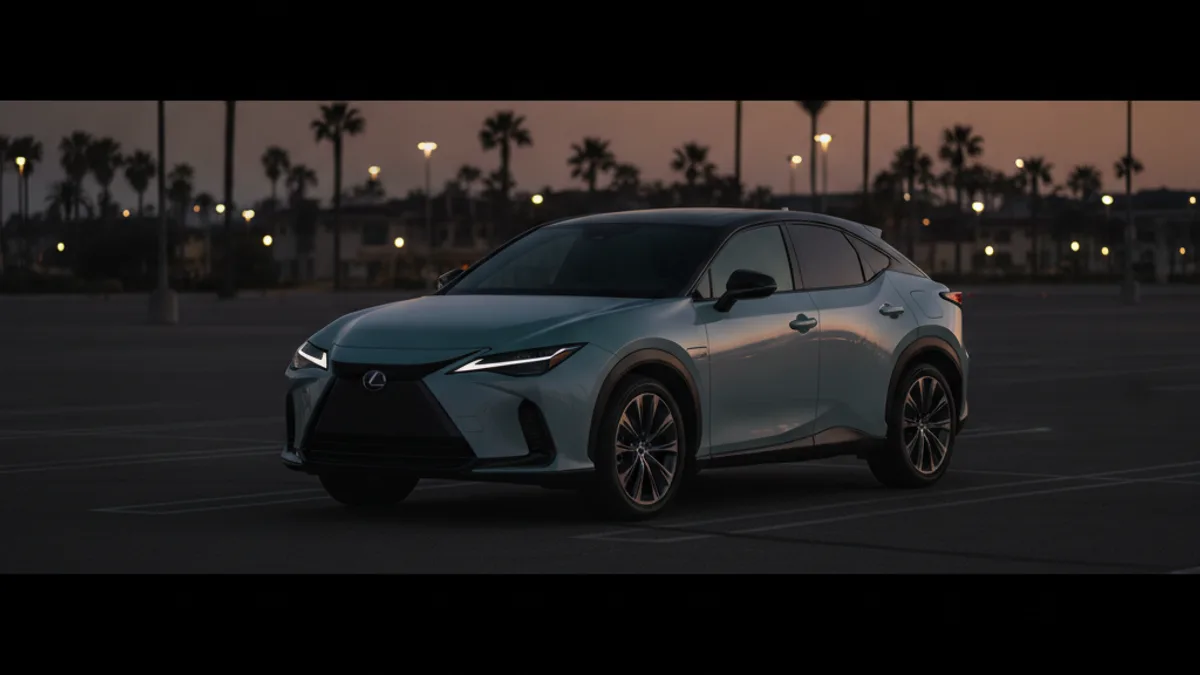
That sit is common around Tysons, Merrifield, and Fairfax City. The car is locked in an office stall from morning until evening. Keyless systems never fully sleep. A lead-acid 12-volt that already sits low then drops under that load. You walk back at 6 p.m. and the Lexus does nothing.
The City of Fairfax and Fairfax County are separate jurisdictions. Long-dwell parking wears this 12-volt in county office parks and Fairfax City decks. A similar stall shows up after a long sit at Tysons Corner Center.
The RZ has two batteries, and they don’t fail the same way
One pack moves the car. That’s the high-voltage traction battery. A second, ordinary 12-volt battery runs locks, lights, screens, and the computers. Those computers have to boot before the traction pack can connect. Kill the 12-volt and the big pack stays locked out. A range number in the app can look fine. The car can still be a brick. No chime. No READY light. Power does nothing. People assume they’re out of charge. They’re looking at the wrong battery.
Watch for a silent cabin:
- Dash, ambient lighting, and the center screen stay dark when you press Power
- The fob won’t unlock, so the mechanical key blade is the way in
- Hazard lights won’t fire
- No lock clunk as you walk up
If the cluster lights, throws a high-voltage warning, and dies, that’s a different path. Don’t jump in a loop. Get a dealer scan. The all-dark case is the 12-volt case.
Why this platform lets the 12-volt sag
The RZ shares its e-TNGA bones with the Toyota bZ4X and the Subaru Solterra. The 12-volt habit travels with that platform. Owners report the auxiliary battery lingering at a low state of charge for long stretches. Lead-acid cells that live there sulfate. Sulfation is permanent capacity loss. That’s why some RZs lose the 12-volt earlier than a new Lexus suggests.
A hardwired maintainer at home can keep the 12-volt topped in a driveway. It doesn’t travel with you into a Fairfax garage. The same limit applies in a WMATA park-and-ride. A week in airport parking is the same test. Reagan National has complimentary EV charging on Level 1 of Parking Garages 1 and 2. Come back to a car that sat without a maintainer. You’re testing whatever the 12-volt has left.
Heat makes the chemistry worse. This metro’s summers stack humid stretches above 90 degrees. That speeds sulfation on a lead-acid 12-volt. Dulles runs colder and snowier than Reagan National. Western and northern suburbs see harder freezes than the District core. Cabin heat in a stalled EV comes from the traction pack. Recurrent Auto’s winter study put typical EV range at about 80 percent at freezing. At 20 degrees it’s about 70 percent. None of that helps if the 12-volt never wakes the car.
If the RZ has been slow to wake for a few weeks, get the 12-volt load-tested. A Fairfax garage going dark is the late version of that warning.
Pepco, Dominion Energy Virginia, and NOVEC all publish home charging programs. None of the utility pages we reviewed offer a service that charges a stranded car. A dead RZ in a garage is not a utility call.
Three failures that look like a no-start
An empty traction pack still talks. The dash usually lights. You’ll see a range figure, a charge warning, or a reduced-power prompt.
A dead 12-volt goes quiet. Sometimes no unlock.
A high-voltage fault often lights the cluster, throws a warning, then shuts down. A jump won’t clear it.
READY comes on and the car won’t roll. Press the brake all the way. Confirm you’re in Park. The interlock on these platforms is picky.
Jump points on the RZ, and the clamp order that stays safe
Lexus hides the 12-volt under the hood, in the front compartment, behind plastic covers. You don’t clamp the battery posts if you can avoid it. Lexus gives you a dedicated positive jump post. Confirm the exact spot in your model-year manual. Placement shifts a little across years.
The posts
Positive: open the hood. Open the engine covers and the fuse box cover. Lift the dedicated jump-start terminal cover. Red clamp on the exposed post.
Negative: don’t use the battery’s negative terminal. Clamp an unpainted metal ground on the chassis or front structure. Keep it away from the jump post. That keeps a spark off the battery.
The order
Leave the donor vehicle or jump pack off until the clamps are on.
- Red to the RZ positive jump post.
- Red to the donor positive terminal.
- Black to the donor negative terminal.
- Black to the RZ’s unpainted ground, not the battery negative.
- Wait two to three minutes for the RZ to sense voltage.
- Foot on the brake, press Power. READY should appear.
If READY comes up with a 12-volt warning, the battery woke the car and it’s fading. Schedule a replacement. The EV 12-volt replacement guide covers that next step. For clamp order on any EV, use how to jump start an EV without frying the 12 volt system.
Lexus doesn’t pack a jump box. A compact lithium pack in the front trunk is worth carrying. Any healthy 12-volt car can supply the jump if you have cables. Gas or electric both work. Don’t reverse the last clamp. Connecting negative to the battery post on this layout puts a spark on the cell.
Reading the symptoms on the garage floor
| What the car does | What that usually means | What to try |
|---|---|---|
| Dark screens, dead fob | 12-volt is out | Jump the under-hood positive post |
| Dash lights, no READY | Weak 12-volt or a high-voltage fault | One clean jump, then a scan if READY still fails |
| READY on, no movement | Brake or gear interlock | Firm brake, retry from Park |
| Fine at 8 a.m., dead at 6 p.m. | 12-volt drain during the sit | Load-test; use a maintainer at home |
| Wakes, then cuts out | Loose or corroded 12-volt terminal | Inspect and clean the posts |
Humid summers here grow film on lead-acid terminals. White or green crust drops voltage even when the cell still has life. Clean the posts before you condemn the battery. If the mechanical key gets you in and Power does nothing, it’s still the 12-volt.
Garage stall versus the shoulder
A dead RZ in a Tysons or Merrifield deck is annoying. You can pop the hood without traffic at your back. Put the hazards on if they still work. They often don’t, because hazards run off the 12-volt. Don’t block a ramp or a fire lane while you sort it out.
On the road the order changes. On I-66 from inner Fairfax, get out of the travel lane first. If you’re in the 495 Express Lanes, pull to the left shoulder. Those lanes sit in the median. Stay in the car until help is with you. On the 95 and 395 Express Lanes, use the nearest shoulder. Express Assist is a free patrol on those lanes. It helps with minor mechanical issues and will call a tow. It doesn’t tow, and it doesn’t charge an EV.
VDOT’s Safety Service Patrol covers Virginia interstates, including the I-66 corridor. It clears debris and sets short-term traffic control. It doesn’t charge an EV. Maryland drivers on I-495 or I-270 can reach CHART on #77. CHART publishes tire changes and jump starts. It doesn’t publish EV charging. We found no DDOT motorist-assistance patrol for the District. On NPS parkways, a disabled vehicle is a US Park Police matter at 202-610-7500. Those roads ban commercial vehicles and trucks over 10,000 lb. Shoulders can be narrow or missing.
None of those patrols replace a 12-volt that will not hold. That’s the call for a quoted mobile operator. State disabled-vehicle rules in DC, Maryland, and Virginia treat an EV like any other car. We didn’t find a separate out-of-charge statute in the three codes we reviewed.
A jump that holds is a drive home and a load test. A jump that dies again in the same stall means the battery is done. Don’t nurse a fading 12-volt onto I-66 at peak. Don’t roll it onto the Beltway hoping a public charger will take over. The RZ usually won’t accept a charge until the 12-volt is alive. Charging computers need that small battery too.
What the operator brings, and what we don’t
Charge Pro DC is a referral line. We match stranded drivers with independent local operators. We don’t own trucks or employ techs. The operator quotes you before work starts and bills you directly.
On an RZ, the first job is usually a 12-volt jump in the stall. The operator can also tell you if that battery needs replacing on site. If the traction pack is low too, they can add a 240-volt Level 2 top-up. Operators bring a native NACS plug, plus CCS or J1772 adapters for non-Tesla EVs. A typical top-up adds about 10 to 20 miles of range in 15 to 30 minutes of charging time. That number is charging time. It’s not an arrival time.
Operators cover Fairfax City, Tysons, Merrifield, Vienna, and the rest of this metro. Start with non-Tesla EV rescue or EV roadside assistance in Fairfax City. The 12-volt sequence is shared with the Toyota bZ4X and the Subaru Solterra.
The e-TNGA cousins use the same wake-up logic
The RZ, the bZ4X, and the Solterra boot the same way. Under-hood jump post. Chassis ground. READY last. Still match the cover layout to your own manual. Lexus, Toyota, and Subaru do not hide every fuse box in the same corner.
Frequently asked questions
How do you jump start a Lexus RZ?
Open the hood. Pull the engine and fuse box covers. Lift the dedicated jump-start terminal cover in the front compartment. Red clamp on the exposed positive post. Black clamp on an unpainted chassis ground, not the battery’s negative terminal. Wait two to three minutes. Press Power with your foot on the brake. READY should come on. Confirm the post against your model-year manual before you clip anything.
Why won’t READY come on in a Lexus RZ?
The usual cause is a depleted or failed 12-volt battery. The RZ needs that battery to power the computers before the high-voltage system can engage. A full traction pack won’t help if the 12-volt is dead. Jump first. If READY stays off after a clean jump, look at a high-voltage fault. That needs a dealer scan, not another jump.
Can the RZ charge while the 12-volt is dead?
Usually not. Charging control needs the 12-volt alive. A car that won’t wake generally won’t take a plug. Jump or replace the 12-volt first. Then the RZ can charge, including from an operator’s mobile 240-volt source.
If the RZ is dark in a Fairfax garage, call Charge Pro DC at (202) 629-0844. We’ll connect you with a local operator. The operator quotes before they start.