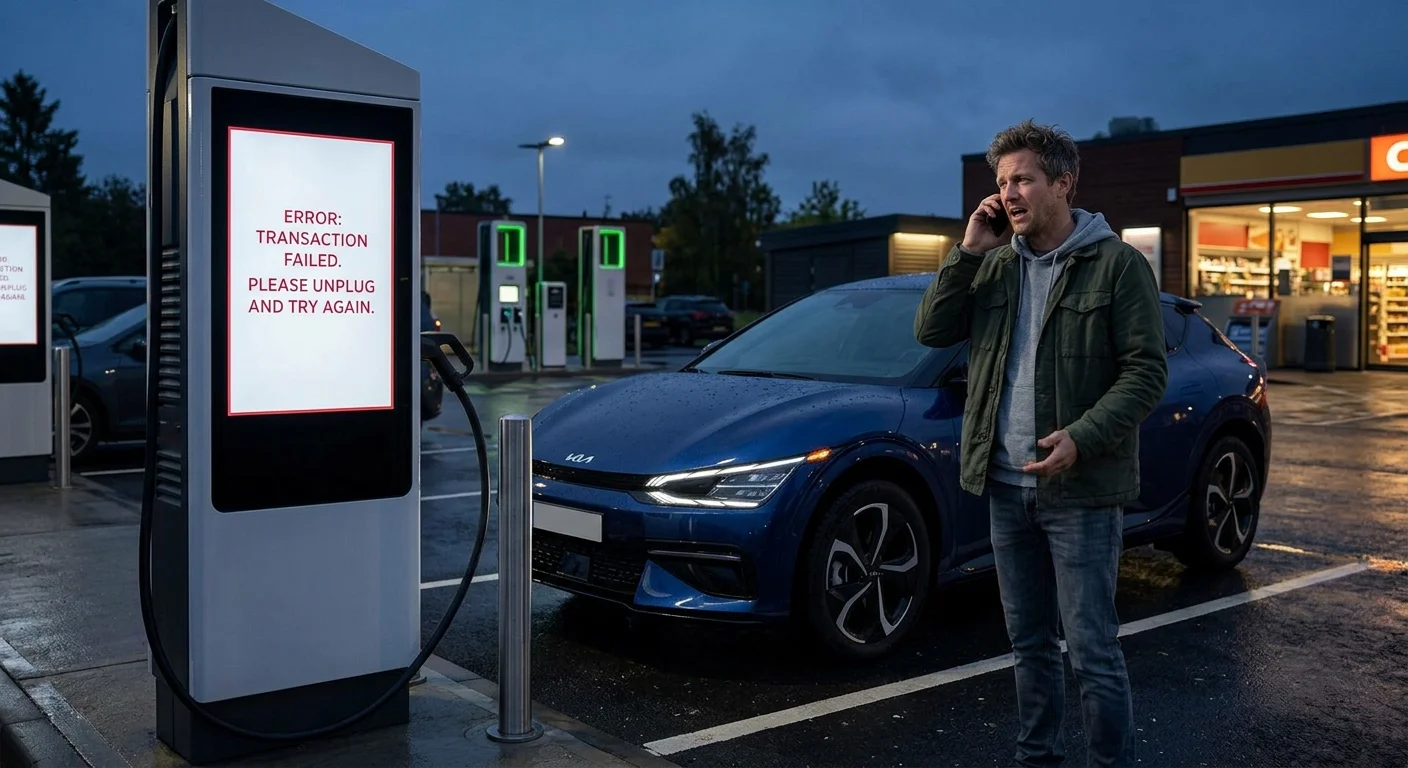
The CCS handle seats in the Kia EV6 charge door. The apartment post hangs on connecting and never starts. That failed handshake isn’t an empty traction pack. The cluster can still show leftover miles. You still need a 240-volt source at the bumper.
Apartment lots, old housing, and a shared post
A lot of EV6 drivers in this metro never park beside a private wallbox. They share a post in an apartment lot. Arlington, Alexandria, and the District have dense rental housing. Silver Spring, Wheaton, Hyattsville, and Annandale skew older too. Takoma Park sits near 90 percent pre-1980. Washington’s housing stock is around 70 percent pre-1980. Those buildings were wired long before a J1772 head in the lot.
You wait for the shared stall after the I-270 or Beltway crawl, then you plug in. The EV6 never begins a charging session. Pepco serves the District, Montgomery County, and Prince George’s County. Dominion Energy Virginia serves most of Northern Virginia. NOVEC serves parts of Loudoun and Prince William, including Sterling, Ashburn, and Gainesville. None of the utility EV pages we’ve reviewed will charge a stranded car. If the post won’t handshake, the power company isn’t finishing the session.
Long sits create a second version of the same night. Airport garages and WMATA park-and-ride lots fade a 12-volt over a week. You come back and the screens are slow. CCS won’t start even if the traction pack still holds range.
What the EV6 needs before current can flow
A US Kia EV6 takes AC through J1772. DC fast charge uses CCS Combo 1, the J1772 inlet plus two large DC pins. Before any current moves, the car and the post have to agree. They check the latch, the safety interlock, the voltage, and the current cap. If that talk fails, the pack takes nothing. Range on the cluster can still look fine.
A dark post, a station error, or a stuck payment app is a stall problem. Try the next stall. Then try a different network if you can roll that far. If every post fails, including a building J1772 you’ve used before, look at the car.
Scheduled charging in Kia Connect or on the head unit can look like a refusal too. The car’s waiting for a clock window or a percent cap. Clear both, then plug in again.
When the handle shows connected and nothing happens, use the checklist for a public charger that won’t start.
Two-minute checks at the stall
Set the parking brake. Open the charge door fully so the sensor isn’t half-tripped. Push the handle in until it latches. Watch the EV6 charge lights. No change means unplug, wait a few seconds, and reseat. Don’t yank on the pins.
On the infotainment screen, open charging. Look for a departure schedule. Look for a charge limit sitting at the percent you already have. A car that thinks it’s done won’t take more AC. Turn the schedule off. Raise the limit, then retry.
If this is a home wallbox, check the panel. The EV breaker may have tripped. Reset that breaker only. If it trips again, leave it off. That’s a wiring or wallbox fault. It isn’t a job for a roadside operator.
An overnight plug that never started is a different case. A CCS stall that errors in seconds is its own problem. Read what to do when the car sat plugged in all night for that pattern.
CCS at the curb and J1772 at the building
Apartment lots mix slow J1772 posts and a few CCS fast stalls. The EV6 can use both. A dead CCS session doesn’t prove J1772 is dead. If building AC works and the CCS stall fails, stay on the station side. If both refuse, the car’s in play. The 12-volt battery is the usual block.
Heat and cold change how fast the pack accepts power. They don’t, by themselves, prove a handshake fault. Recurrent Auto’s winter study of more than 30,000 EVs found typical cars keep about 80 percent of range at 32F. At 20F, that figure is about 70 percent. Cabin heat comes from the pack. Dulles runs colder and snowier than Reagan National. Loudoun, upper Montgomery, and Prince William freeze harder than the inner District. An EV6 that sat outside in Ashburn or Germantown may need a short wake-up. Give it a minute before you blame the post.
Sitting in summer heat with AC on has the same idle-drain shape. The pack falls while the car covers no miles. That’s a Beltway problem, not a CCS pin problem.
When the 12-volt battery blocks the handshake
The traction pack is high voltage. A small 12-volt battery still runs the computers that talk to the charger. If that 12-volt is low, the EV6 may not wake. Screens stay black. The charge port may not unlock. The CCS post never gets a partner on the other end of the cable.
Watch for these signs, not an empty pack:
- Cluster and infotainment flicker or die
- Locks and windows act weak
- Charge door won’t release the handle
- A Check EV system lamp or a 12-volt message
A jump on the 12-volt terminals can wake those computers. Follow the Kia owner’s manual for clamp points. Don’t guess from a gas-car layout. How to jump-start an EV 12-volt walks through the safety order.
A successful jump is a wake-up. It isn’t a new battery. If the EV6 dies again after a few miles, plan a 12-volt replacement. Don’t keep jumping it in the same lot.
If the car wakes, screens look normal, and CCS plus J1772 still refuse, you’ve left the two-minute list.
Idle drain on the Beltway and I-270
Sitting still with climate on burns charge without covering ground. That’s the I-495 crawl and the I-270 stack toward Rockville and Germantown. It’s also the I-95 standstill through Prince William. You arrive at the apartment post already low. Then the handshake fails.
The region’s hard example is January 3 and 4, 2022. Snow and a multi-truck crash shut about 50 miles of I-95. That stretch was in the Fredericksburg area, just south of this metro. The road stayed closed overnight for more than 36 hours. Drivers sat with heat on. An EV6 in that pattern can hit the lot with little buffer.
If you stall on the 495 Express Lanes, pull to the left shoulder. Those lanes sit in the median. On the 95 and 395 Express Lanes, pull to the nearest shoulder. Stay in the car. Express Assist helps with minor issues and will call a tow. It doesn’t charge an EV.
What CHART, VDOT, and the District won’t do
Maryland’s CHART Emergency Traffic Patrol works the Baltimore/Washington metro roads. Technicians change tires and jump 12-volt batteries. They add about a gallon of gas and radiator water. On I-495, I-270, US-50, and MD-295, dial #77. CHART’s published work doesn’t include charging an EV.
VDOT Safety Service Patrol covers Virginia interstates, including I-66 and I-95 in Northern Virginia. Drivers reach them through Virginia 511. Published material describes incident clearance, debris, and short-term traffic control. It doesn’t describe EV charging.
Reviewed District material shows no DDOT motorist-assistance patrol. DC drivers use MPD, a private roadside plan, or US Park Police on the parkways. NPS parkways here ban commercial vehicles and trucks over 10,000 lb. That list is the Baltimore-Washington, George Washington Memorial, Clara Barton, Rock Creek, and Suitland parkways. Report a disabled vehicle on the Baltimore-Washington Parkway to US Park Police at 202-610-7500.
Disabled-vehicle rules in DC, Maryland, and Virginia treat an empty EV like any other stopped car. None of the three codes we’ve reviewed has a special out-of-charge section.
A mobile 240-volt visit when the post still won’t talk
You can clear the schedule, reseat the handle, and try a second stall. You can still sit in an Arlington apartment lot with a CCS post that won’t start. Towing an EV6 that won’t power accessories is a last resort. A quoted mobile visit brings 240-volt Level 2 to the bumper.
Charge Pro DC is a referral line. We match stranded drivers with independent local operators. We don’t hold a trade license, own trucks, or employ technicians. We don’t set prices or promise when someone arrives. The operator quotes you before work starts and bills you directly.
For a Kia EV6, the operator uses a CCS or J1772 adapter on that 240-volt source. A typical session adds 10 to 20 miles of range in 15 to 30 minutes of charging time. That clock is time on the plug. It isn’t a claim about when the truck shows up.
If the 12-volt is the block, the same visit can jump it on site. If the traction pack is low and the apartment CCS post failed, the 240-volt top-up is what moves you. That gets you to a working stall or home. See non-Tesla EV rescue and mobile EV charging for how that visit is scoped.
When the EV6 still won’t take a charge
You tried another stall. You turned off the charge schedule. You reseated the handle. The screens won’t wake, or they wake and still refuse CCS and J1772. Stop stacking guesses at that point.
Call (202) 629-0844. We connect you with a local operator who quotes the visit before anything starts. If you’re on a parkway or an express lane, stay with the car. Keep climate use low so the pack doesn’t fall while you wait for the quote.