Most Arlington EV drivers rent without an assigned plug. You park under a Ballston or Crystal City building, and the stall is just a stall. Public charging carries you through the week until it does not. Then the pack is empty overnight, or you fly home to a silent car at DCA. Mobile EV charging in Arlington is an independent operator bringing 240 volts to that stall, or jumping a dead 12-volt on site.
Why Arlington renters live without a plug
Arlington County is the dense inner-Virginia core. Census ACS 2019-2023 counts put it at 235,463 people on about 26 square miles. It is a county with no incorporated towns. More than half the housing, 53.1 percent, was built before 1980. That older high-rise and garden-apartment mix is why so many EVs never got a dedicated charger.
You rent near Ballston Quarter. Or you park under a Crystal City / National Landing deck. The space was poured as parking, not as a charging stall. Dominion Energy serves the county. It publishes a residential EV rate called Schedule 1EV, a voluntary Off-Peak Plan that needs a smart meter, and EV Charger Rewards. None of those programs send a truck to a dead car in a shared garage.
The week looks the same for a lot of drivers here. You catch public sessions when you can. A late crawl on I-66 or a stacked I-395 run eats more range than you budgeted. You roll into the building with a sliver left. Overnight the car sits. In the morning it will not go. That is a renter with no assigned plug, living on public sessions, who ran out in a garage.
Humid summers on the bluff above the Potomac make cabin AC tempting while you wait. Winters swing from mild to quick ice. Heat and AC from a standstill drain the pack without covering a mile. Shared-garage life means you are often already close to empty before that wait starts.
If you want the county overview, start with EV charging in Arlington. For the stall-by-stall rescue walkthrough, use EV roadside assistance in Arlington.
DCA garages and the 12-volt that dies while you are away
Reagan National sits in this county. Its long-term garages are a classic dead-car call. You park, you fly, you come back a week later, and the car will not wake. The traction pack is usually fine. The 12-volt sat unused and dropped too low to close the contactors.
MWAA publishes complimentary EV charging on Level 1 of Parking Garages 1 and 2. It is first-come, first-served, with limited spaces. 2026 electrical upgrades are expanding capacity. Garages 1 and 2 connect to the terminal. If you actually plugged in, that is a different problem. If the car sat a week on a non-charging level, you are in 12-volt territory.
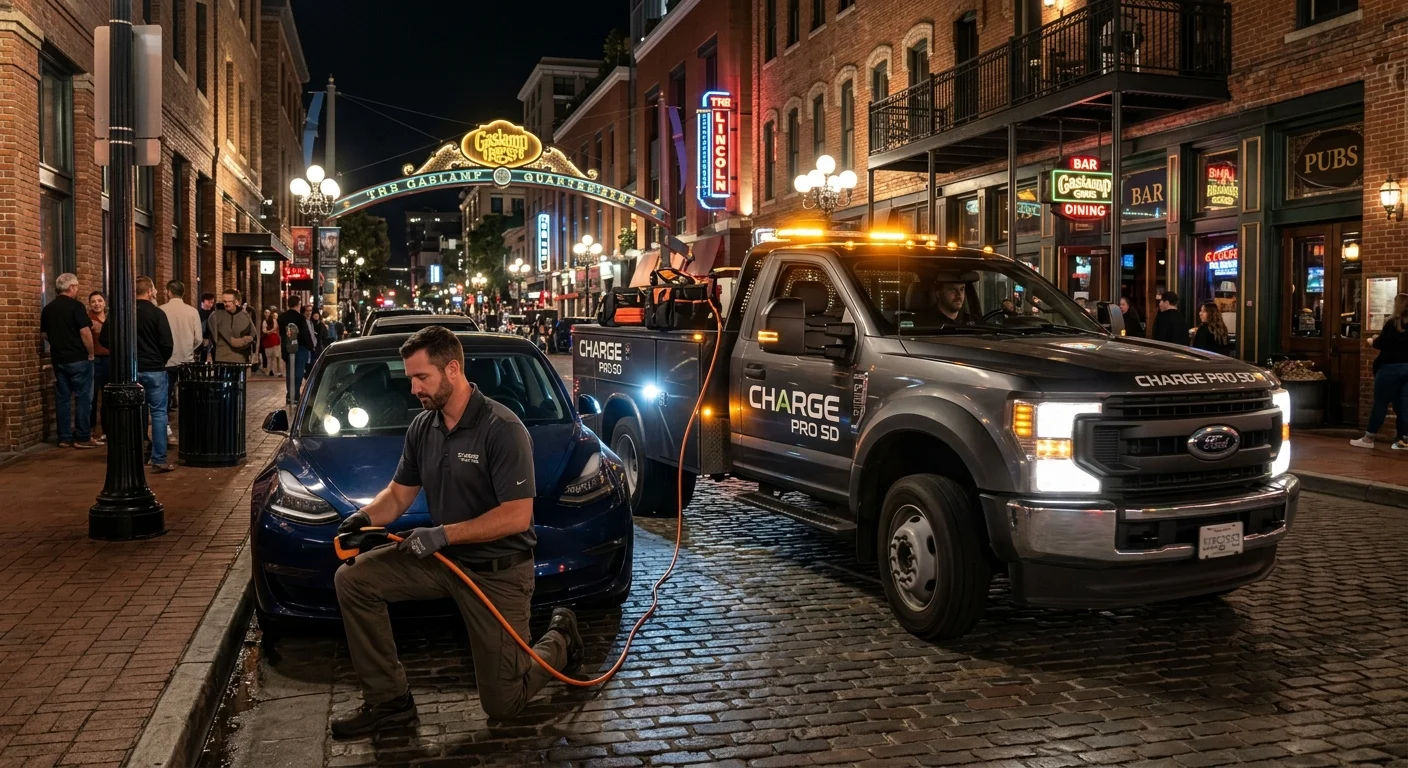
A tow out of an airport garage is messy. Clearance, tickets, and a car that will not roll on its own. A mobile operator can often reach the stall. They bring a 240-volt Level 2 source, or they jump the 12-volt on site. Tesla and every major EV brand show up in these decks. Native NACS for Teslas. CCS or J1772 adapters for everyone else.
Pentagon and Pentagon City garages run the same long-dwell pattern. So do Crystal City office decks. The car sits through a conference, a shift, or a weekend trip. Cabin cameras, sentry modes, and the always-on computer nibble the 12-volt. You return to a silent dash. For the trip-parking version of this failure, read what happens when an EV 12-volt dies on a trip.
What the operator actually brings to the stall
Charge Pro DC is a referral line. We match you with an independent local mobile rescue operator. We do not own trucks. We do not employ technicians. We do not set the price. The operator quotes you before any work starts and bills you directly.
What they typically bring is a 240-volt Level 2 source. On a drained pack, that usually adds about 10 to 20 miles of range in 15 to 30 minutes of charging. That is charging time, never an arrival window. Nobody here publishes a clock for when the van shows up.
If the high-voltage pack is fine and the 12-volt is dead, the job is a jump or an on-site replacement. That is not the same call as an empty traction battery. Tell the operator which one you think you have. A car that will not unlock, will not wake, and shows a blank screen is usually the 12-volt. A car that is on, with a 0 percent or 1 percent range number, is out-of-charge recovery.
Tesla owners often need the 12-volt path after a long sit. The Tesla 12-volt jump page walks that split. Non-Tesla EVs use the same logic. The plug on the van changes. The diagnosis does not.
You stay with the car when you can. Shared garages in Ballston and Crystal City have attendants, gates, and height bars. Give the operator the garage name, the level, and a stall number. If you are on the George Washington Memorial Parkway, say so up front. That is an NPS road with narrow shoulders. Commercial trucks over 10,000 lb are banned on those parkways. The operator needs that before they roll.
Corridors where Arlington drivers actually stall
I-395 cuts through the county toward the Pentagon and the 14th Street bridges. I-66 runs east-west into the District. US-50 is Arlington Boulevard. US-1 is Jefferson Davis / Richmond Highway along the south. The GW Parkway hugs the river toward Alexandria and Mount Vernon.
If you go empty on the 395 Express Lanes, Transurban’s published rule is to pull to the nearest shoulder. Stay in the car. Express Assist is a free patrol on those lanes. It helps with minor mechanical issues and will call a tow. It does not charge an EV. On the 495 Express Lanes the published pull-off is the left shoulder, because those lanes sit in the median. That is a different road. Do not mix the two.
VDOT’s Safety Service Patrol covers Virginia interstates, including the I-66 corridor in Northern Virginia. Drivers reach that help through Virginia 511. Published material covers incident clearance and short-term traffic control. It does not describe EV charging. You still call 511 if you are blocking a travel lane. You still call a charging operator if the pack is empty.
Disabled-vehicle rules in Virginia apply the same to an EV as to any car. The codes we reviewed do not carve out a special out-of-charge offense. You are a disabled vehicle. Get off the travel lane if you can. Put on hazards. Then call.
A tow from a private garage in Virginia sits under Va. Code § 46.2-1231 and related sections. Localities may set fee limits by ordinance. Confirm the current Arlington County rules before you authorize a hook. A mobile charge that gets you rolling under your own power often avoids that fight.
On the GW Parkway, safety comes first. These are limited-access scenic roads with narrow or absent shoulders. US Park Police handle disabled vehicles on NPS parkways. For the Baltimore-Washington Parkway the published report number is 202-610-7500. For the GW Parkway, use the NPS / US Park Police contacts posted for that road. Do not stand in a travel lane to flag a van.
Apartment garage, office deck, or airport
In a Ballston, Courthouse, or Rosslyn residential garage, the operator is working around pillars, reserved stalls, and a gate arm. You may need to meet them at the entrance and walk them in. Building management sometimes wants a ticket on file. Have the front desk number ready.
Crystal City and National Landing decks are office-heavy. After hours the garage can be quiet and the attendant gone. Note the nearest stairwell and the garage’s posted name. Pentagon City mall and office parking is the same idea: a long sit, then a car that will not start.
At DCA, follow airport parking rules. Do not block a travel aisle. If the car is on a charging level but never took power, that is a port, app, or payment problem first. If it sat a week on a non-charging floor, start with the 12-volt.
Falls Church and McLean sit next door. Alexandria is the other half of this inner-Virginia core. Washington is across the river. Operators work the metro. They still need the right pin on the map. Say the building, the garage, or the exit. Do not say “near the Pentagon” if you are actually in a Crystal City basement.
Arlington National Cemetery traffic and funeral processions can clog the parkway and Arlington Boulevard. If you stalled in that flow, stay in the car with hazards on. Do not try to push an EV. These cars are heavy. A quoted mobile EV charging visit is the move when you are in a legal stall or a safe pull-off.
When a mobile charge is the right call
Call for a 240-volt visit when the pack is too low to reach a charger you already know, and the car is in a stall or a legal pull-off. Call for a 12-volt jump when the car is silent after a long sit. Do not sit in the travel lane of I-66 hoping a van can occupy the same space as moving traffic.
If the car has a mechanical fault, a damaged port, or a pack that will not accept charge, roadside charging will not invent a fix. You want a shop, not a top-up. If you are already on a charger that will not start a session, try the app, the card, and another stall before you assume the car is dead.
Dominion will not dispatch a charger to your bumper. Club-style roadside plans vary. Many still send a jump pack meant for a gas car, or a tow. Confirm what your plan actually covers for EVs before you assume they will charge you. A quoted local operator is the backup when the plan does not include a Level 2 source.
Cabin climate while you wait is the quiet killer. Drop heat or AC. Keep the electronics you need for locks and phones. Save what is left in the pack. That habit matters more in a Ballston garage in August, and more again on an icy I-395 shoulder in January.
How to get a quoted visit
You call Charge Pro DC. You describe the car, the location, and whether it is an empty pack or a dead 12-volt. We connect you with an independent operator who can take the job. They quote before they start. You accept or you do not. They bill you.
Have this ready: make, model, and year. Tesla or not, because the plug changes. Garage name and level, or the nearest exit on I-395, I-66, or Arlington Boulevard. Whether the car unlocks. Approximate percent on the dash, if you can see one. If you are at DCA, name the garage number and the level.
Neighbors in Alexandria, McLean, and Falls Church hit the same apartment and garage pattern. The county line does not change the 12-volt. It does change who you tell on the phone, so the operator pins the right deck.
When you are ready, call (202) 629-0844. That number starts the match. It is not a promise of when someone arrives.