Your Hyundai Ioniq 5 won’t release the CCS cable. Use the manual loop in the cargo area. Open the rear hatch. On the driver’s side, behind the tail light, pop the small liner panel. Pull the loop toward the center of the trunk until you hear the pin retract. That cable frees the latch even when software or the 12-volt battery has quit. Ice west of Dulles often locks the pin overnight. Humid District summers soak the same port and jam it shut.
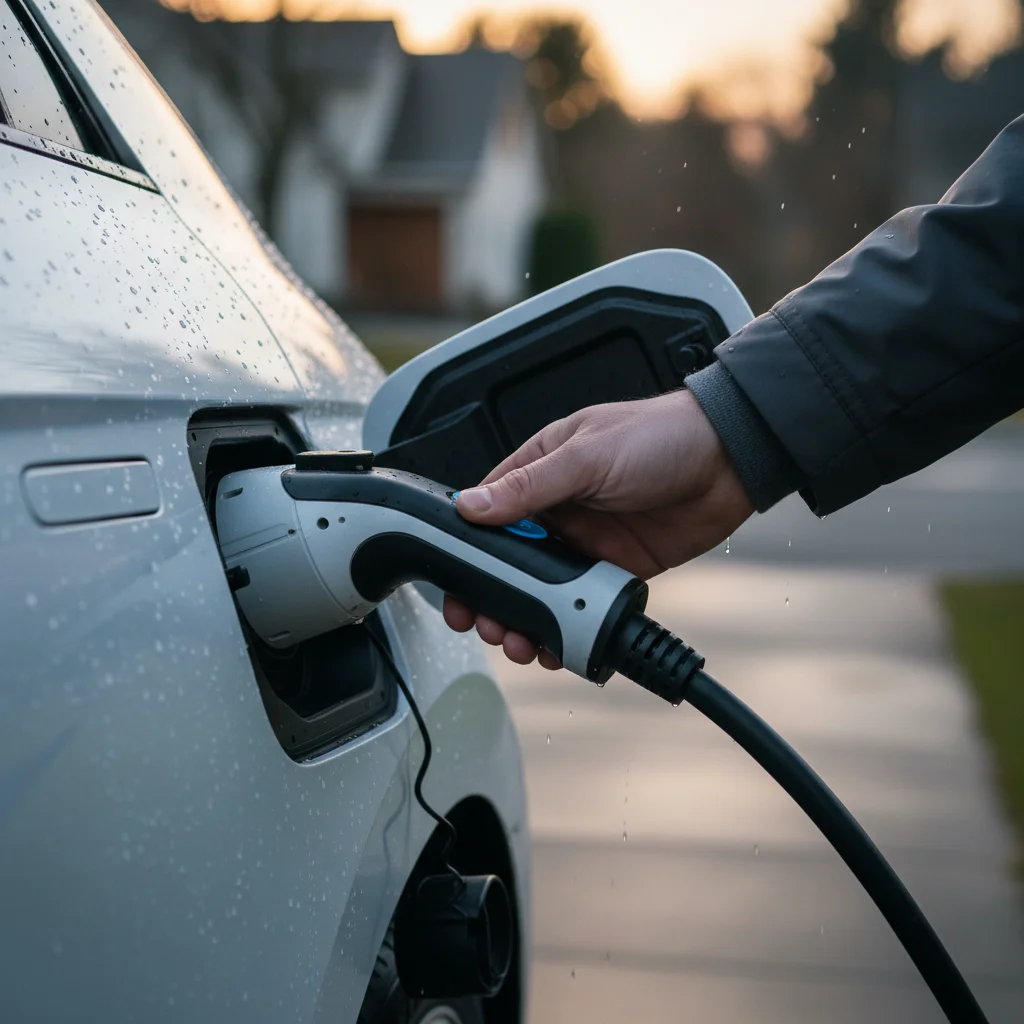
The Ioniq 5 charge port stuck problem is the latch, not the traction pack. The car uses a motorized charge door. A separate pin grabs the CCS handle. Either one can hold you at the stall. You’re still plugged in. You’re not out of miles.
Ice west of Dulles, humidity in the District
This metro doesn’t share one winter. Dulles runs colder and snowier than Reagan National. That’s a real local split. Loudoun, upper Montgomery, and Prince William take the harder freezes. Ashburn, Sterling, Herndon, and Leesburg sit on that western, colder side. A pin that went to bed wet can ice in the bore by morning.
The District and the inner Virginia core stay milder in January. They pay for it from June through September. Hot, humid stretches above 90F leave water in the port after every storm. That moisture swells dirt around the actuator. The CCS handle then sits in a sticky lock. Same Ioniq 5. Different season.
Cabin heat is what cuts winter range. A typical EV keeps about 80 percent of range at 32F. At 20F, retained range falls to about 70 percent. Recurrent Auto’s winter study of more than 30,000 EVs is the source. The latch doesn’t read those numbers. It only cares whether the pin can slide.
If you can see water in the port, dry it before you plug in again. Our guide on water in an EV charging port walks through that cleanup. Don’t shove a frozen handle past a motorized door. You’ll crack the door more often than you’ll free the pin.
Two parts can trap the CCS handle
The Ioniq 5 charge port isn’t a spring flap. The door is motorized. A separate electromechanical pin slides into a notch on the CCS connector. Software drives both. The pin should lock when a session starts. It should retract when the session ends, or when you unlock the doors.
A messy handshake with a public DC fast charger can skip that retract command. Stopping the session at the wrong second can do the same. So can mashing the fob while the charger is still in the handshake. The pin stays in the notch. The handle won’t come out. That’s a lockup. That’s not a dead pack.
Those electronics ride on the 12-volt system. If the 12-volt is dead, the fob and the powered release go quiet. That pattern is common after a long sit. WMATA park-and-ride decks and airport garages produce it all the time. An Ioniq 5 that won’t start is often that small battery.
Older housing tracks with wall chargers that were never installed. Takoma Park’s housing stock is about 90 percent pre-1980. Drivers there lean on public CCS stalls more often. More public sessions means more handshake glitches. Ashburn’s housing is only about 3 percent pre-1980. Home Level 2 is common there. The stuck-cable call still happens.
Reset the software before you touch the trunk panel
Start with the steps that don’t involve trim tools.
Lock and unlock the doors with the fob. Wait a few seconds between presses. The unlock command is what usually tells the pin to retract.
Open Hyundai Bluelink if you have it. Stop the charging session from the phone. A remote stop often sends the command the stall never finished.
Read the station screen. Press stop there as well. Some cabinets keep the session live after the car thinks it’s done. If the screen still shows charging, the pin may be doing its job on purpose.
Don’t yank the handle during an active session. You can fault the stall. The next driver then inherits a cabinet that won’t start.
If the motorized door itself won’t open or close, stop pushing it. The door motor is a different part from the CCS pin. Forcing the door doesn’t retract the pin. It breaks a gear.
At a public stall, let the network force-stop first
You’re occupying a stall. It isn’t a reason to tear the port.
Read the support number printed on the cabinet. Give them the station ID. Remote techs can often force-stop the session from their side. That’s the cleanest unlock you’ll get at a public unit.
If the screen is frozen, still call. They can see faults you can’t. Ask them to end the session before you pull the manual cable. A mid-session mechanical pull can throw a fault and take the stall offline.
Pepco serves the District, Montgomery County, and Prince George’s County. Dominion Energy Virginia serves most of Northern Virginia. NOVEC covers parts of Loudoun and Prince William, including much of Sterling, Ashburn, and Gainesville. Those utilities publish home EV programs. None of the utility EV pages we reviewed offer a stranded-car charge. A rebate won’t unlatch this pin.
VDOT’s Safety Service Patrol covers Virginia interstates, including the I-66 corridor. Published material describes incident clearance, debris, and short-term traffic control. It doesn’t describe EV charging. It doesn’t describe charge-port release. Maryland’s CHART Emergency Traffic Patrol covers I-495, I-270, US-50, and MD-295. Dial #77 on those state roads. CHART techs change tires, jump-start, and add a little gas. They’re not a CCS latch shop. We found no DDOT motorist-assistance patrol for the District. On NPS parkways, a disabled car is a US Park Police problem, not a utility problem.
Find the manual cable in the cargo area
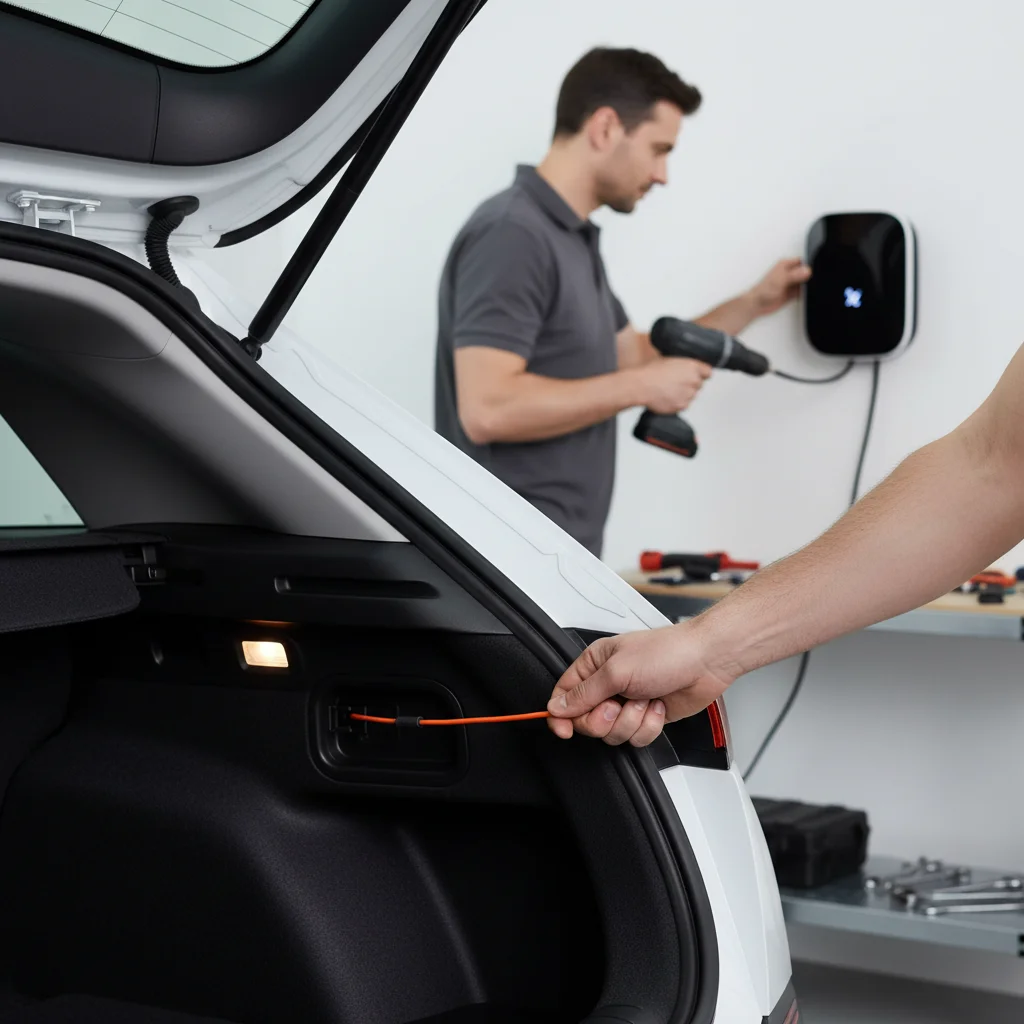
Use the mechanical release last. Try the fob, the app, and network support first. Hyundai hid a cable in the cargo area for this failure.
Confirm the car’s off. Confirm it’s unlocked if the 12-volt still has life. Open the rear hatch. Stand in the cargo opening. Look to the driver’s side, not the passenger side. You want the liner just behind the tail light. There’s a small rectangular plastic panel in that liner.
Pry the panel with your fingertips. If it’s stiff, a plastic trim tool beats a metal key. Inside you’ll see a wiring bundle and a small cable loop. The loop often has a black handle.
Grip the handle. Pull it toward the center of the cargo area. Use a short, steady pull. Don’t snatch it. You should hear a clunk from the charge-port side of the car. That clunk is the pin leaving the CCS notch.
Walk to the port. Lift the handle out the way you always do. Support the cable as it comes free. The stall’s heavy DC lead can twist the port. Snap the access panel back into the liner.
Hyundai publishes the diagram in its owner’s manuals library.
Other EVs stick too. Our shared charge-port release guide covers the common checks. The Ioniq 5’s override lives in that driver’s-side cargo pocket. It doesn’t live in a frunk.
Stop if the cable won’t move
If the loop is hard to pull, stop. If you pull and hear no clunk, stop. That’s hardware. It isn’t a missed software command.
Ice can seize the pin in the bore. Beltway grit can pack in after a week of slush. A damaged CCS handle can hold the pin in its slot. That can happen even after the car’s side has retracted. Forcing the handle then breaks the port’s plastic.
West of Dulles, treat ice as the first guess on a hard freeze morning. In the District in August, treat a wet port as the first guess.
Don’t pour hot water on a frozen port. Melt can crack housings. It can also run into the actuator and refreeze. Warm air from a safe distance is kinder than a kettle. If you can’t see the pin move after the cable pull, you’re past a parking-lot fix.
A dead 12-volt leaves the latch locked
The latch is an electronic lock. No 12-volt means no powered unlock. The fob goes mute. Bluelink won’t talk. The motorized door stays where it is.
That sit happens in long-dwell garages. Dulles Economy Lot is the classic week-away pattern. You come back from a trip. The traction pack may still show a healthy percent. The 12-volt doesn’t. WMATA park-and-ride decks repeat the same drain on a long workday. Reagan National has complimentary Level 1 charging on Level 1 of Parking Garages 1 and 2. Dulles has Level 2 charging in Garage 1 and Garage 2. A car that sat in another lot still wakes to whatever the 12-volt has left.
An operator who knows EVs will jump or replace that 12-volt on site. Power returns to the latch. Then the fob or the trunk cable can finish the release. For the jump steps, see how to jump-start an EV’s 12-volt. Don’t copy a gas-car clamp pattern onto this pack.
Charge Pro DC is a referral line. It matches stranded EV drivers with independent local mobile rescue operators. The brand doesn’t own trucks. It doesn’t employ technicians. It doesn’t do the work. The operator quotes you before starting and bills you directly.
If you need a 12-volt jump and a careful unlatch, that’s a non-Tesla EV rescue call. Operators bring a 240-volt Level 2 source. They use a CCS or J1772 adapter for non-Tesla cars. They typically add 10 to 20 miles of range in 15 to 30 minutes of charging. That’s charging time. It’s never an arrival time. They also jump or replace a dead 12-volt on site.
Freeways, parkways, and a car you can’t unplug
On the 495 Express Lanes, pull to the left shoulder. Those lanes sit in the median. On the 95 and 395 Express Lanes, pull to the nearest shoulder. Stay in the car until help arrives. Transurban’s Express Assist patrol helps with minor mechanical issues. It’ll call a tow. Published FAQs don’t describe charge-port work.
The Woodrow Wilson Bridge sits at the meeting of Virginia, Maryland, and the District. The American Legion Bridge does the same between McLean and Montgomery County. Both spans are high and wind-exposed. Shoulders are limited. Don’t stand in a travel lane to wrestle a CCS handle.
The George Washington Memorial Parkway and the Baltimore-Washington Parkway have narrow shoulders, or none. Clara Barton, Rock Creek, and Suitland Parkway match that pattern. Commercial vehicles and trucks over 10,000 lb are banned. A disabled vehicle on the Baltimore-Washington Parkway is reported to the US Park Police at 202-610-7500. If you’re locked to a stall in a lot, stay with the car. If you’re on a parkway with no safe workspace, wait for the agency that owns the road.
I-270, I-66, and I-95 are common places for a public CCS session on a commute. None of that changes the latch. It only changes where you can safely open a hatch.
None of the three local codes we reviewed names a dead EV as a special case. Disabled-vehicle rules apply to an Ioniq 5 the same as any other car.
When to stop DIY and get a quoted operator
Call if the trunk cable won’t move. Call if it moves with no clunk. Call if the 12-volt is dead and you can’t unlock the car. Call if you’re on a dark ramp. Call if station support can’t force-stop the session.
Don’t keep yanking. A broken release cable or a snapped actuator turns a latch job into a body-shop visit.
Drivers coming home through Loudoun after a freeze often stall after a Dulles parking sit. Ashburn EV roadside assistance is that local pattern. Once the cable is free, you may still need miles. Ioniq 5 charging time at home and on the road explains what a 240-volt top-up actually adds.
Charge Pro DC connects stranded EV drivers with independent local operators across the District, Maryland, and Virginia. The operator quotes before any work starts. Call (202) 629-0844 and we’ll match you with someone who knows this latch.
Frequently asked questions
Why is my Ioniq 5 charge port stuck after a session?
The CCS locking pin never got the retract command. A messy handshake with a public fast charger is the usual trigger. Ice west of Dulles and humid District air both keep that pin from sliding. Lock and unlock with the fob, stop the session in Bluelink, then press stop on the stall.
How do I free a frozen Ioniq 5 charging cable?
Reset the software first. Then call the number on the charger and ask for a remote force-stop. If the handle still won’t move, use the manual cable in the cargo area. It sits on the driver’s side, behind the tail light, inside a small liner panel.
What if a dead 12-volt is holding the Ioniq 5 latch closed?
The port lock needs 12-volt power. A dead small battery kills the fob, the app, and the powered release. That’s a rescue, not a panel-pry. The operator restores 12-volt power, then releases the cable without tearing the port.