Hyundai Ioniq 5 charging time at home is usually a multi-hour Level 2 session. On the road here, a mobile Level 2 visit is a short top-up. Independent operators typically add about 10 to 20 miles. That takes 15 to 30 minutes of charging. That’s charging time. It’s never an arrival time.
What Hyundai Ioniq 5 charging time actually measures
The Ioniq 5 doesn’t run on one clock. A home Level 2 fill and a public DC fast stop are different jobs. A roadside top-up is a third job. Mix those jobs and the numbers stop lining up.
Most EVs on the Beltway use a 400-volt pack. The Ioniq 5 is built on an 800-volt system instead. That higher voltage helps at a capable DC fast charger. It doesn’t speed up a wall charger at home. A Level 2 unit still feeds the car at the wall’s rate.
So the query “hyundai ioniq 5 charging time” needs a place attached. You’re asking how long the session lasts where you plug in.
Overnight charging in the District, Maryland, and Virginia
A regular 120-volt outlet is Level 1. It works on the Ioniq 5. It’s a backup, not a weekday plan. A full fill from empty on Level 1 can run past a full day.
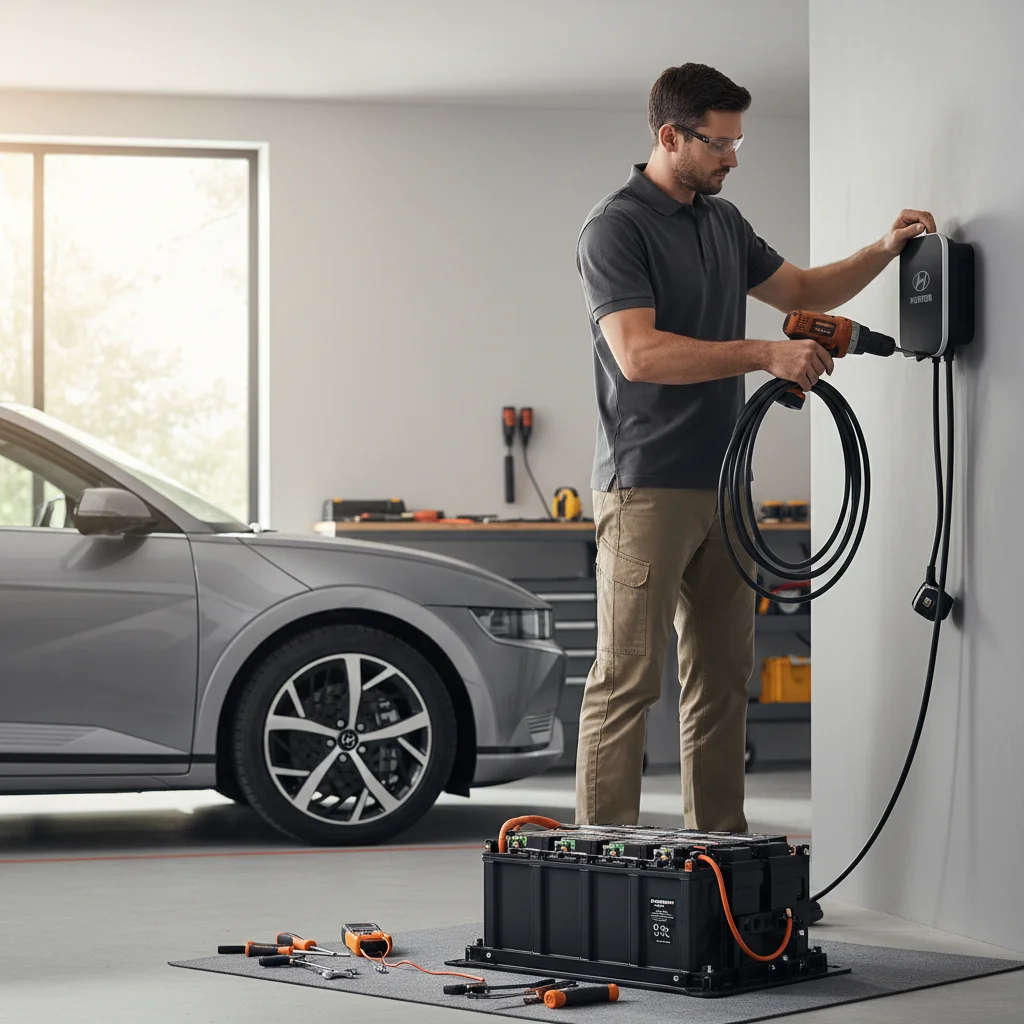
A dedicated 240-volt circuit is Level 2. That’s the overnight habit most owners want. Hyundai’s published home figures put a Standard Range pack at roughly 5 to 6 hours. The Long Range pack is roughly 6 to 7 hours. Your starting percent and the wall unit’s output both move that window.
Those hours only help if you can plug in at home. Census ACS 2019-2023 figures show older housing is still common inside the Beltway. About 70.3% of housing in Washington predates 1980. Takoma Park sits at 90.0%. Annandale is 79.8%. Wheaton is 73.1%. Older buildings often never got a 240-volt run to the parking pad.
Ashburn’s pre-1980 share is about 3.1%. Germantown is about 14.1%. Driveways there are more likely to already have a plug. The no-home-plug pattern is strongest in apartment-heavy places. That includes Arlington, Alexandria, the District, Silver Spring, Wheaton, Hyattsville, and Annandale.
Pepco serves the District, Montgomery County, and Prince George’s County. It publishes Pepco EVsmart. Dominion Energy Virginia serves most of Northern Virginia. Named programs include Schedule 1EV, the Off-Peak Plan, and EV Charger Rewards. NOVEC covers parts of Loudoun and Prince William. That includes much of Sterling, Ashburn, and Gainesville. Confirm the serving utility by address. None of the utility EV pages reviewed offers a charge for a stranded car.
If you still need a wall unit, that’s a licensed electrician’s job. Charge Pro DC doesn’t install chargers. We’re a referral line for stranded cars. Compare the two paths in home 240-volt charging vs a roadside top-up.
The 800-volt pack at a public DC fast charger
This is the session Hyundai publishes for trips. On a charger that can match the car’s peak rate, the published window is short. Specs list about 18 minutes from 10 to 80 percent under ideal conditions. Ideal means a mild battery temperature. It also means the stall is actually delivering rated power. A busy or older stall often runs longer.
Speed isn’t flat across that window. The pack takes power fastest in the middle. It tapers as it nears full. The last 20 percent can eat almost as much clock as the first 80. That’s why trip stops usually target 80 percent, not 100.
Connector type still matters. The Ioniq 5 ships with CCS. Adapters exist for NACS stalls. Confirm your model year’s connector before you count on an unfamiliar stall.
Reagan National lists EV charging on Level 1 of Parking Garages 1 and 2. Dulles lists Level 2 charging in Garage 1 and Garage 2. Those are parking sessions, not a roadside rescue.
Cold, gridlock, and a pack that shrinks while you sit
The metro sits on the fall line. Summers run hot and humid, with stretches above 90F. Winters swing from mild to sudden ice. Dulles runs colder and snowier than Reagan National. Loudoun, upper Montgomery, and Prince William feel that more. The District and the inner Virginia core stay milder.
A Recurrent Auto study covered more than 30,000 EVs. A typical EV keeps roughly 80% of range at 32F. At 20F it’s about 70%. Most lose 20 to 35% in real cold. Cabin heat comes from the traction pack. Sitting still with heat or AC on burns charge without covering miles. That’s the Beltway crawl and the I-95 standstill. It’s not a distance problem.
The January 2022 I-95 shutdown is the local reference. About 14 inches of snow fell on January 3 and 4. A multi-truck crash closed roughly 50 miles near Fredericksburg. The road closed about 5:30 p.m. on January 3. It reopened about 7:40 p.m. on January 4. Hundreds of drivers spent more than 36 hours in the cold with heat running. An Ioniq 5 in that mess burns time on the pack. It isn’t adding miles.
A cold pack also accepts fast-charge power more slowly. Home Level 2 still works. It just may take the long end of those 5 to 7 hours.
Roadside Level 2: miles on the cable, not a truck on a timer
If you’re already empty, you’re not waiting on a 6-hour home fill. You’re also not on Hyundai’s 18-minute DC figure. That only applies if you can reach a stall. A mobile rescue here is a 240-volt Level 2 source brought to the car.
Operators typically add about 10 to 20 miles of range. Charging itself usually runs 15 to 30 minutes. Those minutes are on the cable. They’re not a promise of when someone shows up. Charge Pro DC doesn’t set prices or own trucks. We don’t quote arrival. The independent operator quotes you before work starts. That operator bills you directly.
For a non-Tesla like the Ioniq 5, the visit uses CCS or J1772. That’s enough to limp to a charger, a garage, or home. It’s not a full pack. The mobile EV charging page is the service path. The non-Tesla EV rescue line is built for cars like this.
If you stall on I-270, I-66, I-95, or the Beltway, get clear first. Stay with the car after that. On the 495 Express Lanes, pull to the left shoulder. Those lanes sit in the median. On the 95 and 395 Express Lanes, use the nearest shoulder. Stay in the car until help arrives.
A stall on the American Legion Bridge sits between McLean and Montgomery County. A stall on the Woodrow Wilson Bridge sits at three jurisdictions. That’s Alexandria, Oxon Hill, and the District. Both spans are high and wind-exposed, with limited shoulder.
VDOT’s Safety Service Patrol covers Virginia interstates, including the I-66 corridor. VDOT’s published material doesn’t describe EV charging. Maryland’s CHART Emergency Traffic Patrol covers state primary roads. Dial #77 on I-495, I-270, US-50, or MD-295. CHART material doesn’t describe charging an empty EV. No DDOT motorist-assistance patrol turned up for the District. Disabled-vehicle rules in DC, Maryland, and Virginia apply the same way. An empty EV is treated like any other stopped car.
When the percentage isn’t moving
If the session isn’t progressing at all, stop thinking about clock time. A cable that won’t release is a known Ioniq 5 issue. How to free a frozen Ioniq 5 cable walks through that. If the car won’t wake, start with the 12-volt. Hyundai Ioniq 5 won’t start covers those checks.
Pack size still sets how far a given session goes. Hyundai Ioniq 5 battery size breaks down Standard Range and Long Range.
Charge Pro DC matches stranded EV drivers with independent local operators. We don’t hold a trade license. We don’t perform the work. We serve the District, Maryland, and Virginia, including Arlington. If you need a mobile Level 2 top-up, call (202) 629-0844. We’ll connect you with an operator who quotes you before starting. That call isn’t a promise of arrival.
Frequently asked questions
How long does a Hyundai Ioniq 5 take on home Level 2?
On Level 2, a Standard Range full charge is roughly 5 to 6 hours. The Long Range pack is roughly 6 to 7 hours. Starting percent and charger output both change that window.
How fast does an Ioniq 5 charge at a DC fast charger?
Hyundai’s published specs list about 18 minutes from 10 to 80 percent under ideal conditions. The stall has to match the car’s peak rate. Real sessions often run longer when the stall is busy or the pack is cold.
How much range does a roadside Level 2 visit add here?
Independent operators typically add about 10 to 20 miles. Charging itself usually takes 15 to 30 minutes. Those minutes are on the cable. They’re never an arrival time.