When the EV charger is stuck in the car, stop yanking the handle. End the charge session on the screen first. Then treat it as a 12-volt problem, not a seized plug. A frozen NACS or CCS latch is a common Beltway-lot call here.
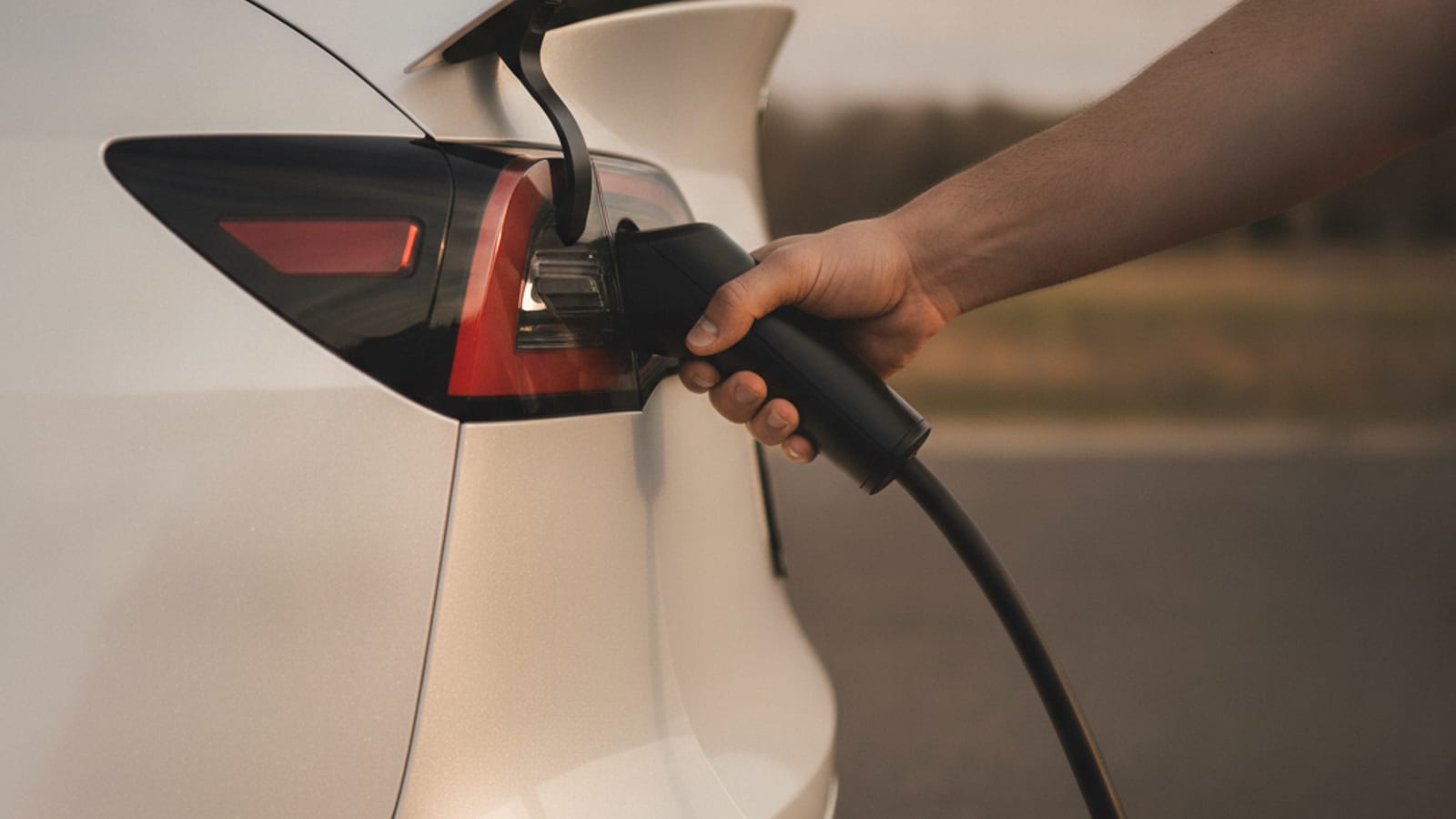
Try the screen before you pull
A lot of stuck cables are still in a live session. The charger stopped pushing power, but the car never got a clean stop. The solenoid stays locked until software says the circuit is dead. On the center display, tap stop charging and wait for confirmation. Only then press the release button on the handle. If you skip that wait, the latch holds on purpose.
This shows up after a glitchy public stall. It also shows up on a home wall unit after a winter overnight. Older houses in Takoma Park, Annandale, and Wheaton often put that plug outside. Ice on the connector face isn’t rare after a freeze.
Why the port locks at all
The lock is a small solenoid in the charge port. The car energizes it to grab the connector. One job is safety, so a yanked handle doesn’t expose a live pin. The other job is theft, so a passerby can’t steal the cable. Apartment lots in Arlington, Alexandria, and Silver Spring see unlocked cords swapped.
When the car says release, the solenoid retracts. The latch then swings off the connector lip. If that command never arrives, the cable stays. If 12-volt power is too weak to move the pin, it stays too.
Cold latches on Beltway lots
This metro sits at the fall line, where summers run hot and humid. Winters swing from mild to a sudden freeze. Dulles runs colder and snowier than Reagan National. Loudoun, upper Montgomery, and Prince William take the harder ice.
A typical EV keeps about 80 percent of range at 32F. At 20F, that falls to about 70 percent, mostly because cabin heat draws the pack. Recurrent Auto’s winter study of more than 30,000 EVs published those figures. Cold also lets melted snow refreeze around a NACS or CCS latch. Tysons Corner Center and WMATA park-and-ride decks show that long-sit pattern.
Reagan National puts complimentary EV charging on Level 1 of Parking Garages 1 and 2. A stuck cable there blocks a limited stall. Dulles has Level 2 charging in Garage 1 and Garage 2, and the same lock-up happens after a week away. In January 2022, drivers sat more than 36 hours on I-95 near Fredericksburg with heat on. Ice on a port follows that same cold-sit physics.
Don’t chip ice with a screwdriver, because you’ll scar the pins. Warm the port door with the car’s own heat if the cabin still wakes. Wipe standing water, then try the release again. The wet-port guide covers a soaked connector before you plug in.
Check the 12-volt next
The release motor runs on 12 volts, not the traction pack. The little battery is what moves locks, screens, and that solenoid. If lights flicker or the screen is dark, jump the 12-volt before you fight the cable. Walk through how to jump-start an EV before you pull harder. A weak 12-volt also explains a car that won’t open the trunk. You can’t reach many manual releases until that battery wakes the car.
Reboot the car if the session looks confused
Software sometimes forgets the charge ended, and a short reboot often clears that glitch. On a Tesla, hold both steering-wheel scroll wheels for ten seconds. On a Rivian, press and hold the cruise-control stalk down for ten seconds. On most other EVs, hold the power button until the car restarts. Open and close the driver’s door if the car looks asleep, then reboot. After the restart, stop charging on the screen again and try the handle.
Some Tesla Mobile Connector handles and some public cables have a worn button. If another cable is in reach, swap it. If you’re on a busy stall, don’t keep cycling plugs you don’t own.
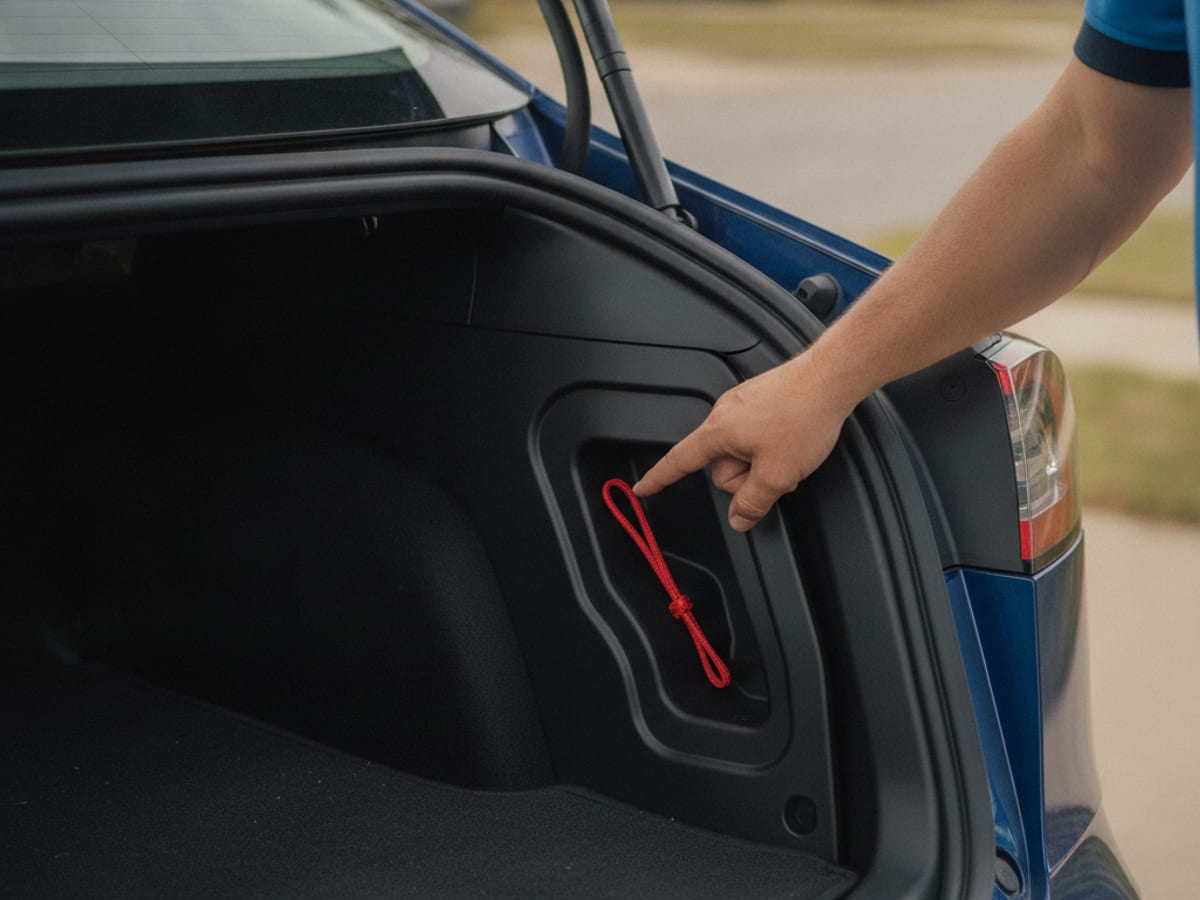
Use the manual release only after those steps
Every major EV has a mechanical override, because makers know solenoids fail. Pull it with steady pressure, and don’t rip trim.
Releases you reach from cargo
Tesla Model 3 and Model Y: open the trunk. On the passenger inner wall, peel the carpeted trim and pop the small access panel. Behind it is a plastic tab on a cable. Pull that cable down and hold it. Slide the charge connector out while you keep tension.
Older Model S and Model X: open the rear hatch. On the driver’s side, near the taillight, pull the carpeted panel. The release cable comes toward you. On 2021 and later refresh S and X, look on the passenger trunk trim instead.
Hyundai Ioniq 5, Kia EV6, and Kia EV9: in the rear cargo area, pull the plastic cover on the driver’s sidewall. Press and hold the small button, then pull the charge cable at the same time. Model-specific notes for the Ioniq 5 are in the Ioniq 5 charge-port guide.
Chevrolet Bolt: lift the rear cargo floor. The cord sits near the 12-volt area, so pull the cord while you pull the handle. Volkswagen ID.4: lift the cargo cover. On the passenger side behind the C-pillar trim, look for a labeled pull loop. Polestar 2: in the trunk, near the driver’s tailgate hinge, drop a small trim panel and pull the cord behind it.
Releases under a seat
Rivian R1T and R1S: open the rear passenger door. Lift the rear seat bottom. A service panel hides the cord, so pull it firmly. Full steps live in the Rivian charge-port guide.
Releases on the port itself
Ford put the override on the charge port. Open the port door and find a small triangular tab with an unlock icon, high or low on the housing. Pull the tab away from the port as you pull the cable. On an F-150 Lightning, FordPass can command a release even when the car feels asleep. Mach-E owners should use the Mach-E port walkthrough.
If the override still does nothing
Confirm the car is actually awake. Then pull the manual release again while you rock the connector a little. A light side-to-side wiggle can unhook the latch from the connector lip. Don’t lever it like a pry bar. Try one more reboot, then stop. Brute force turns a stuck solenoid into a ruined port. Leave the cable in place. Don’t cut it, and don’t twist the handle until plastic cracks.
If you’re blocking a public stall, stay with the car. A disabled EV follows the same rules as any disabled car in DC, Maryland, and Virginia. None of those codes add a special stuck-cable exception. On a Maryland state road, #77 reaches CHART, which can help with a breakdown. It doesn’t publish an EV charge or port-release service. Pepco, Dominion Energy Virginia, and NOVEC also don’t send a truck to unlatch a car.
When to call the referral line
Call Charge Pro DC when the override moved and the cable still won’t slide. Call if the car is dark and you can’t reach the trunk release. Call if the handle button itself is broken. Call after you’ve already done the screen, reboot, and 12-volt checks at a public stall.
Charge Pro DC is a referral line. It matches you with an independent local operator. The brand doesn’t own trucks and doesn’t do the work. The operator quotes you before starting and bills you directly. The pros in that network jump or replace a dead 12-volt on site. That’s what frees most locked ports. They also handle Tesla and every major EV brand. They can bring a 240-volt Level 2 source if the car also needs range. That typically adds 10 to 20 miles in 15 to 30 minutes of charging time. That window is charge time, not a promise of when someone arrives.
Tesla owners can start on Tesla roadside rescue. Other brands use non-Tesla EV rescue.
After the cable comes out
Plug in again when you can do it safely, and run a full session. If it ends and the handle releases on its own, you likely had a glitched stop. If the lock fails a second time, schedule shop time for the solenoid and the 12-volt. If a jump was what freed the latch, plan to replace that 12-volt. It’s already on the way out.
For a stuck cable in the DC area, Maryland, or Virginia, call (202) 629-0844. The line matches you with a local operator.