A Hyundai Kona Electric that won’t start is almost always a dead 12-volt battery. The traction pack can still hold plenty of charge. The computers just have no power to wake the car. That shows up often on older streets in Wheaton and Takoma Park. Many Konas there live on public chargers instead of a garage circuit. The dash can go dark overnight even when the main pack is fine.
Hyundai still sells the Kona as a gas car, a hybrid, and an EV. This page covers only the electric Kona. If yours has a fuel door and a conventional engine bay, stop here. That car follows a gas-car fault tree. A normal roadside jump is the right call for that one. On the electric Kona, a silent dash is a different problem. The high-voltage pack can’t talk to the car until the small battery wakes up.
Two batteries, two different failures
Every Kona Electric carries two batteries with separate jobs. The large pack under the floor drives the motors. The small 12-volt battery runs locks, lights, and the computers. When that small battery dies, the car goes completely quiet. You get no click, no cluster, and no Ready light. A low traction pack feels different, because you usually saw range warnings first. The charge port still opens, and the dash still lights. The car may roll a short stretch, then quit.
Use that split before you call anyone. A jump won’t fill an empty pack. A mobile charge won’t wake a car with a dead 12-volt. The Hyundai Ioniq 5 uses the same two-battery layout.
How to tell a dead 12-volt from an empty pack
Press Start and watch what happens in the cabin. Zero response points to the 12-volt. Some response plus pack warnings points to charge.
| What you see | Dead 12-volt | Empty traction pack |
|---|---|---|
| Dash stays fully dark | Yes | No. Warnings still show |
| Key fob won’t unlock | Yes | No |
| Interior lights stay off | Yes | No |
| Ready light never appears | Yes | Yes |
| Car rolls a few miles, then dies | No | Yes |
| Low-range alerts before it stops | No | Yes |
| Charge port takes a cable | Often no. The door may stay shut | Yes |
If the fob is dead and the cabin is dark, start with the 12-volt. If the car still talks to you and the range bars are gone, you need energy in the pack. Don’t guess from the last public charge alone. A Kona can sit at a healthy state of charge and still refuse to wake.
Why Wheaton and Takoma Park Konas sit this way
Wheaton is an unincorporated community in Montgomery County, not an incorporated city. Takoma Park, next to it, is an incorporated city. Census ACS 2019-2023 tables put about 90 percent of Takoma Park housing in buildings from before 1980. Wheaton is about 73 percent pre-1980. Those older blocks often predate a dedicated 240-volt circuit in the house. Owners then use public chargers to keep the traction pack up. The 12-volt still sits on the street between those sessions. A long idle will flatten it even after a solid public charge.
Pepco is the utility in Montgomery County, including Wheaton and Takoma Park. Pepco EVsmart is the published home and multifamily charging program. Confirm any current rebate on Pepco’s own EVsmart pages. That program doesn’t send a truck to a dark Kona. No utility EV page we reviewed offers a charge for a stranded car. Takoma Park roadside help is the local write-up when the house predates a charger. Wheaton roadside help covers the public-charger pattern on that side of the county.
Silver Spring and Hyattsville show the same older-housing mix. The pack can be fine while the 12-volt is not.
Short hops along I-270 or the Capital Beltway can leave the 12-volt undercharged as well. A brief drive may not give the traction system time to top the small battery. Drivers who stack errands on Wheaton surface streets, then park again, see that slow drain over weeks. An occasional longer drive or a Level 2 session tops the 12-volt alongside the pack.
Heat, ice, and a 12-volt that ages on the street
This metro sits on the fall line, with hot, humid summers and stretches above 90F. Heat ages an AGM 12-volt, even if it doesn’t freeze the case. Winters here still swing from mild air to sudden ice. Dulles runs colder and snowier than Reagan National. Wheaton and Takoma Park sit on the Maryland side of that split. Cabin heat comes from the traction pack.
A Recurrent Auto study of more than 30,000 EVs found a typical car keeps about 80 percent of range at 32F. At 20F, the same study put retained range near 70 percent. That’s pack range in cold air, not a 12-volt lifespan number. We couldn’t confirm a published year-by-year life figure for the Kona’s AGM unit. Ask a Hyundai shop to load-test yours if it’s already died once.
Idling on the Capital Beltway or I-270 with heat or AC on burns pack miles with no distance. That’s a gridlock drain, and it doesn’t prove the 12-volt failed. Read the dash first. The January 2022 I-95 shutdown south of this metro is the regional reminder. Drivers sat more than 36 hours with climate control on after heavy snow closed a long stretch near Fredericksburg. An EV in that standstill spends pack energy to stay warm.
Where the 12-volt sits on a Kona Electric
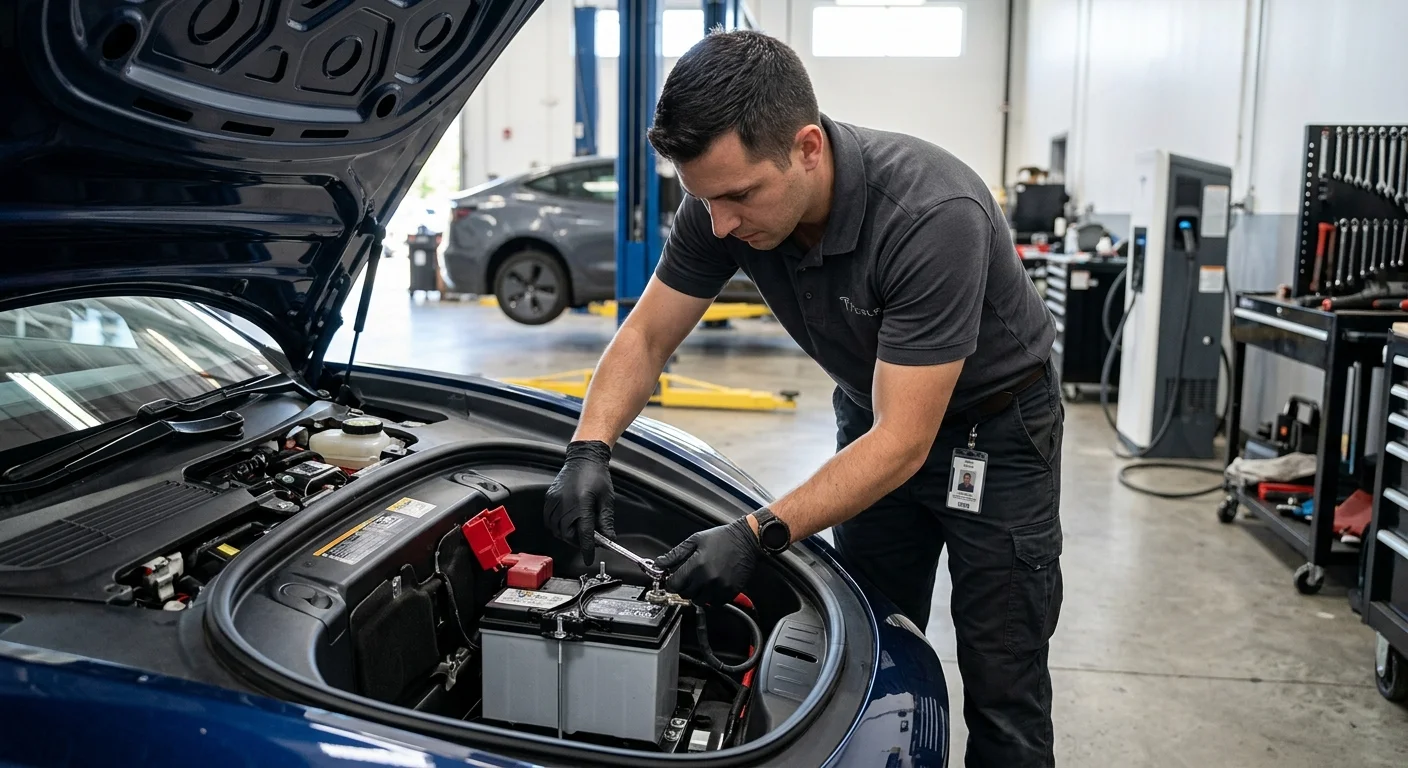
Hyundai put the Kona Electric’s 12-volt in the under-hood bay. It lives on the driver’s side, toward the rear of that bay. It’s a standard AGM battery in a plastic tray, with a strap or bracket.
- Pull the interior hood release if the car still has a trace of 12-volt power.
- If the latch won’t move, use the emergency hood release in the owner’s manual. On many years it’s a pull near the driver-side fender, reached through the grille.
- Look to the rear driver’s side of the bay. The battery sits in the tray.
- The positive terminal has a red cap. The negative is often bare or under a black cap.
If the hood won’t open, you need help at the car. Don’t pry on the latch from the street.
The 12-volt Battery Save setting
Hyundai added a 12-volt Battery Save function on the electric Kona starting with the 2019 model year. On most trims you’ll find it under Settings, then Vehicle, then Charge Settings. The line often reads 12V Battery Save, and the wording shifts a little by year. When it’s enabled, the car can pull a small current from the traction pack. That lift keeps the 12-volt above a cutoff. It’s a rescue mode, not a new battery.
If the 12-volt is already dead, the screen is dark and the menu won’t appear. You need an external jump first. If you keep turning Save on after every drive, the battery is aging out. Have it tested. After a successful jump on an older unit, turn Save on for the drive to a Level 2 session.
How to jump a Kona Electric from the hood
The Kona uses dedicated jump points under the hood. That’s safer than clamping the battery posts in a tight bay. Use a portable jump pack, or a gas car with standard cables. Don’t use another EV as the donor. EVs aren’t designed to source that current, and the donor can throw fault codes.
Our jump-start guide walks the same safety order for any EV. The Kona-specific points are below.
- Open the hood. Use the emergency release if the interior handle does nothing.
- Pull the red cap off the positive jump terminal on the fuse-box cover, driver’s side of the bay.
- Find a clean, unpainted metal ground on the chassis. A bolt on the shock tower is a common point. Prefer that over the battery’s negative post when you can.
- Clamp positive to the Kona’s positive terminal. Then clamp the other positive to the pack or donor car.
- Clamp negative to the pack or donor negative. Then clamp the remaining negative to the Kona’s chassis ground.
- Let the pack feed the system for a couple of minutes before you press Start.
- Press Start with your foot on the brake. The Ready light should come up in a few seconds.
Once it’s awake, get the car onto a Level 2 session and leave it plugged in for a stretch. The traction system can trickle the 12-volt while the car is connected. If the 12-volt dies again within a day or two, the battery needs replacement. A jump is only a bridge. See the 12-volt replacement guide for the signs that the unit is done.
When you need charge, not a jump
If the dash still lights and the range is gone, you need energy in the pack. Charge Pro DC is a referral line. We match you with an independent local operator. We don’t own trucks, employ technicians, or set a price or an arrival time. The operator quotes you before any work starts, and bills you directly. The pros we connect you with are licensed and insured.
Those operators bring a 240-volt Level 2 source to the car. They use a CCS or J1772 adapter for a non-Tesla EV such as the Kona. A typical session adds about 10 to 20 miles of range in 15 to 30 minutes of charging. That’s charging time, not a promise of when someone shows up. They can also jump or replace a dead 12-volt on site. Non-Tesla EV rescue is the path for a Kona that won’t wake. Mobile EV charging is the path when the pack is empty.
On Maryland state primaries such as I-270 or the Capital Beltway, MDOT SHA CHART is the published motorist patrol. Dial #77 for a breakdown on those roads. CHART’s published help includes tire changes and jump starts. The pages we read don’t describe EV charging. VDOT Safety Service Patrol covers Virginia interstates, including the I-66 corridor, and those pages describe incident clearance, not a charge. The District has no DDOT motorist-assistance patrol that we could find. DC drivers use MPD, a private plan, or US Park Police on the parkways.
If you stall in the 495 Express Lanes, pull to the left shoulder. Those lanes sit in the median. Stay in the car until help arrives. Express Assist can help with minor issues and can call a tow. It doesn’t charge an EV.
A week-long sit in a WMATA park-and-ride garage is the same 12-volt story. We didn’t pull a charger inventory for those lots, so treat this as a sit-time warning, not a station list.
If a jump doesn’t wake the car
A proper jump that still leaves the Kona dark usually means one of three things. The 12-volt won’t hold any charge. A fuse in the junction box is open. Or, less often, the battery-management system won’t enable the high-voltage side. Those cases need a Hyundai dealer or an EV shop. The operator we connect you with can look at the car on site. They can tell you whether a tow is the next step before you commit to one.
Virginia, Maryland, and the District each handle disabled-vehicle tows under their own codes. None of the three codes we reviewed has a special rule for running out of electric charge. The same disabled-vehicle rules apply to an EV as to any car. Confirm the current tow rules with the county or city that has the car.
Frequently asked questions
What should I check first if my Kona Electric won’t start?
Look at the dash and the fob. A fully dark car with a silent Start button is a 12-volt problem. Range warnings and a car that still lights up point to the traction pack. Confirm you’re in the electric Kona, not the gas or hybrid model.
Can I jump the 12-volt from under the hood?
Yes, from the dedicated positive terminal on the fuse-box cover. Use a chassis ground for the negative clamp. Wait a couple of minutes, then press Start with the brake down. Don’t use another EV as the donor. After it starts, get it onto a Level 2 charge so the system can rebuild the 12-volt.
When do I need a mobile charge instead of a jump?
Call for a charge when the car still wakes and the pack is empty. Call for a 12-volt jump when the car is silent. If you’re unsure, describe both symptoms to the operator. They quote the work before they start.
If your Kona Electric is dark in Wheaton, Takoma Park, or anywhere we serve in the District, Maryland, and Virginia, call Charge Pro DC at (202) 629-0844. We connect you with a local operator who can jump the 12-volt or add roadside range. The operator quotes you first.