The car sat all afternoon in the Wheaton Metro garage. You took the Red Line in, then came back after dark. The fob does nothing. Or the display wakes with too few miles to cover Georgia Avenue home. That’s the Wheaton pattern. About 73.1 percent of housing here went up before 1980, per the Census ACS 2019-2023 5-year. Plenty of renters park on the street or in a shared lot. A private 240-volt circuit isn’t the default. Public charging is how a lot of local EVs eat. When that plan slips, you want EV roadside assistance that can add range or wake a 12-volt.
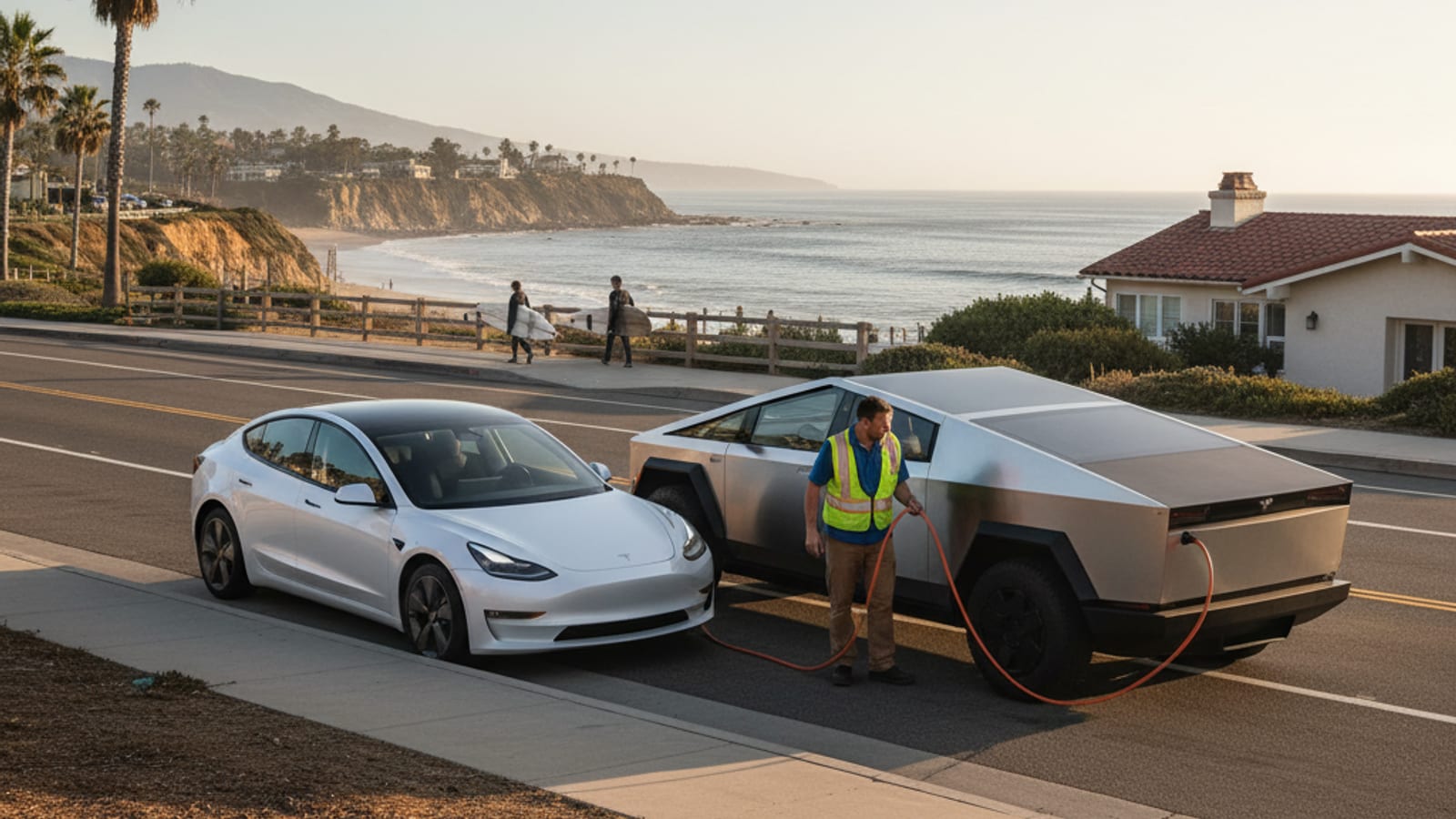
Public charging is the daily plan, not a backup
Wheaton is a census-designated place in lower Montgomery County, Maryland. It’s not an incorporated city. Census ACS 2019-2023 puts the population at 52,172. Hispanic or Latino residents are 43.4 percent of that count, among the higher shares in this ring of the metro. The community sits on about 6.9 square miles. Georgia Avenue (MD-97) is the spine. University Boulevard (MD-193), Veirs Mill Road (MD-586), and Randolph Road stitch the rest.
Older apartments and small lots shape how people charge. You leave the car at Westfield Wheaton while you shop. You leave it in the Metro garage while you ride downtown. You leave it on the street overnight because the building predates a wall connector. That’s housing, not a riddle about the roads. The pack starts the day wherever the last public session ended.
Pepco is the electric utility here. Its EVsmart pages describe home and multifamily charging programs for Montgomery County addresses. Confirm current rebate rules on Pepco’s own site before you apply. Pepco doesn’t send a truck to a stalled car. No utility EV page reviewed for this metro offers a stranded-car charge. That absence matters when the public stall is occupied, the session failed, or the 12-volt died in the garage.
Drivers coming in from Silver Spring already know this mix. Shared lots, Metro parking, and older houses show up there too. Wheaton runs even heavier on pre-1980 stock. If your building has no assigned plug, plan as if every night is a public night.
An empty pack and a silent 12-volt aren’t the same job
Two failures look similar from the sidewalk. They’re not.
An empty traction pack is a range problem. You used the last miles in Veirs Mill traffic. You sat with climate control on. You skipped a public session because the stall was taken. The car still talks to you. Locks work. Lights work. The display just won’t promise enough miles.
A dead 12-volt is a wake-up problem. Teslas and most other EVs still use a small 12-volt battery to close contactors, run locks, and boot the high-voltage system. The traction pack can be half full. The car still sits there like a brick. That’s the long-dwell garage pattern. Wheaton Metro, Westfield Wheaton, and street parking overnight all fit it.
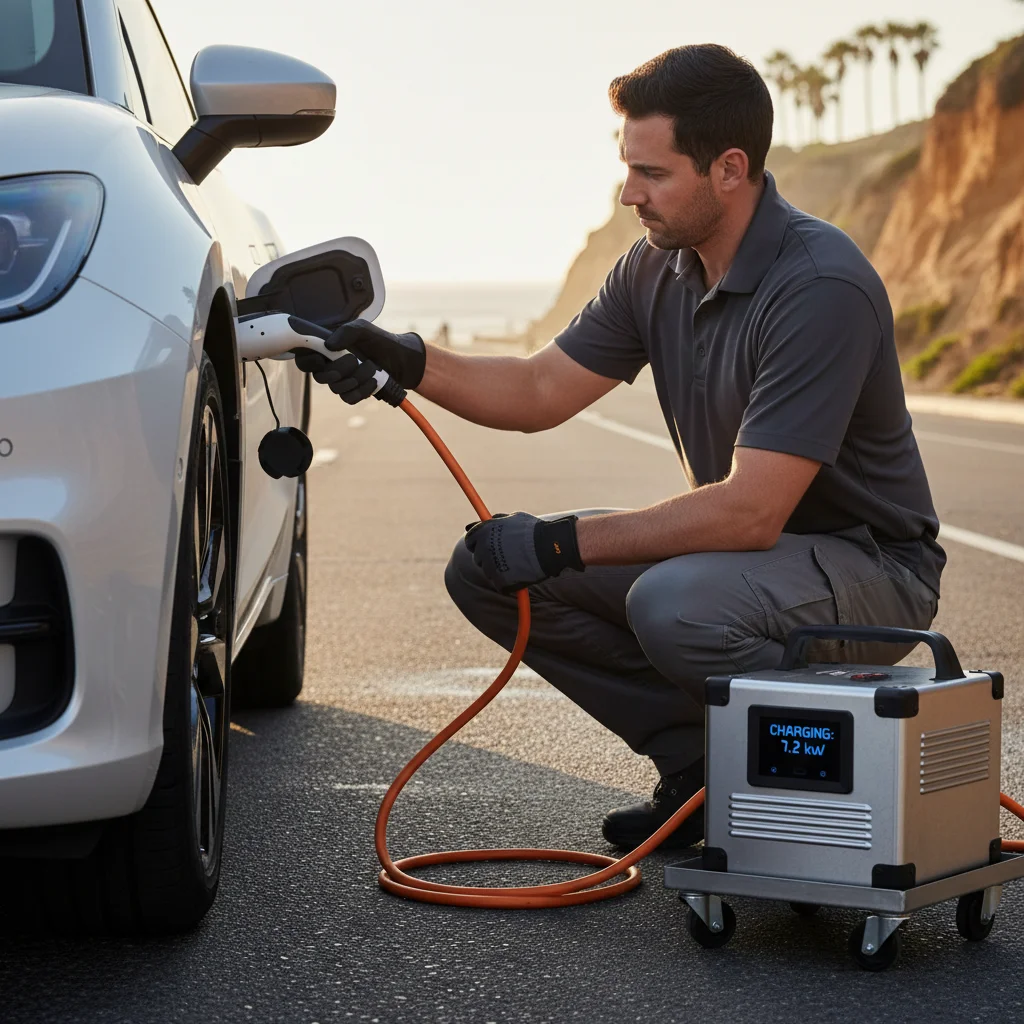
Operators the referral line sends can jump or replace that 12-volt on site. They also bring a 240-volt Level 2 source for an empty pack. Native NACS for Teslas. A CCS or J1772 adapter for other brands. Typical charging time is 15 to 30 minutes. That window is plug-in time, not a promise of when someone arrives. In that charging window they often add about 10 to 20 miles. That’s enough to reach a public stall you already picked, or to get home if home is close.
Don’t guess which failure you have. If the car is mute, start with the 12-volt. If it talks and the miles are gone, you need energy in the pack. For Tesla-specific wake-up steps, see Tesla 12-volt failure signs. For a curb-side charge, see mobile EV charging.
Veirs Mill and Georgia Avenue drain cars that never left town
You don’t need a long trip to run short here. Veirs Mill Road carries a steady commuter load. Georgia Avenue does the same, north toward Olney and south toward downtown Silver Spring. Peak hours mean stop and go. An EV sitting still with heat or AC on burns energy without covering ground.
University Boulevard and Randolph Road add the errand loop. Brookside Gardens and Wheaton Regional Park are easy day stops. They still cost miles you meant to save for the ride home. Westfield Wheaton is a long dwell. So is the Metro garage. Cars wait. Then you ask them to move.
Hot, humid summers sit on this Piedmont shelf with the rest of lower Montgomery. Periodic ice shows up in winter. Recurrent Auto published cold-weather work from a study of more than 30,000 EVs. A typical EV keeps about 80 percent of range at 32F, and about 70 percent at 20F. Cabin heat is the main drain. Cars with a heat pump held more, about 83 percent versus about 75 percent without. That isn’t a Tesla-only figure. Don’t treat your dash estimate as a guarantee after a freeze.
A cold snap plus public-only charging leaves less cushion. You can’t top up in a private garage you don’t have. You wait for a stall. You sit in traffic. Then the number on the dash isn’t the number you planned.
What shows up at the curb is an independent operator
Charge Pro DC is a referral line. It matches stranded EV drivers with independent local mobile rescue operators. It doesn’t hold a trade license. It owns no trucks, no chargers, and no parts inventory. It employs no technicians. It sets no prices and publishes no hours. We don’t send a brand-owned truck. We connect you with an operator who quotes you before any work starts. That operator bills you directly.
That quote is the number that matters. What moves it is ordinary. How far the operator has to come. Time of day. How much range you need. Whether the job is a 12-volt jump, a 12-volt replacement, or a Level 2 top-up. Whether the car is on a quiet side street or a live lane on Georgia Avenue. Ask for the quote. Hear it. Then say yes or no.
The equipment is Level 2, not a Supercharger on wheels. A Supercharger is Tesla’s high-power DC network. A roadside visit is 240-volt AC, closer to a home wall connector. It won’t fill a pack. It’s meant to add enough miles to roll to a stall you choose, or to a driveway if you have one. For a plain-language walkthrough of the truck and the plug, read how mobile EV charging rescue works.
The pros we connect you with are licensed and insured. They handle Tesla and every major EV brand. If your car is a Ford, Hyundai, Kia, Rivian, Chevy, or something else with CCS or J1772, they bring the adapter. You don’t need a Tesla to call.
A tow is a different job, and Maryland treats a dead EV like any disabled car
A tow moves the car. It doesn’t put energy in the pack. Many EVs need a flatbed so all four wheels leave the pavement. Wheel-lift shortcuts can stress motors and the drive unit. If you only need miles, charging at the curb avoids the shop detour. If the car is in a live lane, or the pack won’t take a charge, a tow may still be the right call.
Maryland’s Transportation Article Title 21 covers stopping, standing, and disabled vehicles. None of the DC, Maryland, or Virginia codes reviewed for this site has a special rule for running out of electric charge. The disabled-vehicle rules apply the same to an EV as to any car. Montgomery County sets its own private-property tow rules. A current fee figure wasn’t confirmed for this page. Confirm the number with the county before you argue a bill. Don’t guess.
If you’re on I-270 or the Capital Beltway (I-495), MDOT SHA CHART is the state patrol to know. Dial #77 for a breakdown on those roadways. CHART Emergency Response Technicians publish tire changes, jump starts, about one gallon of gas, and radiator water. Statewide, Maryland reports more than 37,400 assists a year. CHART material doesn’t describe EV charging. Treat it as traffic control and basic motorist help, not a mobile Level 2 visit.
The District has no DDOT motorist-assistance patrol that turned up in the same review. That doesn’t change Wheaton. You’re in Montgomery County. Stay with the car if you can do so safely. Put on hazards. If you’re in a travel lane, follow posted guidance and get to a legal spot when the car will still roll.
For a side-by-side of charging in place versus hauling the car, see mobile EV charging or a tow.
Heat, ice, and a car that sits in a garage all day
Wheaton isn’t the coldest part of the metro. Dulles runs colder and snowier than Reagan National. Upper Montgomery and Loudoun take more freeze than the inner core. You still get ice. You still get stretches above 90F. Both tax the pack.
Summer humidity means climate control while you crawl. Winter ice means cabin heat while you wait. Sitting still is the local drain, not a mountain pass. The land here is Piedmont, not a range. The hard part is the clock. You spend a workday in the Metro garage, then you merge slowly onto Georgia Avenue.
The January 2022 I-95 shutdown south of this metro is the region’s reminder. Snow and a crash closed a long stretch overnight. Drivers sat with heat on for hours. Wheaton is north of that scene. The lesson still applies. If you’re stopped in a freeze, save what you can. Cut extra loads. Keep enough power for lights and a phone. Then call for a charge if you can’t reach a stall.
Airport long-term lots teach the same 12-volt lesson. A week of sitting kills the small battery first. WMATA park-and-ride garages follow that pattern. Wheaton Metro is that kind of dwell. Confirm charger availability on the garage’s own signs or app. Don’t assume a plug. Don’t assume there isn’t one. Look, then decide.
Nearby corridors if you rolled in from the next community
Drivers mix Wheaton with Silver Spring on the same Georgia Avenue run. Rockville sits west toward I-270. North Bethesda sits between office garages and Metro. Olney is the northbound MD-97 continuation.
Charge Pro DC serves the DC area, the District of Columbia, Maryland, and Virginia. Service-area language is simple. If you stalled in Wheaton, the match is a local independent operator. If you stalled after you crossed into Rockville or Silver Spring, the match is still a local operator. The quote still comes before work. The bill still comes from the operator.
Don’t wait for a brand roadside app to guess your block. Tesla, Rivian, and others publish their own programs. Those programs send contractors too. They don’t always include a Level 2 charge at the curb. If the in-app path is a tow you don’t want, a quoted local visit is the other route.
Checks to run while you still have a few miles
Act before the pack is at zero if the car is still rolling.
Pull out of the travel lane. Georgia Avenue and Veirs Mill aren’t places to sit in a live lane. University Boulevard and Randolph Road have their own peak crush. Use a lot, a legal curb, or a side street.
Drop climate control a notch. Seat heat costs less than blasting the cabin. In summer, vent air instead of max AC if you can stand it.
Open your charging app and your car’s nav. Pick a stall you can actually reach with the miles you have. ChargePoint, PlugShare, and the in-car map are the usual tools. The U.S. Department of Energy Alternative Fuels Data Center is a public station finder if you want a second view at https://afdc.energy.gov/. If that stall is beyond the miles on the dash, stop guessing. Call for a top-up.
If the car is dead silent, don’t keep hammering the fob. Check for any 12-volt warning you already ignored. A jump on site can wake the high-voltage system. A pack with miles still in it doesn’t help you if the 12-volt won’t close the contactors.
If you plugged in at a public post and nothing happened, treat that as a charger or port problem first. A connected-but-not-charging stall wastes the miles you spent getting there. Move only if you still can. Then decide between another stall and a mobile visit.
Keep the phone charged. Maryland is an all-party consent state for call recording (Md. Courts and Judicial Proceedings § 10-402). DC and Virginia are one-party. A metro line that can touch Maryland should play a recording notice. You may hear that beep. It’s the legal rule, not a sales tactic.
When you’re ready to call
Pin your exact spot for the operator. Wheaton Metro garage, a level if you know it. Westfield Wheaton, and which side of the lot. A block on Veirs Mill. Georgia Avenue near University Boulevard. Street parked outside a pre-1980 walk-up. Those details change the approach.
Say the brand and model. Say whether the car talks. Say the indicated miles, or that the screen is black. Say you charge in public and don’t have a home plug, if that’s true. The operator will quote the job before starting. You accept or you don’t.
Charge Pro DC doesn’t promise an arrival window. It doesn’t publish hours. It doesn’t set the price. Call (202) 629-0844 when you want a match with a local operator who can bring 240-volt charging or a 12-volt jump. Stay with the car if it’s safe. Stay out of the travel lane.
Frequently asked questions
Can an operator charge a non-Tesla in a Wheaton garage?
Yes. Operators bring a native NACS plug for Teslas. They also carry CCS or J1772 adapters for other EVs. Ford, Hyundai, Kia, Rivian, Chevy, and similar brands are in that set. The visit is still Level 2. You get a quoted top-up, not a high-power DC fill. If the garage has a height or access rule, say so when you call so the operator can plan the approach.
Does waiting on a public stall replace a roadside charge?
Sometimes. If you can reach a working stall with the miles you have, use it. Wheaton drivers already live on public charging. A roadside visit is for when you can’t make that stall, the car won’t wake, or you’re stuck in a place you shouldn’t sit. The operator still quotes you first. You’re not obligated to proceed.
What if the car is silent but I charged yesterday?
Think 12-volt first. A day in the Wheaton Metro garage or a long sit at Westfield Wheaton is enough to flatten the small battery. The traction pack can still hold energy. A jump or on-site replacement is the usual curb fix. If the car then shows a true empty pack, you can add Level 2 miles in the same visit. Ask for that as two parts of one quote so you know the work before it starts.