Your Hyundai Ioniq 6 won’t start after a long sit in a Metro garage. That’s almost always the 12-volt auxiliary battery, not the traction pack. The sedan can sit fully dark with range still stored in the big battery.
Doors may ignore the key fob from a few feet. The start button does nothing when you press it. Screens stay black, and climate never comes up. A lot of owners assume the pack is empty. On this car, the small battery usually failed first.
What a dead Ioniq 6 looks like from the seat
This sedan shares Hyundai’s E-GMP layout with the Ioniq 5. Two batteries work in parallel on this platform. The traction pack is what turns the wheels. The 12-volt runs computers, locks, lights, windows, and the network that wakes the drivetrain.
When that 12-volt is flat, the wake-up never happens. The traction pack stays locked out until 12-volt power returns. How many miles you had last night doesn’t change that. You may remember a healthy range when you parked. Today the car won’t boot when you press start. That mismatch is the real tell on this car.
The Ioniq 5 hides its 12-volt under the hood. This sedan puts it in the trunk instead. Read the Hyundai Ioniq 5 won’t start notes if you drive both. Don’t copy the crossover battery steps onto the Ioniq 6.
Why a Metro garage sit hits the 12-volt
WMATA park-and-ride garages are long-dwell parking, not a quick curb stop. Commuters leave an Ioniq 6 for a full workday. They often walk back to a dark car. The 12-volt keeps sleeping modules alive while the car sits. A weak cell loses that quiet fight overnight.
Silver Line lots around Reston see the same pattern after a District day. Office decks in Tysons do it too, including Tysons Corner Center. Union Station’s garage is another long-dwell lot in the core.
Airport parking is the same 12-volt story after a trip. Reagan National has complimentary EV charging on Level 1 of Garages 1 and 2. Dulles publishes Level 2 charging in Garage 1 and Garage 2. Confirm current stall counts on the MWAA pages before you plan around them. A week in the Economy Lot is a classic “won’t wake” return.
Older housing pushes more cars into Metro lots. Takoma Park, Annandale, Wheaton, and much of Washington have high shares of pre-1980 homes. Many of those addresses never got a wall plug. The Ioniq 6 lives at a garage or a curb, then sits.
Apartment-heavy Arlington, Alexandria, Silver Spring, Hyattsville, and the District run the same way. You didn’t empty the pack on I-270. You starved the 12-volt in a quiet lot.
Hyundai’s battery management can stop topping the 12-volt at a very low pack. Then a sit of several days finishes the drain. A partly charged pack can still leave you with a dark car.
Heat, ice, and a parked Ioniq 6 here
The metro sits on the fall line between the tidal Potomac and the Piedmont. Summers run hot and humid, with stretches above 90F. A closed garage holds that heat around an AGM 12-volt.
Winter weather cuts unevenly across the whole region. Dulles runs colder and snowier than Reagan National. Loudoun, upper Montgomery, and Prince William see harder freezes than the District core.
Cabin heat comes from the traction pack on this car. Sitting in Beltway or I-95 traffic with climate on burns range without covering miles. The 12-volt still feeds computers through that idle. A long standstill plus a tired 12-volt is a bad mix.
Don’t treat a dark Ioniq 6 as proof the pack is empty. Work the 12-volt path first on this sedan.
Where the battery is, and where you jump
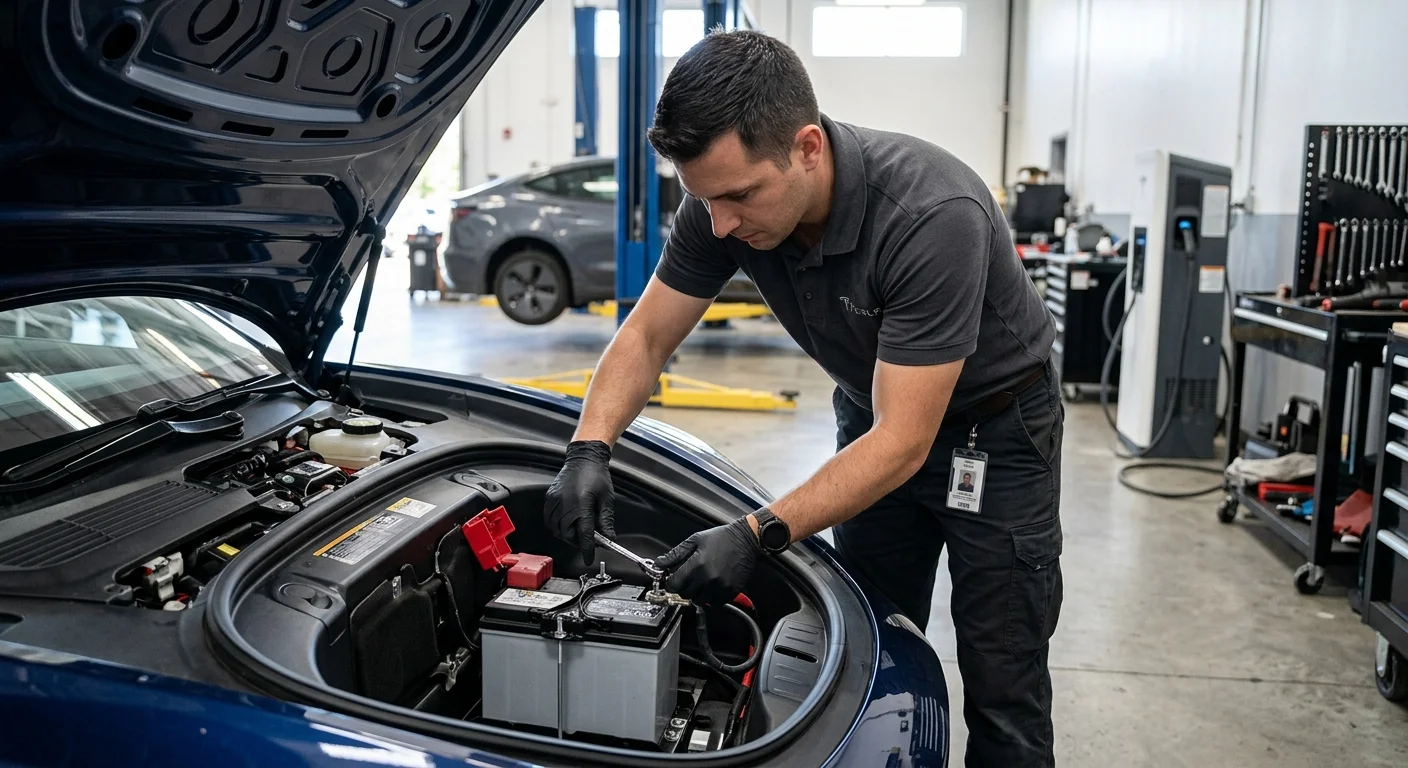
This is the sedan-specific catch on the Ioniq 6. The 12-volt lives in the trunk, not under the hood. It sits on the driver’s side under cargo trim. Pull back the left floor liner to see the AGM unit.
You still don’t jump from those trunk posts. The correct jump points are under the hood.
The hood opens even without a storage frunk. Use the interior hood release to pop it. On the driver’s side of the bay, find the black fuse-box cover. Lift the red cap to expose the positive jump terminal.
Ground is a bare, unpainted chassis bolt in that bay. Use that bolt, not the trunk negative post.
| Spot | What you’ll find |
|---|---|
| Trunk, driver’s side, under trim | The AGM 12-volt battery itself |
| Under hood, driver’s fuse box | Positive jump terminal under a red cap |
| Under hood, on the chassis | Unpainted bolt for the negative clamp |
| Cluster menus, when the car is awake | Auxiliary battery save setting |
If the car is fully dark, entry can be the first problem. You may need the key blade or a mechanical release. If you can’t get in, stop and call. Don’t pry panels or force the charge door.
For clamp order on any EV, use how to jump start an EV. The Ioniq 6 still wants those hood points.
What to try in the garage before you call
Work this list in order, and skip steps that need tools you don’t have.
- Separate a pack guess from a 12-volt failure. Leftover miles after a Metro sit point at the 12-volt.
- Try the fob from a few feet away. Swap the fob coin cell if you have a spare. A dead fob can mimic a dead car.
- Watch for any lock blink or interior glow. Total silence makes the 12-volt the lead suspect.
- Open the hood from inside if you can. Find the red-capped positive post in the driver’s fuse box.
- Use a jump pack or a second vehicle. Clamp red to that post and black to a bare chassis bolt.
- Wait a couple of minutes for the system to take charge. Then press start and give the boot extra seconds.
- If it wakes, drive to a charger you already use. One jump often won’t rebuild a failing AGM.
If it dies again after you drive off, replace the 12-volt. EV 12-volt replacement covers the signs and the next step.
Don’t clamp negative to the trunk battery, and don’t grab a painted bolt for ground. Don’t keep hitting start if the car never boots.
Who can help on the road, and who can’t charge an EV
On Maryland state primary roads, MDOT SHA CHART lists jump starts among its published assists. Dial #77 on I-495, I-270, US-50, or MD-295. Tell them you have a dead 12-volt on an EV. CHART pages don’t describe charging an empty traction pack.
VDOT Safety Service Patrol covers Virginia interstates here, including I-66 and I-95. Published material describes incident clearance, debris, and short-term traffic control. It doesn’t describe EV charging as a service.
No DDOT motorist-assistance patrol turned up in the District sources we checked. In the District, you’re looking at MPD, a private plan, or Park Police.
If you stall in the 495 Express Lanes, pull to the left shoulder. Those lanes sit in the median, so the left side is the safe one. Stay in the car until help is there. Express Assist can call a tow for minor issues, not charge an EV. On the 95 and 395 Express Lanes, use the nearest shoulder.
On the Baltimore-Washington Parkway, call US Park Police at 202-610-7500. Shoulders there are narrow or missing, and trucks over 10,000 lb are banned.
The Woodrow Wilson Bridge and the American Legion Bridge have little shoulder. They’re high, wind-exposed spans, so stay with the car.
None of the three codes we reviewed adds a special rule for an empty EV. Disabled-vehicle rules apply to an Ioniq 6 the same as any car.
Pepco, Dominion Energy Virginia, and NOVEC publish home-charging programs. None of the utility EV pages reviewed offer a stranded-car charge. Don’t wait on the power company for a garage jump.
The auxiliary battery save setting
The Ioniq 6 has an auxiliary battery save mode the Ioniq 5 doesn’t match. You turn it on in the cluster while the car is already awake. The usual path is Settings, then Vehicle, then Auxiliary Battery. Trim and software can move that menu around.
It limits accessory draw while you sit with screens on. It won’t revive a battery that’s already dead. Use it before a long wait, not after the car goes dark.
Parked time with infotainment running is the use case.
Pack empty versus 12-volt dark
A pack that’s truly low usually still lets the car talk. You may see a range warning on the display. The locks may still work from the fob. The car may limp before it refuses to drive.
A dead 12-volt is blunter than a low pack. No screens come up on the dash at all. There’s no polite warning and no start sequence.
If you parked at Metro with leftover range, start with the 12-volt. If you were already crawling the Beltway with heat on, you may have both problems. Jump the 12-volt first, because you can’t charge a car that won’t wake.
See When an EV 12-volt dies on a trip for garage and airport sits.
What a local operator can do
Charge Pro DC is a referral line for the District, Maryland, and Virginia. It doesn’t own trucks, and it doesn’t employ technicians. It matches you with an independent mobile operator. That operator quotes you before work starts and bills you directly.
The pros in the network jump or replace a dead 12-volt on site. They can also bring a 240-volt Level 2 source to the car. They bring a native NACS plug, plus CCS or J1772 adapters for non-Tesla EVs. A typical top-up adds 10 to 20 miles of range. That’s 15 to 30 minutes of charging time, not an arrival time.
Ask the operator which adapter they have for your port. Other non-Tesla models use the same non-Tesla EV rescue path.
If Metro days keep killing the car, get the 12-volt load-tested. Heat, age, and long sits wear AGM units.
For garage sits in Vienna, see EV roadside assistance in Vienna.
If the Ioniq 6 is dark after a Metro sit, call (202) 629-0844. The operator quotes a 12-volt jump or a 240-volt top-up first.
Can an Ioniq 6 refuse to start with charge still in the pack?
Yes, it can sit dark with miles still stored in the pack. The 12-volt wakes the computers that unlock the traction system. If that small battery is dead, the car stays dark. Pack miles from last night don’t get you a start.
Where do you jump a Hyundai Ioniq 6?
Use the hood points, not the trunk posts. The battery itself is in the trunk on the driver’s side. The positive jump terminal is under a red cap in the driver’s fuse box. Ground to a bare chassis bolt in the bay.
Does the auxiliary battery save mode revive a dead 12-volt?
No, that mode only limits accessory drain while the car is already awake. Turn it on before a long parked wait. Once the Ioniq 6 is dark, you need a jump or a quoted operator.