EV roadside assistance in Vienna usually starts in a Metro garage, not on I-66. You parked at Vienna/Fairfax-GMU on Monday. Friday the fob does nothing and the screens stay dark. The traction pack may still hold a commute’s worth of range. The small battery that wakes the car is what failed. Charge Pro DC is a referral line for the DC area. We connect you with an independent local operator. That pro quotes you before any work starts and bills you directly.
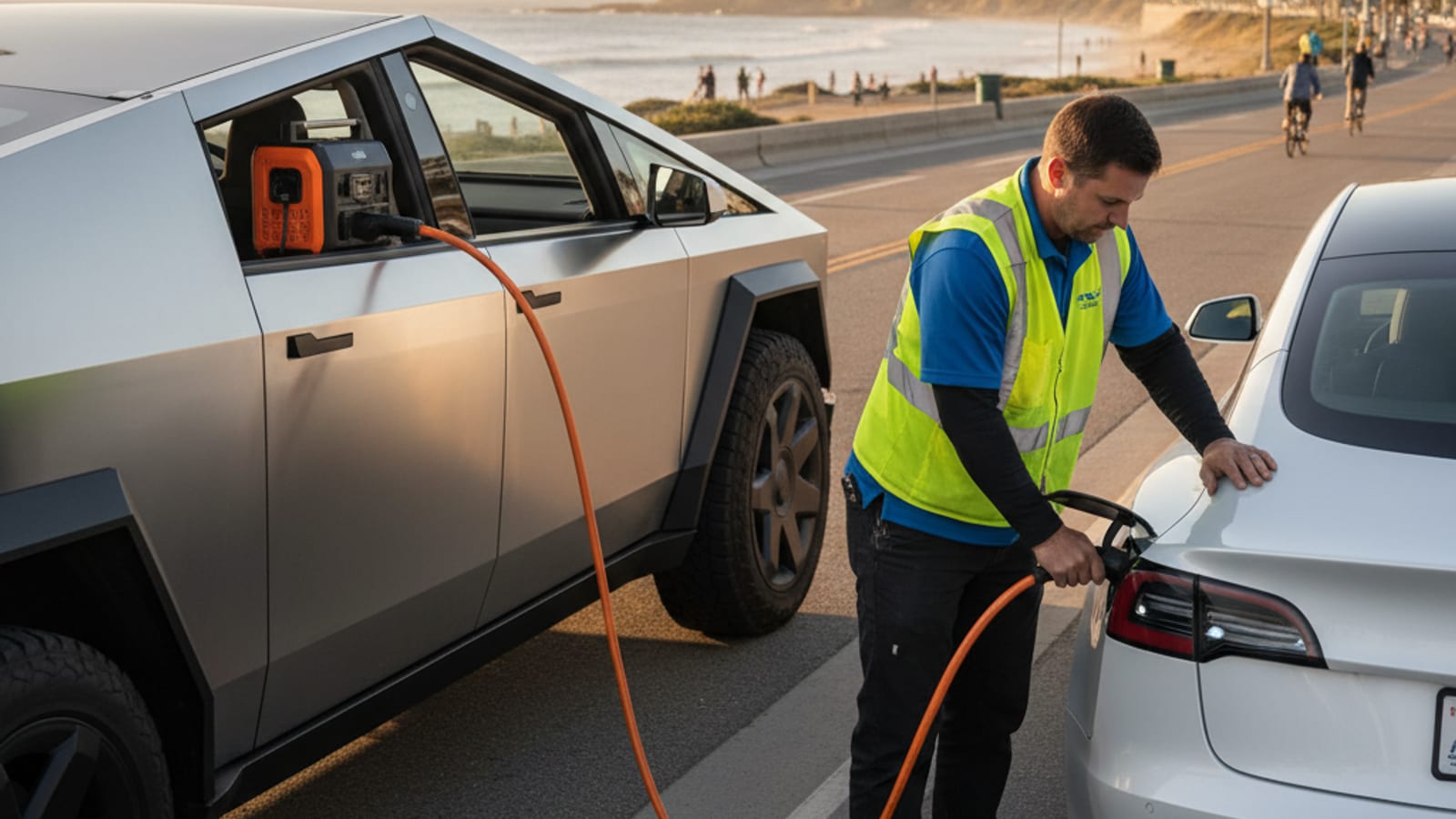
The Orange Line terminus is a week-long parking deck
The Town of Vienna is an incorporated town in Fairfax County. It’s not a census-designated place, and it’s not the City of Fairfax. Those two Fairfax names get mixed up on calls. Vienna covers about 4.4 square miles. ACS 2019-2023 puts the population at 16,369. The town sits in inner Fairfax, tight to Tysons and Merrifield. The City of Fairfax sits close too. Reston sits a little farther west.
The town grew around the Orange Line’s western terminus. The Vienna/Fairfax-GMU garage is one of the biggest park-and-ride lots in the WMATA system. That’s the local fact that matters for an EV. Commuters leave cars there all week and ride into the District. A week in that deck is a long-dwell event. Long-dwell is how 12 volt batteries fail.
A pack at 50 or 70 percent can look fine in the app on Thursday. The 12 volt is a different battery. It feeds locks, lights, infotainment, and the computers. Those computers close the high-voltage contactors. If the 12 volt sags, the pack can’t come online. The car becomes a brick. This is the same week-long parking pattern as airport lots. A Metro terminus just happens more often in this town.
WMATA charging lists for this garage weren’t confirmed in the research for this page. Confirm posted equipment on your level before you count on a plug. The Friday failure is still the 12 volt, whether a pedestal is in sight or not.
What the 12 volt does while you ride Metro
Leave the traction pack out of the first diagnosis. Ask whether the car will unlock. Ask whether any screen boots, and whether the charge port door will move. Those are 12 volt jobs. A healthy pack won’t save you if the small battery can’t close the loop.
Tesla made this failure famous, but it isn’t Tesla-only. Ford, Hyundai, Kia, Chevy, BMW, Mercedes, Rivian, and Lucid still boot from a 12 volt. Some newer Teslas use a lithium 12 volt. Older ones use lead-acid. Both can sit down after days without a drive cycle. The garage doesn’t have to be freezing. Parasitic drain plus a long sit is enough.
There’s a longer garage-sit explainer here: what happens when an EV 12 volt dies in a garage. Pin it to Vienna/Fairfax-GMU and it’s the same failure.
Maple Avenue, Nutley Street, and the I-66 crawl
Downtown Vienna runs along Maple Avenue, signed as VA-123. Nutley Street is the spine between the garage, the town, and I-66. VA-267, the Dulles Toll Road, sits just to the north. If you wake the car and then stall, you’ll stall on one of those roads.
I-66 is inner Fairfax’s stationary drain. Rush-hour stacks you in place while climate control keeps running. Range drops without a mile gained. That’s crawl loss, not hill loss. The land here isn’t mountainous. The problem is time at a standstill.
If the pack actually hits empty on that interstate, treat it as a disabled vehicle. Virginia’s disabled-vehicle rules we reviewed don’t add a special empty-charge section. An EV on the shoulder is still a stalled car. Turn the hazards on. Stay in the vehicle if traffic is close. Virginia 511 is the published path to VDOT help. VDOT’s Safety Service Patrol covers I-66 in Northern Virginia. Published VDOT pages describe incident response, debris, and short-term traffic control. They don’t describe charging an EV.
I-66 inside the Beltway is dynamically tolled in peak hours. A toll doesn’t change the stall. Get out of the travel lane if you can. Then decide on a patrol for the scene, a tow, or a mobile 240 volt visit. For an empty pack on that corridor, read stranded EV on I-66. A silent car in the Metro garage isn’t that article. It’s this one.
Tysons is the next pin east. You can leave the garage, roll toward Tysons Corner Center, and stall in a deck. That’s a long-sit cousin of this call. We cover that pattern in EV roadside assistance in Tysons. Merrifield office garages do the same weekday sit. The City of Fairfax is a separate jurisdiction. Reston Silver Line lots rhyme with this Orange Line terminus. Give the operator the pin you’re actually at.
Wolf Trap is the evening version of the same sit
Wolf Trap National Park for the Performing Arts sits by the town. Evening crowds park, walk in, and stay through a performance. That’s hours with the car dark, not a week. It’s still long-dwell. Summer humidity plus a hot soak can push a weak 12 volt over the edge. A winter show with a freeze on the lot can do it faster.
Treat a Wolf Trap lot like the Metro garage. Confirm any plug you can see before you count on it. We aren’t publishing a charger map for that park. Inventory wasn’t pulled for this page. If the car won’t wake after the show, you want a 12 volt jump or an on-site replacement. If you crawled I-66 to the gates with a low pack, you want Level 2 on the bumper.
Older town-core houses, and what Dominion won’t do
About 63.4 percent of Vienna housing was built before 1980, per ACS 2019-2023. That’s a real local share, not a guess. Older town-core houses often lack a clean 240 volt run to the driveway. Some owners trickle on 120 volt. A weekday in the Metro garage plus a weak home circuit is how both batteries get neglected.
Dominion Energy is the utility in Vienna. Named EV programs on Dominion’s site include Schedule 1EV, the Off-Peak Plan, and EV Charger Rewards. The Off-Peak Plan is a voluntary time-of-use rate and needs a smart meter. EV Charger Rewards is a demand-response incentive. None of those pages, in the set we reviewed, offer to charge a stranded car. That’s an absence, not a maybe. A rebate won’t roll into the Vienna/Fairfax-GMU garage.
We aren’t publishing a cents-per-kWh number. Rate tables change, and we didn’t freeze one for this page. Confirm Schedule 1EV and Off-Peak terms on dominionenergy.com for your address. Charge Pro DC doesn’t set power prices.
Two failures that get described as one stall
Call one: the 12 volt’s dead. The car is a brick. You may not get in, and you may not see a percent. The pack can still be fine. A jump, or a 12 volt replacement on site, is the work. Tesla drivers in this town hit this after a work week in the terminus garage. An on-site Tesla 12 volt jump is often the whole job.
Call two: the pack is empty, or close. The car may still unlock. It won’t take you down Maple Avenue, let alone home. Then you want mobile EV charging. Operators we connect you with bring a 240 volt Level 2 source to the bumper. They use a native NACS plug. They carry CCS or J1772 adapters for non-Tesla EVs. A typical session adds about 10 to 20 miles of range in 15 to 30 minutes of charging. That window is charging time. It isn’t how long they take to arrive. We don’t publish arrival times.
If both are true, start with the 12 volt. A brick can’t accept a charge until it wakes. Then read the percent and decide on a top-up.
The wider product name, if you need it, is EV roadside assistance.
Heat, ice, and sitting still
Vienna summers are humid. Winters swing from mild to ice. Cabin heat and cooling come from the pack. Recurrent Auto’s winter range study, covering more than 30,000 EVs, is the source we’ll use. A typical EV keeps about 80 percent of range at freezing, 32F. It keeps about 70 percent at 20F. Heat-pump cars average about 83 percent retained. Cars without a heat pump average about 75 percent. Those are study figures. Don’t treat them as Tesla’s own published policy.
Inner Fairfax isn’t Loudoun. Dulles still runs colder and snowier than Reagan National. A freeze still reaches the terminus garage. A car that sat Monday to Friday through a cold snap is a 12 volt candidate first. Scheduled cabin climate in a closed garage nicks a weak 12 volt too.
The region’s picture of sitting still with the heat on is the January 2022 I-95 shutdown near Fredericksburg. About 14 inches of snow and a crash closed a long stretch for more than 36 hours. That stretch is south of our service area. We mention it only as the local reference for heat-on, miles-off drain. Your Vienna stall is almost always a garage or a short I-66 shoulder, not that shutdown.
Patrols, tows, and who actually charges the car
VDOT’s Safety Service Patrol is the interstate helper on I-66. Use 511. They can stabilize a disabled-vehicle scene. They don’t bring Level 2. Don’t wait on a patrol for a charge that isn’t in their published job list.
Express Assist is free on the 495, 95, and 395 Express Lanes, run by Transurban with VDOT. It handles minor mechanical issues and will call a tow. It doesn’t tow, and it doesn’t charge an EV. On 495 Express Lanes, pull left. Those lanes sit in the median. I-66 isn’t those lanes. If you left Vienna and later stalled on 495 Express, follow that left-shoulder rule and stay in the car.
A tow is a separate trade. Many EVs need a flatbed so the drivetrain isn’t damaged. Virginia has private-property towing statutes, and localities may set fee limits by ordinance. We aren’t printing a dollar cap here. Confirm the quote with the tower before the hook. Charge Pro DC doesn’t tow. We don’t own a flatbed. We don’t own a charger truck. We match you with a mobile rescue operator. For on-site charging versus a hook, stay on the mobile charging page linked above. For the town hub, use EV charging in Vienna.
What shows up when you call a local operator
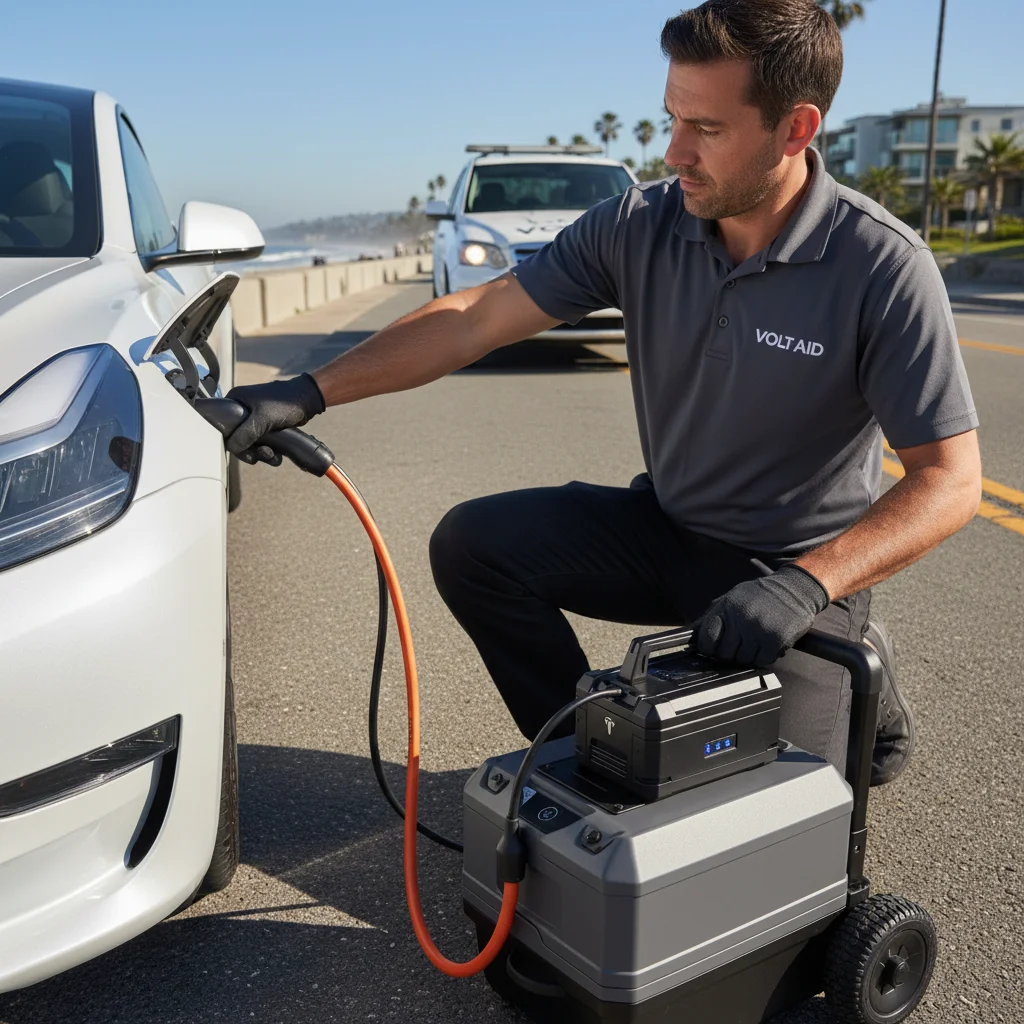
The person who pulls up is an independent operator. They aren’t on our payroll. Charge Pro DC holds no licence and owns no gear. The operator’s vehicle carries the 240 volt source. It also carries 12 volt jump equipment. They handle Tesla and every major EV brand. Native NACS covers Teslas and other NACS ports. CCS or J1772 adapters cover everyone else.
They quote before they start. If the 12 volt is the only fault, a jump may finish it. If the car dies again after a jump, the battery likely needs a replacement, not a third boost. If the pack is low, they plug in and add those 10 to 20 miles. Then you drive to a charger you already trust, or home if that’s close enough.
Tell them you’re at Vienna/Fairfax-GMU, not “a Metro garage.” Give the level and the nearest column or stair. Nutley Street and I-66 traffic will shape their approach. Garage clearance can matter for a tall rescue vehicle. We don’t promise a clock time. The operator gives you their window when they accept the job.
Tesla on that level, and the non-Tesla two stalls over
Teslas and other EVs sit on Orange Line levels all week. A Model 3 or Y that sat five days can look fully dead. Start with the 12 volt path. Phone key, key card, and mechanical release differ by year. Don’t pry a door. If you’re locked out, say that up front.
The high-voltage pack is rarely the first failure after a work-week sit. A low-voltage warning, a car that won’t wake, or an app that can’t connect is the 12 volt script. Once it wakes, then you look at percent.
Non-Tesla EVs follow the same script. The adapter on the truck matches the port after the car will accept power. You don’t need a Tesla-only product. You need the umbrella roadside visit, with the right plug in the bag.
Steps in the garage, on Nutley, or on I-66
If you’re in a travel lane, get to a shoulder or a stall. Turn the hazards on. Stay out of Nutley Street traffic. On I-66, stay in the car if traffic is moving beside you.
In the Metro garage, stay on your level if it’s safe. Don’t wander to another Orange Line station name. Vienna/Fairfax-GMU is the pin. Maple Avenue downtown is a different pin. Wolf Trap is a different pin. A wrong name sends the operator to the wrong deck.
Write down make, model, and year. Note whether any screen flashed, and whether the charge port moved. Note how many days the car sat. Note the last pack percent from the app, if you have one. Last week’s reading is useful. It doesn’t prove today’s 12 volt is healthy.
If you’re blocking I-66, call 511 as well. That’s for the scene. It isn’t a charge. Then call the referral line if you want a quoted operator for a jump or a 240 volt session.
Skip random jump packs if you don’t know the car’s 12 volt limits. Reverse polarity on an EV can take out a module. Waiting is safer than a guess.
After a successful jump, don’t leave the car sitting on that level for another week. Drive it. Plug it in at home if you can. If the 12 volt dies again the next morning, it’s telling you it’s done. Replacement on site, or a shop visit, is next.
After a Level 2 top-up, you have enough range to move. You don’t have a full pack. Go to a charger you already know, or go home. Don’t start a Wolf Trap night or an I-66 crawl on a thin top-up.
Home charging can’t reach a brick
A Dominion-fed wall unit is how most Vienna owners should finish a day. It can’t talk to a car that can’t close contactors. Wake the 12 volt first. Drive it home. Then plug in. If the house predates a 240 volt circuit, that’s electrician work. Charge Pro DC doesn’t install chargers. We don’t pull permits. We don’t upgrade panels. The operator’s visit is rescue in a lot, a driveway, or a shoulder.
Frequently asked questions
Does a dead 12 volt mean the pack is empty too?
Usually it doesn’t. A week in the Vienna/Fairfax-GMU garage is a 12 volt pattern. The pack can still hold a usable percent. Wake the car, then read the display. If the percent is truly low, ask for the Level 2 top-up on the same visit.
Can VDOT charge my EV on I-66 from Vienna?
No VDOT Safety Service Patrol page we reviewed describes EV charging. They handle disabled vehicles, debris, and traffic control. Use 511 if you’re in the lanes. For a jump or a 240 volt session, you still need a mobile operator.
What if I drive a non-Tesla EV in that garage?
The operator brings a 240 volt Level 2 source and the matching adapter. CCS or J1772 covers most non-Tesla ports. NACS covers Tesla and other NACS cars. Tesla and every major EV brand are in scope for the network.
When you’re ready to call
Charge Pro DC matches stranded EV drivers in the Town of Vienna with independent local operators. We serve the DC area, Maryland, and Virginia, including this inner Fairfax town. The operator quotes you before they start. They bill you directly. For a Metro garage brick, a Wolf Trap lot, or an I-66 shoulder, call (202) 629-0844.