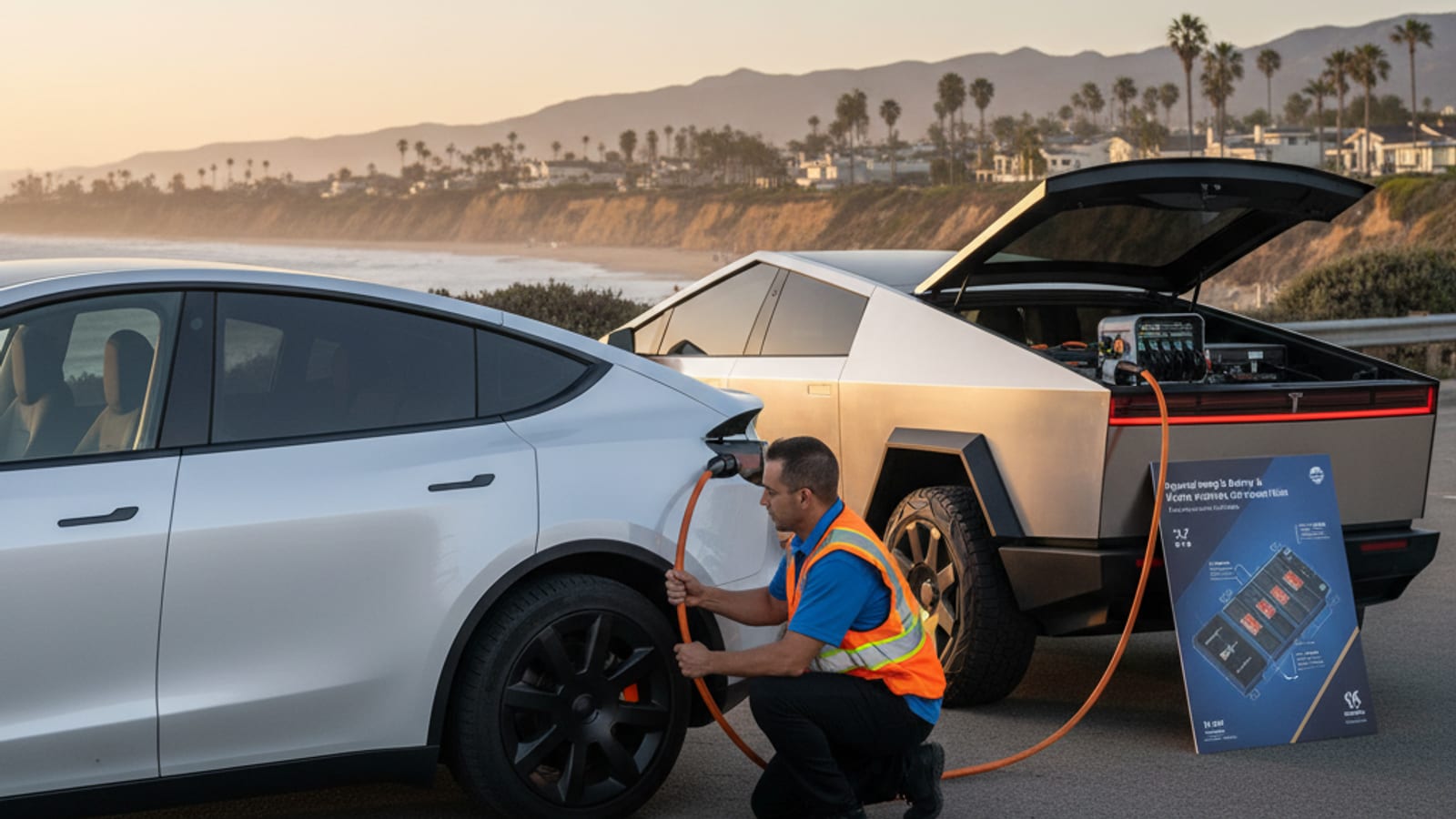
The Hyundai Ioniq 5 battery size is 58.0 kWh gross on the Standard Range pack, and 77.4 kWh gross on the Long Range pack. Usable energy is about 54.0 kWh and 74.0 kWh. That’s the tank you actually drive on. A 15 to 30 minute Level 2 stop on a DC-area shoulder isn’t a fill-up. The operators we connect you with typically add 10 to 20 miles. That happens in 15 to 30 minutes of charging. The job is to get you off the Beltway, I-270, or I-66. Then you finish at a plug you can sit on.
Those pack numbers come from Hyundai’s published 2022-2024 specs. Later model years can differ. Confirm your trim on the in-car energy screen, the window sticker, or Hyundai’s current site. A brochure range isn’t a promise on a humid crawl through Tysons. It isn’t a promise on a freeze west of Dulles either.
Two packs, and which one you likely have
Hyundai sold the Ioniq 5 with two lithium-ion packs. Both use an 800-volt architecture. That’s why DC fast charging can be quick when a compatible stall is working. It doesn’t change what a roadside 240-volt visit is for. Fast architecture still drinks Level 2 at Level 2 speed.
| Feature | Standard Range, 2022-2024 RWD | Long Range, 2022-2024 RWD | Long Range, 2022-2024 AWD |
|---|---|---|---|
| Gross pack | 58.0 kWh | 77.4 kWh | 77.4 kWh |
| Usable pack | about 54.0 kWh | about 74.0 kWh | about 74.0 kWh |
| EPA range listed | about 220 miles | about 303 miles | about 260 miles |
| Drive | rear-wheel | rear-wheel | all-wheel |
More motors spend more energy. They don’t enlarge the tank. If your door sticker disagrees with this table, trust the sticker.
Standard Range
The Standard Range pack is the smaller tank. Rear-drive was the usual pairing. About 220 EPA miles sounds ample for District errands if you left home with a real charge. It gets thin if you idle on I-95 through Woodbridge and Dale City with the climate running. It also gets thin after a US-50 run to Bowie without a top-up.
This pack still uses the CCS port. It still accepts Level 2 AC up to Hyundai’s published 10.9 kW ceiling. A smaller pack doesn’t mean a different roadside connector. It means fewer miles in reserve when the gauge is already low. Ten to twenty recovered miles are a larger share of a 220-mile tank than of a 303-mile tank. They’re still not a fill.
Long Range
The Long Range pack is the one most owners bought. Hyundai listed 77.4 kWh gross for 2022-2024. About 74.0 kWh is usable. Rear-drive was listed around 303 miles. All-wheel drive was listed around 260 miles. You feel the AWD penalty on the American Legion Bridge in a wind. You also feel it on the climb up I-270 toward Frederick.
The larger tank buys you more commuting slack. It doesn’t buy you a full recharge from a shoulder stop. Seventy-four usable kWh is a long overnight on a wall box. It isn’t a 20-minute mobile session.
If you aren’t sure which pack you have, check the energy screen first. The door-jamb label and the original window sticker also name the trim. A dealer can read the VIN. Guessing from a used-car ad is a weak plan.
Percent on the dash isn’t miles. A Long Range AWD at 15 percent in 20F weather isn’t the same remaining distance as 15 percent in May near the Mall. Convert with the car’s recent efficiency, not the EPA sticker. The trip computer is the better guide on a humid Beltway day.
Gross kWh isn’t the miles you can spend
Gross capacity is the whole pack. Usable capacity is what the car will let you use. Hyundai holds a buffer at both ends so cells aren’t run to the wall. On the Ioniq 5, usable energy is about 95 percent of gross. That buffer exists for cell life. Zero percent on the dash isn’t a chemistry zero. One hundred percent isn’t a chemistry max.
Range isn’t kWh alone. Speed spends the tank. Heat spends it. Cold spends it. Sitting in gear with the climate on spends it with no miles to show. EPA tests assume a smooth cycle. They don’t assume a standstill on the 495 Express Lanes. They don’t assume a week in the Dulles Economy Lot.
Keep daily charge in a mid band when you can. Many owners stay near 20 to 80 percent on routine days. That’s a battery-care habit, not a roadside tactic. On the shoulder, the useful check is whether the car will take 240-volt. Then it’s how many miles that feed will add.
Tire pressure, extra cargo, and hard launches all cut range. So does high speed on I-66 or I-95. Smooth throttle and the Ioniq 5’s regen put some energy back. Regen won’t refund a two-hour idle. If the gauge is already in the low teens, don’t spend the rest on climate while you wait.
A roadside Level 2 stop doesn’t fill either pack
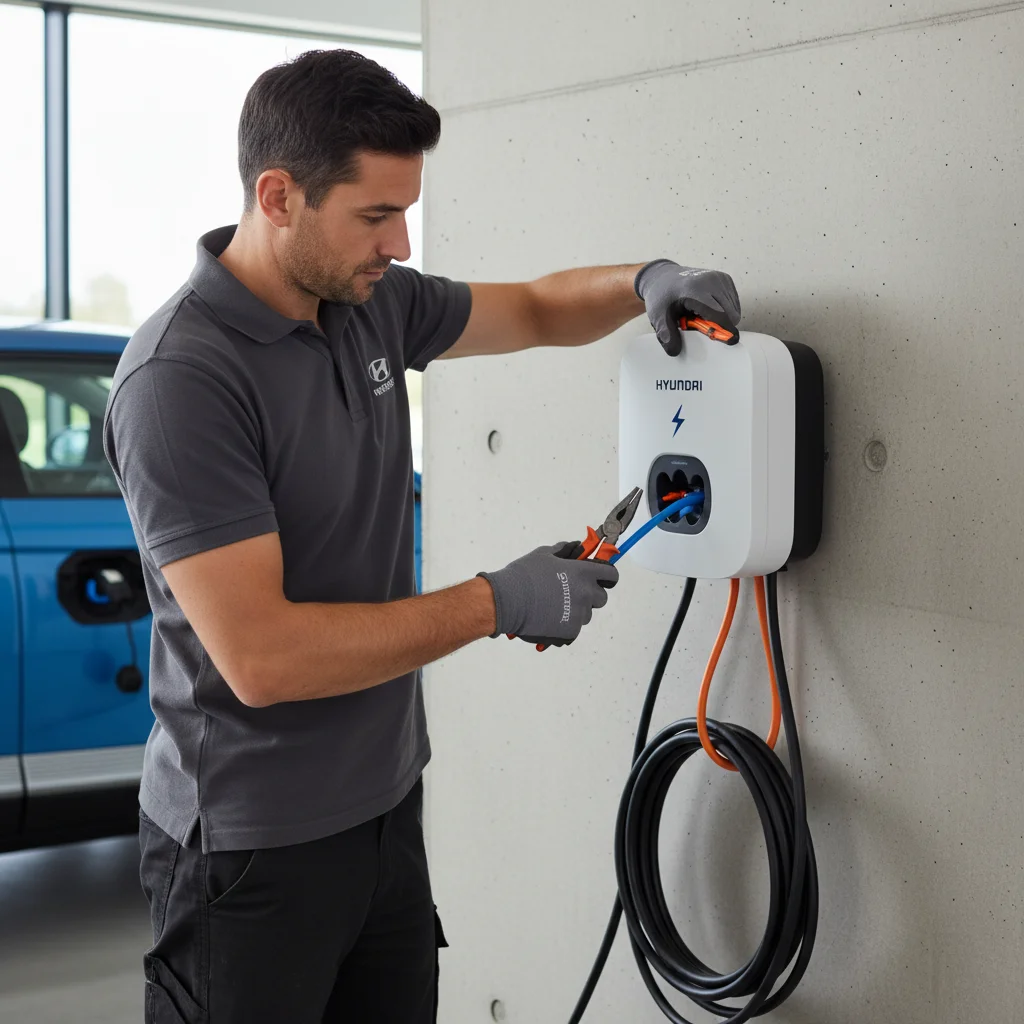
Home Level 2 is a refill. The Ioniq 5 can take up to 10.9 kW on AC. At that rate, a Long Range pack from empty to full is a long overnight. Plan on about 7 to 8 hours if the circuit and the car both hold the rate. That’s how you put 74 kWh back. For session times at a wall box versus on the road, see Hyundai Ioniq 5 charging time at home and roadside. For what each charging level can do when you’re already stuck, see EV charging levels that actually matter when you’re stranded.
The operators we connect you with bring a 240-volt Level 2 source to the car. They arrive with a native NACS plug, plus a CCS or J1772 adapter for non-Tesla EVs. Your Ioniq 5 uses CCS. The CCS adapter is the usual match. Typical added range is 10 to 20 miles in 15 to 30 minutes of charging. That clock is charging time. It isn’t a promise about when someone shows up.
Do the arithmetic. About 74 kWh usable is the Long Range tank. A short Level 2 session moves a slice of it. Ten to twenty miles is a corridor hop. That can mean off the Beltway general lanes, off I-66, or off I-270 between Rockville and Germantown. Then you roll into a garage or a public plug. It isn’t 303 EPA miles. On Standard Range the shape is the same with a smaller ceiling. You still leave with a top-up, not a 220-mile reset.
A 120-volt household outlet is a trickle. It’s how some drivers nurse a car overnight in a pinch. It isn’t how you leave a travel lane.
DC fast charging is the other extreme. Hyundai published peak DC rates up to 239 kW on compatible hardware. It also published about 18 minutes from 10 to 80 percent under ideal conditions. Ideal means a working 800-volt stall, a conditioned pack, and a station that holds the curve. A Beltway shoulder isn’t that stall. A mobile 240-volt rescue isn’t that stall either. With an adapter, an Ioniq 5 can use NACS hardware where the network allows it. This page doesn’t publish a local station inventory. That inventory wasn’t pulled for this brief. Use your charging apps for live stalls. Use a quoted Level 2 visit when you can’t reach one.
If someone says a roadside stop will fill it, they’re describing home charging. They aren’t describing this product.
What 10 to 20 miles actually buys here
Ten miles isn’t a trip. In this metro it’s often enough to leave a bad lane. From a Beltway general-lane shoulder, that can be the next exit into Arlington, Alexandria, or Prince George’s County, depending on which loop you’re on. We’re not publishing a miles-to-charger figure. Live apps are the way to pick the stall. The top-up is what makes that choice possible.
On I-270, 10 to 20 miles covers a hop between Rockville, North Bethesda, Gaithersburg, and Germantown in normal traffic. In a crawl it covers less distance and more time. The pack still only gained a short Level 2 slice.
On I-95 through Woodbridge, Dale City, and Lake Ridge, the same top-up is an exit and a chance to sit on a plug. It isn’t a run to the District.
On I-66, 10 to 20 miles can get you out of the Express Lanes. It can put you on a surface street in Centreville, in Fairfax County, or in the City of Fairfax. Watch which jurisdiction you actually entered.
A Standard Range car at 5 percent has less cushion after that stop than a Long Range car at 5 percent. The stop added the same kind of energy. The smaller tank still ends lower. Plan the next plug immediately. Don’t treat 20 recovered miles as a new commute.
If the car won’t accept a charge, stop guessing at kWh. Check the port latch, the screen for a charging error, and the 12-volt. A pack that won’t take power isn’t fixed by waiting. It also isn’t fixed by a longer Level 2 session.
EPA miles versus Beltway miles
A 303-mile window-sticker number assumes you’re rolling. The Capital Beltway, I-95, and I-66 spend energy while the car is barely moving. Cabin heat and air conditioning come from the same pack. Sitting still with climate on is the gridlock problem. It’s also the I-95 standstill through Prince William.
The land here isn’t mountain country, and it isn’t pancake-flat either. The metro sits at the fall line. You rise from the tidal Potomac at the District onto the Piedmont. I-270 toward Frederick is a real climb. West of the inner core, Loudoun and Prince William rise toward the Bull Run Mountains and the Blue Ridge. No specific pass elevation was confirmed for this page, so we’re not publishing a number. You still feel the extra draw in a Long Range AWD climbing out of the inner suburbs.
Regen helps on the way back down. It doesn’t replace the energy you burned sitting in snow or in a crash backup.
On the 495 Express Lanes the published safety rule is specific. Pull to the LEFT shoulder. Those lanes sit in the median. On the 95 and 395 Express Lanes, pull to the nearest shoulder. Stay in the car until help arrives. Transurban runs those lanes with VDOT. Express Assist is a free patrol for minor mechanical trouble. It will call a tow. It doesn’t tow. Published FAQs don’t describe charging an EV. Treat that patrol as traffic control, not a pack fill.
I-270 and the Beltway general lanes are free. I-66 inside the Beltway is tolled in peak windows. The I-66 Express Lanes run outside the Beltway. The Dulles Toll Road is VA-267 under MWAA. The Dulles Greenway is a separate private road west of the airport. A low Ioniq 5 in a toll lane is still a disabled vehicle. Get out of the travel lane first.
The Woodrow Wilson Bridge is the Beltway crossing of the Potomac between Alexandria, Oxon Hill, and the District. A stall there sits at three jurisdictions. The American Legion Bridge is the Beltway crossing between McLean and Montgomery County. Both spans are high and wind-exposed, with limited shoulder. If you’re fading on approach, don’t try to make the other side on a guess. Stop where the published shoulder rule says to stop. Then arrange a 240-volt top-up or a 12-volt wake-up, depending on what actually failed.
If you’re already empty on the Beltway itself, start with Out of charge on the Capital Beltway: what you should do next.
Heat, ice, and climate that runs while you sit
This metro runs hot, humid summers with stretches above 90F. It also swings from mild winter days into sudden ice. Those aren’t the same range problem.
Cabin cooling in August pulls from the traction pack. So does the thermal system that keeps the battery in a safe band. Western and inland suburbs can feel that harder than the inner core. We don’t have a verified local percentage for how much range heat costs in Prince William, so we won’t invent one. Plan as if air conditioning is real miles. Precondition while you’re still plugged in at home when you can. That uses wall power for cabin and pack temperature instead of the tank.
Cold is the clearer published story. Dulles runs colder and snowier than Reagan National. Loudoun, upper Montgomery, and Prince William see more snow and harder freezes than the District and the inner Virginia core. Recurrent Auto’s winter study of more than 30,000 EVs found a typical EV keeps about 80 percent of range at 32F. At 20F that figure is about 70 percent. Most lose 20 to 35 percent in real cold. Cars with a heat pump averaged about 83 percent retained, versus about 75 percent without. Cabin heat is the main reason. An EV makes that heat from the pack. That study isn’t a Hyundai spec sheet. Don’t treat it as an Ioniq 5 warranty figure.
The January 2022 I-95 shutdown is the regional memory for this. On January 3 and 4, about 14 inches of snow and a multi-truck crash closed a stretch near Fredericksburg. That’s just south of this service area. The road was shut more than 36 hours. Hundreds of drivers sat overnight with heat on. An Ioniq 5 in that situation spends the same tank you wanted for driving. If you’re stopped in snow with a low gauge, cut accessory load. Keep required safety lighting. Call for a quoted 240-volt visit instead of burning the remainder on climate.
Leesburg and the outer Loudoun freeze is a different daily plan than a garage in the District. Same car. Same published pack. Different weather.
Who has a home plug, and who doesn’t
Pack size matters more when you can’t refill every night. Census ACS 2019-2023 housing age is a decent proxy. Pre-1980 housing often means no garage circuit and no wall box.
Takoma Park’s housing stock is about 90.0 percent pre-1980. Annandale is about 79.8 percent. Wheaton is about 73.1 percent. Washington is about 70.3 percent. Those are places where an Ioniq 5 often lives on workplace plugs and public sessions. A 58 kWh Standard Range car beside a Takoma Park house that predates a charger is a different daily plan than the same badge on a new pad.
Ashburn’s pre-1980 share is about 3.1 percent. Gainesville is about 3.8 percent. Centreville is about 11.1 percent. Germantown is about 14.1 percent. Newer subdivisions are where Level 2 at home is common. The Long Range pack still helps on a Dulles Greenway or I-270 commute. It doesn’t replace a working wall box.
Apartment and condo density raises the same no-home-plug pattern. You’ll see it in Arlington, Alexandria, the District, Silver Spring, Wheaton, Hyattsville, and Annandale. Arlington is a county, not a town. Alexandria is an independent city. So are Fairfax, Falls Church, Manassas, and Manassas Park. Silver Spring, Wheaton, Annandale, Tysons, Bethesda, McLean, Reston, and Sterling aren’t incorporated cities. National Harbor is a development in Oxon Hill, not a town. Fairfax County and the City of Fairfax are separate jurisdictions. Say the right one when you talk to an operator. It affects who patrols the road. It doesn’t change kWh.
Utilities here don’t roll a truck to charge a stranded Ioniq 5. That absence showed up on every EV program page reviewed for this brief. Pepco serves the District, Montgomery County, and Prince George’s County under Pepco EVsmart. Dominion Energy Virginia serves most of Northern Virginia. Named programs include Schedule 1EV, a voluntary Off-Peak Plan that needs a smart meter, and EV Charger Rewards. NOVEC covers parts of Loudoun and Prince William, including much of Sterling, Ashburn, and Gainesville. BGE touches parts of Laurel. SMECO serves the southern edge toward Clinton. The City of Manassas runs its own municipal electric utility. Confirm the serving utility by address before you assume a rebate or a rate. None of those programs is a shoulder rescue.
Rebate and time-of-use details change. We’re not publishing dollar figures here. Read the utility’s current EV page before you buy hardware.
Airports and long sits: the pack may still be full
The common airport call isn’t an empty 77.4 kWh tank. It’s a 12-volt that died after a week in long-term parking.
At Reagan National, MWAA publishes complimentary EV charging on Level 1 of Parking Garages 1 and 2 for parking customers. Spaces are first-come, first-served, and limited. Electrical upgrades in 2026 were described as expanding capacity. Confirm the current stall count with MWAA. Garages 1 and 2 connect to the terminal.
At Dulles, MWAA has Level 2 charging in Garage 1 and Garage 2. Published counts have sat around 96 and 66 Level 1 units. Confirm current numbers before you plan around them. MWAA publishes no EV charging in the Economy Lot, the Terminal Lot, or Valet. The Economy Lot is the largest on-airport option, reached by shuttle at Curb 2F. A driver who leaves an Ioniq 5 there for a week comes back to whatever the 12-volt has left. The traction pack can still show a healthy percent. The car still won’t wake.
Union Station’s garage and WMATA park-and-ride lots produce the same long-dwell 12-volt pattern. Which WMATA garages publish EV charging wasn’t confirmed for this page, so we’re not naming a station list. A Silver Line sit in Reston can look the same. The car can show 60 percent and still not unlock.
If the Ioniq 5 is silent after a sit, read Hyundai Ioniq 5 won’t start: check the 12 volt first before you assume the big pack is empty. Operators we connect you with can jump or replace a dead 12-volt on site. That’s a different job from a 10 to 20 mile top-up.
Patrols, parkways, and what they won’t do
VDOT Safety Service Patrol covers Virginia interstates, including the I-66 corridor in Northern Virginia. Drivers reach help through Virginia 511. VDOT describes incident and debris clearance and short-term traffic control. It doesn’t describe EV charging.
MDOT SHA CHART Emergency Traffic Patrol covers the Baltimore/Washington metropolitan area at all published hours, and 5 a.m. to 9 p.m. in the Western Region. Technicians provide tire changes, jump starts, about a gallon of gasoline, and radiator water. Dial #77 on state primary roadways, including I-495, I-270, US-50, and MD-295. CHART material doesn’t describe charging an empty EV pack. A jump can help a 12-volt. It won’t refill 74 kWh.
No DDOT motorist-assistance patrol turned up in the sources reviewed. District drivers rely on MPD, private roadside plans, and US Park Police on the parkways.
National Park Service parkways here include the Baltimore-Washington Parkway, the George Washington Memorial Parkway, Clara Barton Parkway, Rock Creek, and Suitland Parkway. Commercial vehicles and trucks over 10,000 lb are banned. Shoulders are narrow or missing. A disabled vehicle on the Baltimore-Washington Parkway is reported to US Park Police at 202-610-7500. A stall on the George Washington Memorial Parkway is a shoulder problem first. The road is limited-access, with little room to fail. Stay out of the live lane. Tell the operator you’re on an NPS parkway, and which one. Don’t assume a heavy truck can legally roll in.
None of the District, Maryland, or Virginia codes reviewed has a special rule for running out of electric charge. Disabled-vehicle rules apply the same as they do to any other car. Get the Ioniq 5 out of the travel lane. Use hazards. Stay with the car when that’s the safer choice, especially on express lanes.
What we actually connect you with
Charge Pro DC is a referral line. We match stranded EV drivers with independent local mobile rescue operators across the District, Maryland, and Virginia. We don’t perform the work. We don’t own trucks. We don’t employ technicians. We don’t set prices. We don’t promise an arrival time. The operator quotes you before starting, and bills you directly.
What those operators do is specific. They bring a 240-volt Level 2 source to the car. They typically add 10 to 20 miles in 15 to 30 minutes of charging. They can jump or replace a dead 12-volt battery on site. They handle Tesla and every major EV brand, including the Ioniq 5.
If the traction pack is empty, that’s mobile EV charging and out of charge recovery. If you drive a Hyundai rather than a Tesla, start with non-Tesla EV rescue.
Have the trim, the plug type, and the road. CCS is the Ioniq 5 port. Say whether the car will wake. Say whether you’re on the left shoulder of the 495 Express Lanes, the general Beltway, I-270, I-95, I-66, or an NPS parkway. That routing detail matters more than reciting 77.4 kWh.
Hyundai publishes a high-voltage battery warranty. Terms weren’t confirmed against a live Hyundai legal page for this brief. Read the current warranty booklet on Hyundai’s site before you rely on any year or mile figure.
Hyundai also publishes vehicle-to-load outlets on the Ioniq 5 for household loads. Output, and whether that feature can feed another EV, weren’t confirmed here as a rescue method. Don’t treat the car as a substitute for a dedicated 240-volt visit.
Frequently asked questions
What is the Hyundai Ioniq 5 battery size?
Standard Range is 58.0 kWh gross, about 54.0 kWh usable. Long Range is 77.4 kWh gross, about 74.0 kWh usable. Those are Hyundai’s published 2022-2024 figures. Confirm later years on Hyundai’s site or your window sticker.
How far does a 15 to 30 minute roadside charge go?
The operators we connect you with typically add 10 to 20 miles of range in 15 to 30 minutes of Level 2 charging. That window is for leaving a DC-area shoulder. It isn’t a full charge on a 58 or 77.4 kWh pack.
What if the Ioniq 5 won’t start but the pack isn’t empty?
Treat it as a 12-volt problem until proven otherwise. A week in a Dulles Economy stall is a classic pattern. A jump or a 12-volt swap can wake the car without adding traction miles.
When the gauge is already low
Know your pack size so you know what empty even means. Know that a roadside Level 2 visit is a 10 to 20 mile bridge, not a refill of 54 or 74 usable kWh. If you need that bridge, call Charge Pro DC at (202) 629-0844. An independent operator will quote the work before it starts. You pay that operator directly.