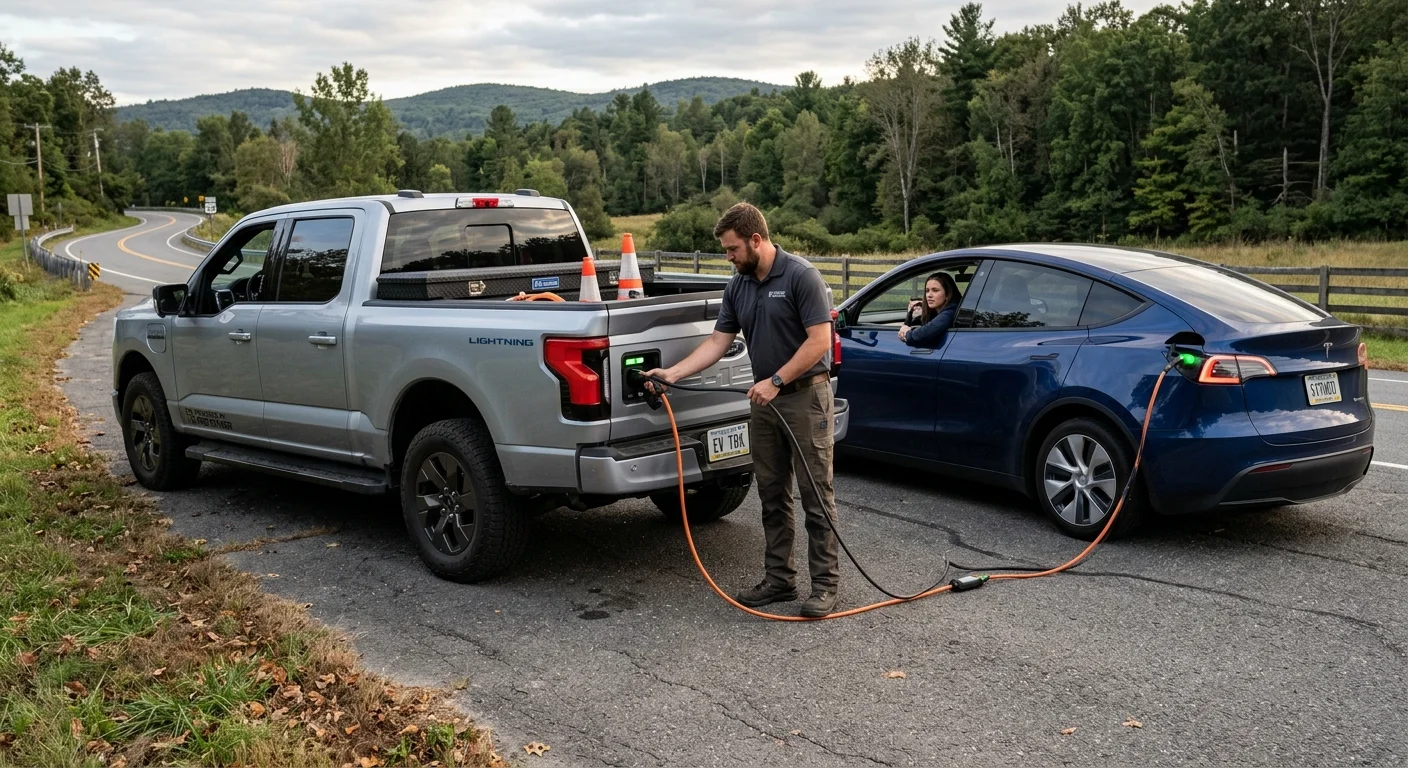
You can charge another EV from a Ford F-150 Lightning. Pro Power Onboard puts AC on the bed and cabin outlets. A portable Level 2 EVSE can feed the other car from that 240-volt receptacle. That’s vehicle-to-load, not a DC handshake. Powering up a stranded car on the Beltway still isn’t a rescue.
Two jobs that look the same from the cab
Work trucks in this metro already carry outlets for saws and compressors. A stalled EV on I-495 looks like the next load.
The American Legion Bridge carries the Beltway between McLean and Montgomery County. The Woodrow Wilson Bridge carries it between Alexandria, Oxon Hill, and the District. Both spans are high and wind-exposed, with limited shoulder. Sharing a cable there is a traffic scene, not a job-site favor.
I-495’s general lanes aren’t the Express Lanes. The 495 Express Lanes sit in the median. Pull to the left shoulder there, not the right. On the 95 and 395 Express Lanes, pull to the nearest shoulder. Transurban’s Express Assist handles minor mechanical issues and will call a tow. It doesn’t tow. Published Express Lanes pages don’t describe EV charging.
Charge Pro DC doesn’t own the Lightning in the next stall.
Pepco serves the District, Montgomery County, and Prince George’s County. Dominion Energy Virginia serves most of Northern Virginia. NOVEC covers parts of Loudoun and Prince William. None of the utility EV pages we reviewed offer a stranded-car charge.
What Pro Power Onboard is sending
Ford sold those outlets for tools, camping loads, and backup. Bed and cabin receptacles put 120-volt and 240-volt AC on tap. A portable EV charger can clip into the 240-volt face.
The path is AC into the other car’s onboard charger. It isn’t a Supercharger session. We couldn’t confirm a publishable kilowatt ceiling on Ford’s site for this page. Read the output rating on the sticker and in that year’s owner’s manual. Lower trims sit near a household outlet. Higher trims sit in portable Level 2 range. None of them are DC fast charging.
Home 240-volt charging vs a roadside top-up is the same voltage class. The Lightning still has to get you home after the share.
The other car has to accept AC. A locked charge port can refuse the plug. A dead 12-volt can leave the dash dark. A fault on the screen can end the session before a mile lands.
Can one EV charge another is the wider question. The Lightning is the truck that makes yes feel obvious. Without the cord kit, you’re only parked.
The kit that has to ride in the bed
A household lamp cord won’t do this. You need a portable EVSE whose plug matches the Lightning’s 240-volt outlet. Many trucks show a NEMA 14-50 face there. Confirm the face on your own bed before you buy anything.
Most non-Tesla EVs take J1772 from that EVSE. A Chevy, Hyundai, Kia, Mach-E, or Volkswagen often plugs in as-is. DOE material shows J1772 and J3400, also called NACS, for AC Level 2. A Tesla still needs the adapter that car actually takes. CCS in that same DOE material is DC fast-charging hardware. Don’t treat a CCS inlet as an assumed AC adapter.
Match the EVSE rating to the Pro Power number in your book. Look at the plug faces before you energize them. Stop if a prong is burned or a cable is cut. Stay with both vehicles until the cable comes out. Don’t walk away from two cars joined on a shoulder.
Why the Beltway is a bad charging office
Pro Power Onboard can move energy. It still does it at portable Level 2 pace, from a pack you need. There’s no verified miles-per-hour figure we can publish for every car. Pack size, cabin climate, and how empty the other EV is all change it. Ford’s rating in your manual is the number you can check.
Watch your own state of charge the whole time. Sharing power spends the Lightning as you sit. After a crawl on I-270 or I-66, those miles are your commute. You can empty yourself next to the person you meant to help.
Cabin heat and AC drain charge without covering distance. That’s the Beltway gridlock problem, and the I-95 standstill. Recurrent Auto studied more than 30,000 EVs in winter. A typical car keeps about 80 percent of range at 32F. At 20F it keeps about 70 percent. Dulles runs colder and snowier than Reagan National.
Snow and a multi-truck crash shut I-95 near Fredericksburg in January 2022. That’s just south of this service area. Hundreds of drivers sat more than 36 hours with the heat on. A bed outlet doesn’t rewrite that night.
On Maryland primary roads, dial #77 for MDOT SHA’s CHART patrol. That covers I-495, I-270, US-50, and MD-295. Published help includes tire changes, jump starts, gas, and radiator water. Those pages don’t describe charging an EV. In Virginia, VDOT’s Safety Service Patrol covers interstates, including I-66. Drivers reach that help through Virginia 511. VDOT describes incident clearance and traffic control, not EV charging. In the District, we didn’t find a DDOT motorist-assistance patrol. District drivers rely on MPD, private plans, and US Park Police on the parkways.
National Park Service parkways here include the Baltimore-Washington and George Washington Memorial parkways. Commercial vehicles and trucks over 10,000 lb are banned. Confirm your truck’s rating before you stop to share power. Report a disabled vehicle on the Baltimore-Washington Parkway to US Park Police. The published number is 202-610-7500.
None of the three local codes we reviewed has a special out-of-charge rule. Disabled-vehicle rules apply to an EV the same as any other car. Out of charge on the Capital Beltway covers the stop itself.
Off the travel lanes, a short share can still help
A driveway in Rockville or a garage in Tysons is a different scene. You’re off the live lanes, and you can watch the cable. They may only need enough to reach a planned stop.
Skip the share if you lack the EVSE or the Tesla adapter. Skip it if your own pack is already thin. Skip it if you can’t stay until the plug comes out. Don’t make the Lightning a daily charger for the building.
Apartment drivers in Arlington, Alexandria, and the District often lack a home plug. A week in airport parking is often a 12-volt story. Reagan National lists EV charging on Level 1 of Parking Garages 1 and 2. Dulles lists Level 2 charging in Garage 1 and Garage 2. A bed outlet won’t wake a car whose 12-volt is gone.
What a rescue operator brings that a work truck doesn’t
The Lightning is the truck you already drove there. Charge Pro DC is a referral line, not a fleet. We match you with independent local mobile rescue operators. We don’t own trucks, employ technicians, or set prices. The operator quotes you before starting and bills you directly. The pros we connect you with are licensed and insured.
Those operators bring a 240-volt Level 2 source to the car. They typically add 10 to 20 miles of range. That takes 15 to 30 minutes of charging, not travel time. Teslas take a native NACS plug. Other brands use a CCS or J1772 adapter. Operators can jump or replace a dead 12-volt on site.
See mobile EV charging when the car is already down. If this Lightning won’t start, begin with the 12-volt checks. Range for the truck itself is a different clock.
If you’re the empty car, or you own the Lightning
Get out of the travel lanes if you can do it safely. On the 495 Express Lanes, pull left. On the 95 and 395 Express Lanes, pull to the nearest shoulder. Put the hazards on and stay in the car until help arrives.
Don’t stand in a lane to aim a plug. Off the live lanes, a Lightning with the kit can offer a short session. If they’re missing the EVSE, the adapter, or spare range, don’t wait.
Call (202) 629-0844 to reach our referral line. We’ll connect you with a local operator who quotes before they start.