A week in airport or Metro parking kills a Ford F-150 Lightning 12 volt. The truck looks dead, but the traction pack is usually still charged. That small battery is what failed, not the pack under the floor.
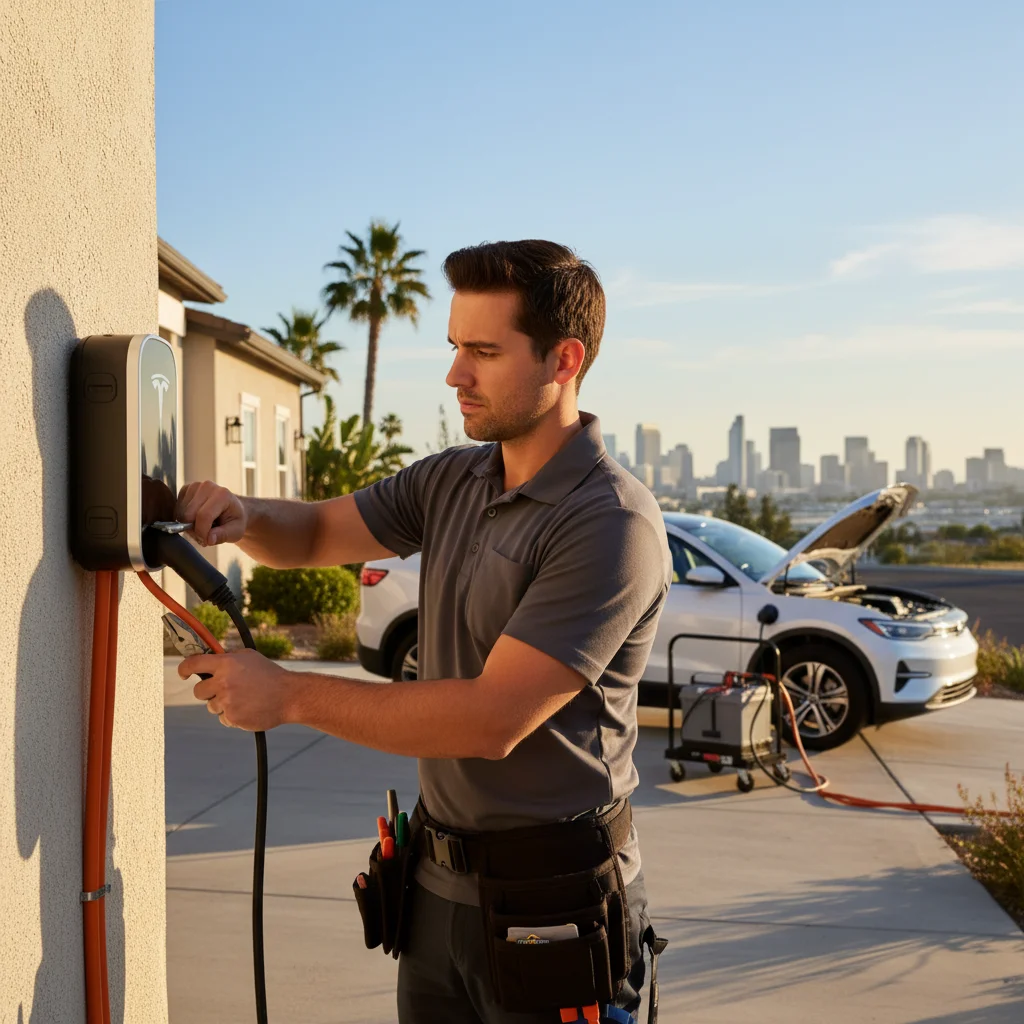
Week-long parking here is what kills the 12 volt
The stall that defines this metro is a return, not a roadside empty pack. You left the Lightning in long-term parking and came back from a trip. The truck won’t unlock, and the screens stay black. Range was never the problem on that kind of sit.
Dulles is the classic version of that call. MWAA publishes Level 2 charging in Garage 1 and Garage 2. Plenty of week-long stays still go to the Economy Lot. It’s the largest on-airport option, and a shuttle meets you at Curb 2F. You walk back to a truck that’s been sipping 12 volt all week.
Reagan National is closer for District and Arlington trips. EV charging there sits on Level 1 of Parking Garages 1 and 2. Those stalls are complimentary for parking customers, and they’re first-come, first-served. A truck that never got a plug still sits dark for days. Modules keep drawing from the auxiliary battery while you fly.
Union Station’s garage is a long-dwell lot for rail trips. WMATA park-and-ride garages around the region repeat that long-sit pattern. Confirm any charger listing on WMATA’s own pages before you count on a plug. The sit drains the 12 volt if the truck never actually charged.
Silver Line parking in Reston collects the same dark-truck returns. Office garages around Tysons do too after travel that started as a workday. The Lightning carries a lot of always-on electronics. “Off” still isn’t zero draw on this truck.
Dulles runs colder and snowier than Reagan National. That’s a real weather split across this metro. Loudoun, upper Montgomery, and Prince William take harder freezes than the inner District core. A weak 12 volt gives up sooner in that cold. The truck may have started fine the morning you parked.
The Lightning can’t use the pack until the 12 volt wakes
This truck has two batteries with different jobs. The traction pack is the high-voltage battery that moves the Lightning. The 12 volt is a small lead-acid unit. It runs computers, screens, locks, lights, and the contactors that connect the pack.
Those contactors won’t close on a dead 12 volt. The truck can’t boot, and it can’t borrow energy from a full pack. You stand there with unused range and a truck that acts like a brick.
Short trips inside the Beltway never give the DC-DC converter time to catch up. A door left slightly open in a Rockville or Gaithersburg garage does the same. So does Pro Power Onboard left in a mode that keeps modules alive. None of that empties the traction pack first.
Ford’s owner’s manual is the source for your year on service intervals. Don’t guess a 12 volt’s age from memory. After a week in a lot, treat that small battery as suspect number one.
Census ACS 2019-2023 figures show why parking habits split. Takoma Park housing is about 90 percent pre-1980. Many of those trucks live in a lot. Ashburn has almost no pre-1980 housing stock. A home circuit is easier to add there. A week at Dulles still kills the 12 volt in both places.
Signs it’s the 12 volt, not the traction pack
A dead Lightning 12 volt has a tight set of tells. You’ll usually get more than one of these:
- The fob or phone app gets no answer, and the truck won’t unlock.
- The center screen and cluster stay black, or they flash once and die.
- The mega power frunk stays shut because the latch needs 12 volt.
- Interior lights are dim or gone, and relays click with no chime.
- You plug in and nothing starts because the truck never initializes.
A pack problem looks like a different truck. Screens usually come up on a pack problem. You see a low-range warning or reduced power. You may also find that drive won’t engage. If the Lightning wakes and still won’t move, start with this 12 volt trip guide. That piece separates a dark truck from an empty pack.
The frunk latch is electric, so a dead 12 volt traps the jump points
Ford put the 12 volt battery and the jump terminals in the frunk. That’s a problem when the latch has no power. You can’t reach the posts until the lid opens.
The Lightning has a manual frunk release for this exact failure. It’s a mechanical pull, not an electric switch. Some years use a tab, and some use a cable. Check the owner’s manual for your truck before you start peeling trim. The spot isn’t identical on every model year.
With the frunk open, look for dedicated jump terminals. Ford doesn’t want you on the battery posts themselves. Find the positive terminal under a red cap. The negative is a ground stud or a body bracket nearby. You connect a 12 volt donor or jump pack there. It’s the same idea as a gas F-150.
You’re only reviving the low-voltage system on this truck. Stay away from the orange high-voltage cables under the hood. If the labels are unclear, stop and wait. A non-Tesla EV rescue operator can make those connections. The EV 12 volt jump guide covers cable order. It also flags the mistakes that damage modules.
An empty pack needs a charge, not a jump
Sometimes the Lightning really did run the traction pack to zero. A 12 volt jump won’t create miles. The truck needs energy in the big battery before it can drive anywhere.
That’s a charging visit, not a jump. Independent operators in this network bring a 240 volt Level 2 source to the truck. For a Lightning they use a CCS or J1772 adapter. A typical stop adds 10 to 20 miles of range. That takes 15 to 30 minutes of charging. That window is charge time on the truck. It isn’t an arrival time for the operator.
If the pack is flat, use out-of-charge recovery to get matched. They quote you before they start, and they bill you directly. Charge Pro DC doesn’t set the price and doesn’t own the equipment.
Pepco, Dominion Energy Virginia, and NOVEC publish home EV programs. None of the utility EV pages reviewed offer stranded-truck charging. A home rate won’t wake a Lightning in Economy parking.
Highway patrols can jump a 12 volt, not the pack
On a Maryland primary road, MDOT SHA CHART is the published patrol. Dial #77 on I-495, I-270, US-50, or MD-295. CHART’s listed help includes tire changes and jump starts. It doesn’t list EV charging on those pages. A CHART jump may wake the 12 volt. It won’t refill an empty pack on its own.
VDOT’s Safety Service Patrol covers Virginia interstates, including the I-66 corridor in Northern Virginia. You reach that help through Virginia 511 from the truck. Published duties are incidents, debris, and short-term traffic control. The pages don’t describe charging an EV at all.
No DDOT motorist-assistance patrol turned up in the sources reviewed for the District. DC drivers use MPD, a private roadside plan, or US Park Police on the parkways. A disabled vehicle on the Baltimore-Washington Parkway is reported to US Park Police at 202-610-7500. Those parkways have narrow or missing shoulders in places. Stay with the truck when it’s safe to do so.
Disabled-vehicle rules in DC, Maryland, and Virginia were reviewed for this page. None of the three codes had a provision for an empty EV pack. A Lightning that won’t start is treated like any other disabled vehicle. The 12 volt still has to be fixed on site.
Who actually shows up, and what they can do
Charge Pro DC is a referral line for stranded drivers. It matches stranded EV drivers with independent local mobile rescue operators. It doesn’t hold a trade license of its own. It owns no trucks, employs no technicians, and publishes no hours.
The operator tests the 12 volt first on site. If it’s only discharged, they jump the published terminals and let the truck wake. The DC-DC converter can then recharge the 12 volt off the traction pack. If the battery won’t hold a charge, they can replace it on site.
If the pack is empty, they connect Level 2 power. That adds enough miles to get you rolling. They don’t install home chargers at your house. They don’t rewire Pro Power Onboard on the truck. A wiring fault is a licensed electrician’s job.
Work Lightnings sit near Dulles in Ashburn, Sterling, and Herndon lots. Commuter trucks sit in Arlington garages and District structures. Apartment blocks in Wheaton, Hyattsville, and Annandale often lack a home plug. After a week in a garage, the 12 volt still fails there too.
The same long-sit pattern shows up in a car that won’t wake at Dulles. The badge can be Tesla or Ford on that call. The 12 volt doesn’t care which badge it is.
If your Lightning won’t start, call (202) 629-0844. We’ll help you sort a 12 volt failure from an empty pack. The operator who takes the job quotes you before any work starts.
Frequently asked questions
Why won’t my Ford F-150 Lightning start when the pack is full?
A full charge lives in the traction pack. The truck still needs a healthy 12 volt to boot computers and close contactors. If that small battery is drained, nothing wakes. A jump on the published terminals is usually what brings it back.
How do I open the Lightning frunk with no power?
The mega power frunk latch is electric on this truck. A dead 12 volt leaves that latch shut. Ford includes a manual release, a mechanical tab or cable, for this. Your owner’s manual shows the spot for your year. After the lid is up, you can reach the jump terminals.
Can I jump a Lightning the way I jump a gas F-150?
Yes, with one hard limit: you only revive the 12 volt. Use the dedicated positive post under the red cap and the nearby ground. Never clip onto the orange high-voltage cables on this truck. If you can’t tell the terminals apart, stop and wait for the operator.