A Ford F-150 Lightning doesn’t have one charging time. In this metro you plan around three clocks. Overnight 240-volt at home is the daily fill. A public DC stall is the trip clock. A roadside Level 2 visit is the stranded clock. Operators we connect you with typically add 10 to 20 miles. That takes 15 to 30 minutes of charging at the bumper. Those minutes are plug time, never an arrival window.
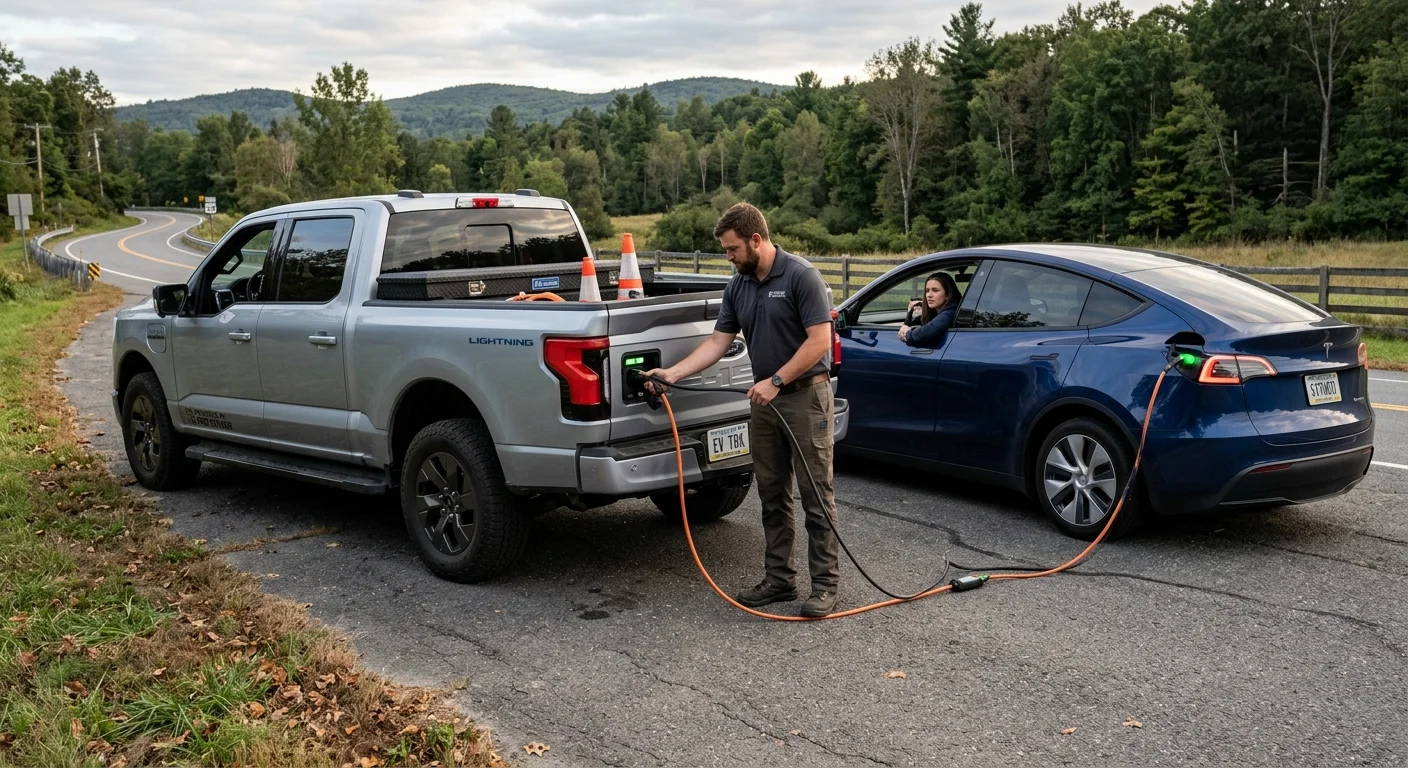
The stranded clock is 15 to 30 minutes
If the pack hits empty on I-270, you aren’t filling the truck. You’re buying enough range to reach a plug you already know. Mobile EV charging is that on-site 240-volt visit. The operator brings a 240-volt Level 2 source to the port. Confirm the Lightning’s inlet and any adapter before they plug in. A typical session adds 10 to 20 miles of usable range. That takes 15 to 30 minutes of charging at the bumper. Charge Pro DC doesn’t own trucks, chargers, or a yard. We match stranded drivers with independent local operators. The operator quotes you before work starts and bills you directly. Non-Tesla EV rescue is the Ford side of that same referral line.
On the 495 Express Lanes, pull over to the left shoulder. Those lanes sit in the median, not the right edge. On the 95 and 395 Express Lanes, use the nearest shoulder. Stay in the truck until help is actually there.
A stall on the Woodrow Wilson Bridge sits at three jurisdictions. Alexandria, Oxon Hill, and the District meet on that span.
Ford’s numbers live on Ford’s sheet
How long a Ford Lightning takes at a rated stall is a Ford figure. Ford publishes times by battery pack and by charger type. Those minutes weren’t frozen on this page. Model years change, and Ford updates the spec sheet. Open Ford’s current Lightning specifications for your exact truck. Use the owner’s manual for the port, the onboard charger, and any DC notes.
The U.S. DOE Alternative Fuels Data Center is the general rule. Charging time depends on state of charge and battery capacity. It also depends on battery type and onboard charging capacity. Equipment output and electrical service change the clock too. A Lightning is a full-size truck pack. Don’t borrow a compact-car hour count and call it yours.
Ford has sold more than one Lightning battery. The larger pack holds more energy. A home fill on that pack takes more total hours. A public DC stop is usually a percent window, not a 0-to-100 fill. Confirm the exact window on Ford’s current sheet.
Overnight 240 volt in this housing stock
A 120-volt household outlet is Level 1. DOE puts typical Level 1 around 5 miles of range per hour. That example is for mid-size EVs. A Lightning pack is larger than that class. Treat the wall outlet as a trickle, not a work-truck plan.
Level 2 is 240-volt AC at home, or 208-volt in many commercial garages. DOE lists Level 2 equipment from about 2.9 to 19.2 kW. Residential gear often lands well below the top of that band. Ford publishes home hours by pack on its spec pages. Check those hours for your truck. Home 240-volt charging vs a roadside top-up covers that split.
Pepco serves the District, Montgomery County, and Prince George’s County. Its EV program is Pepco EVsmart. Dominion Energy Virginia serves most of Northern Virginia. Named programs include Schedule 1EV. NOVEC covers parts of Loudoun and Prince William. That includes much of Sterling, Ashburn, and Gainesville. Confirm the serving utility by address. None of the utility EV pages we reviewed offer a stranded-car charging service.
Older housing is where a 240-volt circuit often never got installed. About 90.0 percent of Takoma Park housing predates 1980. Annandale is about 79.8 percent. Ashburn is about 3.1 percent pre-1980. Arlington, Alexandria, Silver Spring, Wheaton, Hyattsville, and Annandale also concentrate apartments. If the building never got a home plug, overnight Level 2 isn’t your clock. The roadside visit is.
A licensed electrician has to judge the panel. Charge Pro DC doesn’t install home chargers. We don’t hold a trade license. Confirm Pepco or Dominion EV programs on the utility site.
Public DC is a trip clock, not a rescue truck
Public DC fast charging is the trip clock. It isn’t what a mobile operator brings to the bumper. Operators in this network bring Level 2 240-volt AC. They don’t roll up a corridor DC stall.
Ford’s rated DC time only holds when the stall delivers rated power. It also needs a pack in a workable temperature window. A cold pack in Loudoun or upper Montgomery accepts power more slowly. Dulles runs colder and snowier than Reagan National. That’s a real local split.
EVs taper as the pack fills. A percent climb near the top can take as long as the middle. Confirm Ford’s published endpoint for your year. This page doesn’t map public stalls. It doesn’t guess how far the next one sits.
Dulles has Level 2 charging in Garage 1 and Garage 2. MWAA published no EV charging in the Economy Lot. The Terminal Lot and Valet are the same. A week in the Economy Lot is often a 12-volt story. The traction pack may still hold energy while the small battery is dead.
What stretches a Lightning session here
Cabin heat comes from the pack. Recurrent Auto studied more than 30,000 EVs in winter. A typical EV keeps about 80 percent of range at 32F. At 20F that drops to about 70 percent. Most lose 20 to 35 percent in real cold. That study is typical-EV, not a Lightning-only spec. A cold pack also takes DC power more slowly.
Sitting still with heat or AC on burns charge without covering miles. That’s the Beltway crawl and the I-95 standstill. On January 3 and 4, 2022, about 14 inches of snow hit I-95. A multi-truck crash shut roughly 50 miles near Fredericksburg. Drivers sat more than 36 hours. Climate control the whole time is an idle-drain lesson, not a miles lesson.
Climbs on I-270 toward Frederick cost range. So do westbound pulls in Loudoun and Prince William toward the Bull Run Mountains. Starting a DC session already high in the pack adds fewer miles.
When the truck won’t take a charge
If the session never starts, you may not have a charging-time problem. A Lightning that won’t wake is often the 12-volt battery. Locks, computers, and contactors sip from that small battery. The traction pack can still hold energy while the truck stays dark. Ford F-150 Lightning won’t start: the 12 volt fix walks the checks. Operators we connect you with can jump or replace a 12-volt on site.
Charging another stranded EV is a different Lightning feature. See Can your F-150 Lightning charge another stranded EV.
If you stall on a DC-area road
VDOT Safety Service Patrol covers Virginia interstates including I-66 and I-95. Drivers reach that help through Virginia 511. It doesn’t describe EV charging.
MDOT SHA CHART Emergency Traffic Patrol works the Baltimore/Washington area on state primary roadways. That includes I-495, I-270, US-50, and MD-295. Dial #77 from those Maryland roads. Published help is tire changes, jump starts, about a gallon of gas, and radiator water. CHART pages we read don’t describe charging an EV pack.
No DDOT motorist-assistance patrol turned up in the sources we reviewed. District drivers use MPD, private plans, and US Park Police on the parkways. Report a disabled vehicle on the Baltimore-Washington Parkway to US Park Police at 202-610-7500.
For the I-270 pattern between Rockville and Germantown, see Out of charge on I-270. Rockville’s local landing page is EV charging in Rockville.
If the truck is in a travel lane, call 911.
Charge Pro DC serves the District, Maryland, and Virginia in this metro. Call (202) 629-0844 to be matched with an independent operator. We don’t promise when anyone arrives. Ask the operator to confirm the Lightning and the port. Confirm the quote and the charging time they can actually run. The pros we connect you with are licensed and insured.
Frequently asked questions
How long does a roadside 240-volt stop take on a Lightning?
Operators we connect you with typically add 10 to 20 miles of range. That takes 15 to 30 minutes of charging at the bumper. That window is cable time, not travel time. It isn’t a full charge. It’s enough to leave a shoulder or a garage and reach a plug you already picked.
How long does home charging take on a Ford Lightning?
Ford publishes home times by pack on its current spec pages. Those hours weren’t frozen here. A 120-volt outlet is a trickle on a truck pack this size. Overnight 240-volt Level 2 is the daily clock when the house has a circuit. Confirm the hours for your pack on Ford’s sheet.
Does cold weather slow a Ford Lightning charge?
A colder pack generally accepts DC power more slowly. Dulles runs colder than Reagan National. Loudoun, upper Montgomery, and Prince William see harder freezes than the inner core. Recurrent Auto’s typical-EV study found about 80 percent of range retained at 32F, and about 70 percent at 20F. A roadside 240-volt session still runs 15 to 30 minutes of charging. Cold can change how many miles that window adds.