Tesla 12v battery failure here often starts after a week in the Dulles Economy Lot. You fly out, park long-term, and take the shuttle from Curb 2F. You come back to a Tesla that won’t unlock, light up, or answer the app. The traction pack can still hold a healthy charge. The small 12-volt battery is what died while you were gone.
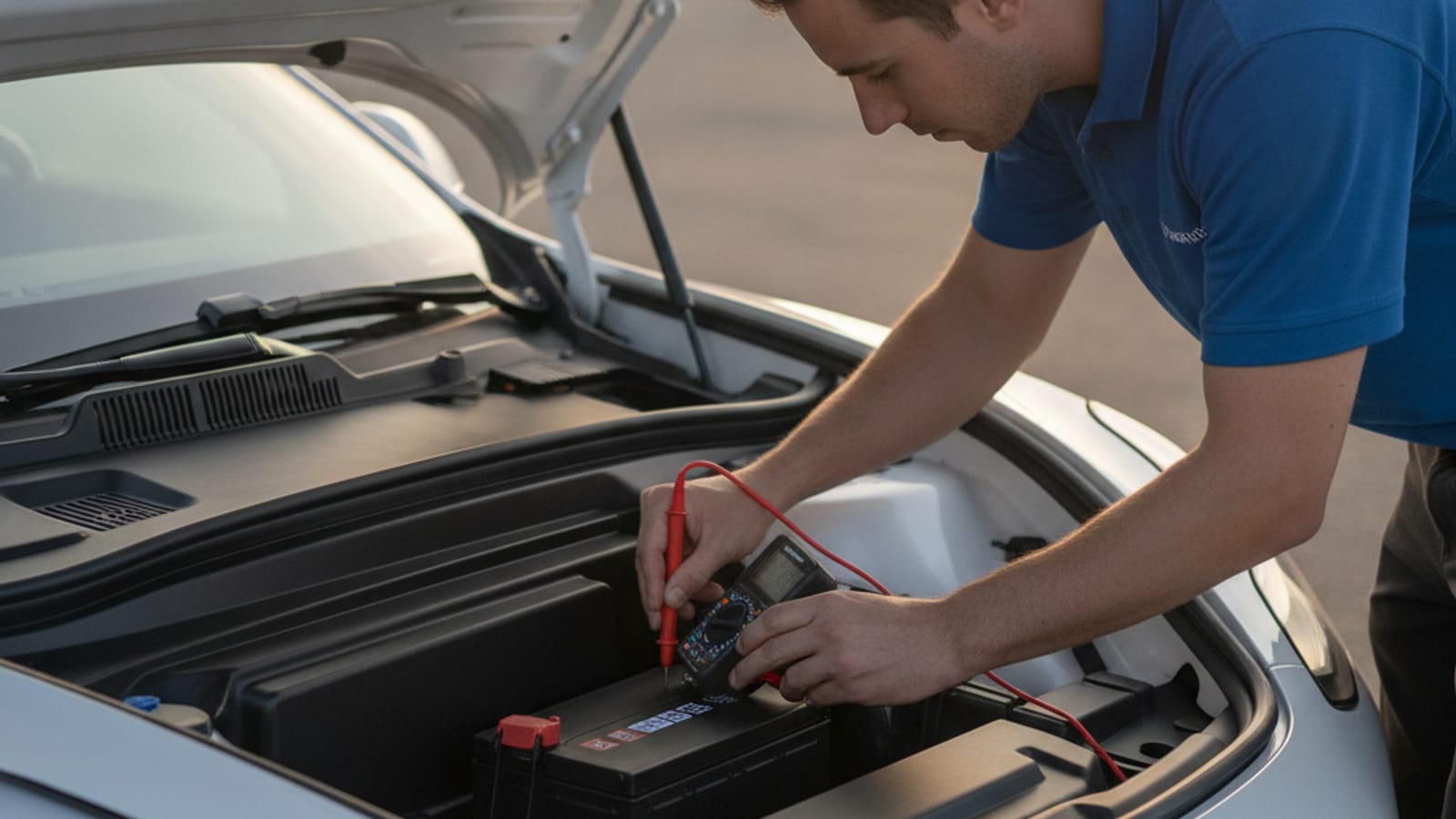
The 12-volt is what wakes the car
A Tesla has no starter motor. The 12-volt pack still runs the car’s low-voltage brain. It feeds door handles, the trunk latch, the display, and the modules that talk to your phone. It also powers the relay that lets the high-voltage pack feed the motors.
If that relay stays open, the big pack can’t help you. A high reading on the traction battery doesn’t matter. The car stays dark until the 12-volt side comes back.
Older Model S and Model X cars use a lead-acid 12-volt. Many newer Model 3 and Model Y cars use a lithium 12-volt. Lead-acid units wear out sooner on a long sit. Lithium units hold a park better, but they still fail. For the layout by model, see Do Teslas have a 12-volt battery? A model-by-model guide.
A week in the Dulles Economy Lot
Metropolitan Washington Airports Authority publishes charging in Garage 1 and Garage 2 at Dulles. Those garages are the close-in product. The Economy Lot is the large long-term lot. You park, you leave, and the car sits.
That week in Economy parking is how tesla 12v battery failure shows up in this metro. The 12-volt isn’t getting a top-up from a plug while you’re away. Sentry Mode, cabin preconditioning, and even a quiet parked car still draw from that small pack. You return to flush handles and a black screen.
If you want the airport-lot walkthrough, read Mobile Tesla charging when yours won’t wake at Dulles. Drivers coming through the Town of Herndon hit this after a work trip more than after a short hop. Ashburn and Sterling sit on the same Dulles side of Loudoun.
Reagan National is a different sit. Charging there is on Level 1 of Parking Garages 1 and 2, first-come, first-served. MWAA has been expanding electrical capacity at National in 2026. A short DCA stay is less of a 12-volt story. A week in Dulles Economy parking is the one that keeps this line busy.
You may have driven in on VA-267, the Dulles Toll Road, which MWAA operates. West of the airport, the Dulles Greenway is a separate private toll road. Those roads get you to the lot. They don’t keep the 12-volt alive once you lock the car and walk to Curb 2F.
Union Station’s garage is the same long-dwell pattern in the District. WMATA park-and-ride decks across the metro are too. Confirm charging on that garage’s own page before you count on a plug.
Ashburn’s housing is mostly post-1980, a home-charger proxy that still won’t cover a week at Dulles.
Cold at Dulles is not National weather
Dulles runs colder and snowier than Reagan National. Loudoun, upper Montgomery, and Prince William take harder freezes than the District and the inner Virginia core.
Lead-acid 12-volt packs lose punch in the cold. A car that sat through a freeze in Economy parking is a worse wake-up. Herndon, Ashburn, and Sterling sit on that colder western side.
Cabin heat on a moving Tesla pulls from the traction pack. A parked Tesla in a freeze still leans on the 12-volt for modules that stay half awake. The two failures look similar from the sidewalk.
Dark car versus a failed pack
A high-voltage pack problem usually still lets the car talk. You may see a warning, a range crash, or a limp-mode message. The display still comes on.
A dead 12-volt is quieter. Handles, screen, and app handshake all go dark. Owners often assume the traction pack died. It usually didn’t.
If a jump on the 12-volt port wakes the car, and the pack shows a normal percent, you found the fault. That’s the split we walk people through on the phone. For the longer diagnostic, see Tesla 12 volt is dead: how to diagnose it and jump it and Tesla won’t wake: 12 volt battery or high-voltage pack.
Watch the Tesla app before you leave town. A “12V battery low” push is the early tell. If you see it, don’t park for a week and hope.
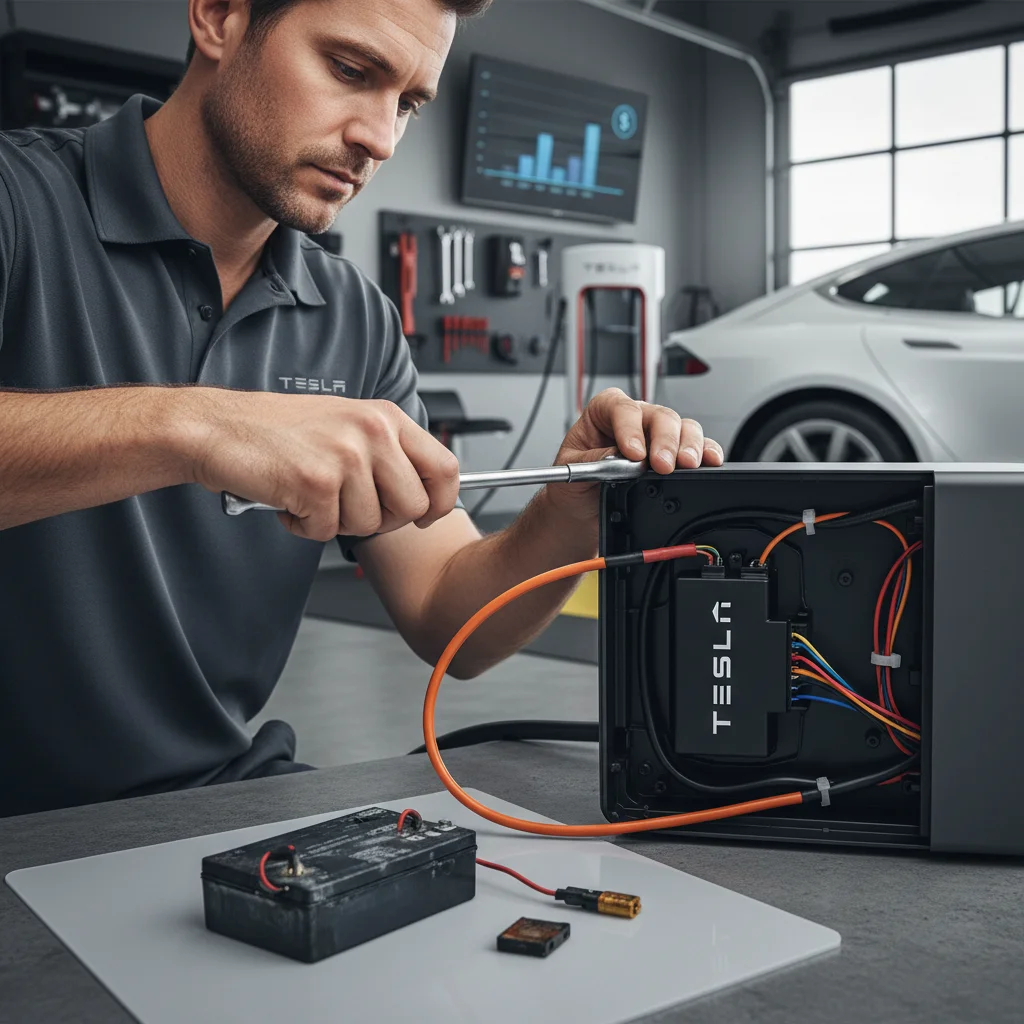
What to try on the lot
Tesla puts a 12-volt jump point under the hood on most models. On Model 3 and Model Y, it’s toward the front right. On Model S and Model X, look in the frunk near the firewall.
Use a standard 12-volt jump pack on those posts. Don’t put clamps on the charge port. Don’t try to feed the traction pack from another EV. The charge port isn’t a jump point.
A successful jump is a test, not a repair. The car may unlock and the screen may return. Pull the pack off those posts and a weak 12-volt often dies again. Plan on a replacement, not a second jump later in the week.
The Economy Lot is airport property, not a VDOT interstate shoulder. VDOT’s Safety Service Patrol covers Virginia interstates and takes reports through Virginia 511. Published material describes debris, incidents, and short-term traffic control. It doesn’t describe charging an EV, and it isn’t a parking-lot 12-volt call.
If you stall on a Maryland state road instead, MDOT SHA CHART can send an Emergency Response Technician. They publish jump starts and tire changes. Dial #77 on roads like I-495 and I-270. Dulles Economy parking isn’t that program.
The District has no DDOT motorist-assistance patrol in the material we reviewed. Inside the District you’re on MPD, a private plan, or U.S. Park Police on the parkways.
Who actually does the work
Charge Pro DC is a referral line. We match you with independent local mobile rescue operators. We don’t own trucks. We don’t employ technicians. We don’t set prices. The operator quotes you before any work starts, then bills you directly.
The pros we connect you with are licensed and insured. They can jump a dead 12-volt on site, or replace it on site when that’s the right call. They can also bring a 240-volt Level 2 source if the traction pack is actually empty. Native NACS on Tesla. CCS or J1772 adapters for other EVs. Typical charging time is 15 to 30 minutes for about 10 to 20 miles of range. That’s plug time, not a promise of when someone arrives.
Pepco, Dominion Energy Virginia, and NOVEC publish home-charger programs. None of the utility EV pages we reviewed offer a stranded-car charge.
If the 12-volt is the fault, a tow is the long way around. Virginia private-property towing rules apply when a lot calls a wrecker. Confirm the lot’s process before you authorize a hook. None of the three codes we reviewed has a special rule for a dead EV 12-volt. Disabled-vehicle rules apply the same as any other car.
For the trip-wide version of this stall, see What happens when an EV 12 volt dies in a garage or airport lot. If you already know you need the 12-volt worked on site, start at Tesla 12-volt battery jump.
After a jump, replace the 12-volt
Once the car is awake, don’t treat it as fixed. A failed 12-volt will drop again. Get it replaced before the next long sit.
We can’t publish a parts price from here. No verified installed figure turned up that we can stand behind. Tesla service, an independent shop, and a mobile operator all quote their own numbers. Ask for the spec first: lead-acid versus lithium. Then ask what the visit includes. The operator you’re connected with tells you the number before they start.
If the car wakes and the traction pack is truly empty, that’s a different job. Then you want a 240-volt top-up, not only a 12-volt jump.
Frequently asked questions
How do I know the 12-volt is the problem?
The car is fully dark and the app won’t connect. A 12-volt jump wakes it, and the pack percent looks normal. A traction-pack fault usually still shows a screen and a warning.
Can I jump a Tesla from another car?
You can use another car’s 12-volt, or a jump pack, on the Tesla 12-volt posts. Stay off the charge port. Don’t try to share traction packs. If you aren’t sure of the posts, wait for an operator.
Does a jump in the Economy Lot finish the job?
No. A jump proves the 12-volt failed. It doesn’t give you a healthy battery. Plan a replacement on site or at a shop before you park long-term again.
If the car is dark in that lot, call (202) 629-0844. We’ll help you sort a 12-volt failure from an empty pack, then connect you with an operator who quotes the work first.