The right call is a live, compatible rapid charger you can actually reach. An “ev rapid charger near me” listing is only a starting point. The stall has to work and match your plug. The route has to fit the range you still have. Beltway traffic, a garage spiral, or a dying 12-volt can wipe that buffer. Then a mobile 240-volt visit from a local operator is the better call.
A map pin isn’t a live stall
Station addresses, access rules, and operating status change. Confirm those details before you spend what’s left in the pack. Start with the operator’s own app or site, then compare it with your car’s navigation. An aggregated map can surface options, but it can’t prove the cabinet still works today.
Match the connector to the vehicle. The US Department of Energy lists CCS, CHAdeMO, and J3400 as DC fast-charging types. Your EV may not accept every one. An adapter doesn’t make every charger compatible. Follow the manufacturer’s guidance for your port.
Treat a green available icon as a hint, not a hold. Another driver can take the stall while you’re still on I-270. The screen, cable, or payment reader can fail after you arrive. Check that the plug matches and that you can enter the property. Skip customer-only or employee-only cabinets. Make sure the car’s estimate covers the full route, with a buffer.
If you still have planning time, save more than one compatible stop. That habit is in our guide to EV charging apps to open before you’re actually stranded.
Beltway miles aren’t map miles
A pin across I-495 can look close on a map. In the car it can be a full loop. Count the exit, the lights, and the return. Do the same on I-66, I-270, and I-95. Ramps and surface streets use range the highway estimate may skip.
The 495 Express Lanes sit in the median. If you go empty there, pull to the left shoulder. On the 95 and 395 Express Lanes, use the nearest shoulder and stay in the car. Transurban’s Express Assist patrol helps with minor mechanical issues and can call a tow. It doesn’t tow, and published material doesn’t describe charging an EV.
A stop on the Woodrow Wilson Bridge sits where Alexandria, Oxon Hill, and the District meet. The American Legion Bridge does the same between McLean and Montgomery County. Both spans are high and wind-exposed, with limited shoulder. Don’t spend the last percent crossing either one to chase a listing.
NPS parkways here have narrow or missing shoulders. That includes the Baltimore-Washington, George Washington Memorial, Clara Barton, Rock Creek, and Suitland Parkways. Commercial vehicles over 10,000 lb are banned on those roads. Report a disabled vehicle on the Baltimore-Washington Parkway to the US Park Police at 202-610-7500.
Garage listings need the same hard look. A pin at Tysons Corner Center or a Silver Line lot can sit several levels in. Confirm the entrance, the height limit, and the path back out. Resident-only stalls show up in Arlington and Alexandria apartment parking. In the District, include the quadrant, because NW and NE numbers repeat. Check the exit path before you burn the buffer. A stall that’s easy to enter can dump you the wrong way on I-270.
Idle time drains the pack without covering miles. Cabin heat and AC come from the traction battery. Beltway gridlock burns charge while the car sits. In winter, a typical EV keeps about 80 percent of range at 32F. At 20F it’s about 70 percent, per Recurrent Auto’s study of more than 30,000 EVs. Dulles runs colder and snowier than Reagan National. Loudoun and Prince William feel that cut more than the inner core.
If the pack is already very low, pick the stall you can reach and use. For the freeway version of this bind, read out of charge on the Capital Beltway.
Confirm the car can still take a charge
Treat the dash range as an estimate. Add every ramp, turn, and garage aisle. If that route leaves no buffer, keep driving and you may stop short.
Read the warnings first. Reduced power, a charge-system fault, or a locked port isn’t an empty-pack problem. A dark screen or doors that won’t unlatch often point to the 12-volt battery. A public rapid charger won’t wake a car that can’t close its contactors.
The long-dwell pattern is common after flights and Metro days. Travelers leave an EV at Reagan National or Dulles, then return to a car that won’t wake. At DCA, MWAA puts EV charging on Level 1 of Parking Garages 1 and 2. It’s for parking customers. At Dulles, MWAA publishes Level 2 charging in Garage 1 and Garage 2. A week in long-term parking often comes back as a 12-volt call.
If you arrive and the stall fails, note the screen text and where the session stopped. Don’t hop between uncertain cabinets on the last percent.
Pepco, Dominion Energy Virginia, and NOVEC publish home and site EV programs. None of those pages offer a charge for a car that’s already stopped. MDOT SHA’s CHART patrol can jump a 12-volt. That covers roads such as I-495, I-270, US-50, and MD-295. Dial #77 from those Maryland routes. CHART’s published help doesn’t include charging a traction pack. VDOT’s Safety Service Patrol covers Virginia interstates, including I-66 and I-95. It describes incident clearance, not EV charging.
When a mobile 240-volt visit beats the hunt
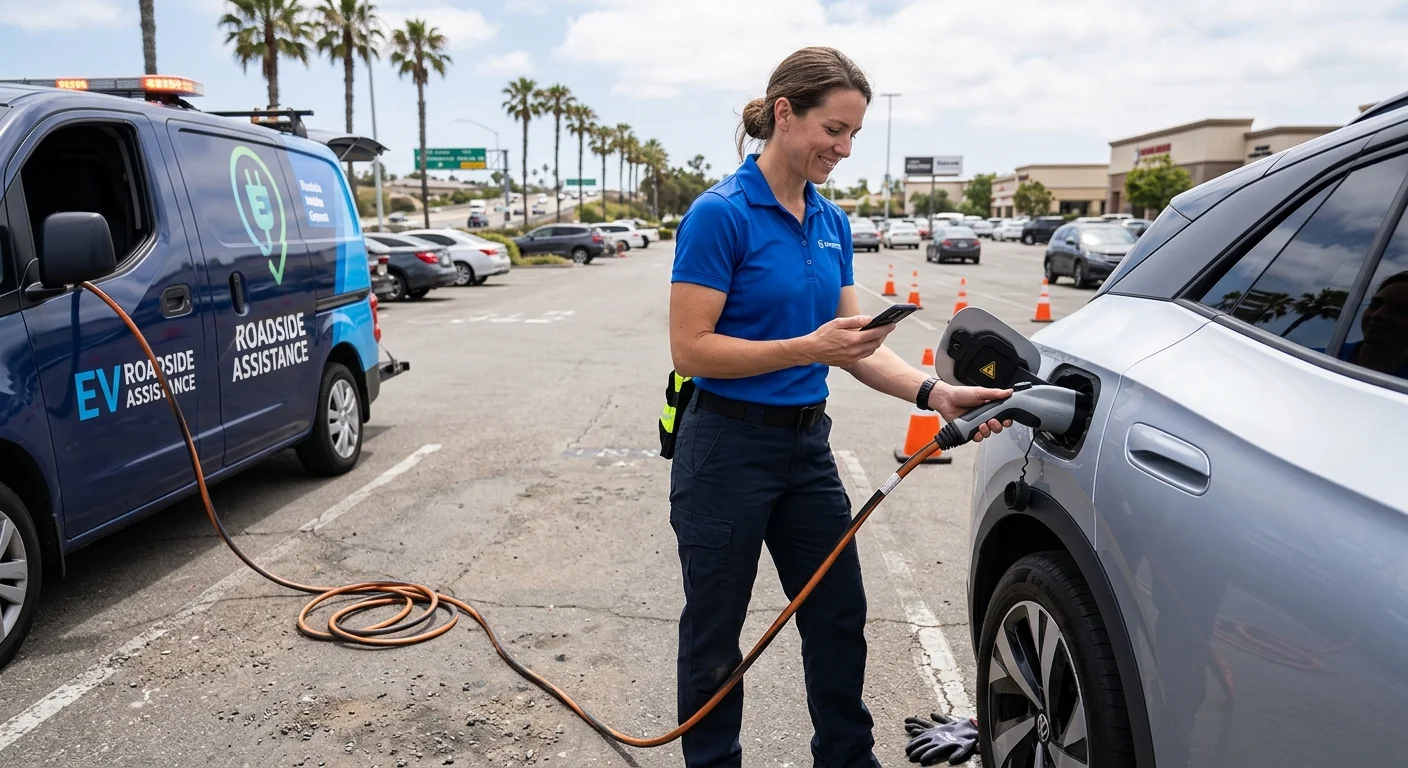
Mobile charging fits when the car sits in a safe, legal spot and the pack is too low to gamble on a maybe. An independent operator can feed the port on site. The usual goal is 10 to 20 miles of range in 15 to 30 minutes of charging time. That’s charging time, never an arrival time. It’s enough to reach a confirmed station or a home plug, not a full session.
Operators bring a 240-volt Level 2 source. Tesla ports take a native NACS plug. Other EVs typically use a CCS or J1772 adapter. Those same operators can jump or replace a dead 12-volt on site. Charge Pro DC is a referral line. We match you with independent local mobile rescue operators. We don’t own trucks, employ technicians, or do the work. The operator quotes you before starting and bills you directly.
Before you ask for mobile EV charging, have the year, make, and model ready. Include the dashboard message, battery percent, and port type. Give an exact pin, plus any gate or height limits. Say whether the car can shift, steer, and unlock.
“Near Tysons” isn’t a location. Give the garage name, the level, and a pin. On the Beltway, give the route, direction, and nearest exit. Say if you’re in the Express Lanes. In the District, include the quadrant.
This call is common where a home plug isn’t part of the building. Pre-1980 housing shares are high in Takoma Park, Annandale, Wheaton, and Washington. A mobile visit meets the car where it sits.
Mobile charging may not fit when the port is damaged or the car refuses power. It also doesn’t fit in a live travel lane. Describe what you see. Don’t guess the cause. The operator will say whether a 240-volt visit matches the job. See what’s an EV charging truck, and who actually owns it.
When a tow is the honest next step
Transport fits when charging won’t fix what’s in front of you. That includes a car that won’t accept power, a stuck charge port, or visible collision damage. It’s also the safer choice when the EV has already stopped in a live lane.
An empty pack and a dead 12-volt can look the same from the seat. Share the symptoms, and don’t request a charger or a rollback on a guess. Our comparison of mobile EV charging or a tow lays out that fork.
If every verified compatible stall sits behind more driving than the car can do, stop hunting pins. Move to a safe legal spot if the car can still roll. If it can’t, don’t push it.
If a tow is the plan, follow the manufacturer’s loading steps. Charge Pro DC doesn’t tow. Through out-of-charge recovery, we can connect you with an independent local operator. Confirm the work, the quote, and the destination before you agree.
If you’re already stopped
Stay with the car. On the 495 Express Lanes, that means the left shoulder. On the Baltimore-Washington Parkway, call US Park Police if you’re disabled. Then choose based on what the car can still do, not on the closest map pin.
If a confirmed rapid charger is in range and the car can use it, go there. If Beltway traffic makes that a gamble, ask for a quoted mobile 240-volt visit instead.
Call Charge Pro DC at (202) 629-0844 and we’ll connect you with an independent local operator. We don’t promise when someone arrives. The operator does the work, and they quote you first.