Apps for EV charging show a stall on I-66 or the Beltway. They don’t send a 240-volt truck onto a National Park Service parkway. Open those apps while you still have range to spend. Once the pack is empty, a pin is only a map.
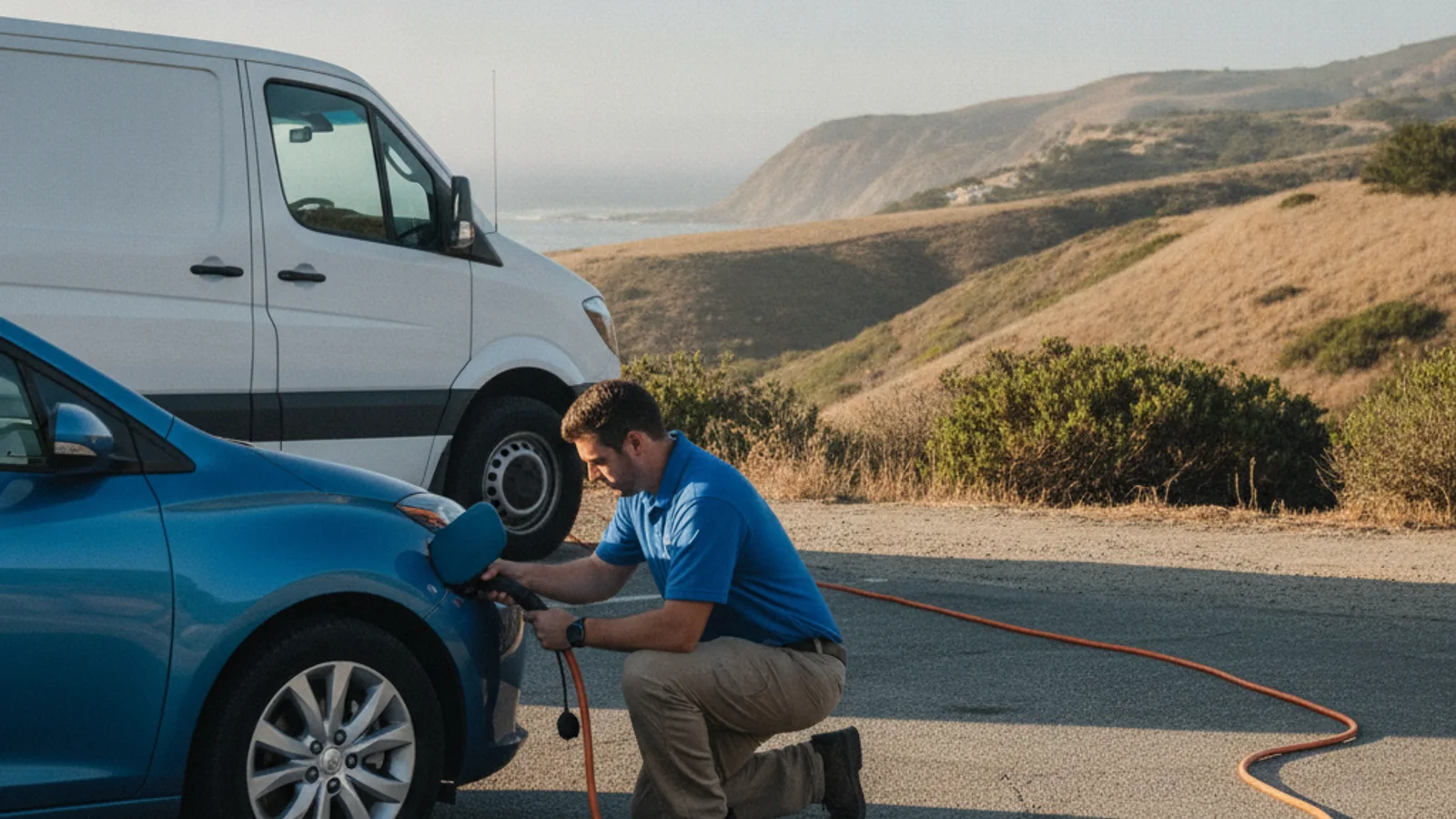
Maps find a stall, not a 240-volt truck
Drivers look up apps for EV charging to keep a trip moving. An app lists equipment someone else owns and maintains. A mobile rescue brings a 240-volt source to the car you already parked. Mixing those jobs up wastes the last miles.
Charge Pro DC is a referral line for this metro. We match stranded EV drivers with independent local operators. We don’t own trucks, and we don’t employ technicians. We don’t set prices or publish arrival times. The operator quotes you before work starts, then bills you directly.
Pepco serves the District, Montgomery County, and Prince George’s County. Dominion Energy Virginia serves most of Northern Virginia. NOVEC, BGE, SMECO, and the City of Manassas cover other pockets. Confirm the serving utility by address, because their EV pages publish home programs. Pepco publishes EVsmart as its home EV program. Dominion publishes Schedule 1EV and an Off-Peak Plan. None of those pages describe charging a car that’s already stuck.
VDOT’s Safety Service Patrol works Virginia interstates, including I-66. Published VDOT material covers incidents and debris, not charging a stranded EV. CHART covers Maryland roads such as I-495, I-270, and US-50. Dial #77 for a breakdown on those state roadways. CHART lists tires, 12-volt jumps, and about a gallon of gas, not pack charging. No DDOT motorist-assistance patrol turned up in the District sources used here.
What to open, and in what order
Start with the app your automaker built for your vehicle. It talks to the car you’re sitting in. That lets it use your real state of charge. A public map only knows where stalls were reported. It doesn’t know how your pack is doing right now.
We’re not going to name a maker’s app or list current features. Your owner’s manual or the automaker’s site is the source that stays current. If you’re not sure the car has an app, ask a dealer service desk.
Treat the in-car suggestion as a plan, not a proof. It can point you toward a stop on your route. It can’t promise a specific plug is free when you arrive.
That check matters more once you’re committed to a long corridor. A hop across Arlington or Alexandria still lets you change the plan. A run west on I-66 toward Centreville or Gainesville spends those miles either way. So does I-270 through Rockville and Germantown as the land rises toward Frederick. The routing idea is more useful on those longer runs. It’s also more costly if the listing is stale.
Next, open the network app for the hardware you actually expect to use. Those tools show that network’s own stations and status. One network app doesn’t see another network’s stalls. The Beltway, US-50 toward Bowie, and MD-295 mix networks. You may need two or three apps, not the one you always open. Check that network’s own site if you need its current feature list.
Then use an aggregator if you want several networks in one view. A pin on that map is still not a promise. A listed stall can be occupied, broken, or taken out of service. A three-week-old comment describes one visit, not the stall in front of you.
For a government inventory, use the DOE Alternative Fuels Data Center station locator. It draws from reported infrastructure data, not a live occupancy feed. We didn’t pull Supercharger, Electrify America, or ChargePoint counts for this page. We’re not going to guess at those numbers.
Our DC-area charging hub is metro context, not a live stall feed. If the percentage is already sliding, stop treating the map as the whole plan. Save charge before you are stuck while the car can still move.
Airport lots, parkways, and other places a pin can’t help
A lot of calls in this metro aren’t empty traction packs on a freeway. They’re cars that sat in a garage all week. A traveler comes back to Reagan National or Dulles after a week. Often the 12-volt is dead, not the traction pack.
Reagan National lists complimentary EV charging on Level 1 of Garages 1 and 2. At Dulles, MWAA publishes Level 2 charging in Garage 1 and Garage 2. Confirm current stall counts on the airport’s own parking pages. If you used the Economy Lot, check those pages for that lot. Don’t assume an in-app stall applies to your row.
A garage stall on a map doesn’t prove your 12-volt survived the trip. A dark car in a Tysons garage needs a 12-volt check, not another pin. The same 12-volt pattern shows up in a Reston Silver Line lot.
National Park Service parkways here ban commercial vehicles and trucks over 10,000 lb. That covers the Baltimore-Washington, George Washington Memorial, Clara Barton, Rock Creek, and Suitland parkways. Shoulders on those roads are narrow or missing. On the Baltimore-Washington Parkway, call US Park Police at 202-610-7500. Get the car reported and to a legal, safe spot first.
On the 495 Express Lanes, pull to the left shoulder. Those lanes sit in the median, not on the right. On the 95 and 395 Express Lanes, pull to the nearest shoulder. Stay in the car until help arrives on those lanes. Express Assist handles minor mechanical issues and will call a tow. It doesn’t tow, and published material doesn’t describe EV charging.
The Woodrow Wilson Bridge sits at Virginia, Maryland, and the District. The American Legion Bridge does the same between McLean and Montgomery County. None of the three codes we reviewed has a special out-of-charge section. An empty EV is treated as a disabled vehicle.
For a fading pack on the Beltway, start with the Capital Beltway guide. For a stall on the parkway itself, use the GW Parkway roadside guide.
Older inner housing is why a lot of drivers here never plug in at home. In Takoma Park, about 90 percent of housing predates 1980. Annandale, Wheaton, and Washington sit in that older-stock group. Arlington, Alexandria, Silver Spring, Hyattsville, and the District add dense apartment living. Newer housing in Ashburn, Gainesville, Centreville, and Germantown is the usual home-charger proxy.
Cold cuts range even when the map looks fine. Dulles runs colder and snowier than Reagan National. Loudoun, upper Montgomery, and Prince William see harder freezes than the inner Virginia core. Recurrent Auto studied more than 30,000 EVs in winter conditions. A typical car keeps about 80 percent of range at 32F. At 20F, that figure is about 70 percent. Beltway or I-95 gridlock with climate control on spends charge without covering miles.
When the apps have nothing reachable, stop checking
There’s a point where another app is wasted time. The maps agree, and none of them get you to a working stall. Stop driving, stay with the car, and call for a quote.
Don’t spend the last percent chasing an unverified pin. If the car is parked safely, mobile EV charging is the question to ask. That’s the call when you can’t reach a working public stall. Operators we connect you with bring a 240-volt Level 2 source to the car. They bring a native NACS plug, plus CCS or J1772 adapters for non-Tesla EVs. They typically add 10 to 20 miles of range in 15 to 30 minutes. That’s charging time on site, not an arrival time. If the pack is already at zero, ask about out-of-charge recovery instead.
A rapid-charger search versus a roadside call is the same decision in different words. The app’s job is over when you can’t drive to the stall it drew.
Call when the map has run out
If every app has failed to turn up a working, reachable charger, planning is done. Call (202) 629-0844 and we’ll connect you with a local independent operator. That operator quotes you first, then bills you directly.